stories for letting go and letting come (21)

11 everyday opportunities

We are born to a heroic adventure.

Not the Hollywood, CGI’d kind, nor the one that closes with a Disneyesque Happy Ever After.

It’s the kind which invites us to explore what it is to be human.

On a macro-level, human craft and creativity makes it possible for us to step outside of natural selection and survival of the fittest.  There appears to be nothing we cannot do as we stand on the brink of altering ourselves at a genetic level and contemplate colonising other planets.

Whilst there are attempts to curb these kinds of research and development, it’s hard to see how such a trajectory can be halted.

The challenge and question is about whether we will continue to explore living selflessly, generously, and wisely.

On a micro or personal level, we get to focus every day on the things which capture our attention.  We get to be divergent with these, developing something that is different to, and not a copy of, what others are doing.

As well as this craft and creativity, we also get to practice being people who bring qualities like love and joy and peace and patience and kindness and goodness and gentleness into the world.
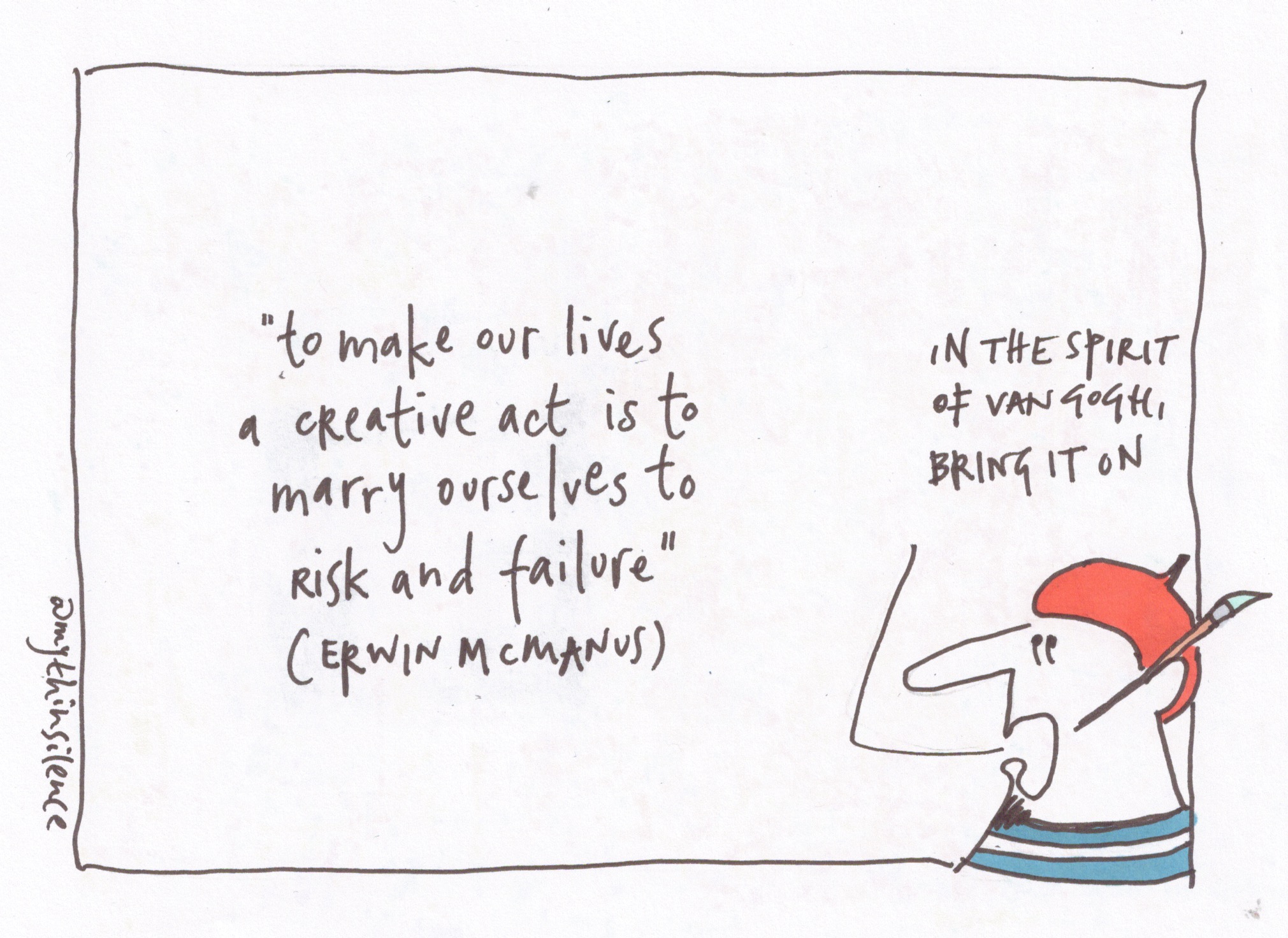
stories for letting go and letting come (20)

10 in the spirit of van gogh

‘In every situation, that which blocks our path actually presents a new path with a new part of us.’*

Surely being powerful means removing the obstacle.

“Traveller, there is no path, the path must be forged as you walk.”**

I’ve changed my mind.  Finding a new path sounds more powerful.

True power comes from within, from integrity.  We trust people who have integrity.  Being an integrated person means we can trust ourselves to make the path, too.

The hero in this story is the person who falls through what they thought their life was about to something deeper.  She finds there’s more to who she is and allows the journey to change her – finding new parts or facets of her life.

‘The hero or heroine is by definition a “generative” person.’^

The ability to generate comes from knowing who we are and what we have, and making this available to wherever we can.  All we are comes together as one, we realise this is enough, and with that, we are willing to move: to make, to give, to do, to will – to shape the future.

‘Will is our internal power which can never be affected by the outside world.  It is our final trump card.’*

(*From Ryan Holliday’s The Obstacle is the Way.)
(**Antonio Machado, quoted in Brené Brown’s Daring Greatly.)
(^From Richard Rohr’s Falling Upward.)

stories for letting and letting come (19)

9 the best way

‘[T]he process of living itself, if you please, is a work of art, as a masterpiece of anybody’s life, holds the optimal strength and growth, and which in his life is the most important thing.’*

Every life contains a world of stories.  Stories lived and stories neglected, and potential stories too.

Though we may have chosen what we now think of as the wrong stories – the ones which satisfied us for a moment, or that pleased someone else – there are still more stories to choose from.   The alternative may be to live with a low-level discontent. It seeps into how we think about and talk to people, how we get up in the morning, the ideas we have and what we’re prepared to say yes to, and what we daydream about.

The right story allows us to “Enjoy now.”**  This word always reminds me of creativity and generosity, from which enjoyment is a product.  Erich Fromm identifies how people ‘want to live happily without know how to live happily’.*

But living happily is an art and we can all learn it.

‘In such a [well-being] culture the main purpose of life is the full development of man and not thing and not production, not wealth, not riches.’*

We know the achievement of these things, in and of themselves, doesn’t make us better human beings.  But to seek integrity, that is, an integrated life with ourselves, with others, and with our world, leads us to the stories we want to live, stories with courage and honour: works of art and masterpiece stories.

(*From Erich Fromm’s The Art of Listening.)
(*From Gretchen Rubin’s The Happiness Project.)


stories for letting go and letting come (18)

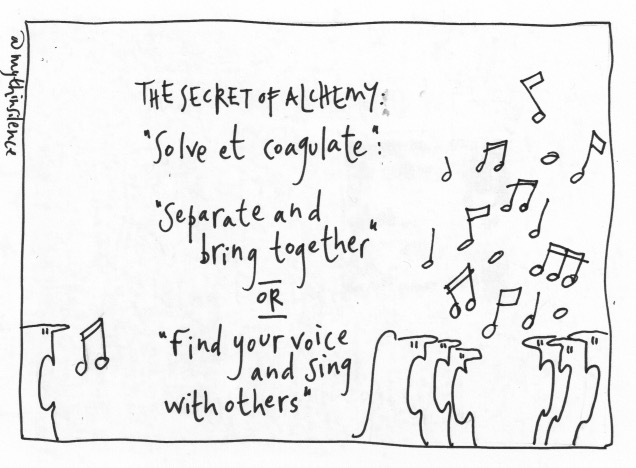
8 the secret of alchemy

‘But wouldn’t it be amazing if we could somehow encourage acts of greatness?  No order them, but create an environment where people feel they can embrace the superhero within and achieve great things.’*

Such environments would build on the best from our past and be stronger than the worst moments.

Spaces like this connect and reconnect us to our story: ‘the human mind was shaped for story, so that it could be shaped by story’.**

When we lost sight of our story, or we don’t believe we have one, we experience the “uneasiness” Erich Fromm observed in twentieth century Western society when he was speaking as a social psychologist, which we might also say, characterises ours:

‘No symptoms at all, but feeling unhappy, strange not even sleeplessness, life has no meaning, no zest for life, drifting, a feeling of vague malaise … people suffer from themselves … . Nobody who suffers from the malaise can be successfully analysed without a radical change and without  a transformation of character,’^

Richard Rohr would see our first attempts at creating our story as identifying our ego – in order that we might ‘let go of it and move beyond it’.^^  We’re not strong in our ego, though, but in our true Self.  Our ego has a victim part which Eckhart Tolle names the “painbody,” the part of us that wants to be offended, and, in extreme cases, wants to be offended in order to affirm its view of the world,*^ but, to go back to Rohr:

‘The True Self … is very hard to offend.’^^

We find ourselves in order to let go of ourselves by entering into the eco (from oikos, the whole house), into company (originally, those with whom we share bread).

Others not only help me to see what I’m doing badly and what I shouldn’t be doing, but, also, what I should be doing.

(*David Marquet in 99U’s Make Your Mark.)
(**From Jonathan Gottschall’s The Storytelling Animal.)
(^From Erich Fromm’s The Art of Listening.)
(^^From Richard Rohr’s Falling Upward.)

stories for letting go and letting come (17)

7 stories to connect

I met Rick briefly eleven years ago.  He’d made himself available to escort and look after Chip Anderson – the man who was to open my eyes to my talents and set me on a path to developing dreamwhispering.  Chip was living with cancer and Rick was going to make sure he was cared for throughout the day.

Erwin McManus writes of Rick Yamamoto:

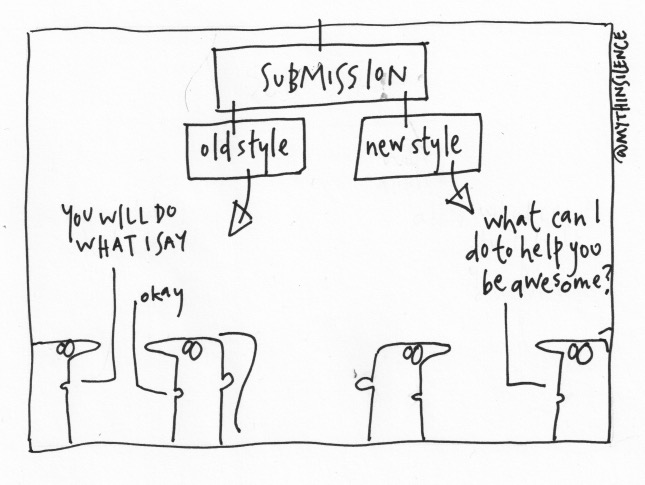
‘He became living proof at individuals of great power can live under submission.’*

What I didn’t know about Rick at the time was that he was responsible for a two billion dollar investment company.

‘Humility gives us the mobility to adapt to whatever context we are placed within.’*

This is a story about developing human capacity.  The best stories, like myths, operate at the soul level: ‘not always true in particular but entirely true in general … they hold together the paradoxes that the rational mind cannot process by itself’.**  When we focus on the intelligence of the mind we can forget there’s an intelligence of the body and heart, too.   Together, these form the whole me or, as some would say, my soul.

Here is the power of story for our lives.  They provide a vessel for more than our minds and our ideas.

This morning, I had a choice of waiting for a little while for a bus or to walk on a number of stops to where I could look over the city where I live.  So, I walked on so I could enjoy looking over the city in the cold Spring sunshine, realising the wow I felt was not in my head but in my chest.

Stories help us to sense and make sense of the whole.

(*From Erwin McManus’s Uprising.)
(**From Richard Rohr’s Falling Upward.)

stories for letting go and letting come (16)

6 submission

submission

səbˈmɪʃ(ə)n/

noun:
1. the action of accepting or yielding to a superior force or to the will or authority of another person.”they were forced into submission”

2. the action of a skillmaster who submits her mission to the fulfilment of the mission of another

Submission is a skill of heart and mind which, when sought and mastered, offers everything we are in service to another so their life mission can be achieved.


stories for letting go and letting come (15)

5 another day

‘I would say that the demand for the perfect is the greatest enemy of the good.’*

What if good lies on the far side of perfection.  That life lies on the far side of an answer, in another question.

Dan Ariely points to how we label something once we believe we know it, how these labels become ‘anchors,” and how anchors influence our future decisions. In education, we use these anchors to teach children things they aren’t asking questions about.

Life isn’t so much about destinations or conclusions but in the ongoing interplay of the adventure of many things.  We are children asking many questions leading to greater creativity and more curiosity.  Warren Berger writes about children:

‘If they are permitted to do that research – to raise and explore their own questions, through forms of experimentation and without being burdened with instructions – they exhibit signs of more creativity and curiosity.’**

We let go of our anchors to move deeper into he adventure of goodness.

(*From Richard Rohr’s Falling Upward.)
(**From Warren Berger’s A More Beautiful Question.)

stories for letting go and letting come (14)

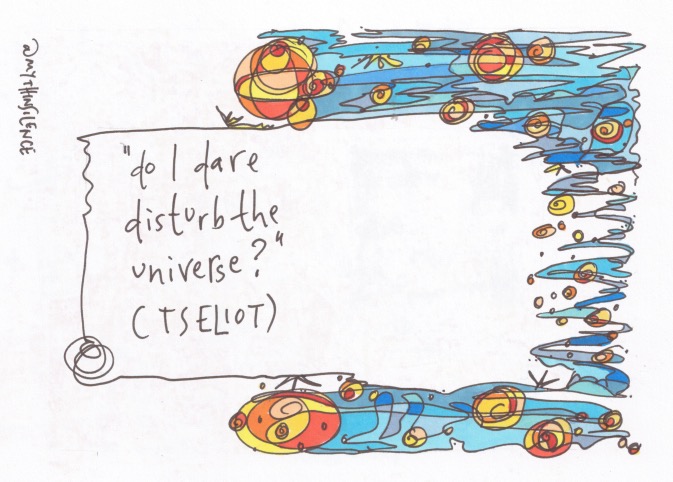
4 do i dare

‘It does not naturally occur to us that standing still – or in some cases, even going backward – might be the best way to advance.’*

Our talent helps us to rush forward so quickly that our character can struggle to keep pace.

To wait awhile, to even take a step backward to reflect and develop who we are becoming turns into a freeing experience as we journey into an adventure of universal proportions.

“Heroes Wanted for an epic quest to hack the universe.  Starting with Earth. Safe return doubtful.”**

Here is a cause for those who don’t worry about failing or losing or looking foolish.

When I’m not so much concerned with status, title, or position, I’m enabled to get things wrong, ask the stupid questions, and needing the help of others – all of which has an unexpected sense of freedom about it.  I’m reminded of Carol Dweck’s research^ which has shown that people who have a fixed mindset begin to protect their achievements, whilst those who know they can grow more are open to trying and failing and trying again.

We’re invited to ungrasp who we want to appear to be before others to let come an endless adventure.

(*From Ryan Holliday’s The Obstacle is the Way.)
(**From Alex McManus’s Makers of Fire.)
(^Carol Dweck’s Mindset.)

stories of letting go and letting come (13)

3 finding our voices

Impressionists are enjoyed for their ability to impersonate all kinds of celebrities.  I was brought up on Mike Yarwood who’d end his Saturday night show singing a song in various guises, finally saying “And this is me.”  I can’t remember anything he sang, although I do remember the one liners he created for his characters which they never said but he made us believe they did.

Impressionists in everyday life aren’t so enjoyable. As writer Rob Bell was told by his counsellor, “The world doesn’t need a second someone else, it needs the first you.”

Finding our own voice, to say “and this is me,” syncing us with our day, is not as straightforward as it sounds. We can end up sounding like our parents, our friends, our employers, but not ourselves.

And what if the people we try and copy are, or were, themselves copying someone else?  Pixar’s Ed Catmull tells of how he felt a fraud when he took up his first job in management at New York Tech, because he wasn’t aggressive and extremely confident like the other managers – he admits that he believed these to be the traits necessary for success.

But the fraud is the person who isn’t prepared to find their own voice and really change something with it.  Voice is about character as well as personality.

‘Integrity is formed in the heart of the humble.’*

Humility, not pride, allows us find our voices.   The quality of our voice will be determined by the extent to which we interact with new ideas and new people and new places.  When we close ourselves to others, we’re effectively saying, “You know nothing I need to know,”  “You are someone I do not care or need to connect with.”

The tragedy is that the isolated life becomes an inflexible life.  Unable to climb down or ask for help or learn new ways, it is a life stealing from itself the possibility of creatively employing talents and resources to find a voice the world wants to hear.

(*From Erwin McManus’s Uprising.)

stories for letting go and letting come (12)

2 let's make life a gifthack 1

‘Here was an invention that quantified the passage of time, that laid ruler and compass to the span of desire, that measured out exactly the moments of life.  It was magical, it was unbearable, it was outside natural law.  Yet the clock could bot be ignored.  It would have to be worshipped.’*

In another of his short stories about time, Alan Lightman imagines a world where pilgrims journey towards the “Great Clock,” each, in turn, taking one of twelve places around the clock and chanting in turn.

Stockmarkets open and close at precise times.  Time is money, we say.  We ask one another if we have time.

“Punctuality is the soul of business.”

“Preparedness and punctuality are two of the most important qualities of a leader.”

Time brings order, alignment, control.

It’s too easy to confuse control with freedom.

We think those who are in control are free to do what they want, but perhaps they find themselves trapped, having replaced the important for the urgent.

‘Every action, no matter how little, is no longer free.’*

Erich Fromm says psychoanalysis is “to know oneself.”**  The truth will set us free, he says.

To not know ourselves is not to be as free as we thought, or as in control.  But where is the time to “know oneself” when there’s so much to do?  How free are we to do ‘the right thing in the right way at the right time with the right spirit’?^  Something like this sounds more hopeful for the world – people who know how to move through time and with time wisely – not seeking to control only to find themselves controlled by it.

Perhaps Peter Senge would call such people animateurs:

‘An animateur (from the root animer) is someone who “brings to life” a new way of thinking, seeing, or interacting that creates focus and energy.’^^

(*From Alan Lightman’s Einstein’s Dreams.)
(**From Erich Fromm’s The Art of Listening.)
(^Alex McManus.)
(^^From Peter Senge’s The Necessary Revolution.)