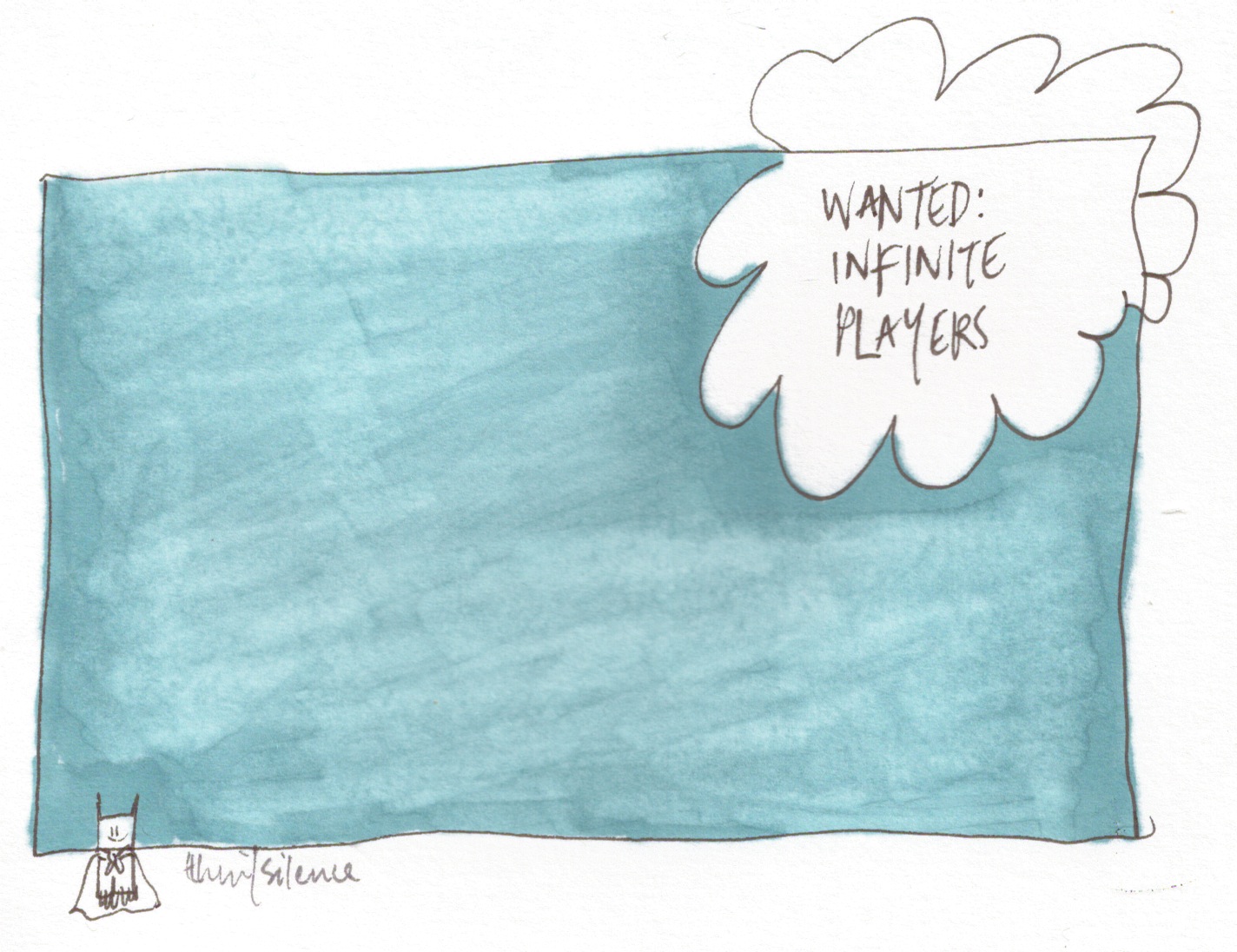
wanted: gameplayers without borders

26 wanted infinite players

We need to have some experimental games running.

To test out whether James Carse is right to suggest cultures are different to societies in that they are boundaryless.

Borders and boundaries exist because of opposition, they are the result of protecting the past from corruption – often an ideal which never existed but, then, ideologies don’t have to have any foundation in reality.

Carse defines a culture as something people do together rather than something a person does. Of the Renaissance he suggests: ‘the Renaissance is not a period but a people, moreover a people without a boundary, and therefore without an enemy.  The Renaissance is not against anyone.’

Cultures, then, play with borders and, if Carse is right, they don’t obtain freedom by taking it away from others.  In contrast to the finite game often found in societies, the infinite game* desires as many as possible to play and for the game to be as open-ended as possible into the future.

Our hope lies in infinite games; here are some final thoughts from Carse:

‘A people as a people, has nothing to defend.  In the same
way a people has nothing and no one to attack.  One cannot
be free by opposing another.  My freedom does not depend on
your loss of freedom.  On the contrary, since freedom is never
freedom from society, but freedom for it, my freedom inherently
affirms yours. A people has no enemies.’

(*Hospitality is an example of a cultural game rather than a societal one; although an ancient practice, it is open-ended towards the future because of its subversive nature, reversing roles between host and guest.)

leftovers of joy

25 after all the creativity ...

Who is my Self?

What is my Work?

Two questions posed by Stanford University’s Michael Ray of students on creativity courses.

In the place of thin silence where we are most aware of who we are and what we can do that hope is most powerful.  I was going to write fully aware, but who we are and what we do is more open-ended than we know.

The Self is not about me but who I can be in relation to others and this world.  My Work is not what I get paid for or even volunteer to do, but the art I produce from my skills and passions to make a difference.

When we live our lives in this way, we discover there are more than enough leftovers of joy for ourselves when we live our lives for the good of others (creativity plus generosity leads to enjoyment).

People want to make a difference; they only have to find a means for doing this.

Who is my Self?

What is my Work?

the problem

24 embracing our quest ...

It’s me.

I am the problem within the problem.

Oh, and you are too.

We want simple or fast solutions to problems, yet when we think we’re just coming to an answer, we’ve only begun to define the true question.

This from Daniel Kahneman: ‘ A general “law of least effort” applies to cognitive as well as physical exertion.  The law asserts that if there are several ways of achieving the same goal, people will eventually gravitate to the least demanding course of action.’  Furthermore, he suggests you ‘are likely to stop when you are no longer sure you should go further – at the near edge of the region of uncertainty.’

The reason for this can be unseen anchors from our past which determine our way of approaching an issue or problem.  Blind to exactly what this is,  we believe we have considered everything and WYSIATI (What You See Is All There Is) blocks attempts to find the better solution.

All Human systems are broken somewhere, some of the time, often in a different way or place to where we’re prepared to look.  We can live in denial of this and patch problems, or, we can do the hard and strenuous, and personally costly thing of going further.

So I am the problem in the problem, but when I am willing see and understand more deeply, what is hidden in the background comes to the fore.

None of us like to be wrong.  It’s thought of as weakness, but to the contrary, it’s the stronger way of hope.

remembering and permission

23 even those who anticipate the future ...

Because every day you and I have to remember we have a choice to be an infinite player.

Every day, we are confronted, and drawn in, by many finite games and their players.*  Whilst we need to play some finite games (the airline delivers you to the airport it promised to, the student turns in their dissertation by the agreed time, your employer allows you to leave at the end of the workday), we can forget there is always a greater game of open-mindedness, open-heartedness, and open-willed-ness, being played.

The infinite game anticipates an unknown and undefined future, aiming to include as many as possible for as long as possible (and when something threatens to exclude people or end the game, the rules are changed).

When we remember, we provide ourselves with permission to live with humility, gratitude, and faithfulness – practices which enable openness.  And because openness to seeing and understanding more, through the lives of others, towards changing our goals and behaviours can be frightening and threatening, infinite players need to create spaces for boundarylessness to be explored, replacing them with horizons.

Writing this has helped me remember again, giving myself permission to be an infinite player today.  By the way, feel free to join in.

(*Finite games can be both sophisticated and subtle and all-pervasive.)

complexipacity and the artist

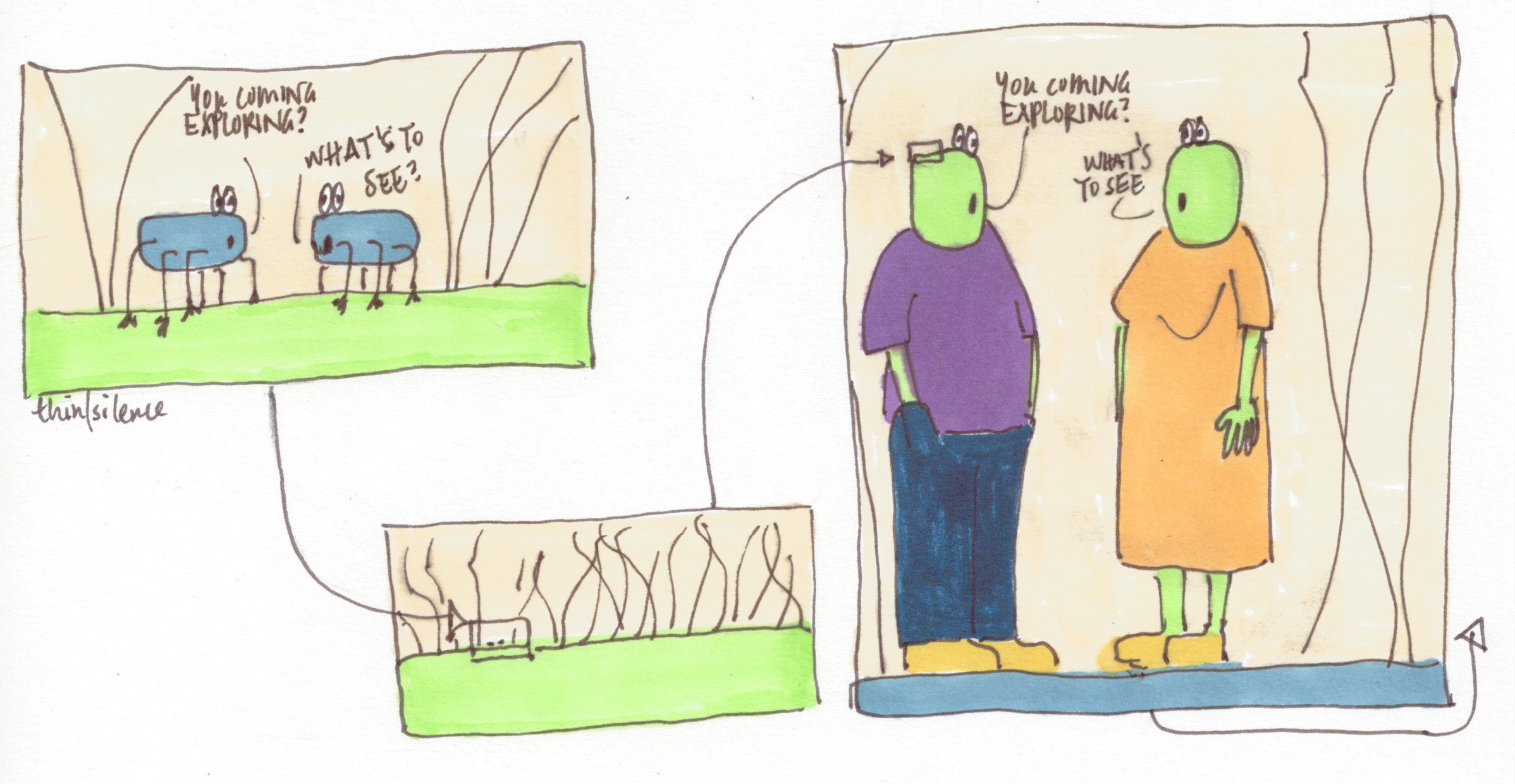
22 you coming exploring?

Complexipacity is the ability to cope with the complex,* far-more-random than we know universe we find ourselves in – and the micro-universe of our life within it.

Complexipacity appreciates how we not only must see and understand more by opening our minds, but we must feel and embrace more by opening our hearts, especially to others who are not like us.  However, in order to “let come” the emerging future, we have to contribute to this by opening our wills and acting upon what we become increasingly aware of.   We are then developing complexipacity: more than learning, more than discovery and exploration, but practice too.

The danger for Humans is, we’re accomplished at finding easier answers to a substituted easier question – though we often don’t realise we’ve done this.

The infinite artist knows their art is who they are not what they produce.

A work of art is literally that – a work produced by art but not the art itself, which continues in the artist and those she inspires: ‘Art has no scripted roles for its performers.  It is precisely because it has none that it is art.’

Art is awakened in a person when their heart is opened to open-ended (or infinite) possibility, not by copying the person who’s inspired them.

When an artist closes down their art to be the thing they produce, they are resisting complexipacity, the possibility to live creatively and open-endedly – infinitely inspired by who knows what?  When it is not, when it is found in something rather than in someone, when it is in some place and not in others, can it be art?

(*Complexity is different to complicated.  Complicated is, well, complicated, but usually there are discernible, repeatable patterns; complexity means does not necessarily contain such patterns- none we can discern, anyway, hence more randomness than we often admit.)

seed people

21 wanted seeds of possibility

Each of us is a place through which a possible better future can emerge.

Henri Bortoft suggested, ‘The part is a place for the presencing of the whole.”  Our future needs people who will offer themselves as such a place.

Them when people come together, offering themselves as a greater place, the possibilities grow immensely.

I was part of such a group last night.  For quite some months now, we’ve been meeting and talking in ways intended to sense some possible future we can help to shape, meeting to practice the means by which we will make it possible for people to live with creativity, generosity, and enjoyment – what we believe to be the possible for every Human – each bringing something different to our times together.

Some of the most profound things were sharing how, for a number of days following our conversations, he was a “better me.”  That ‘s what it’s about.

Then I read this morning, from Bernadette Jiwa: ‘How can your business be about making [your customer] live as a better version of themselves?’

It’s a great question, one asked by seed people.

Why seed people?  Because a seed doesn’t contain everything the future plant will be, but is a place where all that is necessary for the future can converge from the soil and from the sky.

We all can be such a place, though all different, according to that thing we each do – our art.

not ready

20 you have enough to begin

I come across many people who need more (fill in the blank … time, training, information, money) to begin.  (I’ve met members of my own organisation who are in their 80s and are still saying this!)

I also come across many people feeling a deep pain because they want to make a difference but don’t know how to.

Reality is, we are more ready than we know.

Over thirty years of doing my particular job tells me, those in the first group will never be ready – they don’t want to be and will always hide behind this or that excuse, including how it’s your fault they’re not able to and you ought to be doing it anyway.

The second group only need to connect their pain with who they are and what they do and take a step: we find purpose where our deep gladness meets the world’s deep pain.

The tragedy is, the people in the first group have most of the time and help afforded to them and the second group carry their pain, often in silence.

Which are you?

Another thing to add, is you won’t know exactly what you need until you do begin.

repeat?

19 just remember ...

It depends on what it is.

Hugh Macleod offers:

‘There is a famous old quip: “A lot of people in business
say they have twenty years’ experience, when in fact all
they have is one year’s experience, repeated twenty times.”‘

In fact, there’s evidence to show that doing the same thing over such a period of time sees the quality of performance reduce – you’re worse at your job at the end than you were at the beginning.

Not the kind of repeat we want, but add some freedom to do your art and something interesting happens.  It’s now impossible to do the something in exactly the same was as you did before, no matter how you try – a different: colour, note, line, movement, idea, context, juxtaposition, person, speed, culture … – and you can’t repeat.

Which for most of the time is good, though it can also be frustrating.  I didn’t say it wouldn’t be hard.

Two things that repeat in a good way: 1) you turn up every day, ready to contribute your art; 2) your ‘constant potential for renewal’ turns up on a similar cycle.*

(*Ken Robinson argues that life is not linear but cyclical – opportunities come back around.)


like crazy ones


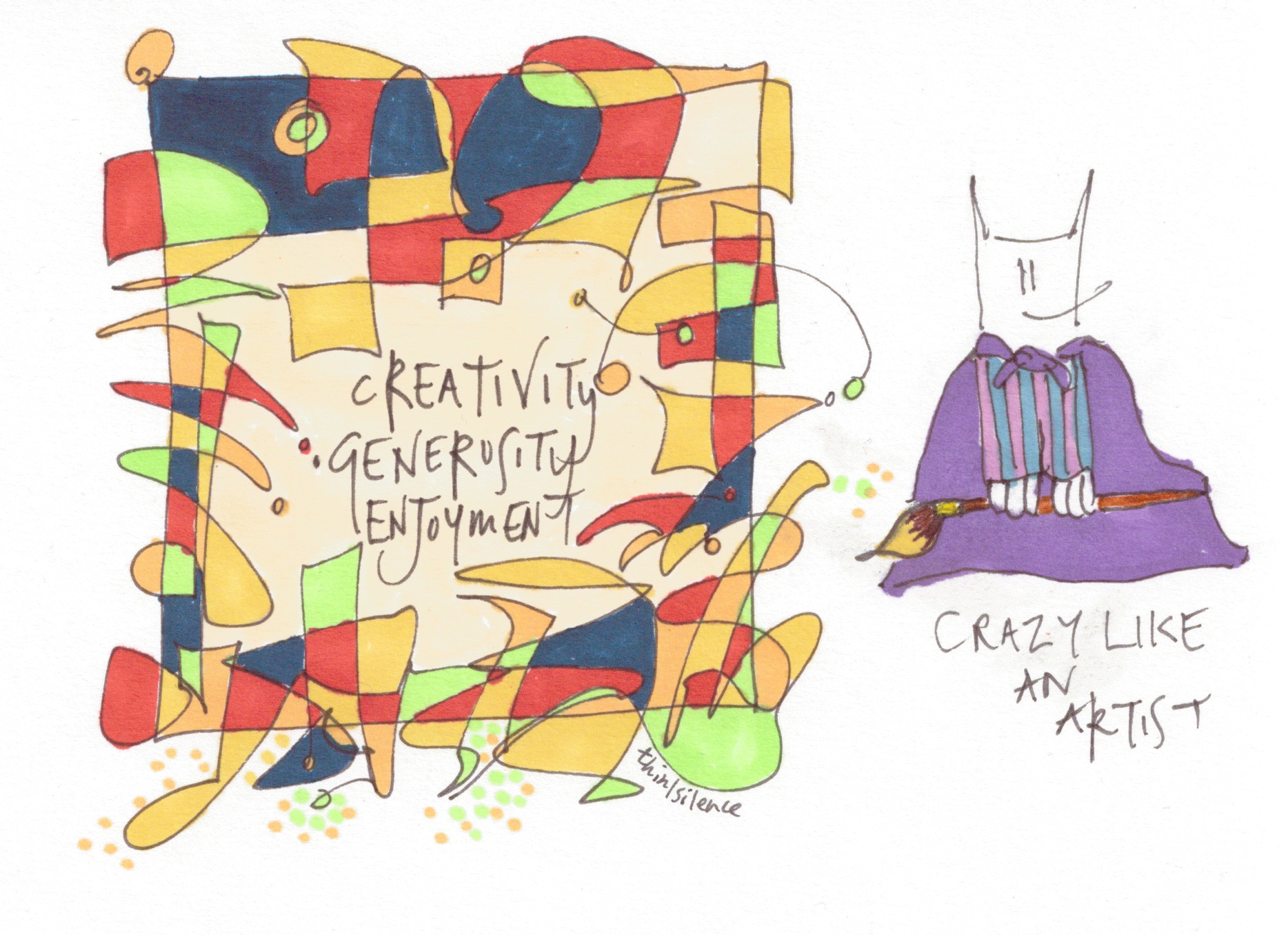
18 crazy like an artist

We’re not prepared to accept the story as read to us.

Those who’ve believed in and seen a better future have always been looked at as being strange, or hopeless, or crazy.

We hope and act, making it possible for more to discover and bring their art into the infinite game of open-ended life is worth everything we can bring to it.

“When return on investment is measured by delight instead
of sales o conversions, there is a lot more freedom to create,
to be bold, or maybe event to be creative and bold.”  
(MailChimp Non-Profit Brand Manager Lain Shakespeare)

Here’s to those who never give up on being courageous and generous with their art.


reality

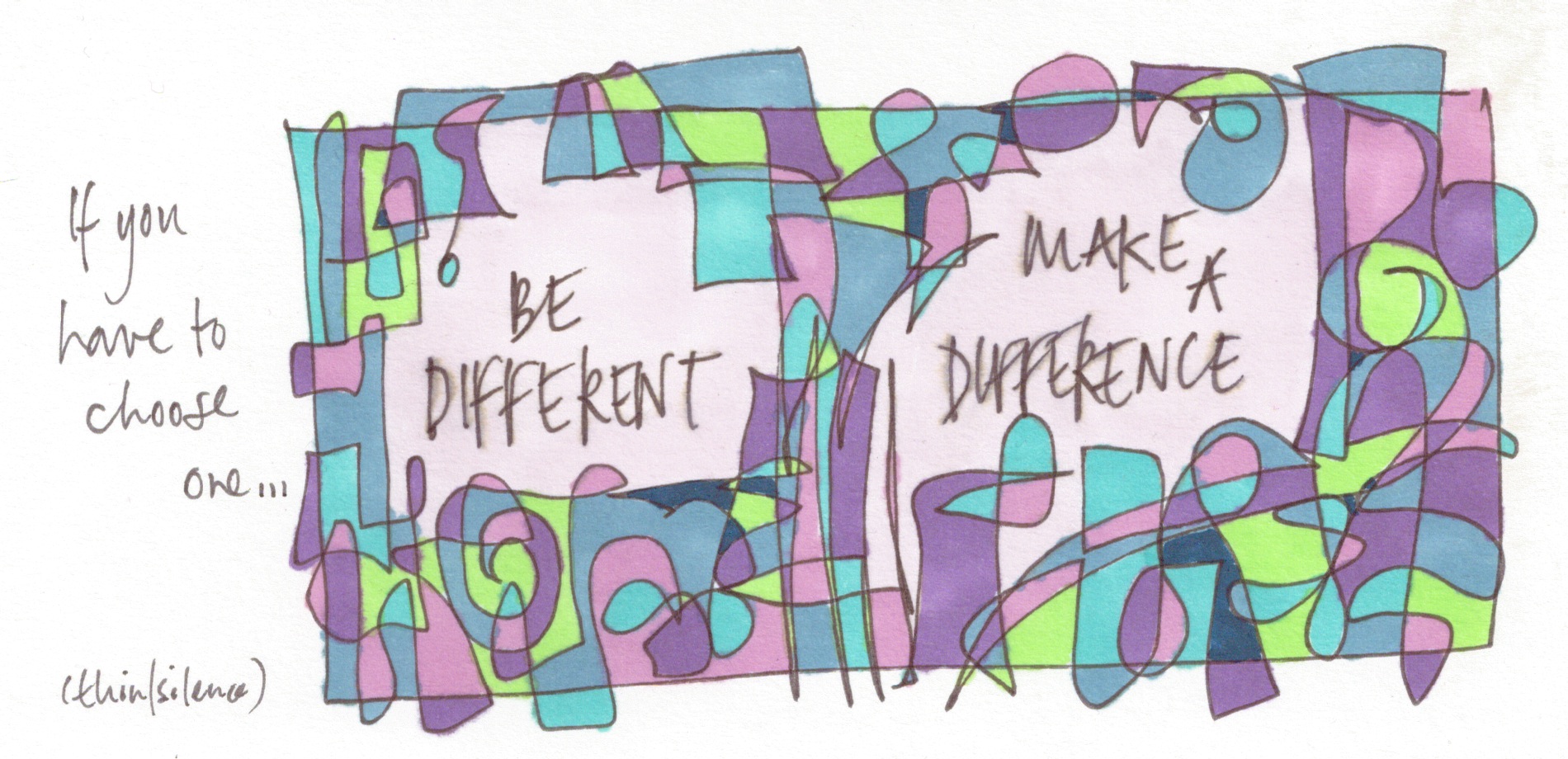
17 … make a difference

Really?

Or are you just making this up?

It’s a good question.  We’re exploring how to produce our art in an infinite game.  It sounds more like fiction, right?


We might be surprised, though, by what’s real and what isn’t.

Is repeating the past (behaviours, policies, marketing, process, thinking … ) when it hasn’t worked, really an option for our future?*  Or is trying the untried alternative not as crazy as it first appears?

Individuals and whole societies can create stories which are unrelated to reality.  (We can behave as though we live in a world where our nation’s behaviours are impeachable, that everyone really could have clean water, freedom from disease, enjoy education, live in security, but we don’t.)

I really believe in the goodness of people and often find myself saying “People are amazing,” but I know many are not good or do right, and  too many choose selfish over selfless, but I also see people who live to make a difference; I typed “Stephen” in my browser and here’s the top result.

Some just know there’s another reality and live towards it.  These people change the rules.  Different can often be good, but can be another shade of same, but making a difference is about something which changes a person’s life, often beginning with our own.

We often think real means tangible, but Humans can value what they feel about something even more highly.

So is your art real, or delusion?  You can check it out by asking the following?

Am I successful at what I do (what’s the difference I make)?

Do I do this intuitively (does it flow from my life)?

Am I growing as a result of doing this (is there a difference in me)?

Do I need to do this to be satisfied and fulfilled ?

Your stuff which makes a difference is real.

(*I was one of the naive ones who watched the televised debates leading up to the British election of 2010, hoping for a new politics, but it turned out to be more of the same.)