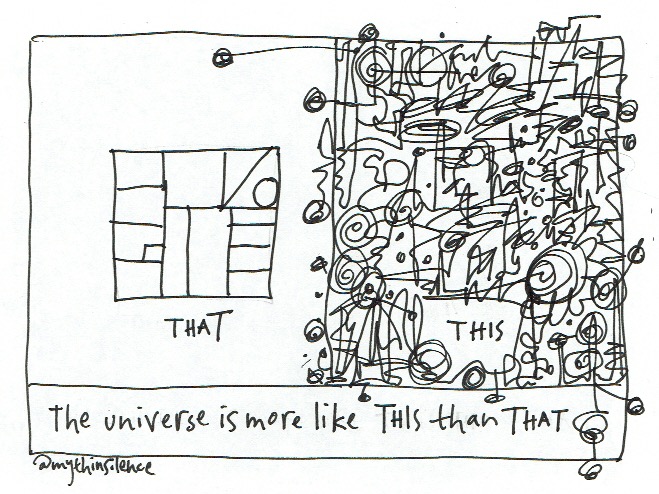
practising unpredictability

4 the universe is

I love ingenuity, how it makes adventures of possibility available to everyone.

Now, right where we are, we can identify an adventure.

It doesn’t matter that we’re not somewhere else, that our education is what it is, that we own various have limitations and responsibilities.  We can innovate for ourselves and for each other.

The adventure or quest, Chris Guillebeau suggests, has the following marks which set it apart from a project: there’s a clear goal, it’s measurable, it has a sense of calling to it, and it involves great effort.*

At the end of 2013, I had an idea to blog every day in 2014 because I was already journalling every day – a 365 day adventure.  To add more of a challenge, and being inspired by Hugh Macleod, I decided to post only if I could add a doodle – the challenge being, I’d never doodled before.  With this, a project turned into a quest.  I bought the same pen as Hugh Macleod – a 0.2 drawing pen – and began to doodle on the back of business cards, as he had done.**

What is your “right where I am” adventure?

This is the practising part I engage in everyday.

I’m so glad that I didn’t stop on the 31st December 2014, though.  When I set out, I’d no idea where it would lead to, which is the unpredictability part of this.  There’s a randomness to where doodling has taken me.  Which means there are other things that haven’t happened, but I’m oblivious too.

I’ve mentioned that Malcolm Gladwell identified how 10,000 hours of deep practice develops remarkable skills in the world of measurement.  Practising unpredictability, however, is about exploring how hours of questioning and openness can lead to remarkable skills in the universe of possibility.

I realise now, answers haven’t led me here – questions have.  Questions and openness have allowed life to become what it is, which, to connect this with my opening thoughts, is a lot more than we often think.

Questions are like a long lever to pry open what remains closed to short answers.

‘In most situations, the rules of the game change all the time.’^

Each of us has an adventure waiting to be started:

‘Obsessively specialise.  No niche is too small if it’s yours.’^^

(*See Chris Guillebeau’s The Happiness of Pursuit.)
(**Enjoy Hugh Macleod’s Ignore Everybody.)
(^From Frans Johansson’s The Click Moment.)
(^^From Seth Godin’s Whatcha Gonna Do With That Duck?)
board games

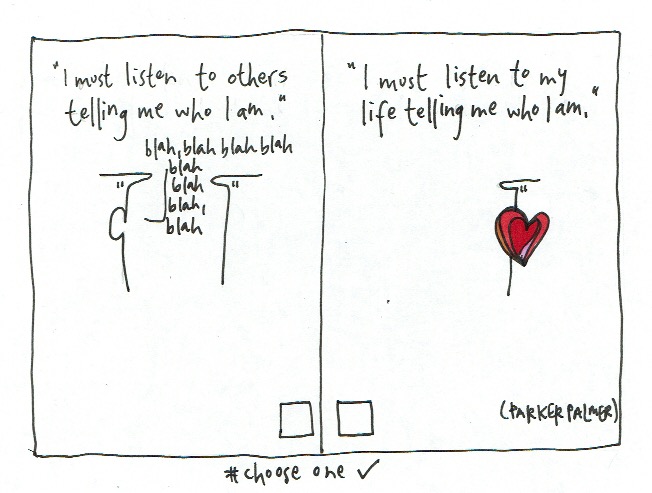
3 i must listen

‘[Y]ou define yourself not as a piece, nor as the strategist, but as the board itself, the framework for the game of life around you.’*

Beyond reacting, beyond even responding, we’re able to have a perspective on life which opens up the possibility of initiating.  This is the infinite game** – a game we play for others.

The infinite game includes as many players for as long as possible and if these dynamics are threatened then the rules are changed.  The infinite game player is content to dissolve into the background, knowing the infinite game makes it possible to do everything they love, making the game more open and inclusive.

The infinite player knows that in any game there’re multiple games being played.  Peter Senge talks about how in any system there’s more than one loop at play.  Most will see the reinforcing loop – the thing the business is about, but will fail to see the balancing loop – where the real problems are to be found, and also where the unseen or undervalued rules are found.^

Imagine these thoughts for the individual:

‘Before you can disrupt your product you have to disrupt your process.’^^

‘This is the essence of intuitive heuristics: when faced with a difficult question, we often answer an easier one instead, usually without noticing the substitution.’*^

‘Finding the time and the space to question, in a cultural landscape that doesn’t encourage it, is challenging.’^*

A synopsis of these might be: we need to look behind the scenes of our lives at our values, curiosities, talents, experiences, and passions; but we have a tendency to focus on the things we’re doing on the surface and resist going deeper; and, this is often reinforced by a culture that doesn’t value deep reflection, often being sceptical or reasoning that it’s too busy.

Malcolm Gladwell highlighted the critical element of 10,000 hours of deep practice for living a remarkable life.***  However, when we look closer what we see is how these 10,000 hours of practice are in relation to the obvious rules – Frans Johansson points out that the more rule-bound the game the more visible the benefits of the 10,000 hours are.^^^

When we’re prepared to focus on the balancing loop of our lives, we begin to see the invisible rules, that is, the interplay of deep practice around the things which make us essentially who we are – and the universe of possibility which emerges.

“I must listen to my life telling me who I am.”**^^

(*From Rosamund and Benjamin Zander’s The Art of Possibility.)
(**See James case’s Finite and Infinite Games.)
(^See Peter Senge’s The Necessary Revolution.)
(^^From James McQuivey’s Digital Disruption.)
(*^From Daniel Kahneman’s Thinking, Fast and Slow.)
(^*From Warren Berger’s A More Beautiful Question.)
(***See Malcolm Gladwell’s Outliers.)
(^^^See Frans Johansson’s The Click Moment.)
(**^^Parker Palmer, quoted in Henri Nouwen’s Discernment.)


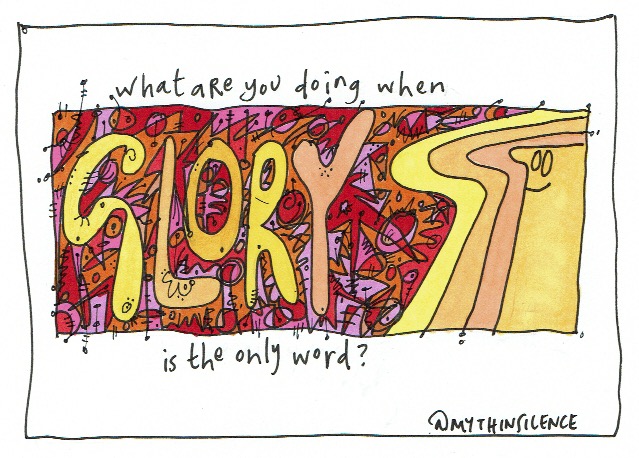
when glory is the only word

2 what are you doing

“It’s important to think about that time and place and activity where you shine, where you feel most alive.”*

Glory is such a short word for something so full of magnificence and beauty.

It was a year ago when I first reflected on the quote, above.  It reminded me of what I love to do.  One year later, I find them to be more true one year later – the point they are making.  We must focus on the things we most love to do.

I juxtapose this idea from Roz and Ben Zander:

‘Gracing yourself responsibility that happens in your life leaves your spirit whole, and leaves you free to choose again.’**

I found myself thinking back to a moment when I decided to blame no-one and no thing for being close to burning out; instead, I took responsibility for what I had and hadn’t done.  It turned out to be the beginning of an incredible journey which continues today, which finds me journeying from the general to the specific, and sometimes the only word to describe this is glory.^

‘Obsessively socialise.  No niche is too small if it’s yours.’^^

(*Jacqueline Novogratz, quoted by Warren Berger’s A More Beautiful Question.)
(**From Rosamund and Benjamin Zander’s The Art of Possibility.)
(^Scott Peck uses the word glory when describing the fourth stage of community,I his book The Different Drum.)
(^^From Seth Godin’s Whatcha Gonna Do With That Duck?)

isn’t that a bit risky?

1 you're fired 1

‘Finding the time and the space to question, in a cultural landscape that doesn’t encourage it, is challenging.’*

“So many people live within unhappy circumstances and yet will not take the initiative to change their situation because they are conditioned to a life of security, conformity, and conservatism, all of which may appear to give one peace of mind, but in reality nothing is more dangerous to the adventurous spirit within a man than a secure future.  The very core of a man’s living spirit is his passion for adventure.”**

A year ago, I’d found myself pondering something I called concentredness, describing a state of being where our lives are most centred and connected – being joined up at the centre, rather than the edges.

Concentredness is about everything we are and have and our day-to-day practices and expressions all lining up.  It’s about per connectedness (with others, our world, our spirituality, and our Self) and our enoughness and our perseverance all lining up.  And it’s about what we do at our most selfless and our generosity and the way we live what we know all lining up.

All of these elements combine into what we MUST do with our lives.

Must is always risky, but we can mitigate the risk; what we don’t get is get a second life to live out our dream.

‘Gifts are the essence of art.  Art isn’t made as part of an even exchange, it is your chance to create imbalance, which leads to connection.’^

“Go, my child, find your way, make mistakes, learn, suffer, grow, and become whom you need to be.  Don’t be afraid.  You are free and I am always near.”^^

(*From Warren Berger’s A More Beautiful Question.)
(**Chris McCandless, quote in Chris Guillebeau’s The Happiness of Pursuit.  McCandless died in his attempt to live off the land in Alaska; it turned out to be a mistake – potato seeds, which normally would have been okay to eat, were toxic to his emaciated body.)
(^From Seth Godin’s V is for Vulnerable.)
(^^From Henri Nouwen’s Discernment.)

wondering what could have been

30 he made me realise

“We are small creatures.
Our lives are not long, but long
enough to learn.”*

“He made me realise that
Education was so important
to everyone, not just the
Intelligent, it’s as simple as that!”**

Creativity is for everyone.

Some hold that only some are creative, that it’s a nonsense to say everyone is, but people can be innovative in ways these people can’t begin to imagine.

Everyone deserves opportunities to imagine and bring something beautiful into the world.  Some discover this early on in life, others later (I count myself amongst the latter), but it would be the most terrible thing to leave this world without making an attempt.

This is about asking what creativity lies at the centre of our lives (ways of thinking, relating, and behaving/acting), the thing which makes us feel at one with the universe, and, if we have one, our god.

It’s from this place that we ask our best questions.  It’s as though questions, the kind of questions which lead us out from our creativity into more – a journey of open and difficult questions, with every one of us asking something different.

The saddest question in the world, then, would be, “What could have been if I’d taken that path?

(*Stephen Lawhead, quoted in the Northumbria Community‘s Morning Prayer for 30/4/16.)
(**From student Karl Kripps’s poem following Ben Zander’s visit to Kripps’s London school, quoted in Rosamund and Benjamin Zander’s The Art of Possibility.)

troubadour

29 hey, your song

troubadour

noun  trou·ba·dour  \ˈtrü-bə-ˌdȯr, -ˌdu̇r\

Simple Definition of troubadour

  • : a writer and performer of songs or poetry in the Middle Ages

I love this.  A troubadour wrote and performed their own songs.

You are a troubadour – you must compose and perform your song.  I want to heart it.

Relying on others to write your song, or only singing a “cover version” of someone else’s song, is akin to what Martin Seligman has termed “learned helplessness.”  We all have a song:

‘Could the psychological state of mastery – the opposite of helplessness – somehow reach inside and strengthen the body?’

“I have no song,” or, “I cannot sing.” is not good for our health and wellbeing.

The following line caught my attention because of my one-with-one dreamwhispering work with people:

“Certain things in life are better done in person.”**

This line is Ben Zander’s father’s response to Ben’s question about why he took a train from London to Glasgow (and back, in a day) to speak to someone, rather than speaking on the phone.

There’s nothing like face to face.  And face to face – which is about our future – is a wonderful thing when we turn up with our original and authentic song.

The universe has produced troubadours and they will sing in the future.

(*From Martin Seligman’s Flourish.)
(**Walter Zander, quoted in Rosamund and Benjamin Zander’s The Art of Possibility.)

the second way

28 curiouser

“We all have but a short time on this earth.  As slow as time can be it is also fast, swift, furious and might, and then it’s over.”*

“If I were to wish for anything I should not wish for wealth and power, but for the passionate sense of what can be, for the eye, which, ever young and ardent, see the possible.”**

We can live out our days, or …

We can live out our days with passion.

Pursuing the thing we feel MUST do with out lives is easier than we think, and that’s the scary thing about it.

In Alice’s Adventures in Wonderland, Alice is intrigued to see a talking and clothed white rabbit, and follows him down a rabbit hole.  She suspends her disbelief in order to follow what she is seeing.  She doesn’t know how deep the rabbit hole is but once inside there’s no going back.  Lewis Carroll must have written this story just for us.

Living with passion is about noticing our curiosity and pursuing it.  At first this will mean we have to suspend our belief and disbelief to find ourselves “falling slowly” enabling us to notice more and more about what is all around us.  We’re falling and full of questions, and we have just begun.

Alice’s curiosity focused on a white rabbit.  My curiosity focuses on the potential people have to live amazing stories.  What’s yours?

We can live out our days, or we can choose the second way.

(*Photographer Thomas Hawk, quoted in Chris Guillebeau’s The Happiness of Pursuit.)
(**Soren Kierkegaard, quoted in Rosamund and Benjamin Zander’s The Art of Possibility.)

holes and walls

27 if we turn up (colour)

The future is deeper than we know – a rabbit hole of possibilities.

Two people can look at the same thing, though, and one sees a rabbit hole, while the other sees a wall.

I don’t know where the rabbit holes will lead, I don’t know how deep they will go.  I only know I am getting to see some amazing things and meeting some remarkable people, and trying a few new things along the way.

Possibilities are what they are.  Randomness, as the way the universe is, will determine the number of possibilities there are.  Our curiosities and beautiful questions will not only determine which holes we find, but will also ensure we’re more likely to turn up when they appear.  Then it’s all about how we see them:

“I can’t go there,” or

“I wonder where the rabbit hole goes?”


the way things are

26 doodling inside

‘[T]he capacity to be present to everything that is happening, without resistance, creates possibility.’*

How many times have you heard heard or talked about “out of the box thinking”?

There’s a lot of value to thinking outside the box.  It implies we’ve defined or designated the box, which often is not the case.  When we do this, rather than resisting the box or trying to escape it, we can find more comes into view that was previously invisible.

We can take someone’s life as an example.  Many people think the have to escape their lives in order to follow their dreams, when maybe all they need to do is to notice more of what is already in their lives.

Being present is really just noticing more – without barriers – to the people around us, the world in which we live, and absolutely to our own lives.  When we do, from the way things are, more happens.

26 doodling inside (colour)

(*From Rosamund and Benjamin Zander’s The Art of Possibility.)

undivided heart

25 when i listen

‘The fact is that most of us are half asleep while we believe ourselves to be awake.’*

Some lives never identify their unique voice.

More than twenty years ago, I was lost in the general, feeling – though, I didn’t know what I was feeling – there had to be something specific.

It is from the specific that we come to ask our beautiful questions.  And the most beautiful questions are always disruptive ones.

There are some who appear very clear about what they must do in their lives, but the test is whether they remain open to, and are changed by, the new and the unknown.  The wide awake life is both specific and permeable, resulting in flow.

Inasmuch as this flow life works, we’re able to say the universe is amenable to it.

(*From Erich Fromm’s The Art of Listening.)