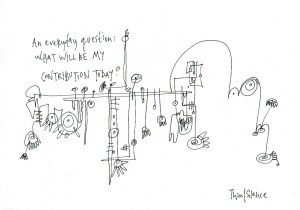
a useful lament

23-a-useful-lament

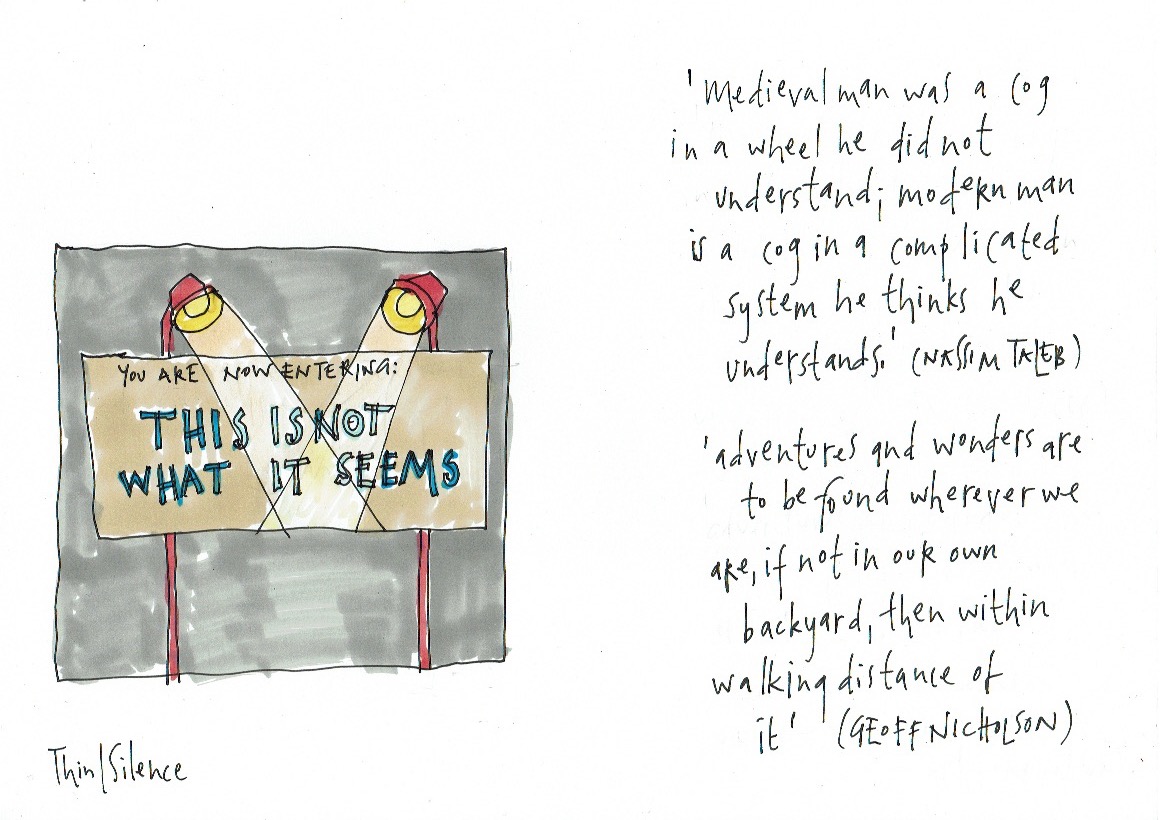
‘An artist is someone who brings new thinking and generosity to his work, who does human work that changes another for the better.’*

‘Several forces seem to be driving this global shift [the revolution from within]: the birth of civil society as a global force, the rise of the creative class, and the emergence of a new spirituality.’**

It is important to lament: to feel some grief or sorrow deeply until it changes us.

When we don’t lament long enough at something that is wrong or painful, it’s too easy to do nothing.

When we are caught in continuous lamenting, it’s too easy to do nothing.

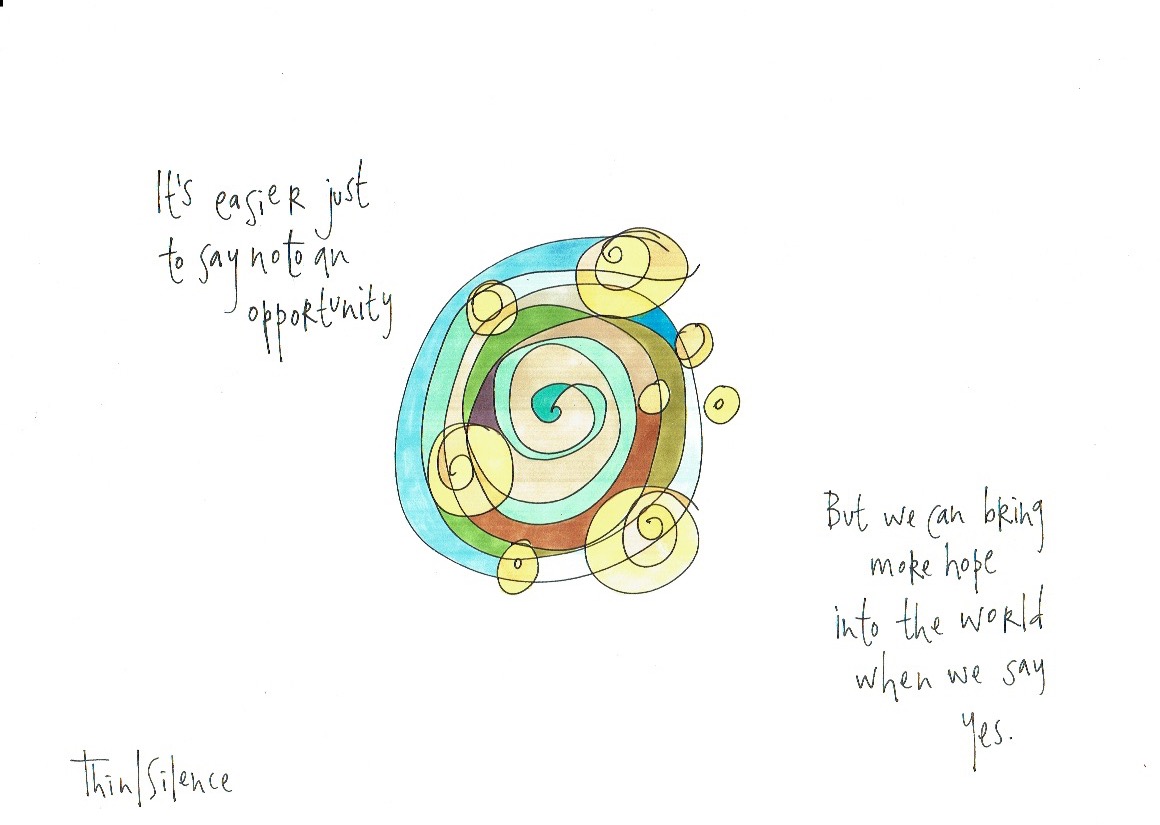
Hope comes when we are moved to imaginatively and creatively make some change; perhaps first of all on our own, and then together with others.

I have hope in the future because of what each of us is capable of doing.

(*From Seth Godin’s Whatcha Gonna Do With That Duck?)
(*From Otto Scharmer’s Theory U.)

wave-particle people

22-now-were-wandering

‘[A]ll matter has a “wave-particle duality,” sometimes acting as a particle and sometimes acting as a wave.’*

Most of what we know about the universe, we we’ve uncovered with the aid of instruments which extend our limited senses – including we now know that we exist within this wave-particle duality at the sub-atomic level.

It’s an interesting life-metaphor and, of course, we need no realities for a healthy life, though, most of the time, we can’t see how we are both particle and wave people

Sometimes we’re at rest, very much in one place; other times we are in many places at the same time.

We can physically be somewhere else, but thinking of home.  Or at home thinking of somewhere else.  Then we can we thinking of somewhere else and connecting with what happened there once upon a time, in some art or science or thinking or movement of people.

Our discovery has been that time is relative.  We can make great journeys of imagining or remembering and return younger than we ought to be.  It could possibly be that these imagining and dreaming journeys make us younger at heart than those who avoid them.

There’s another time-bending effect that occurs when we’re pursuing the things we love.  We speed time up – able to act faster and whisper more softly; these wave-effects presenting the particle-possibilities of ‘transformation, friendship, or love’.**

(*From Alan Lightman’s The Accidental Universe.)
(**From Lewis Hyde’s The Gift.)

it isn’t a gift yet

21-one-dimension

Creativity comes down to doing the hard work.

First of all, gathering together the imagining and thinking, and the evidence for possibility, whatever forms these take.

Then to begin mixing these together observing what happens, and seeing what begins to come into being. This feels a lot like experimenting.

There’ll be plenty we cannot or should not use, but some things will rise higher, or emerge, as the things to pursue.  Some would call this detachment and attachment.

Only then do we come to name, or picture, what it is we have to do, and something of how to go about it.

We have arrived at living out our gift. Not in some fixed way because at any time the other four steps can be moved through again.*

As this is about people’s lives there are some other things we can explore when it comes to the kinds of environment for these things to be developed.  Earlier in the week, I could only marvel at the way Michelangelo worked three-dimensionally on the unfinished statues my trip to Florence had been about.  Positing this, I imagined what a three-dimensional environment might look like.

Honour?

To be a person of worth and dignity with the freedom to act.

Nobility?

To be someone with skill and mastery.

Enlightenment?

To be a person who lives beyond themselves for the greatest purpose possible.

‘[T]here is an element of scarcity in what you do and how and why you do it, a combination of your story and your superpower.’** 

(*i’ve borrowed these steps from Rohit Bhargava’s Non-Obvious towards noticing trends: gathering, aggregating, elevating, naming, and proving. There are many other ways for describing the steps, but there are always steps.)
(**From Bernadette Jiwa’s Make Your Idea Matter.)

behold, a new thing

image

To behold the new thing, we have to be able to leave the old behind, at least to suspend our older way of seeing and understanding.

Our presence to more is weaker in the familiar – how much don’t we notice in a regular day?* – but stronger in the unfamiliar, where we find ourselves exploring our life’s labour, rather than our work or employment, where we identify more with our gift than with our talents.

The familiar often becomes caught up in heuristics, our personal ways of seeing and understanding derived from substitution (the real question for an easier one) and WYSIATI (what you see is all there is – an unwillingness or inability to move from our present worldview).

It is in the unfamiliar, though, where we grow our talents into a gift.

(*I noticed recently how I was overwhelmed with information on arriving for the first time at Florence railways station.  Only three days later, I knew all I needed to buy some tickets for Rome and could ignore all the rest.)

and i saw the earth turn

19-everyones-in-such

Reported by a journalist attending a presentation by Leon Foucault in 1851 intended to show, by means of a rotating pendulum, that the sun was not moving around the Earth, but the Earth was moving invisibly around the Sun.

It still is.

Many things are invisible to us, and we have to slow down to notice them and sometimes indirectly.

I watched the people streaming into the long gallery, their eyes carried immediately to the figure of Michelangelo’s David standing high above the crowd of people taking their pictures.  For an hour I obseRved so many people quickly moving moving along to join the crowd, past the unfinished statues By Michelangelo that I had come to see.

What these figures show is what had to happen to the block of marble that once was David before he would be completed.  All the hard work, innumerable chisel strokes, hours and even years of work.

I was was thinking about our lives, how there’s so much invisible work we cannot bypass or ignore, and how, in so many ways, we’re never the finished article.

We cannot be rushed.  We are a mystery.

‘And I hope that there will always be an edge between the known and the unknown, beyond which lies strangeness and unpredictability and life.’*

(*From Alan Lightman’s The Accidental Universe.)

it’s time

18-two-words-that

“I will not die an unlived life, I will not live in fear of failing or catching fire.”*

‘Between the time a gift comes to us and the time we pass it along, we suffer gratitude.   Moreover, with gifts that are agents of change it is only when the gift has worked in us, only when we have come up to its level, as it were, that we can give it away again.’**

We live in a very big universe, and it seems a shame not to explore it’ though, we can explore only the tiniest part of it with our physiclly.  The rest of it must be explored by extending ourselves through our imaginations and in our thinking, and then, in our living on this Earth.

By this, I think we can be marvellously altered.

While we live, each of us has a particular gift to bring into the world.  While the gift reposes within us, it’s a potential gift, when we reposition the gift by developing it, then we can pass it on.

It’s taken four years to get here, but today it was time to view some of Michelangelo’s statues whose descriptions captured my imagination as soon as I read about them.  I’ve never physically seen them – until today.   Often mentioning these unfinished figures wresting themselves from the stone that appears to  hold them fast, they illustrate how each of us has the gift of a unique life and perspective to bring into this world.

(*Dawna Markova, quoted in the Northumbria Community’s Morning Prayer.)

(**From Lewis Hyde’s The Gift.)

the banquet of surprises

17-life-in-tension

“Curiosity pleases me.  It evokes … a readiness to find strange and singular what surrounds us; a certain relentlessness to break up our familiarities.”*

‘This view is about turning toward instead of turning away.  But that doesn’t give you a method.  It is about allowing yourself to be curious and finding that enthusiasm to lean in, rather than escaping the bad feelings.’**

When we turn up with curiosity we will be surprised and enthralled by what we find – something about life in all its fullness.  Beyond  “It’ll never happen,” and “This is the way it always is,” and “They’ll never change” … such a universe of possibilities awaits us.

Healthy curiosity is both inward and outward.

Finding more within is opened up by the more we find without, and the more without by the more within.  Being only fascinated by what is not us means we will never develop.  Only being fascinated by ourselves means we will never find our generative presence in the world.

Last year, I witnessed a lifeboat launch.  In a few moments the crew had arrived, kitted up, and were on the water.  I found myself pondering how they didn’t get to choose who they were rescuing: it was everyone and anyone.  It was not about them.  It’s a helpful metaphor.

(*Michael Foucoult, quoted in Alan Lightman’s The Accidental Universe.)
(**From Pema Chodron’s Fail, Fail Again.)

renaissance

 16-life-has

Almost six centuries ago, Florence was the most exciting city in the West, with a proliferation of new art and thinking challenging and driving ever new heights I  what was to be called the Renaissance.

There are those who believe we’re on the cusp of a new Renaissance, one that is more democratised and has more for everyone to play with.  We get to look around us and imagine what might come about if we put this with this, if we introduce this person to this person, if we stretch what it is we can do to some new place or person.

‘Trend curators don’t seek needles, they gather the hay and stick a needle into the middle of it.’*

We take the artefacts we find all around us – things that others have made or thought – and we understand the cultures in which we find ourselves, and we bring our passion and creativity, and make something new.**

Many of these things will not be large or be noticed by millions, but that’s not the point.  The point is to be human, and humans make things.

(*From Rohit Bhargava’s Non-Obvious.)

(**See Alex McManus’s Makers of Fire.)

(Today’s doodle came from a conversation with Nikki Callander, a passenger on the plane to Italy, a massage therapist who finds herself helping people who are increasingly stressed with their work and are using coping techniques to get through.)

tinkering

15-gezmek

‘When engaging in tinkering, you incur a lot of small losses, then once in a while you find something rather significant.’*

This is about flanering, or wandering, from the man who introduced me to the concept. Engaging with life in a curious and intentional way, finding the rather significant something, or what Rohit Bhargava might call the elegant proof: ‘they are simple, ingenious, concise, and persuasive; they have an unexpected quality, and they are very satisfying.’**

Elegance involves flow; it’s what makes your giftedness flow to others in a simple and beautiful way.  You will find it by tinkering, wandering, flanering.

Have fun.

(*Nassim Taleb, either from The Black Swan.)
(**From Rohit Bhargava’s Non-Obvious.)

personal heuristics

14-consider

‘They don’t know who they really are and what they’re capable of.’*

‘First, find something you feel deeply passionate about creating.  Second, choose something the crowd is passionate about seeing come into existence.’**

Everyone has some or other graceful gift to discover and share.  Something which has about it the feeling of being an eternal, creative, joyful movement in our lives.  In Pamela Slim’s words, it will likely be something “an inch wide and a mile deep.” ^

An inch wide means we can miss it, of course.  To make this journey into a larger universe of what our lives can be, we have to lay aside, or step outside of, our personal heuristics – the things we have come to think of as defining our lives.  There is more to all of us than we know and, when connected to a dream, something special is about to be released.

Lewis Hyde^^ reminds me that the graceful gift is alive when it is what it is, when it embodies a spirit or dream, and when it creates a community.  If it doesn’t do these things, the likelihood is that its been commoditised – perhaps a skill to be sold in the labour market, something disconnected from our family and friends and the rest of life.

The laws of nature are basically gravity, magnetism, electricity, and nuclear force – everything that is finds itself governed by these laws.

And against these laws, we play out our lives.  However, there appear to be some secondary laws for human life to be lived beyond heuristics: we need to be autonomous, express our unique skilfulness, and live for a purpose greater than ourselves.

(*From Donald Miller’s Scary Close.)
(**From Peter Diamandis and Steven Kotler’s Bold.)

(^See Pamela Slim’s Escape From Cubicle Nation.)
(^^See Lewis Hyde’s The Gift.)