wait for me

‘The more prepared you are, the more spontaneous you can be.”

‘Walking came from Africa, from evolution and from necessity, and it went everywhere, usually looking for something.  The pilgrimage is one of the basic modes of walking in search of something intangible, and we were on pilgrimage.’**

There is waiting for something.  And that something may never come.

There is waiting towards something.  Moving towards we don’t know what, watchful for what appears.

Whether we call it a walk, a pilgrimage, or a quest doesn’t matter.  What matters is what happens while we’re waiting towards something:

‘[W]hen we go, we find we’re not just entering new territory.  We are becoming new people.’^

‘Real learning gets to the heart of what it means to be human.  through learning we recreate ourselves.’^^

(*From Chris Guillebeau’s The Happiness of Pursuit.)
(**From Rebecca Solnit’s Wanderlust.)
(^From John Ortberg’s All the Places to Go.)
(^^From Peter Senge’s The Fifth Discipline.)

so you want the moon?

“Character – the willingness to accept responsibility for one’s own life – is the source from which self-respect springs.”*

‘Technology isn’t an answer, it’s a tool.”**

Technology isn’t the thing.

The system or the rule isn’t the thing.

Neither is the teacher or guide who has lots of good things to share.

Each can help us move towards the thing, if we find the right ones.

The thing is simply the integrity and wholeness of our lives, no matter how imperfect or incomplete these are, out of which we make our contribution:

‘I’m still left standing squarely in my integrity.  From there, all things are possible.’^

(*Joan Didion, quoted in Brené Brown’s Rising Strong.)
(**From gapingvoid’s blog Identifying the question.)
(^From Brené Brown’s Rising Strong.)

the habits of our lives

The first step is learning how to do it. […] But step two is turning it into a habit.’*

This is how it is with the thing we most want to do.

It can take us a long time to identify the art or artisanship we want to contribute into the world.  The next thing we must do is to embody it, to make it into the many habits that are as special friends to us and that help us get up in the morning with a larger anticipation, move into the space we need to be in, and are channels for our unique energy in yet another day.

Without habits, personal energy leaks.

(*From Seth Godin’s blog: Don’t forget the second step.)

when a guide comes along

‘Each society and each individual usually explores only a tiny fraction of their horizon of possibilities.’*

‘It is a cause of great joy when a guide comes along who can help us discern our way.’**

What if Nassim Taleb and Albert Einstein are half-right?  What if we were to move through our adult lives unquestioning of how we see the world, then we see some faux-horizon at best:

‘I remind myself of Einstein’s remark that common sense is nothing but a collection of misconceptions acquired by age eighteen.’^

My experience has been that it is through the lives of countless others that we see what is the real horizon.  This can be overwhelming and I’m reminded of Pamela Slim’s exhortation to find a niche an inch wide and a mile deep.^^  That’s all we need.  We don’t have to do everything but we do have to do something to allow our creativity to flow, opening the possibility of generosity, and these bringing us enjoyment.

The infinite can be very small and the finite very large.

(*From Yuval Noah Harari’s Sapiens.)
(**From Henri Nouwen’s Discernment.)
(^From Nassim Taleb’s Fooled by Randomness.)
(^^See Pamela Slim’s Escape from Cubicle Nation.)

the future depends on what we can imagine

Thomas Merton offers a prayer for lostness:

“My Lord God, I have no idea where I am going.”*

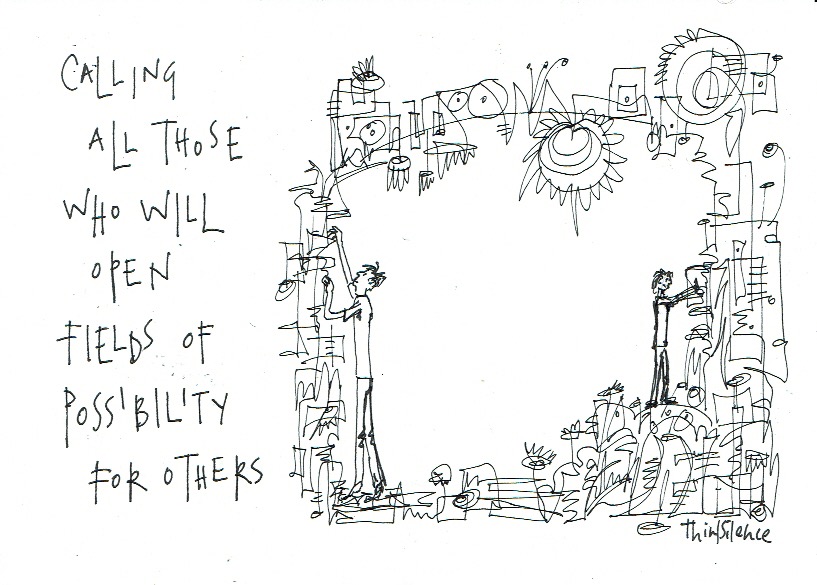
God or not, we all need those paths in our lives about which we’ve no idea where they’ll take us, which open up surprises.

We also need others to walk their paths of unknowing that may or may not lead them to us, bringing to us what we have no idea of – someone living differently, doing something we may like the look and sound of, and which we may try out ourselves:  ‘concrete embodiments of big ideas [which] spark imagination in ways that abstract arguments cannot’.**

(*From the Northumbria Community‘s Morning Prayer.)
(**From Peter Senge’s The Necessary Revolution.)

on boundaries

‘Finite players play within boundaries, infinite players play with boundaries.’*

The first boundaries to be played with are those of our own lives.  It’s likely, though, that we all stop short of exploring the extent to which these boundaries are malleable.

Brené Brown asks a question on boundaries when it comes to ours and those of others:

‘What boundaries need to be in place so that you can stay in your integrity and make generous assumptions about this person’s motivation, intentions, or behaviours?’**

We’re explorers of the generosity of our boundaries.

Only we can take responsibility for this.  Education tends not to teach on this, and it’s unlikely that our workplaces will help – even with the best of intentions, our teachers and employers are in a system that focuses on some but not on everyone.  Anne Lamott seems to see mercy as important to playing with boundaries, especially when we see boundaries through Brown’s question:

‘Pope Francis says the name of God is mercy.  Our name was mercy, too, until we put it away to become more productive, more admired, and less vulnerable.  We tend to forget it’s still there.’^

We don’t have to believe in a god to see Lamott’s suggestion that mercy adds an important element to the growing of our boundaries:

‘We startle awake.  This is part of the mystery, that the humane, humanity, human bodies, are where we experience transcendence and God, restoration, the inclination to serve those who are suffering.  We reach out as we are reached out to.’^

This plasticity of boundaries witnesses others reaching out to us as we reach out to others is provided with more beauty and wonder by John Ortberg when he writes:

‘Somebody said that what the world needs is not more geniuses but more genius makers, people who enhance and don’t diminish the gifts of those around them,’^^

Let’s go play with that.

(*From James Carse’s Finite and Infinite Games.)
(**From Brené Brown’s Rising Strong.)
(^From Anne Lamott’s Hallelujah Anyway.)
(^^From John Ortberg’s All the Places to Go.)

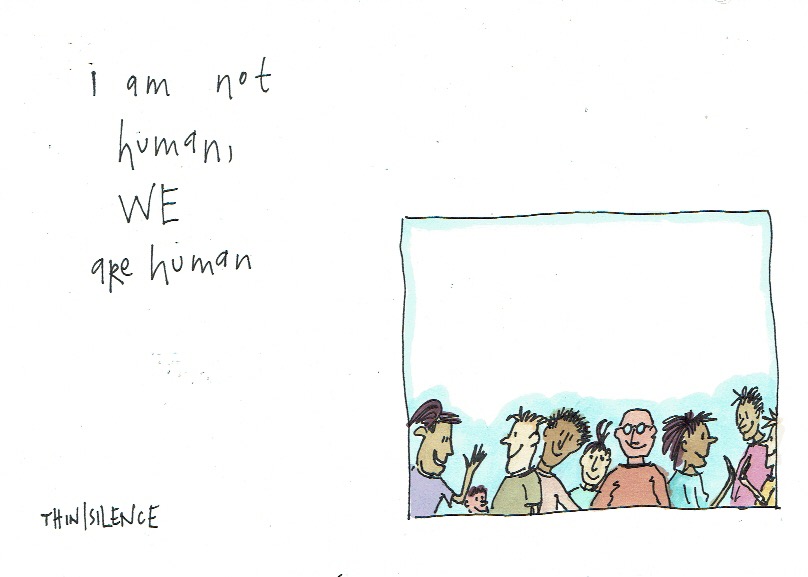
getting closer to the WE story


‘The WE appears when, for a moment, we set aside the story of fear, competition, and struggle, and tell its story. […] What happens after that is not in your control, but springs spontaneously from the WE itself.’*

As we move deeper into the “connected” future, we’re trying to figure this story out.  For whilst we have the greatest means to connect we have ever had, yet we’re becoming more disconnected.

Kio Stark writes about the simple joy of introducing her daughter to a neighbour from where she used to live, about whom she knew quite a bit, though not his name:

‘I wrote this book, in some ways, to describe why that moment made me so soaringly happy – why I love introducing my daughter to a man whose name I could not remember and calling him my friend.’**

Stark’s remark echoes what we know at our core: that we are part of a WE story.

Peter Senge, in describing systems thinking, observes how inventions becomes innovation when many elements come together:

‘In engineering, when an idea moves from an invention to an innovation, diverse “component technologies” come together. […] Until this ensemble forms, the idea, though possible in the laboratory, does not achieve its potential in practice.’^

This suggests that many people must come together.  The WE story is about a people system which not only reaches around our planet, recognising how we live interdependently with one another – knowingly or unknowingly, but also into our past and into our future.  The ways our ancestors lived affect us today, and we are ancestors to those who will follow.

Connecting to the WE story recognises this, each able to take their place through a unique contribution.

(*From Rosalind and Benjamin Zander’s The Art of Possibility.)
(**From Kio Stark’s When Strangers Meet.)
(^From Peter Senge’s The Fifth Discipline.)

profound simplicity, profound possibility

‘It reminded me of the importance of the place of transformation in our lives – the changing room – the places and disciplines of solitude in which to access the wisdom that is within us.’*

Philip Newell describes what happens when we listen to our lives, providing the possibility of change, of becoming, of becoming more of who we are.  He names this state “profound simplicity,” where we find ourselves in oneness with everything.  I think this is what Oliver Wendell Holmes was referring to when he identified a simplicity on the far side of complexity:

*I would not give a fig for the simplicity this side of complexity, but I would give my life for the simplicity on the other side of complexity.”

It is what Brian McLaren points to as the season of harmony, lying beyond the seasons of simplicity, complexity, and perplexity.**

This feels more like a journeying stream that we are able to slip into than it does a destination, akin to Constantine Cavafy’s poem Ithaca:

“As you set out on the way to Ithaca
hope that the road is a long one,
filled with adventures, filled with understanding.
The Laestrygonians and the Cyclopes,
Poseidon in his anger: do not fear them,
you’ll never come across them on your way
as long as your mind stays aloft, and a choice
emotion touches your spirit and your body.
The Laestrygonians and the Cyclopes,
savage Poseidon; you’ll not encounter them
unless you carry them within your soul,
unless your soul sets them up before you.

Hope that the road is a long one.
Many may the summer mornings be
when—with what pleasure, with what joy—
you first put in to harbours new to your eyes;
may you stop at Phoenician trading posts
and there acquire fine goods:
mother-of-pearl and coral, amber and ebony,
and heady perfumes of every kind:
as many heady perfumes as you can.
To many Egyptian cities may you go
so you may learn, and go on learning, from their sages.

Always keep Ithaca in your mind;
to reach her is your destiny.
But do not rush your journey in the least.
Better that it last for many years;
that you drop anchor at the island an old man,
rich with all you’ve gotten on the way,
not expecting Ithaca to make you rich.

Ithaca gave to you the beautiful journey;
without her you’d not have set upon the road.
But she has nothing left to give you any more.

And if you find her poor, Ithaca did not deceive you.
As wise as you’ll have become, with so much experience,
you’ll have understood, by then, what these Ithacas mean. “^

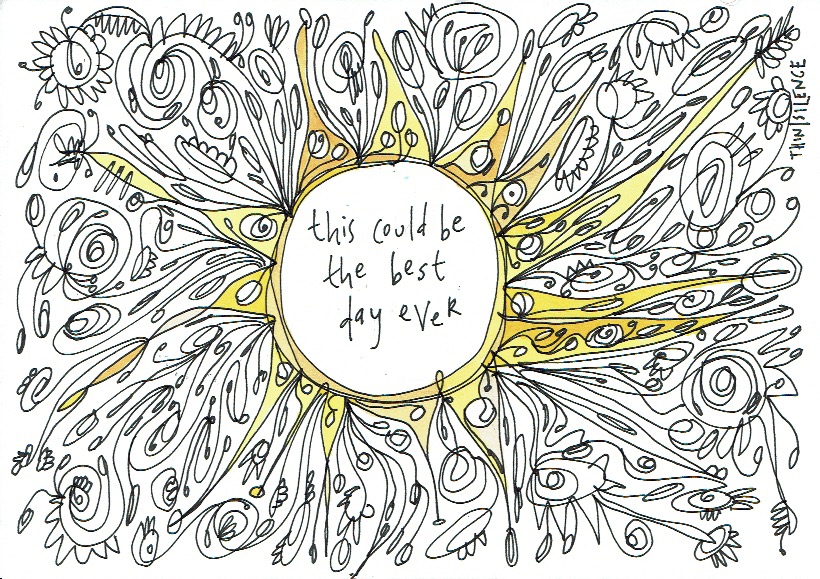
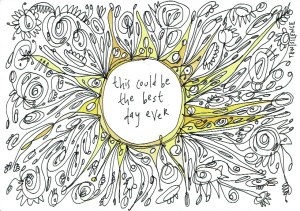
“That was the best day ever,” declares Anne Lamott’s six year old grandson at the end of a day.  The next morning he begins with the words, “This could be the best day ever.”^^

In-between lies the terror of a nightmare.  Lamott comforts him in the night:

”He is like a pond, a self-contained waterbody with long brown legs, teeming with ever manner of life, rooted water plants and flowers, fish, turtles, tadpoles, ducks, but also, hidden in the silt, piranhas, stingrays, great white sharks.’^^

Such are all of us: people of simplicity, complexity, perplexity, and harmony*^

I smile.

This six year old reminds me of my thirty five year old friend Steve, who loves so much about every day, declaring so many things to be the best ever.  It strikes me that he has held on to and is developing this profound simplicity and, so, profound possibility.    I realise we’re not meant to lose the best day ever-ness of life we knew as a young child but rather to develop it into an adult version on the far-side of complexity.

The first simplicity is a doorway life invites us to walk through, an opening or re-opening of our mind, leading to the opening of our heart and then the opening of our will.

Wisdom is not a body of knowledge that we gain, some far-off Ithaca, but a journey we immerse ourselves in and grow rich through:

‘I am in charge of one dynamic: when a door is opened, I get to choose hope I will respond.’^*

‘We relax down into higher rungs of awareness, immediacy – being.  Just humanly being.’^^

(*From Philip Newell’s The Rebirthing of God.)
(**See Brian McLaren’s Naked Spirituality.)
(^Constantine cavity’s Ithaca, quoted in part in Chris Guillebeau’s The Happiness of Pursuit.)
(^^From Anne Lamott’s Hallelujah Anyway.)
(*^These are Brian McLaren’s four seasons: beginning with the  first simplicity, then things turn out to be more complex than we thought, and then we face the horrors of perplexity – what can we do, before bringing all of these together in harmony, that is, a simplicity on the far side of complexity.)
(^*From John Ortberg’s All the Places to Go.)

hands on

‘If we allow ourselves to see, we will more readily feel, and if we open to the river of compassionate feeling, we will more likely act.  But the call to action is the sticking point.’*

‘The larger issue here is that simulation can be a poor substitute for tactile experience.’**

Richard Sennett argues that the first industrial revolution robbed us of our hands, as machines replace human skills, and the second (technological revolution) has robbed us of our brains.  We press a button in the workplace and something happens.  But beyond this, technology is also altering our relationship with those around us and with ourselves.

We have technology that make it possible to move around quickly, or not to move at all (when we shop at home), communicate immediately without seeing or hearing each other, fit more into the day (apparently), project the self we want others to see, receive selected information rather than the whole story.

I think the deeper life journey will ask us to participate in deeper tactile, organic, “analogue” dive, one stimulating our senses and connects us with the wonder we are as creatures capable of learning perpetually, in which we both explore the silence and solitude and face-to-face spaces with others, especially others who are not like us.

(*From Philip Newell’s The Rebirthing of God.)
(**From Richard Sennett’s The Craftsman.)

loosen my heart until it becomes a wing, a torch, a promise*

I imagine Erwin McManus’ three quests** in Michelangelo’s unfinished statues: the human search for honour, nobility, and enlightenment.

Michelangelo sought to identify and release the figure within the blocks of marble he loved to work on.  He was never more free then when he was working with his beloved marble.^

This relationship between sculptor and stone also helps us to see how our release is only possible as we make ourselves available to others so that they are able to find their own honour, their own nobility, and their own enlightenment.

Derek Sivers is taking the role of sculptor when he exhorts:

“Whatever excites you, go do it.  Whatever drains you, stop doing it.”^^

(*Dawna Markova, quoted in the Northumbria Community‘s Morning Prayer.)
(**From Erwin McManus’ Uprising.)
(^Irving Stone’s The Agony and the Ecstasy is a compelling biographical novel telling the story of Michelangelo.)
(^^Derek Sivers, quoted iin Austin Kleon’s Show Your Work.)