magnificence

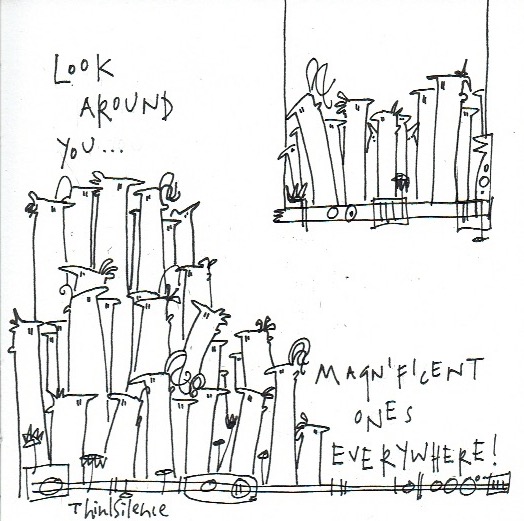
The magnificent are everywhere, especially among the unrecognised, undervalued, unregarded and discarded.

In his book of aphorisms, Nassim Taleb introduces the the idea of The Magnificent, from Aristotle’s megalopsychos, or “great-souled.”

What if magnificence is something lived from the inside out, without need of title, role, position, or possession?  Christian theologians wrote and spoke about imago Dei, the image of god found in every person, but went on to add qualifications and conditions which looked very ugly in real life.

Mihaly Csikszentmihalyi reflects this inside-outness when he writes:

‘Whether we are happy depends on inner harmony, not on the controls we are able to exert over the great forces of the universe.’**

This has to do with how we see people, and if we see people wrongly or badly, as Seth Godin points out, we can change our way of seeing for a better one:

‘If the way you see the world isn’t helping you make the changes you seek to make, consider seeing the world differently.’^

Richard Rohr’s “great being” sounds magnificent or the great-souled.  Whilst coming from a developing Christian tradition, Rohr’s understanding of the person with great being emerged from learning from an Indian holy man:

‘A great being stays with what she loves; she’s patient, she forgives and she allows what she loves to develop, to grow.  She overlooks its mistakes, and in this sense she suffers for and with reality.  This is the deepest meaning of passion: patior is the Latin verb meaning to suffer or to undergo reality (as opposed to controlling it).^^

It’s the final phrase about undergoing reality that captures my attention here.  Magnificent ones are not marked by their role, position, title, or possessions – though they may have some or all of these things, they are first of all people who understand they must form a relationship with the universe because they cannot control it.

Csikszentmihalyi writes about our world and universe in terms of perspectives:

‘The earth may be our home, but it is a one full of booby traps.  It is not that the universe is random in an abstract mathematical sense.  The motion of the stars, the transformations of energy that occur in it might be predicted and explained well enough.  But natural processes do not take human desires into account.  They are deaf and blind to our needs, and this they are random contrast with the order we attempt to establish through our goals.’**

He’s saying what we see and what the universe “sees” are two different things.

What we think of as our life appears somewhere between these two seeings.

This relationship exists between the two powers of reality (the universe) and imagination (the human perspective), described by Wallace Stevens as the pressure of reality and the power of imagination.  They cannot overpower each other but what forms between is a very interesting life.

Both are the universe.  We are the product of the universe, formed of what the rest of the universe is made of.

In his fable of creation, Alan Lightman writes about how human existence transitions from impermanence to permanence, by which he means our atoms formed into our lives for seventy or eighty years are the impermanent, their permanent state being a cycling and recycling through the world.

We are the world, the world is us.  As Martin Buber expressed it, we are moving from “I-it” to “I-Thou” understanding, which brings us back to seeing.

Imagine meeting another human being, both of you for this moment being stripped of title, position, role, possessions.  Who do you meet?

Rohr suggests we are meeting an “anointed one,” which from his tradition is saying “a christ.”  We are meeting magnificence.

(*From Nassim Taleb’s The Bed of Procrustes.)
(**From Mihaly Csikzentmihalyi’s Flow.)
(^From Seth Godin’s blog: A shared and useful illusion.)
(^^From Richard Rohr’s The Divine Dance.)

nonsense

What if the way we must find for our lives is not an answer but a question?

“Live the questions now.
Perhaps then, someday far away in the future,
you will gradually,
without even noticing it,
live your way into the answer.”*

‘The idea, then, is to force your brain off those predictable paths to purposefully “thinking wrong” – coming up with ideas that seem to make no sense, mixing and matching things that don’t normally go together.’**

Predictable is the dangerous path.  It’s akin to Theory U‘s downloaded path, to Mindfulness’ autopilot.  I’ve noticed how I miss so much because of the speed at which I move through life with predictability.  I try to slow down in order to notice more – three or four slow breaths now helps me to stop the rush.

Erwin McManus makes the connection between noticing more and our quest for enlightenment:

‘It should be obvious that those who live enlightened lives have demonstrated a unique ability to learn from everyone and everything around them.’^

Living our questions is also about unfolding the stories in which we set our questions.  Richard Rohr reflects the transformational nature for us of living what we love:

‘I see it in human beings all the time, we all become what we love.’^^

Erwin McManus helps us to see more of the detail of what is happening here:

‘We persevere in the confidence that we ourselves are being transformed.  Perseverance produces character, and character, hope.  And hope, we will discover, is the ultimate gift gained in wisdom.’^

Seeing our lives as stories lived around questions is about drawing lines through the randomness and complexity of life.  Predictability hates questions because they enable us to see our lives for what they can be rather than what they are.

What is your question?  (You’re allowed more than one.)

(*Rainer Maria Rilke, quoted in the Northumbria Community‘s Morning Prayer.)
(**From Warren Berger’s A More Beautiful Question.)
(^From Erwin McManus’ Uprising.)
(^^From Richard Rohr’s The Divine Dance.)

secrets of joy

When we live out our joy then we leave our joy lying around for others to find.

Life provides us with opportunities of making things that give us joy – thoughts, relationships, artefacts – that we can hide for others to find – because we don’t always have opportunity to give directly.

Maria Popova speaks of what I think of as conversations with purpose in this way: ‘the possibility of planting into another mind a seed sprouted in ours and watching it blossom into a breathtaking flower of mutual understanding’.*

Of course, there’s always risk involved.  The beautiful thought – or relationship of artefact –  can be misunderstood or not valued.  Sometimes, though, in the relationship that forms between two or more people, a possibility can grow even more, and, because of this, it is worth it.

(*From Maria Popova’s Brain Pickings: Telling is Listening.)

the jungle of motivation

No one wants to be Sisyphus.

He’s the guy In Greek mythology who, because of his hubris, was condemned by Zeus to endlessly roll a boulder up a hill only for it to roll back down because of an enchantment placed upon it.

Here is the “Sisyphic” condition: being caught in an endeavour without meaning or purpose.  None of us want to find ourselves or to condemn others to live in this place devoid of motivation.

The following words from Dan Ariely, Duke University’s Professor of Psychology and Behavioural Economics, describes motivation as a jungle.  My interest and curiosity were piqued as soon as I read them:

‘Motivation is a forest full of twisting trees, unexplored rivers, threatening insects, weird plants, and colourful birds.’*

Motivation’s complexity – because not everything is equally important in the jungle and we can end up placing greater value on the wrong things – means we can be tempted to overlook the source of our own motivation in favour of something more predictable or measurable, such as the product.  Yet, whilst others will be able to copy our super-widget, they will not be able to copy our story.

‘We are the CEOs of our own lives.’*

Here are three invaluable things when it comes to motivation, what it is to be human:

Autonomy: no one is completely free but we can each embrace how more or less free we are – when we face our experiences, our character, our story, our choices – and then we can grow them.

Mastery: we have each developed skills into talents into strengths over many thousands of hours; the ways we think, relate, communicate, and execute are unique and are full of the kinds of detail that not only can be repeated but also developed and innovated.

Purpose: the purpose bigger than ourselves that we want to contribute to, moving us towards investing in the lives of others – perhaps the greatest of all contributions: ‘the place where [our] deep gladness and the world’s deep hunger meet,’ as Frederick Buechner put it.

All of these can be turned into the kinds of habit and practice that make it possible for us to turn up to our days with meaning and purpose.  Motivation may be a jungle but we can know our jungles.

(*From Dan Ariely’s Payoff.)


exploring thin|silence

I’m going to be exploring some thin|silences previously uninvestigated.  The next post will be on Monday, 10th July.

In the meantime, drop me a line if you want to find out more about what Thin|Silence looks like when it’s dreamwhispering, or doodles for the workplace or personal use.  Any design can be set up as a canvas, framed image, or notecards and bookmarks and business cards.

There’s a colouring book coming out soon: Slow Journeys in the Same Direction – again, drop me a line if you want to know more.

the eye of the storm

The things we see when all around us is far from perfect.  The things we see together in an indifferent universe.

Mihaly Csikszentmihalyi describes the environment in which we see, imagine, and make:

‘[The universe] is the setting for great violence, as when occasionally a star explodes, turning to ashes everything within billions of miles.  The rare planet  who gravity field would not crush our bones is probably swimming in lethal gases.  Even planet Earth, which can be so idyllic and picturesque, is not to be taken for granted.  To survive on it men and women have had to struggle for millions of years against, ice, fire, floods, wild animals, and invisible microorganisms that appear out of nowhere to snuff us out.’*

It’s a hard place to live without making it harder for each other but we know only too well that on a bad day we can do exactly this, fighting against one another in all manner of ways, discriminating against each other as if we are from different planets:

‘We discriminate, decide, qualify, and dissociate almost all whom we look at instead of loving them as they are.’**

We’re capable of more, though, drawn out here by Roz and Ben Zander when they explain the difference giving people an A makes:

‘We give the A to finesse the stronghold of judgement that grades have over our consciousness from our earliest days.’^

When we treat one another as “A people” then we’re creating an environment in which more can emerge:

‘The acknowledgement of abundance all around you awakens the dormant abundance within.’^^

The struggle to live with meaning and purpose, and with love and joy continues.

Sean Carroll identifies what has become one of the significant divides since the emergence of the major sciences, between religion and science, but Carroll want to draw a different line:

“The important distinction is not between theists and naturalists; it’s between people who care enough about the universe to make a good-faith effort to understand it, and those who fit it into a predetermined box or simply take it for granted. The universe is much bigger than you or me, and the quest to figure it out unites people with a spectrum of substantive beliefs. It’s us against the mysteries of the universe; if we care about understanding, we’re on the same side.”*^

When we see together, the possibilities we can shape, the universe changes, the world becomes the wonderful place Csikszentmihalyi alludes to, we are makers of the most beautiful and loving things in this eye of the storm:

“We are the miracle, we human beings. […] Our lives are finite, unpredictable and immeasurably precious.  Our emergence has brought meaning and mattering into the world.”*^

(*From Mihaly Csikszentmihalyi’s Flow.)
(**From Richard Rohr’s The Divine Dance.)
(^From Rosalind and Benjamin Zander’s The Art of Possibility.)
(^^From Eckhart Tolle’s A New Earth.)
(*^Sean Carroll, quoted in Maria Popova’s Brain Pickings: Existential Therapy from the Universe.)


to see uncomfortably

‘If you’re seeking to create positive change in your community, it’s almost certain you’ll be creating discomfort as well.’*

‘Data – that which we can usually measure – is supposed to make us smarter, and maybe it can, but I’d argue that it doesn’t always make us wiser. […] We don’t (or can’t) know the significance of things we have no information about, or haven’t yet thought to measure, or can’t possibly know for sure.’**

Little did the occupants of Smartworld know they were being observed.

Far away, with the most advanced technology possible, the residents of Wiseworld looked on.  Would Smartworld citizens make the same mistakes they had made long ago in their past?

They watched as the flow of automation and robotics reached the traditional building industries.   Smartworld was on the cusp of seeing building robots replace traditional workers – maybe there were twenty or thirty years left.  It was happening in the same way.  Wiseworlders had once seen this kind of technology progression of technology firstly come more kindly from within an industry – the industry would see what happened elsewhere, be inspired, and make changes.  Now the skill-machines were being thought up elsewhere; they weren’t asking for them, and they couldn’t be ignored.

Many of the Smartworlders with traditional skills had sold themselves to companies so the decisions weren’t theirs any longer.  Instead one or two people, or maybe a handful at most, made the decisions that were intended to please their stakeholders, not their employees.

As the Wiseworlders looked on, they realised this species on a far off planet were driven by the same things as they were: to be autonomous, to have mastery, and to live for a purpose beyond themselves.  The problem was, as they themselves had experienced it, selling their skills to the companies meant they were now living for someone else’s autonomy, mastery, and purpose when it came to the workplace; they too knew what it felt like to have the three motivations pushed out of the workplace and into their family and leisure lives – it never seemed so satisfying.

The Wiseworlders hadn’t demonised their bosses.  Time had shown them that their employers were like anybody else: they just couldn’t see very well.  They saw their businesses in terms of “countables” an “uncountables.”**  The countables included the number of products produced, how many hours this took, how many sick days were taken, and suchlike.  The uncountables included the ideas their workers had for improving things, how they interacted to help each other during the working day.  The thing was, because these were difficult to measure, the emphasis was invariably placed on what could be counted.

The Wiseworld bosses, when they were going through their own smart-era, thought that the difficult things to count would be covered by good wages and holidays, most finding crossing the invisible line to saying thank you an uncomfortable thing to do.

Smartworld was becoming more connected, the average daily wage was rising, age expectancy increasing, but also anxiety and depression levels were going up and it was baffling to know why.

All of these things played out on Wiseworld, too.

Until they made some breakthrough decisions.

Over a generation or so, they’d revamped their education system to include the triple focus of autonomy, mastery, and purpose, removing artificial learning barriers like upper age limits.  Now education was seen as a process of life.

Children grew up in a world where their curiosity led their learning.  First attempts at new systems were clumsy and many educationalists were for throwing in the towel, but they realised that their thinking and practices had to develop together.  They become more adept and children were brought up to identify their own work in ways that were not fixed but allowed for changes of direction along the way.

They’d come to realise that latitude was critical to success, including those who weren’t sure about which path to take to connect with others.  It had led to all kinds of confederacies of artisanship.

Wiseworlders knew, if their own history had taught them anything, it was that this was not the only or best way.  But they had come to believe openness to the future rather than being shackled to the past, was their best hope.

Their greatest dilemma was whether to leave Smartworlders to figure things out by themselves, or to send some subliminal messages which could be picked up as weak signals: dreams and hunches by those willing to face the discomfort of their curiosity on Smartworld.

(*From Seth Godin’s blog: Creating discomfort.)
(**From Bernadette Jiwa’s Hunch.)

(**Terms taken from Dan Ariely’s Payoff.)

the honest and the artificial

‘Friendship is the sweet grace which liberates us to approach, recognise and inhabit the adventure.’*

I’d pencilled a note in my journal yesterday to be pursued today: “what relationships help us to see”

It’d been the following words from cosmologist Sean Carroll that prompted me not to lose track of this dimension of seeing:

‘We don’t know how the universe began, or if it’s the only universe.  We don’t know the ultimate, complete laws of physics.  We don’t know how life began, or how consciousness arose.  And we certainly haven’t agreed on the best way to live in the world as good human beings.’**

It was the last sentence that intrigued.  In this universe where we know so little, we think we know the best way to live and yet there’s a universe of relationships to explore.

I’d these words from Roz and Ben Zander in mind – from my best read of 2016:

‘The action in a universe of possibility may be characterised as generative, or giving, in all senses of that word – producing new life, creating new ideas, consciously endowing with meaning, contributing, yielding to the power of contexts.  The relationship between people and environments is highlighted, not the people and things themselves.  Emotions that are relegated to the special category of spirituality are abundant here: joy, grace, awe, wholeness, passion, and compassion.’^

Perhaps these words describe what we hope for as “good human beings,” but the interesting thing pointed out by the Zanders is that these emotions exist in the relationships between.  It’s not so much that we join up our seeing but some new seeing comes into existence between two people.  Dan Ariely shares from his work of researching motivation:

‘As people feel connected, challenged, and engaged; as they feel trusted and autonomous, and as they get more recognition for their efforts, the total amount of motivation, joy, and output for everyone grows much larger.’^^

It’s some words from the world of brickcraft that cause me to wonder whether what we have to do is turn up in honesty.  In the 18th century, with literacy on the rise, writings on many crafts began to appear, including brickcraft.  Richard Sennett reflects on this 18th century form of honesty:

‘”Honest” brick […] evokes a building surface in which the brickwork is exposed rather than covered over: no cosmetics, no “pots of whore’s rouge” have been applied to its face.  One reason for this shift was that masons were beginning to be aware of, and feel engaged in debates about the meaning of naturalness as opposed to artifice {…}.’*^

Artifice was the disguising of what lay beneath the surface – it connects with our sense or understanding of what is artificial.  This comment on craftsmanship connects me with Maria Popova’s comment on poetic naturalism:

‘The craftsmanship of meaning amid the unfeeling laws of nature invariably calls us to use human tools like ethics and art to answer questions of what is right and beautiful.’^*

Popova is considering Carroll’s words about what makes a good human being.  We are not only producers of utility but we are also crafters weaving meaning with our artisanship.  We are seeing more.

(*From John O’Donohue’s Anam Cara.)
(**Sean Carroll, quoted in Maria Popova’s Brain Pickings: Existential Therapy from the Universe.)
(^From Rosalind and Benjamin Zander’s The Art of Possibility.)
(^^From Dan Ariely’s Payoff.)
(*^From Richard Sennett’s The Craftsman.)
(^*From Maria Popova’s Brain Pickings: Existential Therapy from the Universe.)

vuja de for the first time

Here is a story in five quotes.

Hugh Macleod points to how we want our lives to count, something life provides us with the opportunity to make happen:

‘We have to have something to live for, to look forward to.  We have to have more than existence: we have to have something inspiring.’*

Dan Ariely backs this up with his research which showed financial incentives can be less effective than our bosses noticing us and saying “Well done!”:

‘These results suggest that there is a lot more to work than merely the opportunity to earn money in exchange for about.’**

Sherry Turkle concludes her reflections on forty three year old Adam’s escape into gaming while his actual life unravels – the problem is, game playing doesn’t produce:

‘This is the sweet spot of simulation: the exhilaration of creativity without its pressures, the excitement of exploration without its risks.’^

John O’Donohue writes about what has always been there waiting to be discovered:

‘It is strange to be here.  The mystery never leaves you alone.  Behind your image, below your words, above your thoughts, the silence of another world waits.  A world lives within you.’^^

Which brings us back to something Hugh Macleod offers in conclusion to his remarks on how we have to have something to live for:

‘And then we have freedom — something that no one can ever take away.’*

Vuja de is the feeling that you are experiencing something completely new in a very familiar context.  We might then learn the art of vuja de: the ability to see what has always been there but has gone unnoticed.

The skills involved include asking different questions, knocking on different doors, and seeking different ways and paths to those we have tried in the past.  All of these are about effort.  Effort cannot be simulated.  But once we sense there’s something more, we have to have it.  Yes?

(*From gapingvoid’s blog: Oh, you can’t take that away from me.)
(**From John O’Donohue’s Anam Cara.)
(^From Sherry Turkle’s Alone Together.)

open seeing

We see what we want to see, not necessarily what is there.

When our expectations are not met, disappointment and unhappiness may follow.

To see only what we want to see hides so many things we do not want to see and with these, things we not able to see.

Life is seeing, it’s learning to open our eyes so we may see more.  When we see more, perhaps joy will follow.

Cosmologist Sean Carroll uses the term poetic naturalism to identify the way we look upon a universe that we know so little about and yet bring meaning to, meaning that grows as we continue to explore:

“Life is a process, not a substance, and it is necessarily temporary.  We are not the reason for the existence of the universe, but our ability for self-awareness and reflection makes us special within it.”*

Novelist and philosopher Iris Murdoch uses the word “attention” to identify seeing that is more than “looking” – looking, she says, is a neutral way of seeing:

‘I can only choose within the world I can see, in the moral sense of ‘see’ which implies that clear vision is a result of moral imagination and moral effort.’**

Seeing is about who we are, who we are becoming, it’s full of stories and fables and myths with triumphs and failures, with conflicts and strivings.  It is no small surprise, then, that we change the universe by our seeing.

This is our art.

‘If you want to achieve the unimaginable, you start by imagining it.’^

(*Sean Carroll, quoted in Maria Popova’s Brain Pickings: Existential Therapy from the Universe.)
(**From Iris Murdoch’s The Sovereignty of Good.)
(^From Chris Guillebeau’s The Happiness of Pursuit.)