It’s a reciprocal, reciprocal world

Tim Harford tells the story of mathematician Paul Erdös who was prolific in his publication of some five hundred papers.  The especially remarkable thing is that he collaborated with others in order to do this.  Never staying in a place for very long, his motto was, “Another roof, another proof.”*

This is an example of inclusive collaboration.  There are exclusive collaborations.  Harford preceded his telling of Erdös’ story with that of the British 2000 Olympics 8+ rowing team that won gold.  They’d carried themselves off to work together in preparation for the Games.  No one knew who they were never mind thinking they would win.

It’s the inclusive collaboration that fascinates me most.

I have come to see reading a book as collaborating.  I was almost 40 before I really began reading.  Reading to gain insight, I’ve come to discover there’s a way of reading that brings new thoughts into being and these new thoughts can be explored with others and then written about.

Now I find myself wondering about how a collaboration of people can work together to produce a book when they have been told that publishers don’t like many people being involved.  It’s messy.  That’s the thing about a reciprocal world.  It’s messy.  And beautifully so.

(*Paul Erdös, quoted in Tim Harford’s Messy.)

The art of making more with less (or why artists will save the world)

In the past five hundred years our population has increased fourteen-fold but our energy consumption has increased by 115 times and the global economy is now 240 times bigger than it was in 1500.*
(Martin Bhaskar)

To become less wasteful we need to become more creative.

The good news is, we’re all artists, and artists, on the most part, make more with less.

When we receive something from our environments, from those around us or those who have gone before us, and when we reflect on it, imagine it, play with it, shape something with it and produce something different, we’re entering into the world of artists and artisans.

It’s a synaesthysic process in as much as it is bringing what we see, feel and do together.  If we only receivers then we are only consumers.

Elle Luna describes the artist’s Must:

‘We can’t prove Must.  We can’t point to it, or define where it stops and starts, because it’s not a thing that we can see.  But we know that it exists because when it’s near, we feel it in our gut; it begs for a second glance, pulls us into another dimension, a space out of time where a day can pass it a moment.’**

Within these words there’s this sense of joining up of what we see, feel and do.  This is where we find we’re most alert, where we find ourselves in a state of Attention.  Not least because we are carried into new, different, unfamiliar places that keep us on our toes.  Brian Eno writes of this state:

“The enemy of creative work is boredom, actually […].  And the friend is alertness.  Now I think what makes you alert is to be faced with a situation that is beyond your control so you have to be watching it very carefully to see how it unfold, to be able to stay on top of it.  That kind of alertness is exciting.”^

Within this lies the prospect of not knowing where we’ll end up, a story unfolding.  Just saying this might be enough to put some off the artistic way.  But if we can go with the flow, something the company 3M encourages its workers to engage in under the title of “flexible attention,” what we find is the kind of engagement with a wide diversity of creativity that may save our planet and solve many of the issues within a creaking eco-system.  Mihaly Csikszentmihalyi writes about living in this unpredictable way:

‘what people enjoy is not the sense of being in control, but the sense of exercising control in difficult situations’.^^

Here is Eno’s alertness made possible by entering the unfamiliar:

‘It is not possible to experience a feeling of control unless one is willing to give up the safety of protective routines.’^^

Who wants to become incompetent, right?  Yet this is where we’ll grow our competences to a new level.  In this case it’s the art of making more with less we’re all capable of.

My friend and mentor Alex McManus states this in his inimitable way when he echoes Ernest Shackleton’s alleged advertisement for a crew:

‘Heroes wanted for an epic quest to hack the universe.  Starting with Earth.  Safe return doubtful.’*^

(*From Martin Bhaskar’s Curation.)
(**From Elle Luna’s The Crossroads of Should and Must.)
(^Brian Eno, quoted in Tim Harford’s Messy.)
(^^From Mihaly Csikszentmihalyi’s Flow.)
(*^From Alex McManus’ Makers of Fire.)

The relentless voyage

Even though your body is always bound to one place, your mind is a relentless voyager.*
(John O’Donohue)

The earliest artists worked within the outlines they imagined, the later reworked their imaginations.’**
(James Carse)

In our imaginations we are able to play in a plethora of ways.

Because these are not tangible, we possibly don’t pay them as much attention as the here and now of what we can touch, tase, see, smell and hear.  We allow our more imaginative thoughts to flee away, then we forget them, until we catch a fleeting glimpse, but that is all.

If we capture these imaginings, though, if we write them down or make some kind of doodle or drawing of them, something more begins to happen.

They begin to grow and develop, and we get to play them into some experiment or exploration.

Then we get to wondering just how expandable and expansive our imaginations can be.

Beyond writing them down and drawing them out, there’s the importance of sharing them with others: in the to-ing and fro-ing of conversation, a possibility can grow and grow.

(Who knew it before we had the dynamic conversation?)

We must beware belittling imagination, which brings with it the ganger of the acousmatic life – the one spoken over us from out of the frame:

‘All of us have to learn how to invent our lives, make them up, imagine them.  We need to be taught these skills; we need guides to show is how.  Without them, our lives get made up for us by other people.’^

(*From John O’Donohue’s Eternal Echoes.)
(**From James Carse’s Finite and Infinite Games.)
(^From Ursula Le Guin’s Words Are My Matter.)

Earth’s Got Talent

An animateur (from the root animer) is someone who “brings to life” a new way of thinking, seeing, or interacting that creates focus or energy.*
(Peter Senge)

I’ve been trying all my life to find out what my limits are and I have not reached them yet.  But then the universe doesn’t really help, it keeps expanding and won’t allow me to know it entirely.**
(J)

The lights are up.

The cameras are poised.

It’s time for action.

The universe, not some or other Simon Cowell, has presented you with a stage and is waiting for you to respond.  And, please, no impressions.  We want to see you.

(*From Peter Senge’s The Necessary Revolution.)
(**Peter Senge’s character J in Aleph.)


Welcome to another day

It is wonderful to behold a person who inhabits their own dignity.  The human body is its own language.*
(John O’Donohue)

If you want to be part of a group that bonds like cement, take on a really demanding tasks that’s deeply meaningful.  All of you will remember it for the rest of your lives.**
(Chip and Dan Heath)

These two statements may appear contradictory or mismatched but there is something that lies deeply within us, something we must search for and understand, that will make it possible to connect to others in what will be some of the most significant and memorable moments of our lives.

Peter Diamandis and Steven Kotler imagine what they call DIY communities:

‘A DIY community is a group of people united around a massively transformative purpose (MTP), a collection of the passionate willing to donate their time and their minds to projects they truly believe in.’^

My hope is that these kinds of community hold the possibility of uniting people across the lines that usually divide: political, religious/areligious, educational, gender, et al, towards some greater purpose every day of our lives.

(*From John O’Donohue’s Eternal Echoes.)
(**From Chip and Dan Heath’s The Power of Moments.)
(^From Peter Diamandis and Steven Kotler’s Bold.)

Great for something

Passion is individualistic. […] purpose is something people can share.*
(Chip and Dan Heath)

I write and talk a lot about passion but Chip and Dan Heath make a good point.  It was Frederick Buechner who pointed out that we find our purpose where our deepest joy meet the world’s greatest need.

Of asking others about what they are doing, the Heaths conclude:

‘You know you’re finished when you reach the contribution.’*

We can’t contribute towards ourselves – that would be to only answer the “Who am I?” question that is important but must be counterweighted by “What is my contribution.”

Which takes us to others with others.

(*From Chip and Dan Heath’s The Power of Moments.)

Living in Lacuna

The only difference between people that matters is the difference between those who allow this space to fill with flow – and those who don’t, or won’t allow it.*
(Richard Rohr)

The proverb announces: “iron sharpens iron”.**  This is about interdependence.  I need you to sharpen me; you need me too sharpen you.  An “iron sharpens iron” world is not competitive but collaborative, the like of which is difficult too imagine because it is about abundance, about valuing everyone, and we have lived too long in a world of scarcity.

I’ve picked up a 1988 edition of Stephen Hawking’s A Brief History of Time.  In the introduction, Carl Sagan remarks:

‘Except for children (who don’t know enough not to ask the important questions), few of us spend much time wondering why nature is the way it is; where the cosmos came from, or whether it was always here; if time will one day flow backward and effects precede causes; or whether there are ultimate limits to what humans can know.’^^

We have left the world of questions and we are struggling to find our way back, but out is not impossible.

I needed to look up the meaning of the word lacuna after coming across it in Maria Popova’s Two Hundred Years of Blue.  It means an unfilled space or gap.  Here we find new horizons and discoveries.  Here we all know something and none of us know everything:

‘Equidistant from the atoms and stars, we are expanding exploratory horizons to explore the very small and the very large.’^

(*From Richard Rohr’s The Divine Dance.)
(**Proverbs 27:17.)
(^Carl Sagan, from Stephen Hawking’s A Brief History of Time.)

Angry is not a place to live

It is egotism that makes us identify with one opinion rather than another, become quarrelsome and unkind, say this could not mean that, and think we have a duty to change other to suit ourselves.*
(Karen Armstrong)

Anger is a powerful emotion but it can be a lazy kind of power when we need it to become smart power.  Needing to become courage and generosity and wisdom, anger often alerts us to something that is not right.

We then need to be asking questions: What’s wrong here?, How can it be changed?

Unless we do this anger can be an ego thing, about me, when it needs to be an eco thing – about us.

Anger doesn’t always spill out.  That’s the message In one of Adam Saddler’s better films Anger Management.  His character doesn’t realise he’s internalising anger and its spoiling his life and the lives of those around him – that is, until he’s set up by his girlfriend to meet an anger management counsellor in the form of Jack Nicholson.

It reminds me, Angry is not where I want to live.

(*From Karen Armstrong’s Twelve Steps to a Compassionate Life.)

Spelunking and kerplunking

You can’t manufacture “moments of courage.”  But […] you can practice courage so that, when the moment demands it, you’ll be ready.*
(Chip and Dan Heath)

The whole point of climbing is to avoid objective dangers as much as possible, and to eliminate subjective dangers entirely by rigorous discipline and sound preparation.**
(Mihaly Csikszentmihalyi)

Spelunking and kerplunking may sound quite similar but they are very different endeavours.  Beware taking up an invitation to go spelunking if you imagine you’re going to play a table game, the object of which is to pull horizontal plastic straws out of a drum without letting any marbles fall through.

Spelunking, I discover, can be a derogatory term for stupid and unprepared caving.  Mihaly Csikszentmihalyi introduces me to the term when he picks out the flow experience of mountaineers which involves eliminating risk rather than inviting it:

‘Rock climbers, for instance, recognise two sets of dangers: “objective” and “subjective” ones.  The first kind are the unpredictable physical events that might confront a person on a mountain […].  Subjective dangers are those that arise from the climber’s lack of skill […].’**

Everyday courage is our ability to turn up as ourselves every day and make our contribution within the familiar and unfamiliar – the flow of our talents, our dreams and our values.  If I want to extend the flow of my own talents, dreams and values, I will need to be more courageous.

Csikszentmihalyi’s point about eliminating subjective dangers by rigorous discipline and sound preparation connects with what Chip and Dan Heath point to: if we want to have more courageous moments in our lives that we can be proud of in the right way, then we need to practise our values, asking questions such as:

What are my values?
What will they mean for different people and how I treat them?
What will I say?
What will I give?
Or receive?

Maybe I will find that, instead of different people and things disrupting my flow, the flow extends to them.

Richard Rohr writes of flow:

‘You just have to walk and breathe and receive and give, and – voilà – you’re in the flow.’^

This might sound like careless or carefree spelunking, but Rohr has to write a whole book to explain how he believes we can live in this way.

I don’t want to play Kerplunk but I don’t want to go spelunking through life either.

(*From Chip and Dan Heath’s The Power of Moments.)
(**From Mihaly Csikszentmihalyi’s Flow.)
(^From Richard Rohr’s The Divine Dance.)

Won’t change/can’t change?

We don’t get to know who we are because we’re not listening.*
(Keri Smith)

It turns out there is no way to divorce the demands of the head and the needs of the hand from the longing of the heart.**
(Bernadette Jiwa)

The young person had described themselves as stubborn.

Stubborn can be useful until it isn’t.

Will we change your minds?

Can we change your minds?

There’s always a choice, even when we feel we’ve been here so long we can’t get out.  It’s one of the most wonderful things in the world when we do:

‘Part of the wonder of being a person is the continual discoveries that you find emerging in your own self; nothing cosmically shattering, merely the unfathomable miracle of ordinary being: this is the heart of longing which calls us into new forms of belonging.’^

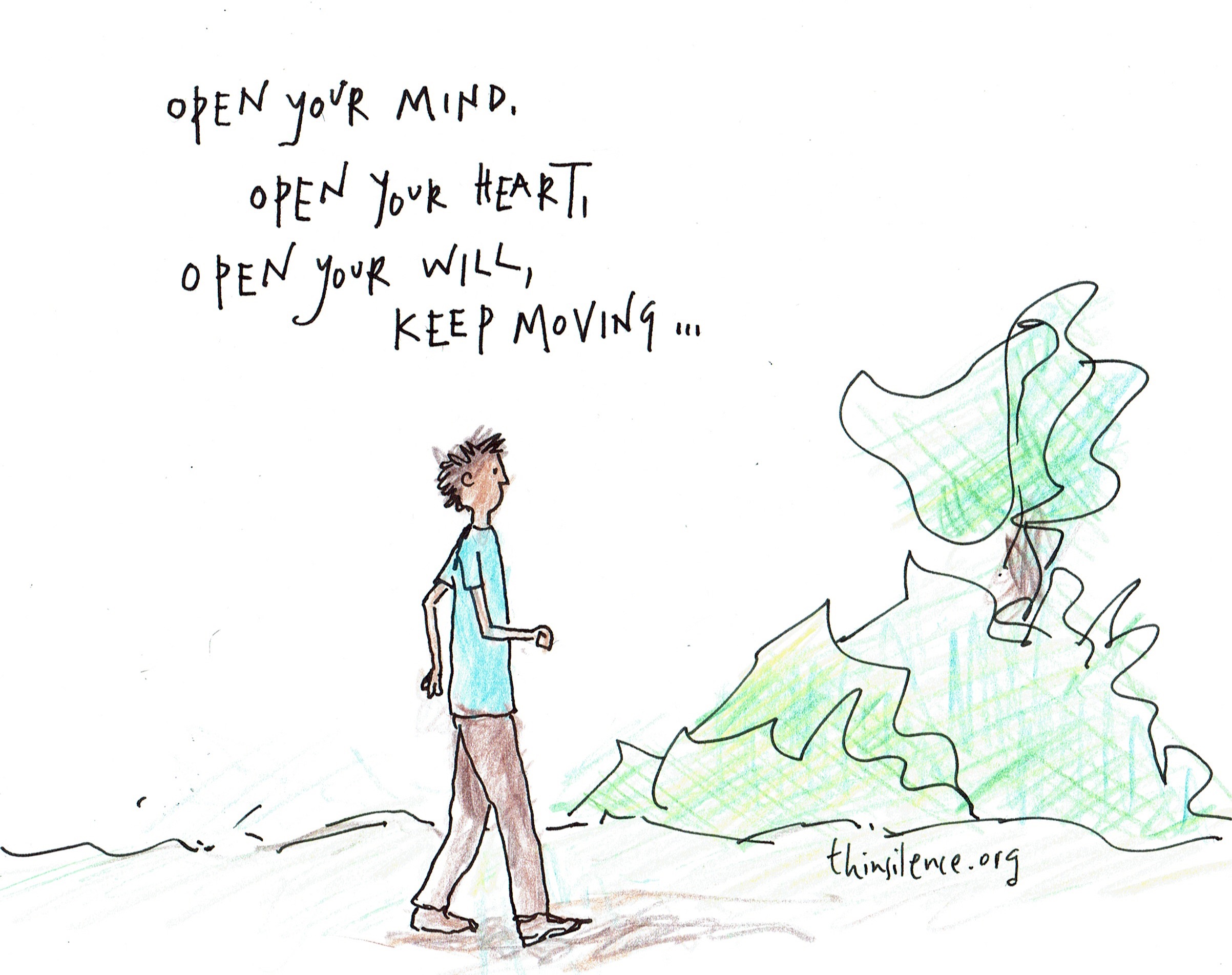
This “ordinary being” moves us from claustrophobic I-in-me to see more, to see the alternative: I-in-it.  Here is Bernadette Jiwa’s “demand of the head,” because we are opening our minds.

From here we find it easier to move towards I-in-You: the “longing of the heart,” which is to open our hearts to the other.

Encouraged, we see the possibility of I-in-Now, which is the “needs of the hand,” to create, but not without you – wherever possible, with you.

Here is the everyday unfathomable miracle of ordinary being open to each of us:

‘The revolutionary force in this century is the awakening of a deep generative human capacity – the I-in-Now.’^^

(*From Keri Smith’s The Wander Society.)
(**From Bernadette Jiwa’s Meaningful.)
(^From John O’Donohue’s Eternal Echoes.)
(^^From Otto Scharmer’s Theory U.)