Underestimation

try to be here.  Which as you know, is the hardest place to be.  Can you be present to this little bit of now?  Get curious …*
(Richard Rohr)

You’re sitting looking at a blank page … space … hour.

How are you going to fill it?

Your mind goes blank.

You look around for some assistance.

Who can help?

What is there to use?

Then your remember.

It’s not what is outside that matters, but what is inside you.

‘If you learn to listen to your curiosity, you will find that you become curious about those things that are different and new. […] Possibilities and the unknown, not the predictable or obvious, make you curious. […] Curiosity pursued is one of the things that allow serendipity to happen.’**

You have overestimated what you need from outside and have underestimated what you carry within, all that has brought you here.

So you bring out your journal, take out your pen and begin to write and to draw:

‘In that special silence, you can hear or see, or get a stronger sense of something that wants to happen that wouldn’t be aware of otherwise.’^

(*From Richard Rohr’s The Divine Dance.)
(**From Frans Johansson’s The Click Moment.)
(^Joseph Jaworki, from Peter Senge, Otto Scharmer, Joseph Jaworski and Betty Sue Flowers’ Presence.)

Some things will take a lifetime

They say everyone has a story.  But more than that, everyone IS a story. […] more as an arc, a thing that is becoming a narrative.’*
(Hugh Macleod)

Everyone has a story to tell.  Over the course of a life, we tell so many stories […] We are so used to it that we don’t even think about structuring our stories, or editing parts in or out […] Style, rhythm, panel arrangement, visualisation, structure and even just how do I go through with it anyway?**
(Tom Hart)

Autobiographies don’t have to be written backwards; they are best written forwards.

I think this is going to be my major theme for 2019.

Instead of waiting for circumstances to be just right, exploring and working into the day ahead what we’ve already got to work with.

(*From gapingvoid’s blog: It’s all about the narrative.)
(**From Tom Hart’s The Art of the Graphics Memoir.)

Where is all the scribbling out?

Here are a few things I’ve learned: Everything flows.  All things are relative.  People are good.  The old ways are dying.  Nothing is certain.  Nature knows best.  Control is an illusion.  Don’t sweat the small stuff.  Not everything goes right; alive with it.  Enjoy the ride.
(Jay Cross)

The only difference between people that matters is the difference between those who allow this space to fill with flow – and those who don’t, or won’t allow it.**
(Richard Rohr)

I was watching a video from Roald Dahl Day 2012 in which the presenter took a camera inside the author’s writing hut, showing all the wonderful things he hoarded, including some pages filled with made up words he was trying out for The BFG, many of them scribbled out because they weren’t going to work.

Scribbling out used to be the thing we did when something was a work in progress, it wasn’t working, or was a mistake, opening up the possibility of moving on and another attempt.  It showed us how we got to where we are.

This no longer physically exists in the eAge.

I enjoyed Jay Cross’ closing words to Informal Learning.  It feels as though there’s a lot of scribbling out in life to arrive at what we want to do.

A little earlier, Cross had written:

“If society lacked deviants and rabble rousers, progress would come to a standstill.’*

These are the people who know they haven’t got it right, but are willing to scribble it out and keep going.  Erich Fromm adds nuance to how we are all heroes with scribblings out:

‘And, actually, every human being is the hero of a drama. […] Hero is a person born with certain gifts, and usually he fails, and his life is a tremendous struggle to make something out of which is born with, fighting against tremendous handicaps.’^

(*From Jay Cross’ Informal Learning.)
(**From Richard Rohr’s The Divine Dance.)
(^From Erich Fromm’s The Art of Listening.)

Specifically unspecific?

When you’re specific, you only find two kinds of people: people who are delighted and the rest.*
(Seth Godin)

Indecision is your greatest threat.**
(Ben Hardy)

Carlos Castaneda wrote about how it doesn’t matter what path you take as long as it has a heart.

If our doesn’t have a heart we must find another path.

This is being specific.  It’s important to know art we must do and do it.  Life is unpredictable, though.  Being able to stick at what we have become able to do is not enough.  What we can do must always be able to move us into what we cannot do yet:

‘When we repeat the same activities day in and day to, we limit our ability to have new experiences.’^

So we wander, we get lost, we explore.  We ways in which we are specific need to be honed in this way.  This is what Richard Sennett insiders as craftsmanship.  It goes deeper, but:

‘As I’ve elsewhere argue, superficiality is put to particular use in modern society.’^^

Sennett is asking, where are the crafts-men and -women today?  I have carried Pamela Slim’s words with me since reading them several years ago: “look for a niche an inch wide and a mile deep.”*^

Why stop at a mile deep, though?

When we are being specific, we find what we are searching for and we keep moving.  In the words of Thomas Merton:

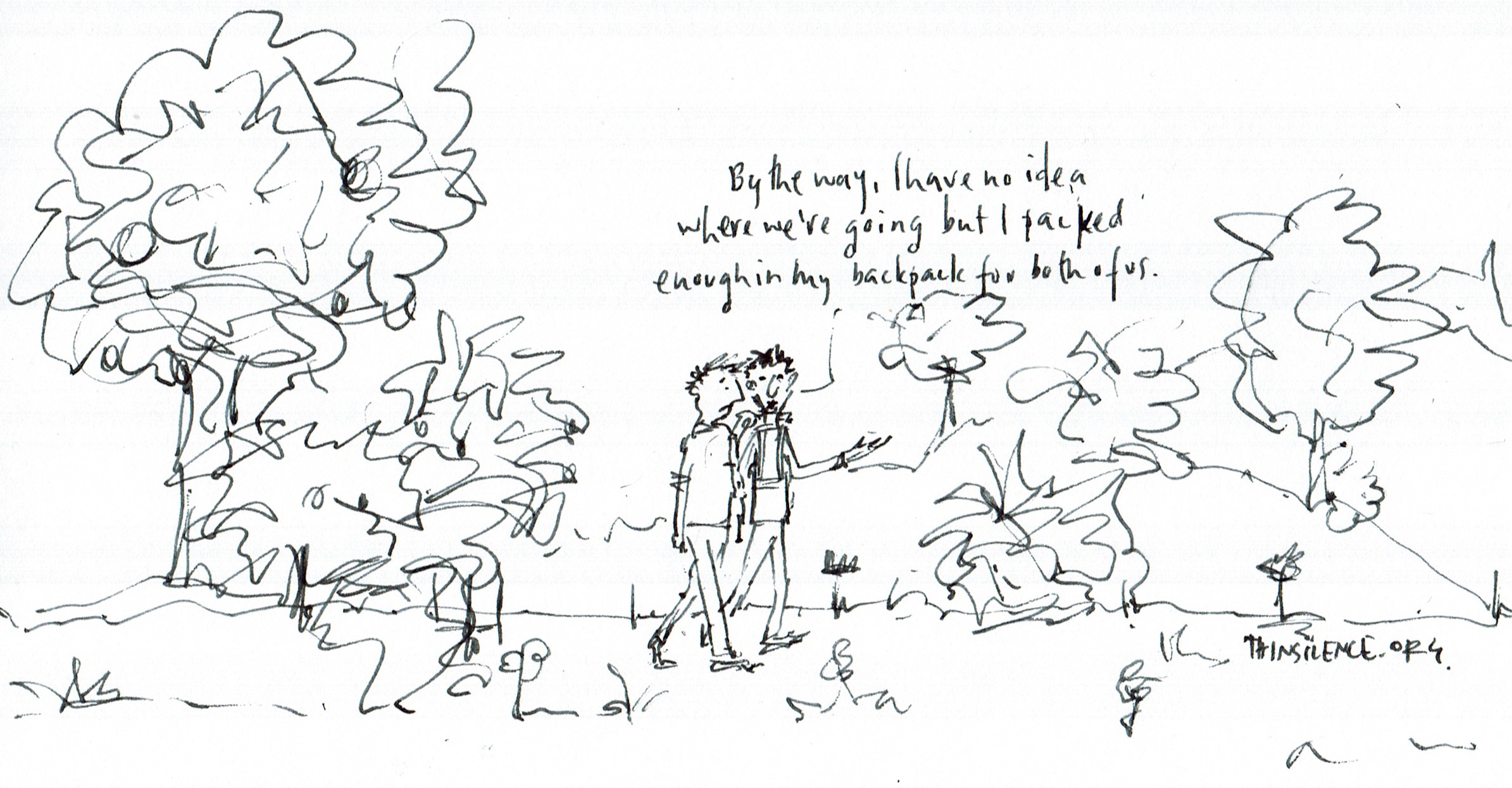
“My Lord God, I have no idea where I am going.”^*  

This is being specifically unspecific, when we continue to explore, to get lost on purpose, to step into incompetency, to find possibilities rather than wait for problems:

“When I examine myself and my methods of thought I come to the conclusion that the gift of fantasy has meant more to me than my talent for absorbing positive knowledge.”⁺

This is how we explore the future, the unknown, the unfamiliar, the chaos and randomness of the beyond.

It is where being specific can flourish.

(*From Seth Godin’s blog: In search of specific.)
(**From Benjamin Hardy’s article: What Happens When You Take Full Responsibility of Your Life.)
(^From Keri Smith’s The Wander Society.)
(^^From Richard Sennett’s The Craftsman.)

(*^See Pamela Slim’s Escape from Cubicle Nation.)
(^*Thomas Merton, quoted in the Northumbria Community‘s Morning Prayer.)
(⁺Albert Einstein, quoted in Jay Cross’ Informal Learning.)

Sleepover?

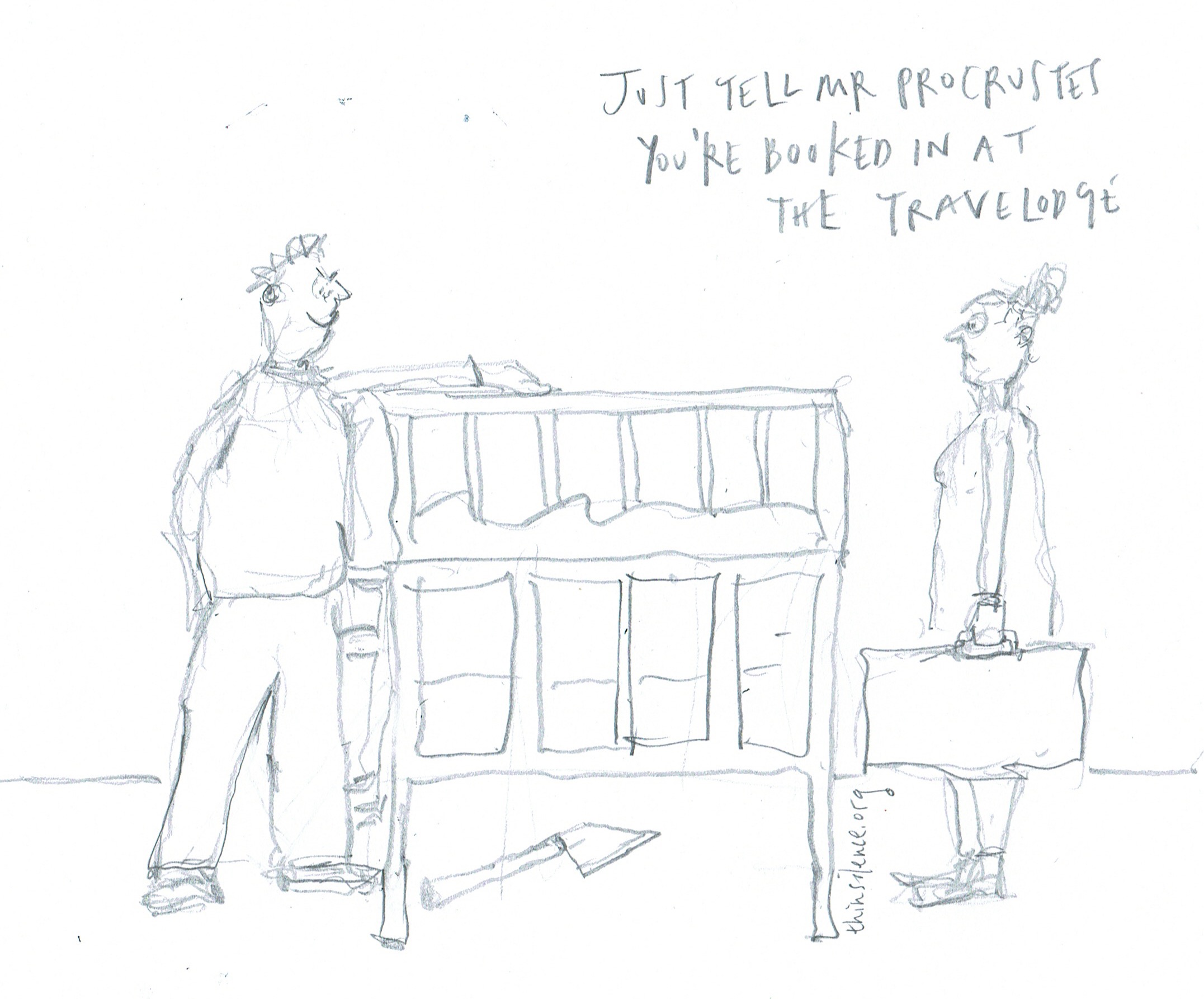
If Procrastes offers you a meal and a bed for the night, politely but firmly decline.

The bed he offers is one of those metal-framed types, and Procrustes wants his guests to fit the bed perfectly, whether they are too tall for it or too short.  So he’ll chop something off his tall guests and stretch his shorter ones – Procrustes means “the Stretcher.”*

Procrustes also goes but the name of Damastes and Polyphemon, so be careful.  Procrustes also hides inside religions and institutions and societies that want you to fit in rather than be who you are; he can even influence parents and teachers and peers and friends to think his way.  Worst of all, his voice speaks inside our heads.

In the wonderful story of a boy and his tree friend Bertolt the little boy is learning how:

‘The only problem is that when you are different, people can laugh at you, or even worse.  Sometime people don’t like what’s different.’**

Anne Lamott offers some hope for letting people be who they are:

‘Kindness towards others and radical kindness towards ourselves buy us a shot at a warm and generous heart, which is the greatest prize of all.  Do you want this, or do you want to be right?  Well, can I get back to you on that?’^

I think the kind of kindness Lamott is describing is about noticing the truth about ourselves and others, the good things and bad, helping each other to navigate the messiness of our lives into something beautiful.

We all struggle with this condition of wanting ourselves and others to fit in, to conform, to get in line, and have to catch our breath, and step back from what we were going to say or do, and help people to be themselves.

Erwin McManus confesses:

‘What I learned from twenty years of indecisiveness is that you will either define yourself or be defined by others.  You will either choose your life or life a life that was never meant to be yours.’^^

Around thirteen years ago, Erwin offered a bed for a few nights of a stay in Los Angeles.  Instead of stretching me or chopping me down, this stay in his home helped me to choose my life in a new way, something I seek to be about every day for myself and others.

(*See Nassim Taleb’s The Bed of Procrustes.)
(**From Jacques Goldstyn’s Bertolt.)
(^From Anne Lamott’s Hallelujah Anyway.)
(^^From Erwin McManus’ The Last Arrow.)

Prints of peace

May you be blessed with good friends,
And learn to be a good friend to yourself,
Journeying to that place in your soul where
There is warmth, and feeling.
May this change you.*
(John O’Donohue)

I found myself thinking of the advantages of a peaceful way.

If we’re always living aggressively with others and ourselves, as in irksomely or at-odds-with, we reduce what we’re able to receive and hold on to and work with and, consequently, what we’re able to give.

Sometimes an “I’ll show them” attitude is just what is needed but not all the time, perhaps not even for very long at all.  It gets us going but then what are we going to do?

Peace is about finding the growing place, releasing our imaginations to roam and capture and open up more possibilities than we can make possible in turmoil.  It doesn’t mean you can’t have edge, you can’t be wild; something John O’Donohue reminds us off in another place:

‘The Irish word “Uaisleacht” means nobility; it also carries echoes of honour, dignity and poise.  A person can be wild, creative and completely passionate and yet maintain Uaisleacht.’ 

(*From John O’Donohue’s To Bless the Space Between Us: For Friendship.)
(**From John O’Donohue’s Eternal Echoes.)

Eighty feet per second

It is honest, spontaneoous curiosity that best conveys my interest  and concern for the client.*
(Edgar Schein)

That is was a traffic of love is sufficiently clear; but love pursued with fervour is one of the roads to knowledge.**
(Nan Shepherd)

We are increasingly adept at sharing information and knowledge but lag behind at caring.

Edgar Schein catches my eye with his connecting of curiosity, interest and care because he exposes a different kind of knowledge.  In his work with one company, Schein reflects:

‘They did not need a common marketing programme; they first need get to know one another at a more fundamental, personal level.’*

Connecting knowing and caring may be one of the greatest breakthroughs we are able to accomplish as a species.

To know something may be a portal to caring.  Nan Shepherd spins this around, saying that our love for something opens up knowledge that is worth having.

Allowing relationships to guide matters of efficiency may appear to be a recipe for trouble but Schein’s experience suggests the opposite:

‘Having outsiders engage in a diagnostic process and analysing data often turns out to be much slower than building a personal relationship with a client and other members of a system and together figuring out what is going on and what needs to be done.’*

When people are engaged and empowered through the building of relationships we engage the most powerful means of change we possibly can: people.

Erwin McManus suggests:

‘Your best future is waiting in your deepest relationships.’^

He has just asked the question:

‘Who are the people you have bound your life to whom you have declared “I am with you”?’^

What if it were possible to affect change wherever we are at eighty feet per second?

In 1852, Hermann von Helmholtz managed to measure the speed of nerve conduction.  Eighty feet per second, then, is the speed of our emotions and feelings – one might argue, it is the speed of a relationship working well.^^

In this way of working, everyone benefits, as Seth Godin points out, though he wasn’t imagining nerve conduction when he wrote these words:

‘The toll of making change is that you will be changed.’*^

(*From Edgar Schein’s Humble Consulting.)
(**From Nan Shepherd’s The Living Mountain.)
(^From Erwin McManus’ The Last Arrow.)
(^^From Maria Popova’s Brain Pickings: Emily Dickinson’s Electric Love Letters to Susan Gilbert.)
(*^From Seth Godin’s Graceful.)

More than a utilitarian life

Conversation is the heart of the new inquiry.  It is perhaps the core human skill for facing the tremendous challenges we face.*
(Institute for the Future)

I realised these brains were participating in the beauty of the cosmos.**
(“Nephew”)

Some of us are all down to earth.  Others of us can be all in their dreams.  The wonder is to be found in both, the thing that happens when these are brought together:

‘May your soul beautify
The desire of your
That you might glimpse
The infinity that hides
In the simple sights
That seem worn
To your usual eyes.’^

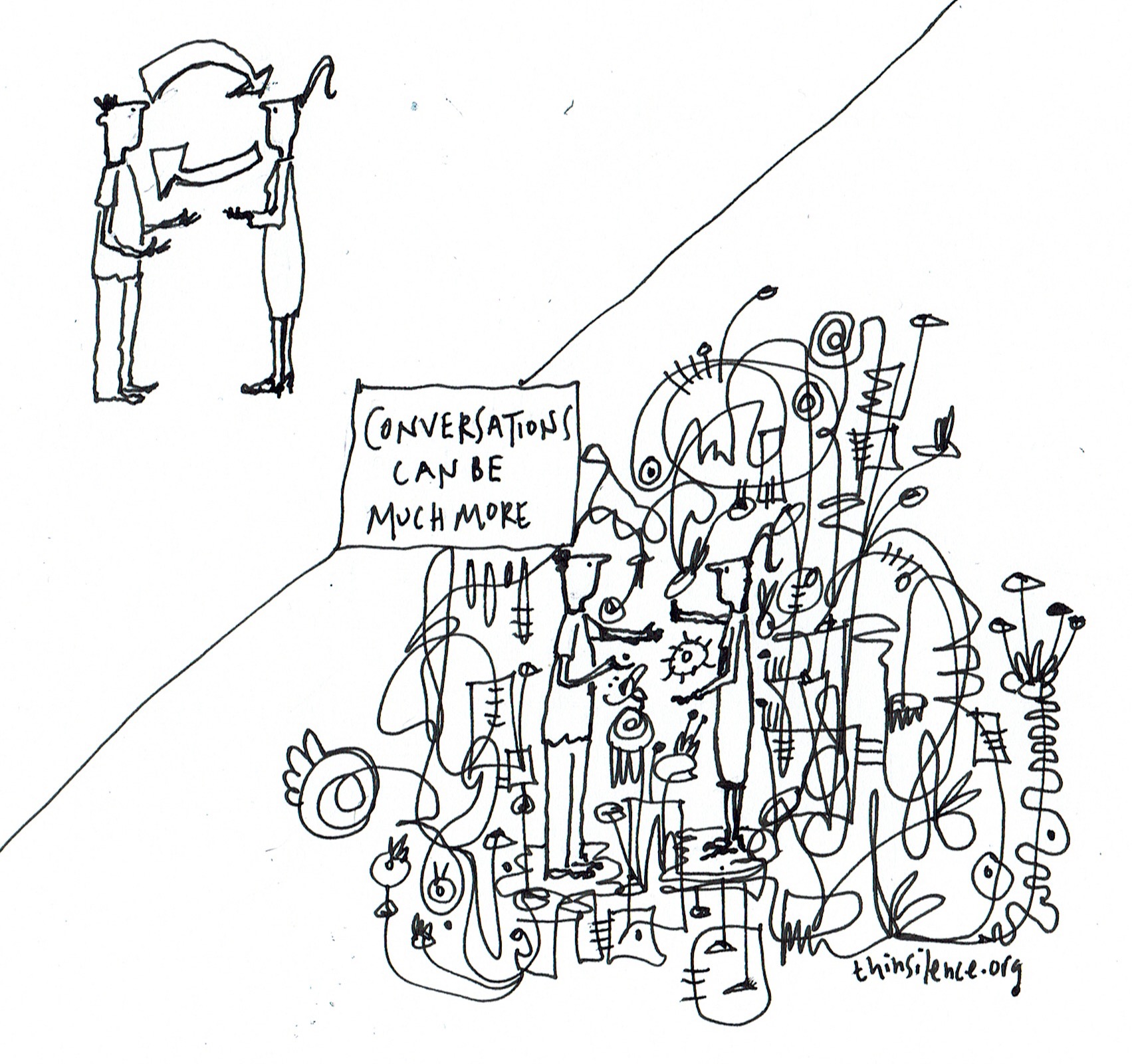
These words from John O’Donohue come from his book To Bless the Space Between Us.  This space between two people, often unnoticed, is the conversation, a wonderful place.  We never speak directly.  In our conversations with one another, we are creating anything from a wasteland to a verdant garden.

When we begin to see how we never meet each other directly but are creating this space then the possibilities increase

I often refer to the process of my work with others as being a journey of converations.  I learn many things about myself and my work as well as about others in these conversations; we help each other to be more fully ourselves:

‘Awaken to the mystery of being here
and enter the quiet immensity of your own presence.
[…]
Respond to the call of your gift and the courage to
follow its path.’^^

Conversations can be both functional and elegant, both down to earth and dreamlike.

(*Institute for the Future, quoted in Jay Cross’ Informal Learning.)
(**The character “Nephew” from Alan Lightman’s Mr g.)
(^From John O’Donohue’s To Bless the Space Between Us: For the Senses.)
(^^From John O’Donohue’s To Bless the Space Between Us: For Presence.)

Commodity or gift?

Humble inquiry maximises my curiosity and interest in the other person and minimises bias and preconceptions about the other person.*
(Edgar Schein)

If you want to go fast, go alone.  If you want to go far, go together.**
(African saying)

We want to bring everything we are to what we do.  It’s hard, though, when we work within systems that treat us more like “It” rather than “You” or “Thou,” as Martin Buber has it – even if this is not the intention; Buber holds out for something more:

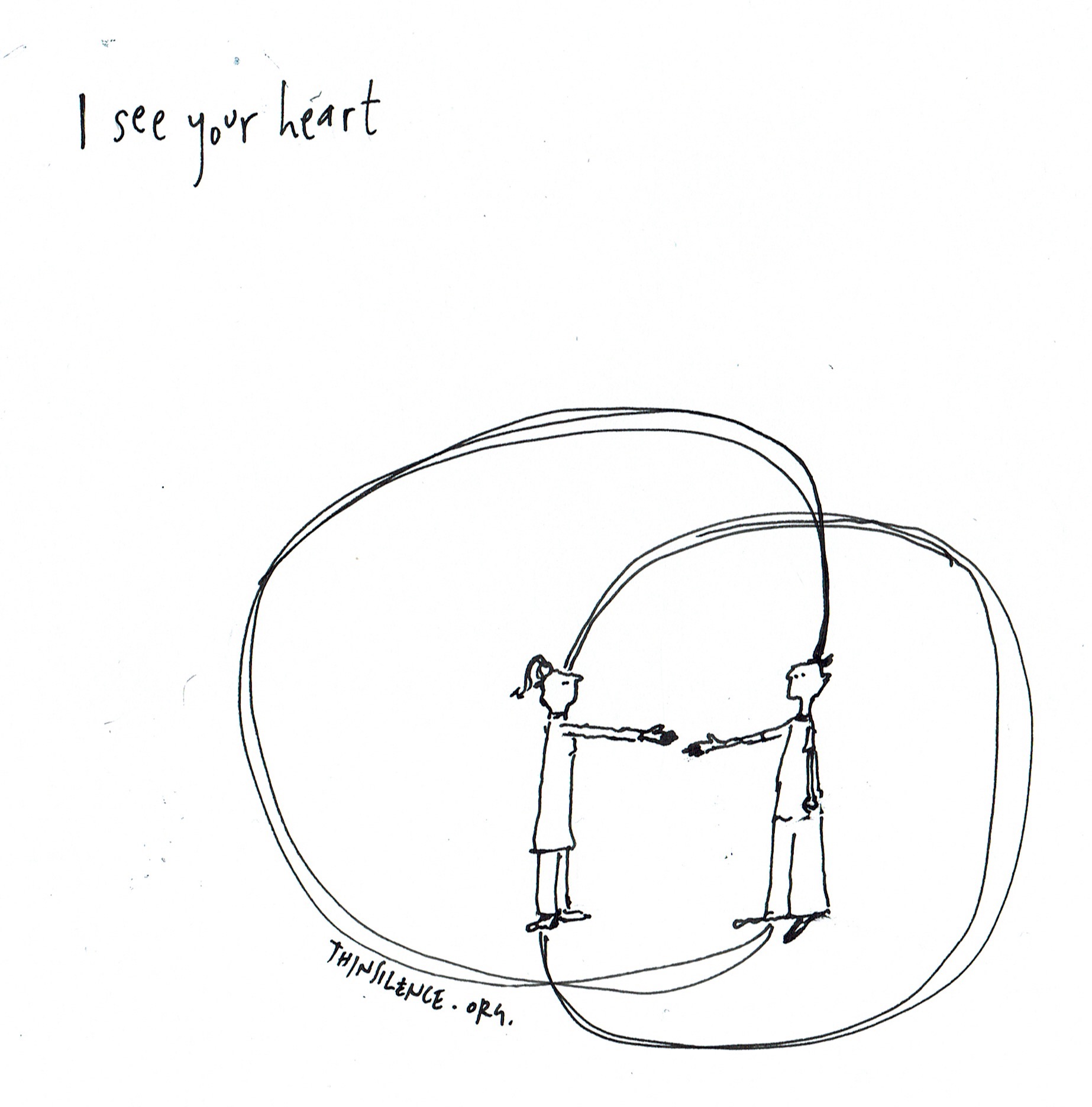
‘Inscrutably involved, we live in the currents of universal reciprocity.’^

Our employees want us to bring heart to work, to be fully engaged, yet don’t dream of giving heart back to us.  They may pay well, but when they fail to listen, when they are suspicious about imagination and play and exploration, when they drop crushing expectations on their people, they are replacing “You” with “It.”    When heartfulness is seen as a commodity then they also fail to see what could be:

‘The It is the chrysalis, the You the butterfly.’^

A human is never a commodity, a human is always a gift.

A commodity is what it is.

A gift is the gift, the spirit of the gift (which is where our heart is especially found) and the community of the gift – the connection we bring.

(*From Edgar Schein’s Humble Inquiry.)
(**African saying, quoted in Erwin McManus’ The Last Arrow.)
(^From Martin Buber’s I and Thou.)