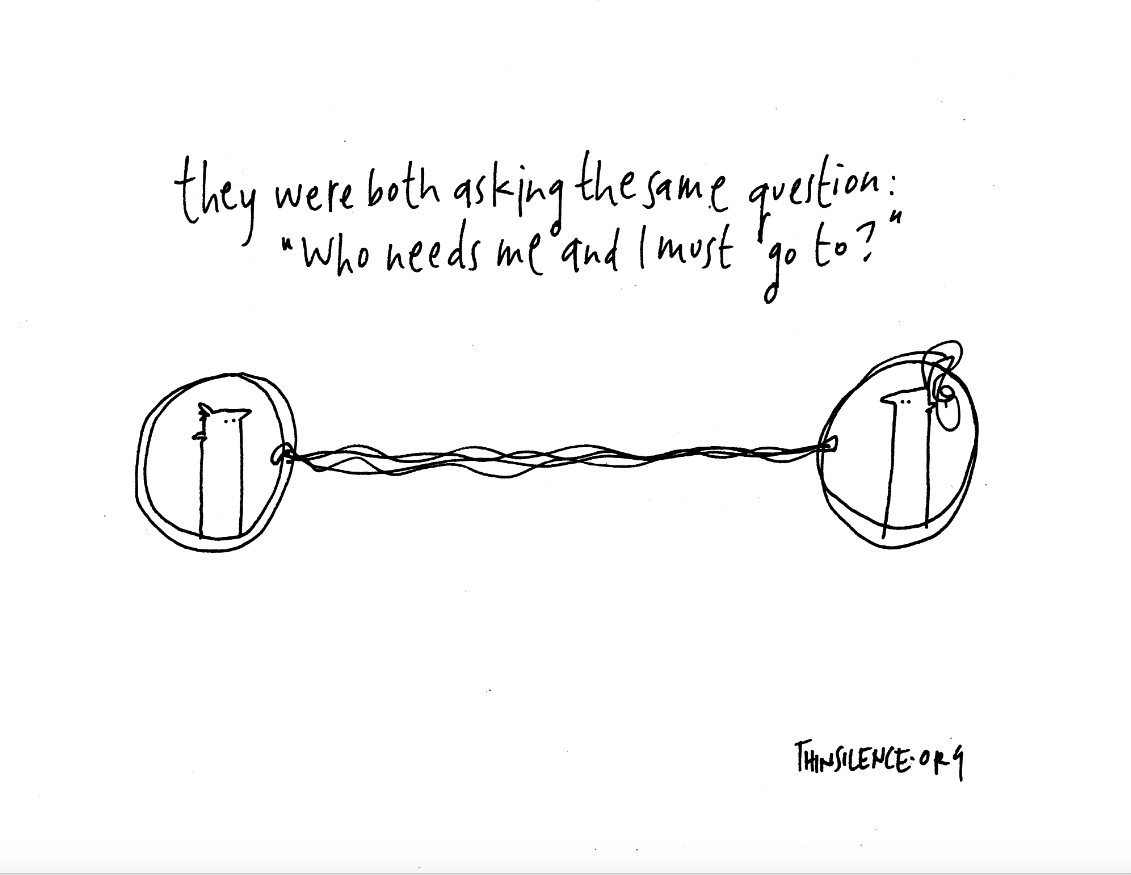
Asking a generous question will elicit a generous answer.*
(Krista Tippett)
The most satisfying encounters are those that allow all members of the conversation to contribute.
(*Unremembered source: Krista Tippett.)

Asking a generous question will elicit a generous answer.*
(Krista Tippett)
The most satisfying encounters are those that allow all members of the conversation to contribute.
(*Unremembered source: Krista Tippett.)
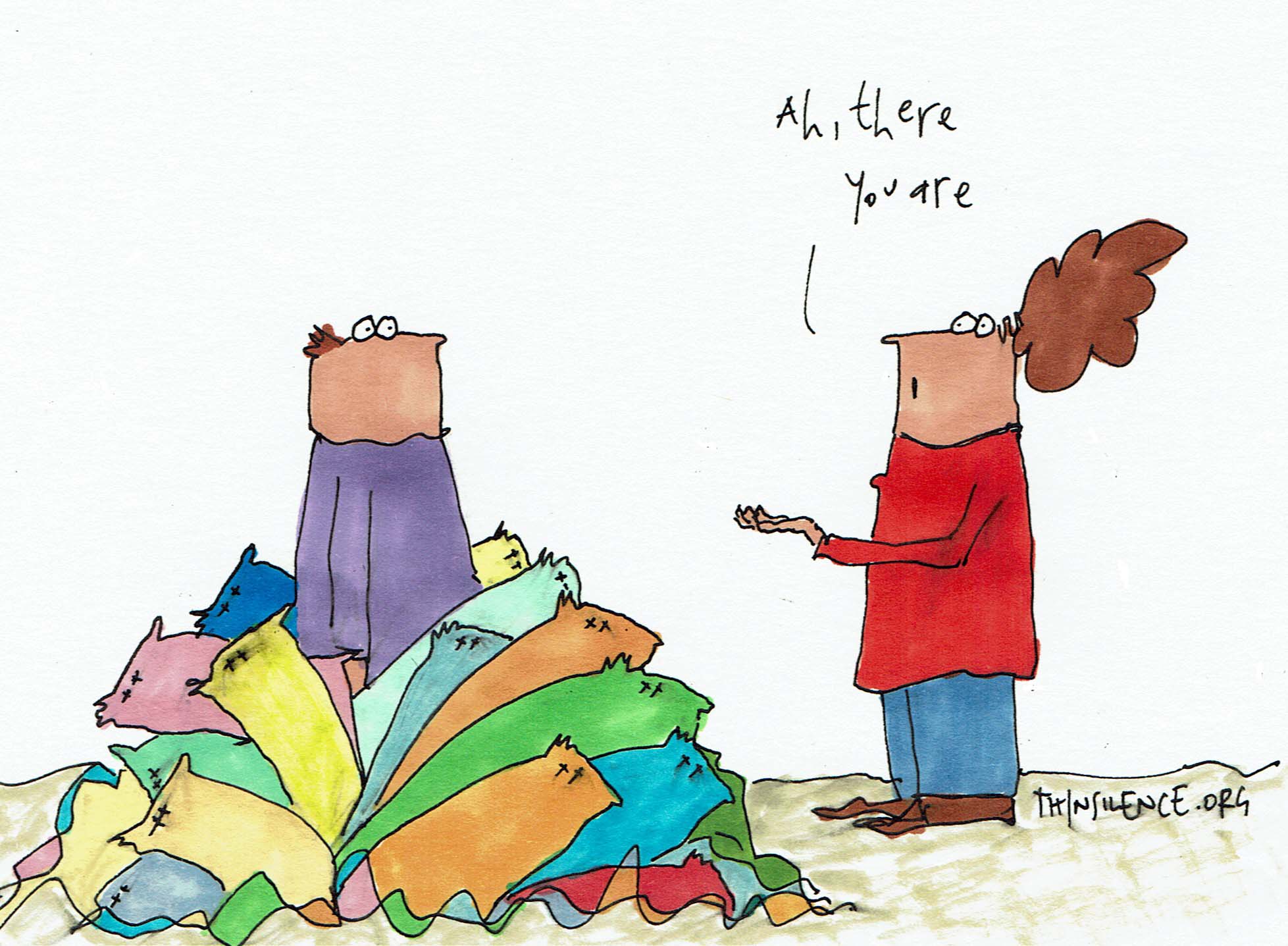
Hindsight is easy, foresight is hard. In hindsight there is no uncertainty left; we know what has happened, and, if we are imaginative, we can always construct an explanation. In foresight, however, we must face uncertainty.*
(Gerd Gigerenzer)
Every morning I is going out and snitching new dreams to put in my bottles.**
(The BFG)
Ken Mogi writes about the Japanese concept ofikigai (our reason or purpose for life):
Ikigai resides in the realm of small things.^
If we accept this then each one of us can develop a unique knowledge and talent core to our lives. As we elevate these things we become artists, connecting with our truest self, those around us and with our environments:
when the poet is in his gifted state, the world seems generous, exhaling odours and auras toward him.^^
The limits to this giftedness and gift are unknown to us. Too often we commoditise what we do and, by so doing, create false limits to our lives.
These words – gift and commodity – help us to explore things further. Youngme Moon writes:
We have to eliminate the extraneous in order to shed new light on the fundamental. […] Less is more only when more has become a commodity.
This is the opposite of fanciful. Seth Godin writes about unicorns:
The problem with unicorns … is that there aren’t any. […] Instead of aspiring to unicorn status, a pipe dream which is simply a place to hide, we can instead decide to do something useful (and possible) instead.*^
When it comes to our dreams – the kind we wake up to and want to live each day, the kind that push us beyond our present limits, when we take away the unicorns, what we’re left with is the less that is more.
If you want to see what this looks like, here are some ways for stripping back the commodity in order to find the gift:
Articulate your values …
Identify the talents you have honed over many years …
Notice when you are most energised and when energy is being stolen from you.
These have emerged as critical things when it comes to some of my dreams, snitched at the beginning of a new day – and which I’ll be sharing with a couple of people before the day is over.
(*From Gerd Gigerenzer’s Gut Feelings.)
(**The Big Friendly Giant, from Roald Dahl’s The BFG.)
(^From Ken Mogi’s The Little Book off Ikigai.)
(^^From Lewis Hyde’s The Gift.)
(*^From Seth Godin’s blog: The problem with unicorns … .)
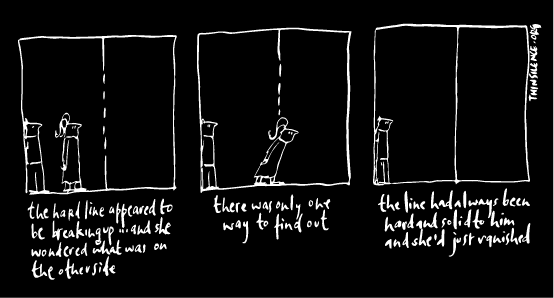
Oh you don’t want to go to college […]. You want to go to collage […] Collage is an institute of education where all the rules can be thrown into the air, and size and space and time and foreground and background all become relative, and because of these skills everything you think you know gets made into something new and strange.*
(Daniel Gluck)
To act on behalf of the future requires a deep sense of responsibility and selflessness.**
(Joseph Jaworski)
Sometimes the gift we want to bring, the contribution we hope to make, the future we want to bring can often only form when we let go of what has become the familiar and the welcomed for us.
Nan Shepherd catches my attention because of her use of the word revenant for a guide in the Cairngorms – I’d begun watching Leonardo de Caprio’s movie of the same name a few nights ago:
we walked in a cloud so thick that when the man who was leading us went ahead so much as an arm’s length, he vanished, except for his whistle. […] And alone in that whiteness, while our revenant came and went, we climbed an endless way.^
Here’s a description for how moving into the unfamiliar can be disorientating and yet wonderful and magical. It feels that Maria Popova adds more detail when describing Albert Einstein’s “combinatory play”:
Part of Einstein’s genius […] was his willingness to leap beyond the limits of his particular mathematical problem and into a field of possibilities, which he explored through improvisational experimentation — gedankenexperiments, or thought experiments. Einstein himself, who believed his best ideas came to him during his violin breaks, called his ideation process “combinatory play” — a wilderness of associations reaching across boundaries of various theories and fields of thought, not as deliberate problem-solving but as unforced mental meanderings.
This desire to explore without intent is also found in some words from Shepherd ahead of her white cloud experience:
Yet often the mountain gives itself most completely when I have no destination, when I reach nowhere in particular, but have gone our merely to be with the mountain as one visits a friend with not intention but to be with him.^
When we are prepared to explore the spaces between people and ideas where the futures are found, letting go of the firm things in our lives will be necessary, sometimes for ever, making it possible to be open to whatever wants to appear.
We may also become invisible to others who do not understand or want to follow or struggle to follow. Just something to be aware of.
Of course, genius is encountered in moving back and forth, but that feels like another blog.
(*The character Daniel Gluck, from Ali Smith’s Autumn.)
(**From Joseph Jaworski’s Source.)
(^From Nan Shepherd’s The Living Mountain.)
(^^From Maria Popova’s Brain Pickings: The Jazz of Physics.)
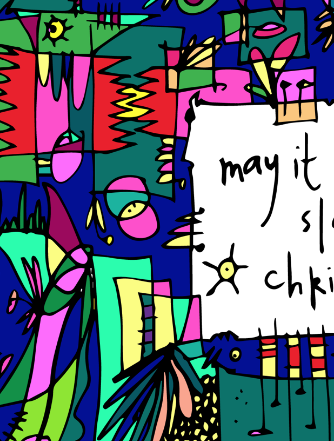
On Christmas Day, I ended up doodling a Christmas card for 2019. It may feel like a long way off, but if you’re interested in a bespoke Christmas card then drop me a line and I can let you know how much they will be – it all depends on how many we get printed.
The card will be A6 and landscape format with a side fold. The image is a small detail of “may it be a slow, slow christmas”.
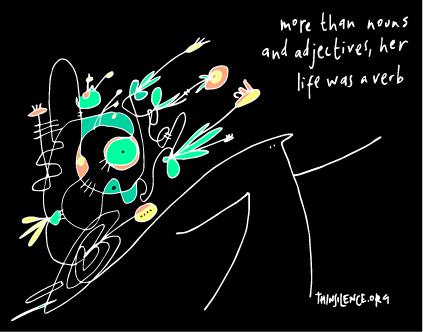
if you have faith as small as a mustard seed, you can say to this mountain, “Move from here to there,” and it will move. Nothing will be impossible for you*
(Jesus of Nazerath)
One way to begin describing the value you create is to talk about what can’t happen without you.**
(Bernadette Jiwa)
“I can’t do that. I’m still waiting for the one who can.”
Instead of waiting for the one, we can articulate the very unique thing we bring into the world.
Seth Godin writes:
Solving interesting problems is the best work we can do. […] Possibility and responsibility are available to anyone who wants them. That could be us, any of us. Seeing the world as it is, offering people dignity, choosing to make a difference … none of these are fast and easy paths, but we do them anyway.^
When we articulate the unique value we bring into the world, we don’t have to wait for problems to come to us, we begin noticing them, the mountains we need to move.
Robert McKee writes about the difference between inexperienced writers and artists:
Writers that ask questions that begin with “Could…” want finite answers to very complex problems that only the experience of writing can solve. They want to know what’s possible, what’s impossible, what they should pursue and what they should avoid. These are questions from someone who wants to know the limits, before they even begin to explore. In story, all things are possible. Anxious, inexperienced writers stick rigidly to the well trodden, designated route. Artists discover a new path.^^
When we identify our unique kind of mustard seed and plant it, it becomes a verb, and what follows is inevitable.
(*Jesus of Nazerath, from Matthew 17: 20-21)
(*From The Story of Telling: Without You.)
(^From Seth Godin’s blog: Speaking up about what could be better.)
(^^From Robert McKee’s blog: “Could I?” vs. “Should I?”)
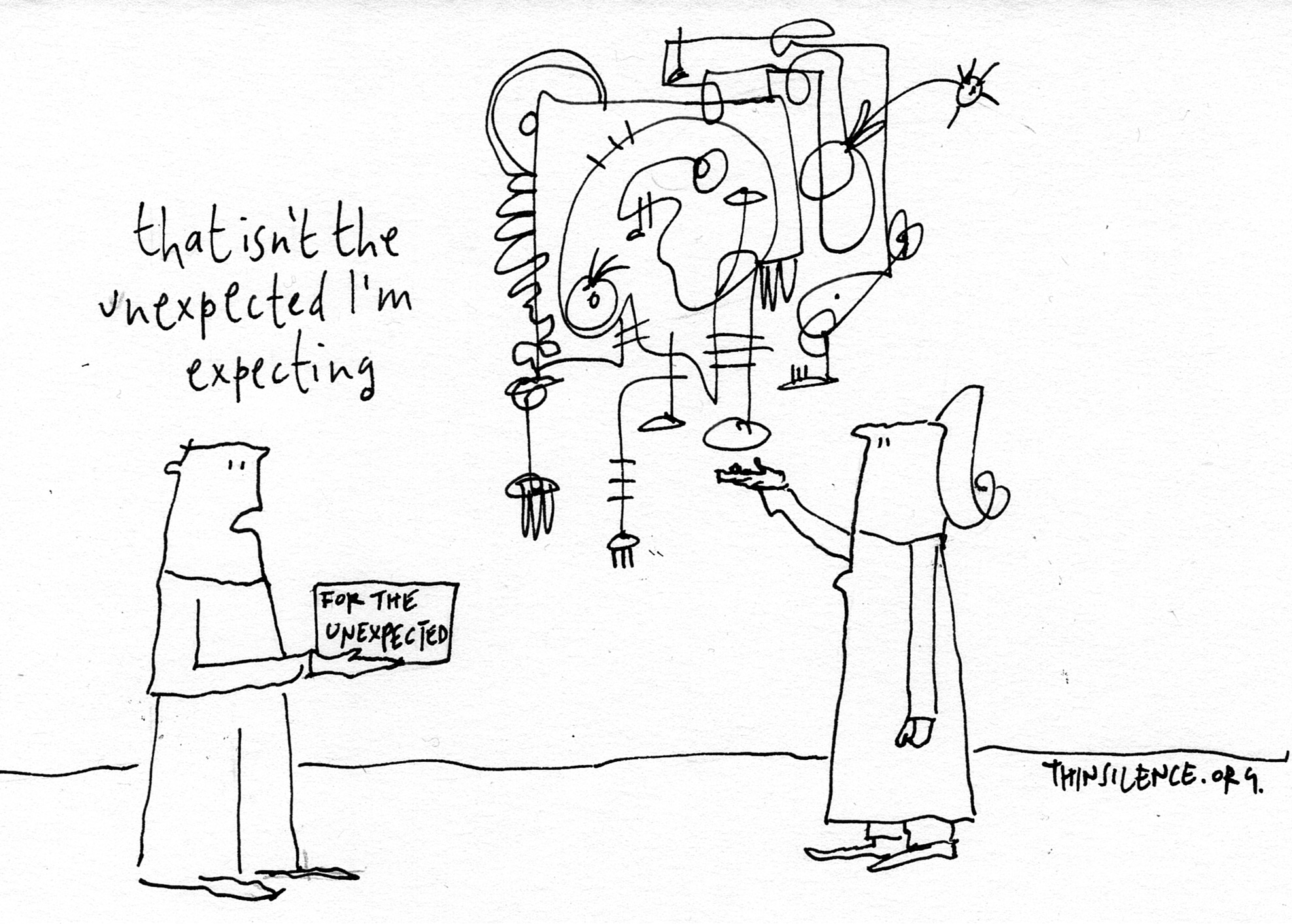
Who drew the circle?
The circle that got me thinking this morning is found in Keri Smith’s Wreck This Journal, which I’m using for my daily journaling at the moment.
I decide to write some words inside the circle from Nassim Taleb on randomness:
This discussion aims to show how some predictability (or lack of knowledge) can be beneficial to our defective species. A slightly random schedule prevents us from optimising and being exceedingly efficient, particu-
I couldn’t get all the words inside the circle, so I had to write outside it:
larly in the wrong things.*
That’s the problem with our pre-existing circles, not everything we want or need to put in them fits.
The discussion Taleb refers to an imaginary weeknight meal with a suburban commuter. The train the commuter is aiming for is the 7.08 express, they don’t want the 7.42 local for some reason. This rules the pacing of their meal together. At 6.58, the commuter excuses themself, leaving Taleb with the bill because the meal hasn’t been finished.
Taleb imagines another scenario. This time the commuter is unaware of the exact times of trains, only that they run roughly every 35 minutes. This time finishing the meal, Taleb sees how, whilst he may still pay for the meal, it is followed by a leisurely walk to the station and a fifteen minute wait.
Taleb has introduced us to the satisficer and the optimiser in his two tales:
research on happiness shows that those who live under a self-imposed pressure to be optimal in their enjoyment of things suffer a measure of distress.*
The good news is that we are made for randomness, for the less optimised version, as Richard Sennett points out here in questioning our desire for the perfect machine:
Humankind has first to accept its own weakness and propensity to make a mess of things; if people really take to heart the faultiness in themselves, the perfect machine will seem less a commanding remedy; indeed we will actively seek a remedy to it.**
Something else begins to emerge when we accept and embrace this randomness within; we become artists:
An artist is someone who brings humanity to a problem, who changes someone else for the better, who does work that can’t be written down in a manual.^
Of course you may still want to fit it all inside the circ …
(*From Nassim Taleb’s Fooled by Randomness.)
(**From Richard Sennett’s The Craftsman.)
(^From Set Godin’s Whatcha Gonna Do With That Duck?)
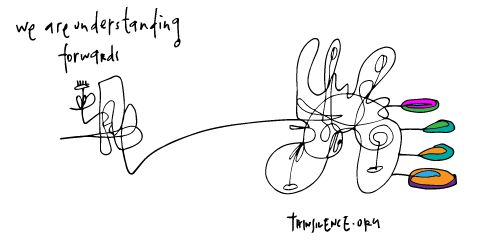
In meditation […] we penetrate the innermost ground of our life. This allows us to find our true meaning not from the outside, […] but from within. It means that we identify ourselves not in terms of social status, race, religion, or sexual orientation, but by our truest identity in the very ground of our being.**
What if life isn’t about beginning with nothing and ending with all we’ve accumulated?
What if it ends the with the ability to see all the possibilities we were born with?
Something we not only see for ourselves but want for others, too?
(*From Kevin Kelly’s The Inevitable.)
(**From Philip Newell’s The Rebirthing of God.)
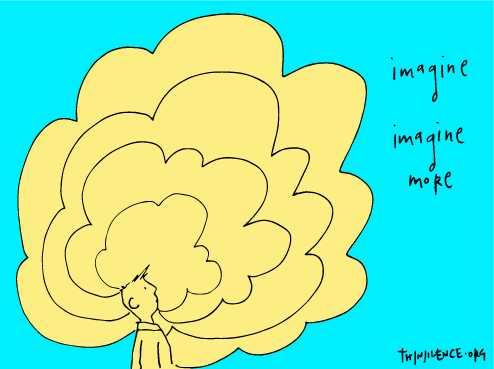
Imagination is no only the uniquely human capacity to envision that which is not, and, therefore, the foundation of all invention and innovation. In its arguably most transformative and revelatory capacity, it is the power that enables us to empathise with humans whose experiences we have never shared.*
(J. K. Rowling)
In an uncertain environment, good intuitions must ignore information.**
(Gerd Gigerenzer)
Yesterday, I visited the Robots exhibition at the National Museum of Scotland, journeying through five hundred years of exploration for making machines more human. From an understanding of the universe being like a machine and thinking of humans as machines, through to seeing the most complex of machines becoming more human.
One of the things that stood out for me was simply how the industrial revolution demanded humans to tend the machines in life-numbing repetitions, souls trapped within the machines.
We are still breaking free from this to understand the possibilities for our lives as creative forces. The argument moves to and fro concerning whether machines serve humans or humans serve machines.
It’s hard to improve on the simple idea, though: Do what you love and love what you do.
(*J. K. Rowling, quoted in Bernadette Jiwa’s Hunch.)
(**From Gerd Gigerenzer’s Gut Feelings.)
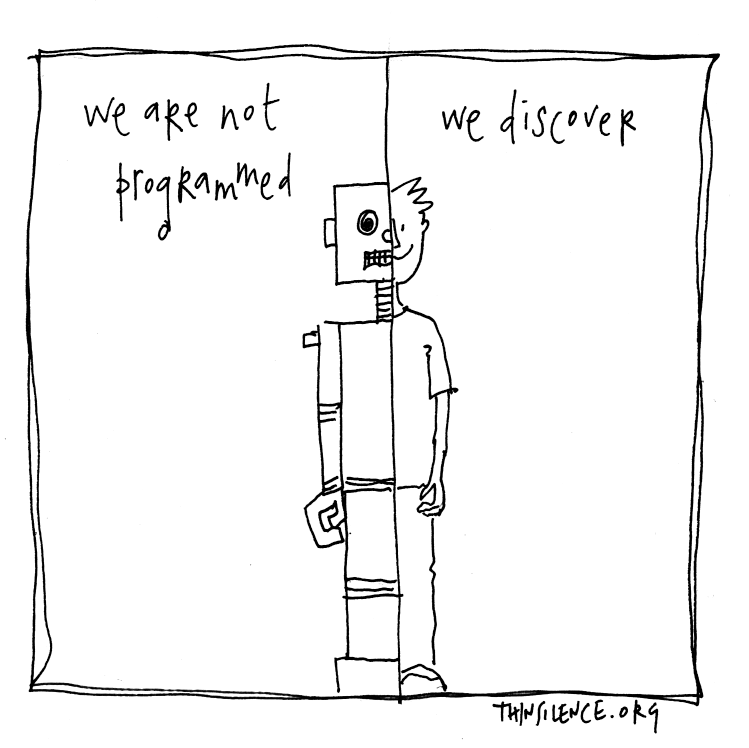
characters change when they live through a story*
(Don Miller)
By reinforcing the separation of people from their problems problem solving often functions as a way of maintaining the status quo rather than enabling fundamental change […] where problems often arise from unquestioned assumptions and deeply habitual ways of acting.**
(Senge, Scharmer, Jaworski, Flowers)
It’s hard to see all the implications or the results of a decision at the time of making it. We have to live through it to see exactly what is what.
Something else then comes into play in a really helpful way. The human capacity to change our mind about something.
Seth Godin writes about how hard it is to say, “I was wrong.” But we can flip this:
The alternative is, “based on new information, I can make a new decision.”
We can make a new decision on what’s happening to our environment, based on new data and new science. We can make a new decision on corporate governance or on a recent political referendum.^
Everyone of us has the ability to receive new information and to change our mind. It allows our imaginations more space in which to posit possibilities no one had seen at the beginning.
Wallace Stevens remarks on the human imagination:
If it merely reconstructed the experience or repeated for us our sensations in the face of it, it would be a memory. What it really does is to use it as material with which it does whatever it wills. This is the typical function of the imagination which always makes use of the familiar to produce the unfamiliar.^^
(*From Donald Miller’s Scary Close.)
(**>>>, from Peter Senge, Otto Scharmer, Joseph Jaworski, Betty Sue Flowers’ Presence.)
(^From Seth Godin’s blog: I was wrong.)
(^^From Wallace Stevens’ The Necessary Angel.)
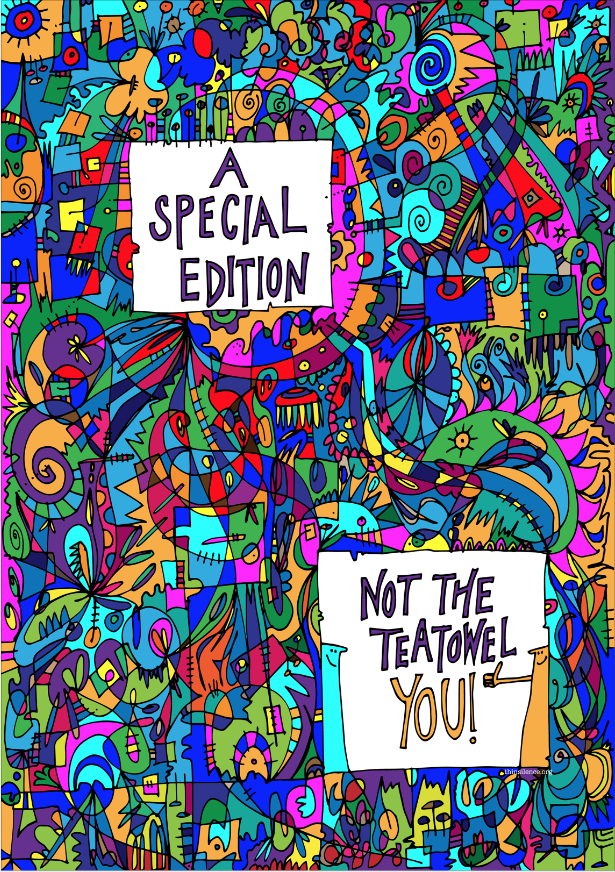
The tea-towel.
There are only 37 of these and now each one remaining comes with a gift card of the same design: £10 (plus posting and packing)


You must be logged in to post a comment.