
Happy Christmas!


I am the reason the birds are missing… I am made of dirt and grit and stars and river, skin, bone, leaf, whiskers and claws. I am a part of you, of this, nothing more or less. I am mycelium, petal pistil and stamen… I am energy and I am dust. I am wave and I am wonder. I am an impulse and an order.*
(Eve Ensler)
Consumption is an activity so different from gainful labour that it showed itself in the mode of leisure, even indolence. We display the success of what we have done by not having to do anything. The more we use up, therefore, the more we show ourselves to be winners of past contests.**
(James Carse)
At the same time as struggling with the cause and affect dynamic, we have been able to exponentially increase the magnitude of the cause.
Eve Ensler comes to terms with 2.9 billion birds begin lost in only fifty years in North America and writes an apology to the Earth taking her share of the responsibility:
Mother, I am the reason the birds are missing. I am the cause of salmon who cannot spawn and the butterflies unable to take their journey home. I am the coral reef bleached death white and the sea boiling with methane. I am the millions running from lands that have dried, forests that are burning or islands drowned in water.*
If we are to be the solution then we must first see that we are the problem, not someone else only, not the system only, not big business only, not governments only – governments would be far happier leading green change if they thoughts people would vote for them:
The art of solving problems often involves spending time and energy on what you’ll do when you don’t actually solve the problem.^
(*Eve Ensler, quote in Maria Popova’s Brain Pickings: Losing the Birds, Finding the Words … .)
(**From James Carse’s Finite and Infinite Games.)
(^From Seth Godin’s blog: “I don’t know how it could fail.”)
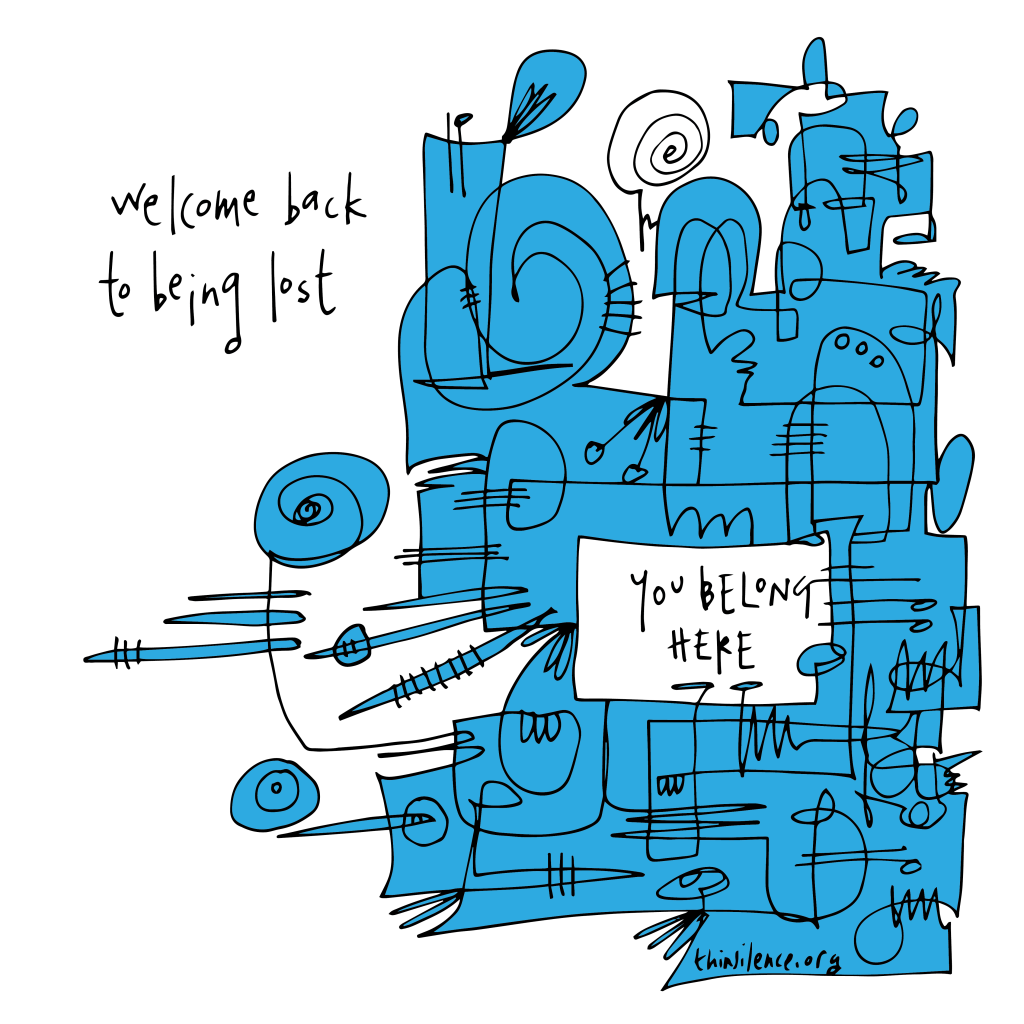
[Freedom] evolves once man is a complete being, when both of his basic impulses [of change and immutability] have developed, and it will therefore be absent so long as man is incomplete and excluded from one of his two impulses; and should be capable of restoration by all that returns him to completeness.*
(Friedrich Schiller)
One never reaches a horizon. It is not a line; it has no place; it encloses no field; its location is always relative to the view.*
(James Carse)
The important thing about being lost is to admit when you are.
Don’t pretend you still know where you are or where you are headed.
Then you begin to see the benefits.
One of the problems with our lives as we have come to find them is that we can be too found, which would be too much of Friedrich Schiller’s immutability impulse and not enough of the change impulse, and too much of James Carse’s boundaries and not enough horizons.
Lost is good sometimes.
We pay more attention.
We are open to more possibilities.
Sometimes we find ourselves lost and when we notice this, wondering how we got to where we find ourselves, the contents of our days and the contents of our life, then we can use this towards something more, different, better … .
We can also get lost on purpose; it’s where we find who we really are and what we have to gift:^
My Lord God,
I have no idea where I am going.
I do not see the road ahead of me.
I cannot know for certain where it will end.^^
(*From Friedrich Schiller’s On the Aesthetic Education of Man.)
(**From James Carse’s Finite and Infinite Games.)
(^Check out Rebecca Solnit’s A Field Guide to Getting Lost and Keri Smith’s The Wander Society.)
(^^Thomas Merton, quoted in the Northumbria Community‘s Morning Prayer: Day 23.)

Nothing is one thing […] If you’re focusing on the part of your day that was “fine,” then you’re ignoring the parts that were a miracle, or disappointing, or thrilling.*
(Seth Godin)
The only problem is that when you are different, people can laugh at you, or even worse. Sometimes people don’t like what’s different.**
(Bertolt)
We’re tempted to summarise in order to know, or to explain and even to be.
Everything is so much more than a summary, including you.
Going beyond the summary would be a brilliant way of spending 2020, not. Not only would you come up with many more words to describe yourself, but you’ll also find more words to describe others.
(*From Seth Godin’s blog: Nothing is one thing.)
(**From Jacques Goldstyn’s Bertolt.)
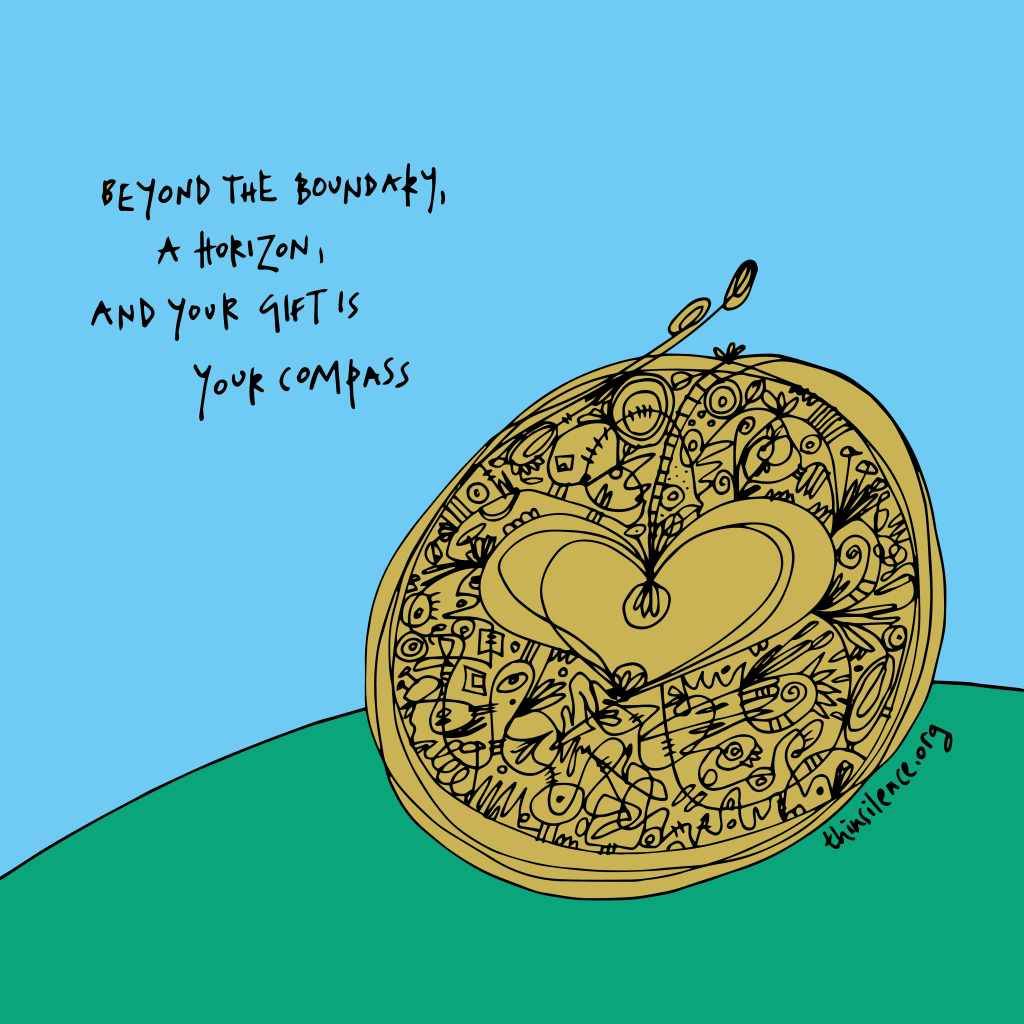
[A] society is defined by its boundaries; a culture is defined by its horizons. […] A horizon is a phenomenon of vision. One cannot look at the horizon; it is simply the point beyond which we cannot see.*
(James Carse)
When it’s your turn, it’s your turn. You own it. Your choice. Your freedom. Your responsibility.**
(Seth Godin)
Boundaries are vertical, horizons are horizontal.
Boundaries exist because of some resistance on the other side of the line, horizons are open, we can never reach them
The future will be more about horizons than boundaries, if we want it to be.
(*From James Carse’s Finite and Infinite Games.)
(**From Seth Godin’s What to Do When it’s Your Turn.)

[I]t is only through the part we have access to the whole, only through the limited that we have access to the unlimited, only through passivity that we have access to activity; but it is only through the whole that we have access to the part, only through the unlimited do we have access to the limited, only through activity do we have access to passivity.*
(Friedrich Schiller)
Perhaps Jung’s most compelling contribution is the idea of individuation, that is, the lifelong project of becoming more nearly the whole person we were meant to be – what the gods intended, not the parent, or the tribe, or especially, the easily intimidated or inflated ego.**
(James Hollis)
We ought to have no idea of who we can become over a lifetime.
If it were scripted from the beginning then it would be limiting. Our limitations are only a doorway to the unlimited. And your myths as expressions of the unlimited and, as such, are doorways to the limited:
Infinite players are not serious actors in any story, but the joyful poets of a story that continues to originate what they cannot finish.^
Buzz Lightyear wants to explore infinity and beyond infinity, and perhaps what he’ll find is “finity” – for we need both. The trick is to not only to hold the finite in the infinite but also the infinite within the finite: the infinite within the finite within the infinite.
(*From Friedrich Schiller’s On the Aesthetic Education of Man.)
(**James Hollis, quoted in Brené Brown’s Rising Strong.)
(^From James Carse’s Finite and Infinite Games.)
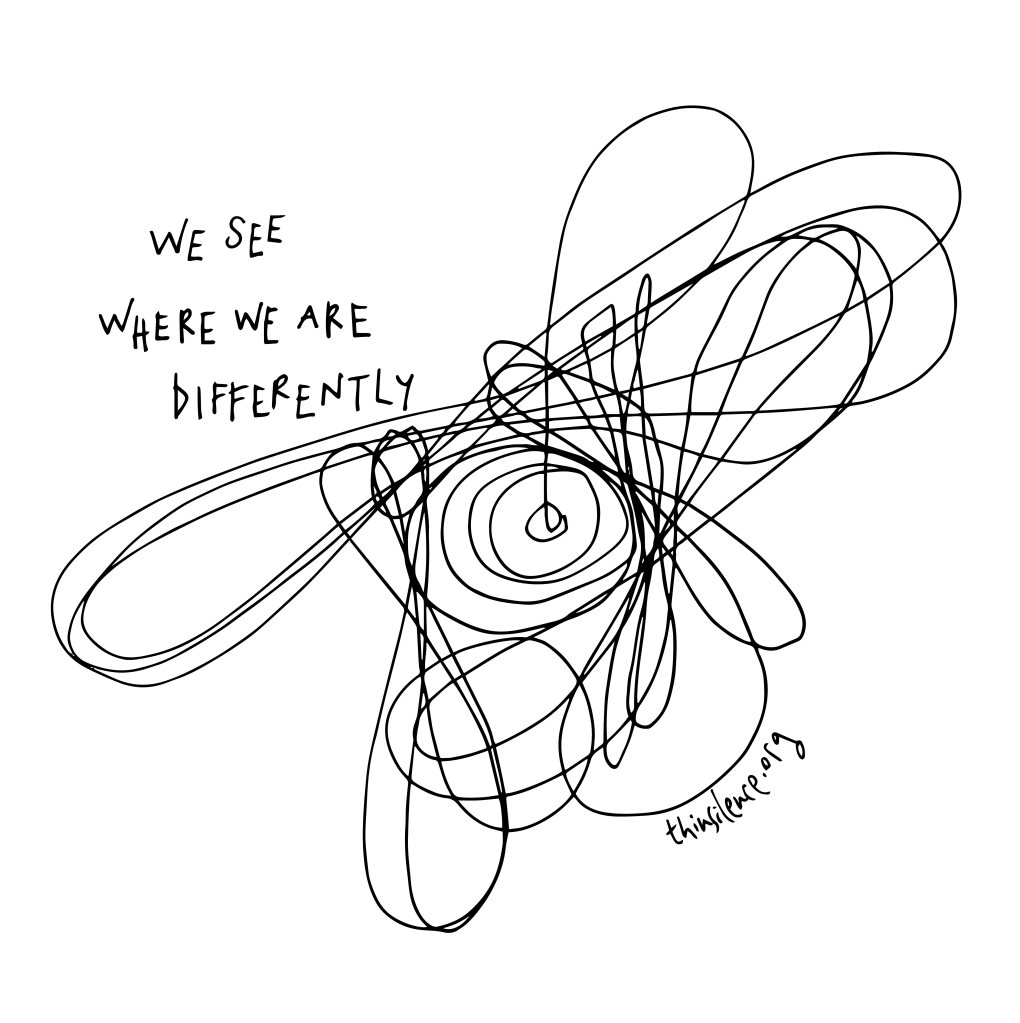
The events in our lives happen in a sequence in time, but in their significance to ourselves they find their own order, a timetable not necessarily – perhaps not possibly – chronological. The time as we know it subjectively is often the chronology that stories and novels follow: it is the continuous thread of revelation.*
(Eudora Welty)
I struggle to keep hold of all the meaningful words I have read in my ongoing journal so when I reread these from Eudora Welty I thought I’d “hide” them within this post.
They present us with the reality that we see things differently to how they are – a way of seeing that comes with the territory of having broken out of the circularity of life that others species are immersed in.
Some words I began with this morning are these from “The Teacher”:
The wind blows to the south, and goes round to the north; round and round goes the wind, and on its circuits the wind returns. All streams run to the sea, but the sea is not full; to the place where the streams flow, there they continue to flow. All things are wearisome; more than one can express; the eye is not satisfied with seeing, or the ear filled with hearing.**
Allowing for what the Teacher didn’t know about how rainfall and oceans work, he has everything^ and yet is so mightily bored, only able to see everything and everyone with the same eyes. How different to what James Carse is imagining when he writes about the infinite traveller:
Genuine travel has no destination. Travellers do not go somewhere, but constantly discover they are somewhere else.^^
If we are such a traveller then we do not:
look on nature as a sequence of changing scenes but look on ourselves as persons in passage.^^
Carse has been putting forward an argument that everything is nature and so nature has no inside or outside, and so we cannot travel through it, instead:
All travel is therefore change within the traveller, and it is for that reason that travellers are always somewhere else. To travel is to grow.^^
Here is an end to the circularity that bores the Teacher so. He needs to see through more eyes:
The only true voyage would be not to travel through a hundred different lands with the same pair of eyes but to see the same land through a hundred different pairs of eyes.*^

Why be imprisoned into one way of seeing things when there are so many ways available to us?
I’ve removed and added some words from the following sentences of Carse so as to offer permission, a mandate for possibility:
look everywhere for differences, […]
see the earth as source, […]
celebrate the genius in others, […]
not [to be] prepared against but for surprise^^.
If Carse is correct and there is no inside and outside to nature then, because we are nature, there can be no inside or outside to you and me and we can become travellers who realise we’re not going somewhere but constantly discovering we are somewhere else, so:
May your soul beautify
The desire of your eyes
That you might glimpse
The infinity that hides
In the simple sights
That seem worn
To our usual eyes.^*
(*Eudora Welty, quoted in Maria Popova’s Brain Pickings: The Continuous Thread of Revelation … .)
(**Ecclesiastes 1:6-8.)
(^It is thought that the Teacher is King Solomon.)
(^^From James Carse’s Finite and Infinite Games.)
(*^Marcel Proust, quoted in James Carse’s Finite and Infinite Games.)
(^*From John O’Donohue’s To Bless the Space Between Us: For the Senses.)
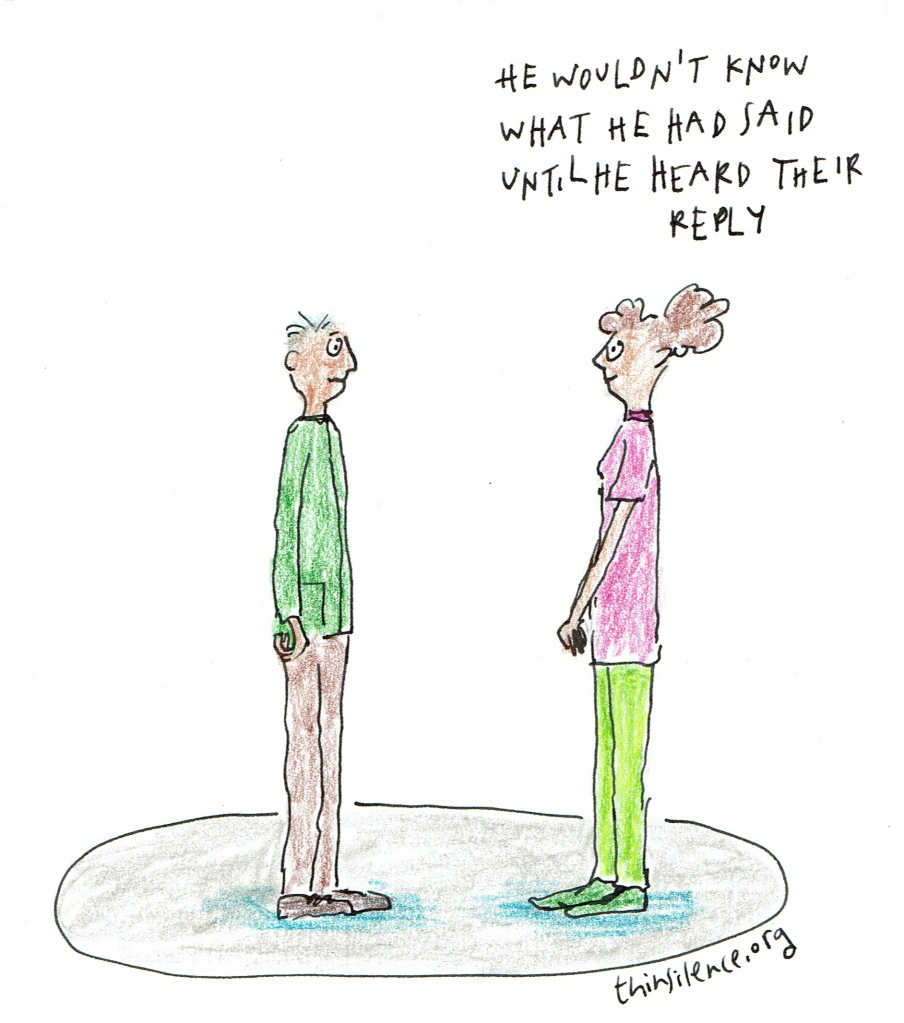
Infinite speakers must wait to see what is done with their language by the listeners before they can know what they have said.*
(James Carse)
Yesterday I was involved in a conversation about a university listening project.
We all listen but how?
Sometimes listening means being aware of what others are saying and ignoring them.
It can mean listening to a different point of view in order to argue a better point of view.
Another form of listening puts arguments aside and is simply curious about the other.
Then there’s listening for the response of the other to know whether what we have said opens possibility for both ourselves and the other, to know, to feel and to act.
This is infinite listening and all are able to develop this capacity.
(*From James Carse’s Finite and Infinite Games.)

Time does not pass for an infinite player. Each moment of time is a beginning. Each moment is not the beginning of a period of time. It is the beginning of an event that gives the time within it its specific quality.*
(James Carse)
We each have a time machine.
(*From James Carse’s Finite and Infinite Games.)
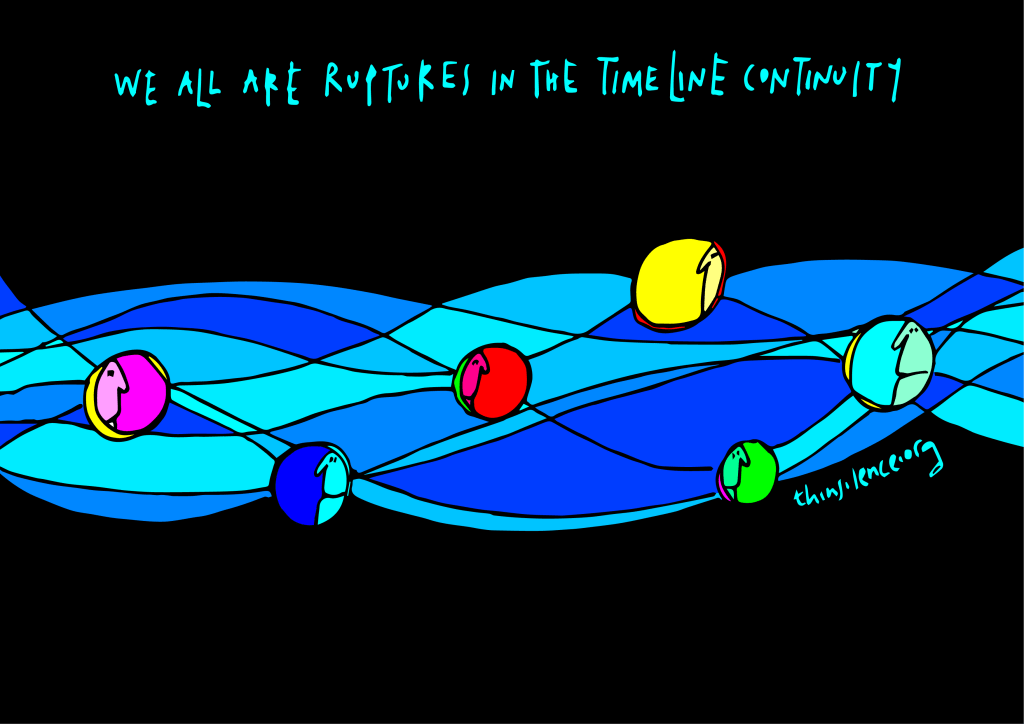
Theatrically, my birth is an event of plotted repetition. I am born as another member of my family and my culture. Who I am is a question already answered by the content and character of a tradition. Dramatically, my birth is the rupture of that repetitive sequence, an event certain to change what the past has meant. In this case the character of tradition is determined by who I am. Dramatically speaking, every birth is the birth of genius.*
(James Carse)
To be an artist is to be on the hook, to take your turn, to do the things that might not work, to see connection, to embrace generosity first, to change someone, to be human.**
(Seth Godin)
We are all person-artists. First and foremostly of ourselves. We create a different story alongside the script nature has included us in.
Second and very importantly, when we do this and we work out our art, we help others to figure who they are, what their art should be.
I can name the people who helped me in this way.
Although we may begin to help each other by looking, we come to understand there is a difference between looking and seeing:
To look at is to look for.*
To look at you is to bring my own perspectives, lenses and filters to bear. It’s a beginning. To see you, though, is to allow who you are to come to me and I merely help you to see this for yourself.
(*From James Carse’s Finite and Infinite Games.)
(**From Seth Godin’s What to Do When it’s Your Turn.)


You must be logged in to post a comment.