With hearts on fire

Every minute, every hour, there is another surprise around the corner.*
(Frans Johansson)

When we know who we are – humility, and know what we have – gratitude, and turn up with these every day, wherever we are and whoever we are with – faithfulness, look forward to some good conversations.

(*From Frans Johansson’s The Click Moment.)

Moving questions

The mind works best in the presence of a question.*
(Nancy Kline)

[W]e are not the stones over which the stream of the world flows; we are the stream itself […] this ceaseless change does not mean discontinuity; rather change is itself the very basis of our continuity as persons. Only that which can change can continue.**
(James Carse)

Wouldn’t it be great if you could buy a bag of questions like you can buy a bag of jelly beans, every flavour enjoyed would lead to a different kind of question appearing in your thoughts?

Well, they may not come to us as jelly beans but they do appear in our reading, in our walking, in our gazing, in our meeting with others …; the world is full of questions, which means, we are full of questions, we only have to allow them to form rather than always wanting the easy answers.

Coming up with questions is how we keep changing, keep moving.

(*From Nancy Kline’s More Time to Think.)
(**From James Carse’s Finite and Infinite Games.)

The revealing story

storytelling is a tool for knowing who we are and what we want*
(Toni Morrison)

Apps can give us a number; only people can provide a narrative. Technology can expose mechanism; people have to find meaning.**
(Sherry Turkle)

Yesterday, I wrote about how imagination needs reality – because our personal stories are not necessarily the truth, but also how reality needs imagination – because it can be altered (through foresight, intention and love).

Only humans can imaginatively and creatively dwell in the space formed by reality and imagination. Technology, at this moment in time, cannot.

One of the technologies I use in my dreamwhispering work with people is Clifton Strengths. I have worked with more than 500 people using this means of identifying our talents and abilities. It’s a brilliant tool, but I know it’s the conversations that follow the analysis results where everything comes alive, becoming a story that is about who we are and what we want to do in the completeness of our lives, not simply finding our next best job.

(*Toni Morrison, source lost.)
(**From Sherry Turkle’s Reclaiming Conversation.)

Stories: the conversations we have with ourselves

By relying on well-told stories, we ignore the real truth, the universal truth of how the world actually is.*
(Seth Godin)

One of the rewards of solitude is an increased capacity for self-reflection – the conversations we have with ourselves in the hope of greater insight about who we are and want to be.**
(Sherry Turkle)

Self-reflection not only allows us to see the truth and reality of who we are but also imagine how we can change. If you like, we see the clothes we want to take off and the new ones we wish to replace these with.

Research, though, appears to indicate we are increasingly struggling to move into and remain in solitude where our self-reflection will take place. Sherry Turkle points to times of boredom and anxiety as being natural moments to move inward and to reflect, but we are now more likely to distract ourselves with some form of technology, even though this in turn may lead to more anxiousness or boredom.

Through our self-reflection, we produce our personal stories; Toni Morrison wrote:

storytelling is a tool for knowing who we are and what we want.^

Seth Godin warns us that our stories aren’t necessarily the same as reality. We must, then, always be trying to bring reality and our stories together. Frederick Buechner wrote about how we find our purpose where our deepest joy meets the world’s greatest need.

Wallace Stevens wrote about the power of imagination needing to be brought to bear the pressure of reality.^^

Our imaginations need reality as much as reality needs our imagination. These conversations, born in solitude, lead us into the most real and imaginative stories of all.

(*From Seth Godin’s blog: Getting to the truth.)
(**From Sherry Turkle’s Reclaiming Conversation.)
(^Toni Morrison, source lost.)
(^^See Wallace StevensThe Necessary Angel.)

Copy that

I think copying someone’s work is the fastest way to learn certain things about drawing and line.  It’s funny how there is such a taboo against it. I learned everything from just copying other people’s work.*
(Lynda Barry)

How will you go about finding that thing the nature of which is totally unknown to you?**
(“Meno”)

Austin Kleon reminds me that I have learned so much towards developing my own values and creativity through copying.

My doodling began in this way, my development of illustration, too – I have copied Quentin Blake‘s illustrations from Roald Dahl’s The BFG and Danny the Champion of the World.

I also read Dahl’s book to gain a sense of how he shaped stories. I read many kinds of book, trying to learn from different styles of writing:

Copy out things that you really love. Any book. Put the quotation marks around it, put the date that you’re doing the copying out, and then copy it out. You’ll find that you just soak into that prose, and you’ll find that the comma means something, that it’s there for a reason, and that that adjective is there for a reason, because the copying out, the handwriting, the becoming an apprentice—or in a way, a servant—to that passage in the book makes you see things in it that you wouldn’t see if you just moved your eyes over it, or even if you typed it.^

And then there are all the ideas to copy, to play with, to connect with others and turn into something else.

I see all of these as conversations I am having. I listen to someone, I journal out their ideas alongside others, I post them here. First of all, these are conversations with myself. It’s how I find myself. It’s how we find ourselves. It’s a place on a journey to somewhere else.

There’s something in these copying-conversations that is about faithfulness. Faithfully copying and trying out words and shapes and ideas and habits that others have to share with me requires humility and gratitude on my part – the most sure way of discovering myself and appreciating and valuing others.

It makes every face-to-face conversation we have a potential smorgasbord of discovery.

(*Lynda Barry, quoted in Austin Kleon’s blog: Copying is How We Learn.)
(**Meno, quoted in Rebecca Solnit’s A Field Guide to Getting Lost.)
(^Nicholson Baker, quoted in Austin Kleon’s blog: Copying is How We Learn.)

Risky conversations

Online life was associated with a loss of empathy and a diminished capacity for self-reflection.*
(Sherry Turkle)

The illiterate of the 21st century will not be those who cannot read or write, but those who cannot LEARN, UNLEARN, and RELEARN.**
(Alvin Toffler)

We are learning not to meet face-to-face, replacing such personal encounters with texts and messages and emails.

It’s not simply about using different ways to communicate. Sherry Turkle describes this as a movement from conversation to connection.

Each of the technological alternatives to conversation comes with learnings for us. Perhaps if we look at what we lose through technology is a helpful way of seeing what we are learning. When we’re in the same room talking with one another there are so many things happening: we say things badly and have to correct ourselves, we stumble with our words and thoughts and wrestle them out sometimes, we see each others face and body expressions including the light in people’s eyes when they’re looking at us, there are pauses when we see each other thinking and silences when we’re not sure what to think, we hear ourselves saying words and ideas we haven’t heard before and they develop into new things, we see the lean of the person towards us as they listen.

All of these and more are lost when we’re texting or messaging. These same texts can be heavily edited to make sure they are correct, offering no opportunity for a thought to develop. Heinrich von Kleist pointed out that in conversation we can find ourselves being surprised by what we say and we get to experience,

the gradual completion of thoughts while speaking.^

We are learning not to have such surprises and experiences.

This kind of connection also makes possible the avoidance of boredom and anxiety by allowing us to go to someone, something, or somewhere else. This is another kind of learning. When we avoid the painful or negative emotions we are not developing our brains in a way that allows us to develops empathy or reflection towards ourselves or others. Clifford Nass reported,

negative emotions require more processing in parts of the brain.^^

Nass noticed that people that those who avoided negative emotions were slower to respond to others and to themselves.

Alvin Toffler‘s opening words provide us with hope, though. We are capable of unlearning what we have learnt, and relearning better ways. It is not about avoiding technology. Technology is part of our lives. It is about how to live in relationship to each more richly with technology.

Part of this is enjoying the risky conversations in which new things emerge from the to and fro of unpredictable conversation that happens when people meet each other in an undistracted way:

The thrill of “risky talk” comes from being in the presence of and in close connection to your listener.*

I cannot count the times in a conversation when I have found myself saying things I had not intended to say that help me to see something in a new way, sharing an idea that I hadn’t thought about before, connecting previously unrelated thoughts and ideas with another, doors appearing where before there were only walls.

These surprises never happen when I’m texting or emailing or messaging.

(*From Sherry Turkle’s Reclaiming Conversation.)
(**Alvin Toffler, quoted in Sunni Brown’s The Doodle Revolution.)
(^Heinrich von Kleist, quoted in Sherry Turkle’s Reclaiming Conversation.)
(^^Clifford Nass, quoted in Sherry Turkle’s Reclaiming Conversation.)

Ardently does it

Afraid of being alone, we struggle to pay attention to ourselves. And what suffers is our ability to pay attention to each other, we lose confidence in what we have to offer others.*
(Sherry Turkle)

When here thoroughly know how good we are, we can readily (and creatively) think well about how to improve. It is as simple as that.**
(Nancy Kline)

Welcome to a month of exploring conversation in which I’ll be reading through Sherry Turkle’s Reclaiming Conversation.

It may seem an unusual place to set out but conversation begins with how we speak to and listen to ourselves.

Turkle imagines Henry David’s Thoreau’s three chairs – one for solitude, two for friendship, three for society – as a picture for her exploration of a “virtuous circle of conversation” that has been interrupted by technology; as Nassim Taleb puts it here:

Technology can degrade (and endanger) every aspect of a sucker’s life while convincing him that it is becoming more efficient.^

I came upon the word ardent (to be very enthusiastic or passionate) as I was reading this morning and thought it a good word word to describe how we need to turn up in our conversations.

First of all, we need to be ardent on the inside, in the conversations we have with ourselves, as well as being ardent on the outside.

It’s easier to turn on the radio or iPad or check messages on our phones, wonderful distractions for taking us away from the conversations we need to have with ourselves, the ones that help us to identify problems and work through solutions, to sense directions to take and find the means of pursuing these.

(*From Sherry Turkle’s Reclaiming Conversation.)
(**From Nancy Kline’s More Time to Think.)
(^From Nassim Taleb’s The Bed of Procrustes.)

Letting go letting come

The great teachers are saying that you cannot start seeing or understanding if you start with “No.”*
(Richard Rohr)

A beginning is ultimately an invitation to open towards the gifts and growth that are stored up for us. To refuse to begin can be an act of great self-neglect.**
John O’Donohue)

In an unfolding universe, there’s perhaps nothing evolving faster than a human life.

Different species take hundred of thousands of years, yet in a single lifetime, a person can be so many things, are able to begin and finish in completely different places doing very different things.

Part of the art to this that we have learned is to let go and let come. Even when the future is uncertain, we sense the possibility to be shaped with foresight and intention and love, so we let go, knowing that we carry with is what is most important of all.^

(*From Richard Rohr’s The Naked Now.)
(**From John O’Donohue’s To Bless the Space Between Us.)
(^My thanks to Alex McManus for these three words in proximity to each other.)

Rolling rolling rolling

We are a mystery wrapped in a question.*
(Alex McManus)

We are partners in the unfolding of the universe.**
(Joseph Jaworski)

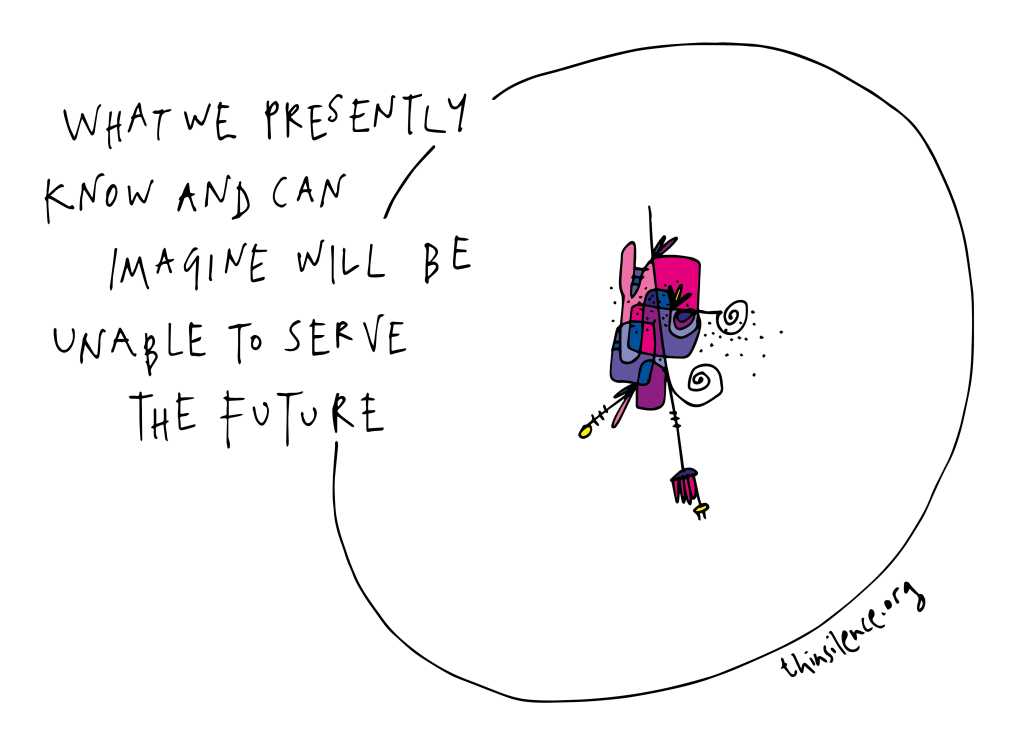
Whatever you love, whatever you’re passionate about, whatever your goals, allow them to move, to grow, to develop and, sometimes, to change, because there’s always more to come.

(*From Alex McManus’ Makers of Fire – eBook version.)
(**From Joseph Jaworski’s Source.)