Oh, what a wonderful day this could be

Before the whites came […] no one in Australia was landless, since everyone inherited, as his or her private property, a stretch of the ancestors song and the stretch of country over which the song passed.*
(Flynn)

How old do you have to be to make a bad drawing?**
(Lynda Barry)

Bryan Ferry singing What a Wonderful World This Would Be was in my head as I was reading and journaling this morning. I found myself grateful for all the decades of my life contain.

I don’t know much about lots of things, as Bryan Ferry and originally Sam Cooke had sung:

Don’t know much about history
Don’t know much biology
Don’t know much about a science book
Don’t know much about the French I took
But I do know that I love you
And I know that if you love me, too
What a wonderful world this would be.^

Beyond those I love, I was thinking about the other thing I love, the thing I do know that helps me get up in the morning and makes it possible to live through the day with the kind of energy I find in these words from Richard Rohr:

I love what I see. Life excites me.^^

It will be different for every one of us yet there’ll be something that excites us beyond everything else. We find it on the far side of what we know about ourselves and what we think we know full-stop.

Lynda Barry’s question reminds us that so many of us will have stopped drawing because someone judged our efforts, perhaps even ourselves pre-empting what we think someone else may think.*^

There’ll be other things we stopped doing because of what others have said or we think they disapprove of, and we have allowed these to drop into the background. I know this was true for me.

But whatever this thing is, it is our inheritance and no-one can take it from us. Drawing comes from within, our purpose or mission also comes from within.

When we know this and own it we have a compelling story to tell ourselves each day, a story in which reality is absorbed and changed.

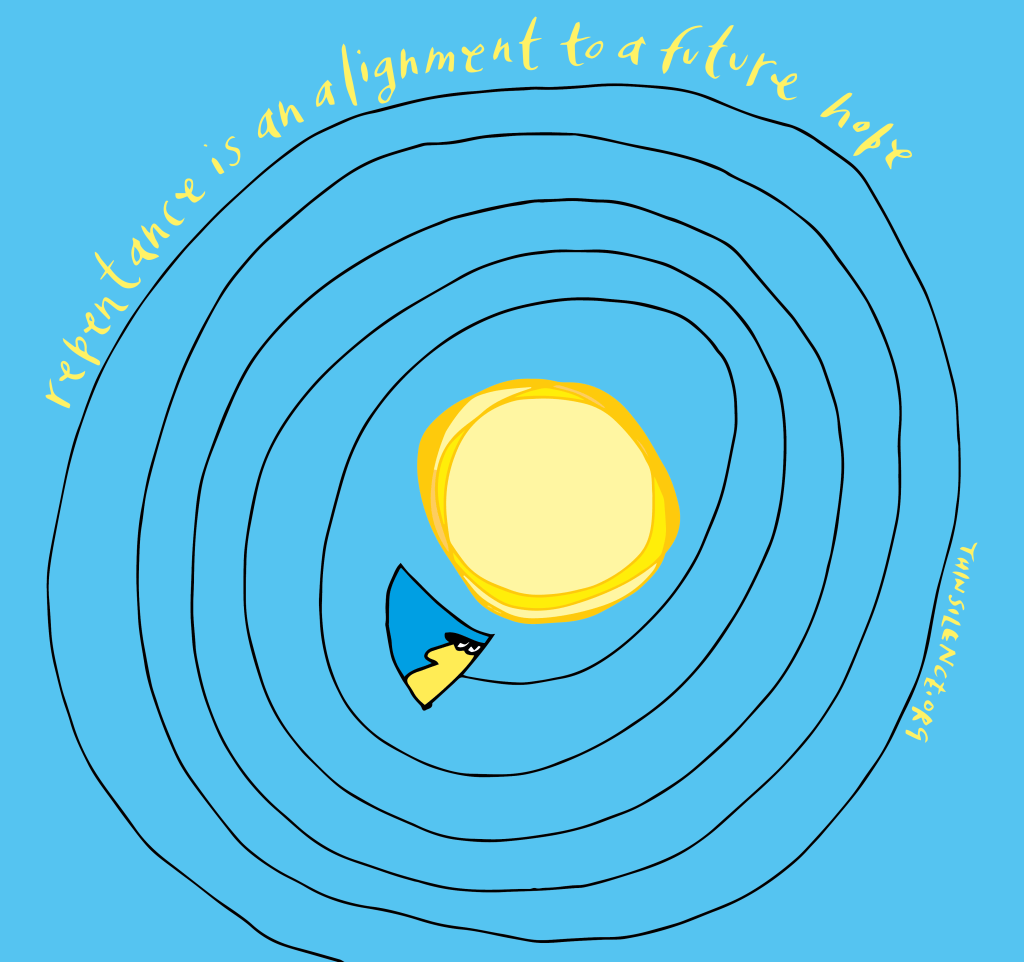
Oh, what a wonderful day this could be.

(*Flynn, quoted in Bruce Chatwin’s The Songlines.)
(**From Lynda Barry’s Making Comics.)
(^From What a Wonderful World This Would Be.)
(^^From Richard Rohr’s Eager to Love.)
(*^Check out peter Reynolds’ very special Ish.)

It was already there

Adults are surprised when what looks like meaningless scribbles turns into something as the kid describes wha’s going on in the picture. When very young kids draw, they cause the lines that causes something to appear. It is there to be found in the same way you found the fish in the drawing […]. And the water and the moon.*
(Lynda Barry)

L’essential est invisible pour les yeux. What’s essential is invisible to the eye.**
(The Fox in The Little Prince)

So much of what we do have is invisible to us; I’m especially thinking of what lies within us.

The invisible requires time and stillness, both of which feel like hard work:

Being present demands all of us. It’s not nothing. It may be the hardest thing in the world. […] It takes real work to grasp what is invisible to just about everyone else.*

These words from Ryan Holiday’s Stillness is the Key means everything to me when it comes my work with people discovering the amazing things in who they are and what they can do, which may have been invisible or not valued by them.

Here’s the picture Lynda Barry is referring to, drawn by two year old Madison.

When Madison says,

This is a fish in the water. And another fish. And this is the moon,^

we can see them. We couldn’t before but now we can.

It’s the same in our lives. With some time and stillness we can do some causing and make the invisible visible, the first time see what it is, the second time to express it somehow.

Playfulness and drawing can help a lot with this. I often mention Johan Huizinga‘s point that seriousness and playfulness have been separated and need to be brought back together. Barry makes a similar point about words and drawing:

Before writing and drawing were separated they were conjoined.*

We drew pictures before we could write and when we learnt to write, it was first of all by drawing shapes.

Try playfully drawing and journaling to find out more.

(*From Lynda Barry’s Making Comics.)
(**From Ryan Holiday’s Stillness is the Key; the fox to the Little Prince in Antoine de Saint-Exupéry’s The Little Prince.)

(^Madison, quoted in Lynda Barry’s Making Comics.)

All present

Being present demands all of us. It’s not nothing. It may be the hardest thing in the world.*
(Ryan Holiday)

Ryan Holiday tells of performance artist’s Marina Abramović‘s performance of The Artist is Present expressed as 750 hours over 79 days of looking silently and intently on 1,545 strangers who sat one by one across a simple table:

She had to be where her feet were; she had to care about the person across from her and the experience they were sharing more than anything else in the world.*

The performance is even more impressive when we become aware that Abramović took no comfort breaks or ate any food to keep her going, only a brief re-set between each person:

Many viewers cried. Each one said the hours in line were worth it. It was like looking in a kind of mirror, where they could feel their own life for the first time.*

This performance illustrates how we each have a capacity to be fully present to one another way beyond what we presently imagine.

(*From Ryan Holiday’s Stillness is the Key.)

Don’t like

The path of least resistance is a poor teacher.*
(Ryan Holiday)

There are certainly three times in my life when something happened to me that I didn’t like one bit, but they got me to to here, doing what I’m doing.

The thing you don’t like may become the most important thing of all.

And when we put some disciplines around the things we don’t like we end developing skills.

(*From Ryan Holiday’s The Obstacle is the Way.)

Not yet

If you do not undertake a risk of real harm, reparable or even potentially irreparable, from an adventure, it is not an adventure.*
(Nassim Taleb)

If we still do not have the thing we want most of all, perhaps we have to do something differently, go to a different place, give something up.

(*From Nassim Taleb’s Skin in the Game.)

Underground overground*

Don’t aim at success – the more you aim at it and make it your target, the more you are got to miss it. For success, like happiness, cannot be pursued; it must ensue … as the intended side effect of one’s personal dedication to a course greater than oneself.**
(Mihaly Csikszentmihalyi)

There’s a huge amount of new home building happening on my side of Edinburgh. If you were to evaluate this building push on houses and apartments appearing then it appears that nothing is happening for ages.

Of course, there’s a huge amount of work happening: determining where ground level will be, stabilising this, laying drainage, putting in building roads, and then laying the foundations.

No one would want to buy a property where this hadn’t scrupulously taken place.

Of course, foundations and superstructures is a much used way of thinking about our lives, as is the more natural growth of a plant. Whichever image we prefer, we know we must never rush or ignore what happens below the surface if we want to see anything worthwhile appearing above the surface.

The best news is, unlike houses, and even trees, we can go return to the foundational things for our lives whenever we want or need to. Indeed, the wise person knows that this is a daily must.

(*Thank you to the Wombles for the title.
(**From Mihaly Csikszentmihalyi’s Flow.)

The beauty and power of humility

What matters isn’t what a person has or doesn’t have; its is what he or she is afraid of losing. The more you have to lose, the more fragile you are.*
(Nassim Taleb)

Yet what is distinctive is just how selective we are about the topics we deem it possible to educate ourselves in. Our energies are overwhelmingly directed toward material, scientific, and technical subjects and away from psychological and emotional ones.**
(Alain de Botton)

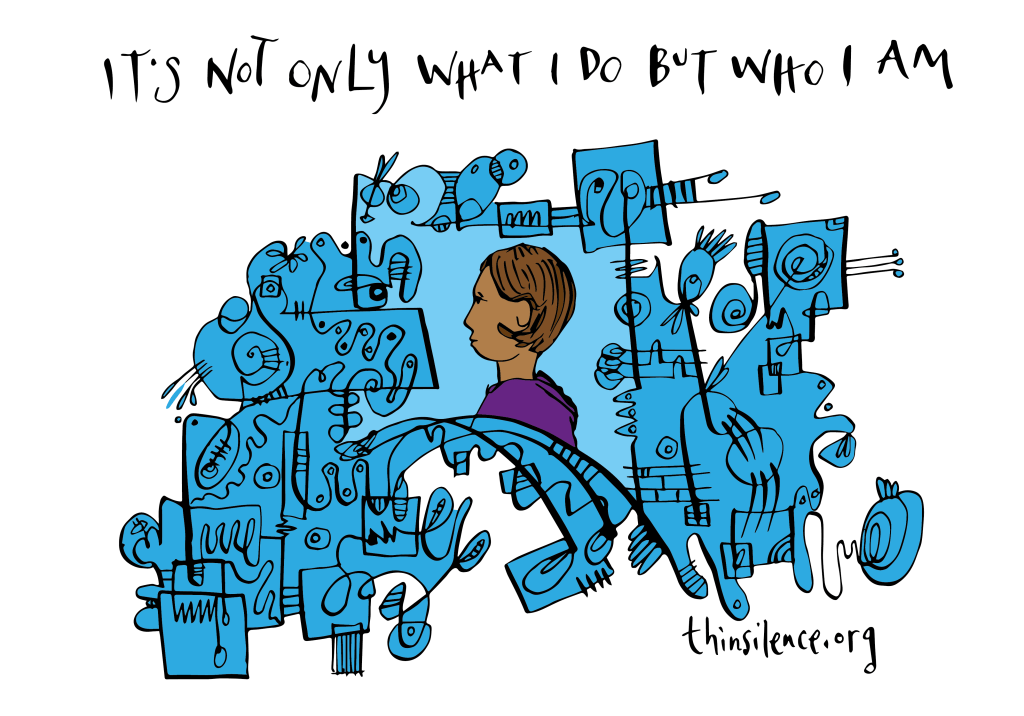
If someone employs me, they don’t only receive what I have but also who I am.

Who we are and what we contribute are immutably joined. Yet we see no reason for including these in our educational curriculums.

What if the following were embraced as skills to be learned alongside reading, writing, maths and science:

Be fully present.
Empty our mind of preconceptions.
Take our time.
Reject distraction.
Weigh advice against the counsel of our convictions.
Deliberate without being paralysed.^

These are listed by Ryan Holiday as the skills and qualities used by John F. Kennedy during the Cuban Missile Crisis. As much as what his office made available to him, it was about the man Kennedy was trying to be.

Alain de Botton in writing on existential maturity and emotional intelligence reflects:

how we are taught may matter inordinately, because we have ingrained tendencies to shut our ears to all the major truths about our deeper selves. Our settled impulse is to blame anyone who lays our blind spots and insufficiencies bare, unless our defenses have first been adroitly and seductively appeased. In the face of critically important insights, we get distracted, proud, or fidgety. We may prefer to do almost anything other than take in information that could save us.**

This is a fragile place to be. Humility changes this. Wrongly thought of as being a way of losing oneself or becoming invisible, humility is how we find our strongest and most beautiful self, destroying the ego and its appetites, providing us with something real to build on:

Constraints are the womb of creation.^^

Though most of us are surrounded by the ordinary we can become generative, alchemists, if you will:

A refined soul is in general one with the gift of transforming the most limited task and the most petty object into something infinite by the way in which it is handled.*^

(*From Nassim Taleb’s Skin in the Game.)
(**Alain de Botton, quoted in Maria Popova’s Brain Pickings: Alain de Botton on Existential Maturity and What Emotional Intelligence really Means.)
(^From Ryan Holiday’s Stillness is the Key.)
(^^From Alex McManus’ Makers of Fire – eBook version.)
(*^From Friedrich Schiller’s On the Aesthetic Education of Man.)

A lifetime in the making (with soundtrack)

Burn old logs. Drink old wine. Read old books. Keep old friends.*
(El Sabio)

We have the technology of an advanced civilisation balancing precariously on an emotional base that has not developed much since we dwelt in caves.**
(Alain de Botton)

It’s not what you do, it’s if you should do it.

Seth Godin began my thinking today, asking of the sentences I’m writing (it could be whatever we’re doing):

This sentence, then, what’s it for? If it doesn’t move us closer to where we seek to go, delete it.^

I have Fun Boy Three‘s It Ain’t What You Do (It’s the Way that You Do It) playing in my head as I am reading this.

I can write my sentences but should I? Nassim Taleb adds to Godin’s thinking for me when he considers the real test of his writing would be its longevity:

So, my real judge being time, it is the stability and robustness of the readership (that is, future readers) that counts.^^

I then read a post from Maria Popova on existential and emotional intelligence – not something that grows passively over time but is a skill we learn:

[Emotional maturity] is, as Toni Morrison well knew, ‘a difficult beauty, an intensely hard won glory’ – the product of intentional character-sculpting, the slow and systemic chiseling away of our childish impulses for tantrums, for sulking, for instant self-gratification without regard for others, for weaponising our feelings of shame, frustration, and loneliness.*^

We can get all the stuff, all the technology, but where’s the help about how to use it? To do the right thing at the right time takes a lifetime of learning and practising and is found in the aged and tested expressions of our lives and loves.

Now I have Queen’s track I Want It All and I Want It Now playing in my head.

I finished off with some thoughts from James Carse about how finite players, if the prize they seek is life, are not properly alive:

They are competing for life. Life, then, is not play but the outcome of play. Finite players play to live, they do not live their playing.^*

Not so for infinite players who live to play rather than play to live:

Infinite players die. Since the boundaries of death are always part of the play, the infinite player does not die at the end of play, but in the course of play.^*

Carse is here echoing the chiseling process Popova has described in the skill-learning of emotional intelligence. The ego dies and something much larger lives in is place.

(*El Sabio, or, King Alfonso X, quoted in Nassim Taleb’s Skin in the Game.)
(**Alain de Botton, quoted in Maria Popova’s Brain Pickings: Alain de Botton on Existential Maturity and What Emotional Intelligence Really Means.)
(^From Seth Godin’s blog: “What is this sentence supposed to do?”)
(^^From Nassim Taleb’s Skin in the Game.)
(*^From Maria Popova’s Brain Pickings: Alain de Botton on Existential Maturity and What Emotional Intelligence Really Means.)
(^*From James Carse’s Finite and Infinite Games.)

Prepared for surprise

Scientists have recently determined that it takes approximately 400 repetitions to create a new synapse in the brain – unless done with play, in which case it takes between 10-20 repetitions.*
(Karyn Purvis)

Whoever touches and whoever it touched cannot but be surprised.**
(James Carse)

There are many reasons why “we-move-rather-than-touch,” one of which is surprise-avoidance. But there are surprises and surprises: the nasty kind and the nice kind.

On Sunday a friend shared how she’d lost a bracelet recently received as a gift. I happened to bump into her yesterday and she told me that her son had encouraged her to go to the shop the bracelet had come from, just in case someone had handed it in.

She didn’t hold out much hope but went along anyway and explained everything. The assistant told my friend that nothing had been handed in, but the shop manager on hearing the story, told the assistant to provide another bracelet.

That’s the kind of surprise that can happen if we turn up and play, which is what my friend did despite her doubts.

There’s no substitute to turning up every day in our values and abilities, and playing.

When we do this over a long enough period, we can be sure we are in quite a different place. Play does this:

Play turns to seriousness and seriousness to play. Play may rise to heights of beauty and sublimity that leave seriousness beneath. […] It adorns life, amplifies it, and it is to that extent a necessity both for the individual – as a life function – and for society by reason of the meaning it contains, its significance, its expressive value, its spiritual and social associations, in short, as a culture function.^

In these words from Johan Huizinga, we look on the reciprocity there ought to be between playfulness and seriousness, each giving to the other, though it is more likely that playfulness and not seriousness seriousness will take us into surprise because it is always exploring.

Play on.

(*Karyn Purvis, from Speech and Language Therapy NHS Lanarkshire.)
(**From James Carse’s Finite and Infinite Games.)
(^From Johan Huizinga’s Homo Ludens.)

Touched or moved?

[T]hat inner voice, I have found, exists in counterpoise to the outer voice – the more we are tasked with speaking, with orienting lip and ear to the world without, the more difficult it becomes to hear the hum of the world within and feel its magmatic churns of self-knowledge.*
(Maria Popova)

[T]ry to be here, which as you know is the hardest place to be. Can you be present to this little bit of now?**
(Richard Rohr)

In a world so full of voices, the hardest to hear can be the one within. To hear this voice we must find stillness and solitude which, if not unknown, feared or undervalued by ourselves, certainly can be in our society.

In his short but wonderful Finite and Infinite Games, James Carse writes about how life has provided us with the opportunity to play an infinite game – infinite meaning everyone is included to play for as long as possible and if either of these are threatened then we have the possibility of changing the rules.

So often, though, our lives are dominated by finite games – selected players working towards a deadline and holding that these are the only rules we can play by.

Though we know we must sometimes play a finite game – I must go to work, vote, pay when I shop for something – we do so knowing these are played within an infinite game. The quality of interaction between the infinite and the finite determines how the inner and outer voices most creatively listen to one another.

This cannot take place if we only listen to the outer voices. Carse names this interaction as touch, reminding us that:

Whoever must play cannot play.^

We do not arrive at our truest play by the sole direction of some outside source – which Carse describes as being moved – but by a conversation between inner and outer voices:

In no way is the source of genius external to itself; never is a child moved to genius. Genius arises with touch. Touch is a characteristically paradoxical phenomenon of infinite play.^

This freedom to play is where we find our “genius,” now we can be fully “here.”

This conversation between inner and outer voices is what you and I are capable of, but not in a way that leaves one of us untouched. Here is surprise for both of us.

I hear my inner voice but you hear yours, too. What we imagine is something new, not pre-determined – whether by you or me:

I am touched only if I respond from my own centre – that is, spontaneously, originally. But you do not touch me except from your own centre, out of your own genius. Touching is always reciprocal. You cannot touch me unless I touch you in response. The opposite of touching is moving. You move me by pressing me from without towards a place you have already foreseen and perhaps prepared. It is a staged action that succeeds only if in moving me you remain unmoved yourself.^

What we are seeing here is what Theory U imagines as generative dialogue, a development from dialogue in which I might tell you more about myself or you may tell me about yourself but neither of us had to do anything with what we now know. The generation of something new occurs only when we are both prepared to let go and let come.

Yesterday, I happened upon a note of four “brave moves” identified by Nipun Mehta^^ which will only come about as we are prepared to touch rather than move one another. I offer them here as something for you to play with:

Consumption to contribution
Transaction to trust
Isolation to community
Scarcity to abundance.

(*From Maria Popova’s Brain Pickings: Kahlil Gibran on Silence, Solitude, and the Courage to Know Yourself.)
(**From Richard Rohr’s The Divine Dance.)
(^From James Carse’s Finite and Infinite Games.)
(^^Source lost.)