That’s not my action


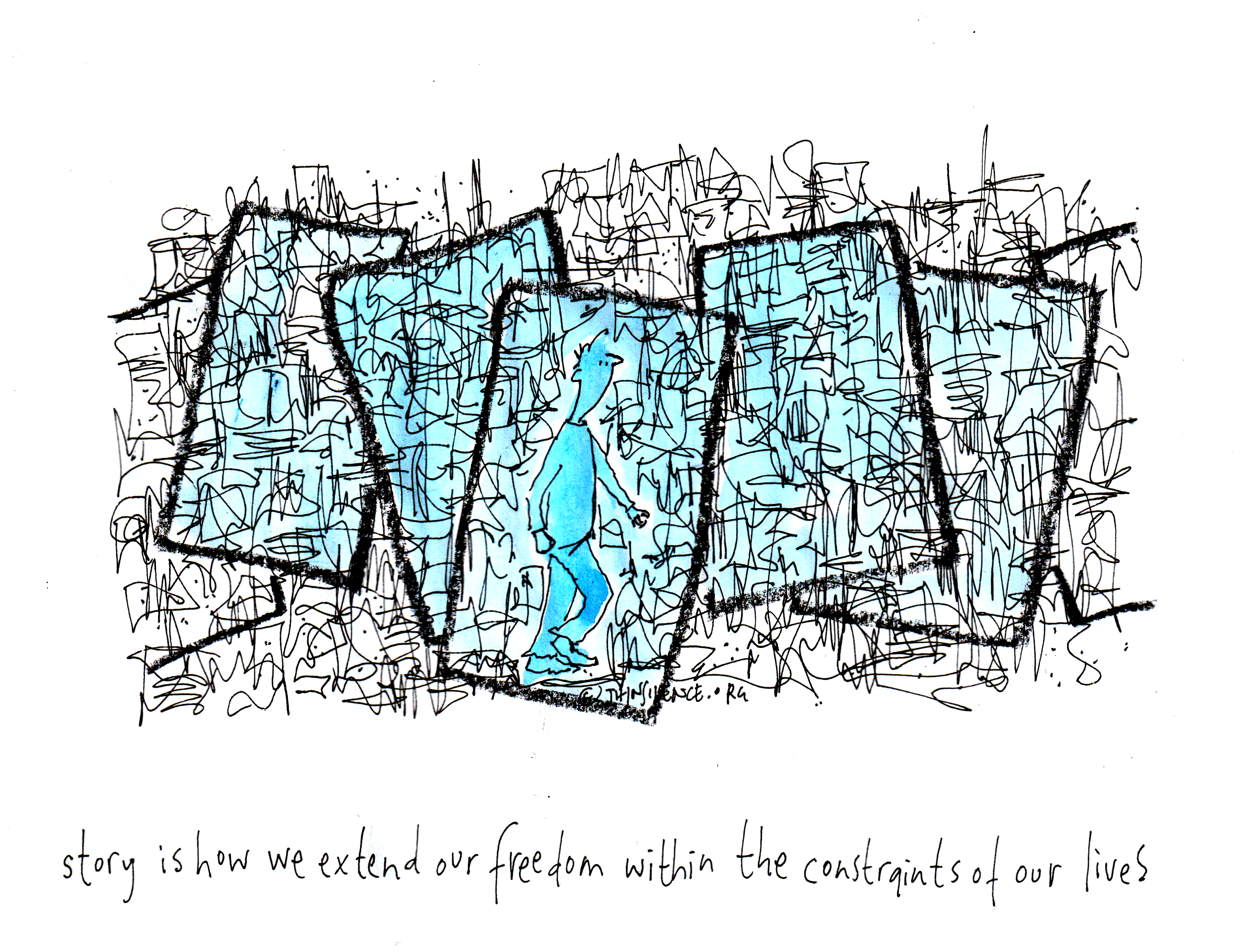
Action isn’t a burden to be hoisted up and lugged around on our shoulders. It is something we are. The work we have to do can be seen as a kind of coming alive.*
Joanna Macy

Like. poetry and music, mythology should awaken us to rapture, even in the face of death and the despair we may feel at the prospect of annihilation. If a myth ceases to do that, it has died and outlived its usefulness.*
Karen Armstrong

If your action weighs you down,
If it’s something external to who you are,
Then perhaps it’s not yours but
someone else’s
(perhaps they are carrying someone else’s, too) –
Everyone has a different kind of action,
It comes from deep within,
It is your bliss, as Joseph Campbell named it;
It seizes you – heart, soul, mind, and strength –
Changing you as well as the world around.

*Oliver Burkeman’s Meditations for Mortals;
**Karen Armstrong’s A Short History of Myth.

A less measured approach


The shadow is that part of you that you won’t allow to show through, that includes good – I mean potent – as well as dangerous and disastrous aspects of your potential … You should find a way to realise your shadow in life somehow.*
Joseph Campbell

The truth is there’s no metric for what matters, no way to measure meaning.**
Bernadette Jiwa

We tend to measure what can be measured,
Which shifts our focus to what we can measure and
away from what we cannot,
But what about these things we can’t calculate –
How what we are doing resonates with what we find meaningful,
How our soul is growing, how our Ego is declining
and our True Self is developing,
How our being rather than doing is fairing –
How goes our self-reflection?

Measuring can be very helpful, but
it may cover over how
what we are measuring doesn’t matter to us
as much as we think it does.

*Joseph Campbell’s Pathways to Bliss;
**Bernadette Jiwa’s Briefly blog: The Measure of Us.

No solitary journey

Just like me, you’re the constant observer, the solitary witness to the whole of your life.*
AleXander McManus

And so love becomes the most gentle and most powerful agent for the fielding and forming of reality. In love the lenses fall away. In love one forms all formings. In love one becomes generate in the aleph. In love one arrives home at last.**
Jean Houston

I’ve been observing my life for more than
sixty six years, and perhaps I’m beginning
to get the hang of it,
Especially appreciating how
I need others to help me.

As the Johari Window reminds me,
there are things about me that
others can see but I cannot,
As well as some things that neither I nor
others can see.^

Here is the continuing journey for all our lives,
One formed through love and for love –
Remaining open to the observations of others, rather than
defensive or denying; we need others to make this journey,
And they need us.

*AleXander McManus’ FutureU.
**Jean Houston’s The Possible Human;
^The four quadrants of the Johari Window are: Things only we know about ourselves, things that both we and other know about us, things that only others know, and things that neither we nor others know. These are not fixed.

Still listening


Before each of us can have a voice of our own, we must enter a silence we can enter only together. It’s a silence without walls. By stepping back to be the listener who has nothing to say we discover the just as there is no language that is exclusively our own, there is no silence that is not a shared silence.*
James Carse

Two people try to speak at the same time,
Two others sit together in silence –
Both scenarios appear wrong to us –
We know that one has to be silent while the another speaks,
And then they swap places –
we know this should work better.

James Carse, though, invites us into
the deeper listening and silence of the infinite game
of life:
The listener with nothing to say – to assert, to demand – is moving from Ego to Self,
Just as language arises from Human sharing, so does silence –
When I am silent to myself, I am also silent to you,
Someone’s true voice can only arise from listening in shared spaces,
Silence doesn’t hide behind walls, but is open, inclusive.

Silence is not absence from but a deep form of relationship.

*James Carse’s Breakfast At the Victory.

Listening or listeners

Listen then with soul-hearing now, for that is the mission of the story.*
Clarissa Pinkola Estés

To live in Kairos time, we need to shift the focus from what we do with our time to how we experience each moment – what you might call mindful productivity.**
Anne-Laure Le Cunff

The Ancients thought there were three
levels or paths of listening:
For the mundane and everyday,
For learning and art,
For guidance and for wisdom;
We can listen or we can be a listener –
There’s a difference,
As I’m learning, the latter requiring
presence, engagement, and attunement.

*Clarissa Pinkola Estés’ Women Who Run With the Wolves;
**Anne-Laure Le Cunff’s Tiny Experiments.

Creating myths

Mythology opens up the world so that it becomes transparent to something that is beyond speech, beyond words – in short, what we call transcendence.*
Joseph Campbell

Mythology is usually inseparable from ritual. Many myths make no sense outside the liturgical drama that bring them to life, and are incomprehensible in a profane setting.**
Karen Armstrong

Though not made of dragons, minotaurs, and odysseys,
Life is mythological in seeing beyond the appearance of
the ordinary or familiar, to
the wonder of life within and around us;
Our personal and collective myths quietly shape
our habits, practices, and systems of energy –
Though some will not understand,
Many are awakening to their hunger for myth.

*Joseph Campbell and Bill Moyers’ The Power of Myth;
**Karen Armstrong’s A Short History of Myth.

We’re all one

[Signs of Egocentricity:]
1 – Playing the comparison game …
2 – Being defensive …
3 – Needing to display our brilliance …
4 – Needing to be liked and accepted*

Sunil Raheja

Properly speaking, a man has as many social selves as there are individuals who recognise him and carry an image of him in their mind.**
William James

A couple of thoughts on the Ego and the Self:

1. The signs of egocentricity make a lot of sense:
We need to know that we are different to our parents and our peers,
It is important to look after ourselves and be secure,
Expressing what we are good at allows us to live with purpose,
Relationship and connection are meaningful for us;
These are important as we grow from dependence towards independence –
But difference, security, purpose, and connection are multiplied and
transformed when we move from independence to
interdependence.

2. When we seek to be different persons or versions of ourselves
depending on who we are with,
It’s likely our Ego turning up, and, whilst the journey is
far from linear, I’m imagining that our movement from Ego to our True Self,
From independence to interdependence is going to see us becoming
the same person towards the many others.

*Sunil Raheeja’s Dancing With Wisdom;
**Dan McAdams’ The Stories We Live By.

This is where I begin

When moved by the wonders of others, the soul in our bodies is awakened, and acts of reverence often quickly follow.*
Dacher Keltner

Allow yourself to be wonderful
so that we may all benefit – you
awaken our souls.

Reverence is our best response –
Deep respect and gratitude for who you are and for
what you bring.

This is where I begin my day, with some or other
variant of this theme –
If this is stuck then I am very glad.

*Dacher Keltner’s Awe.