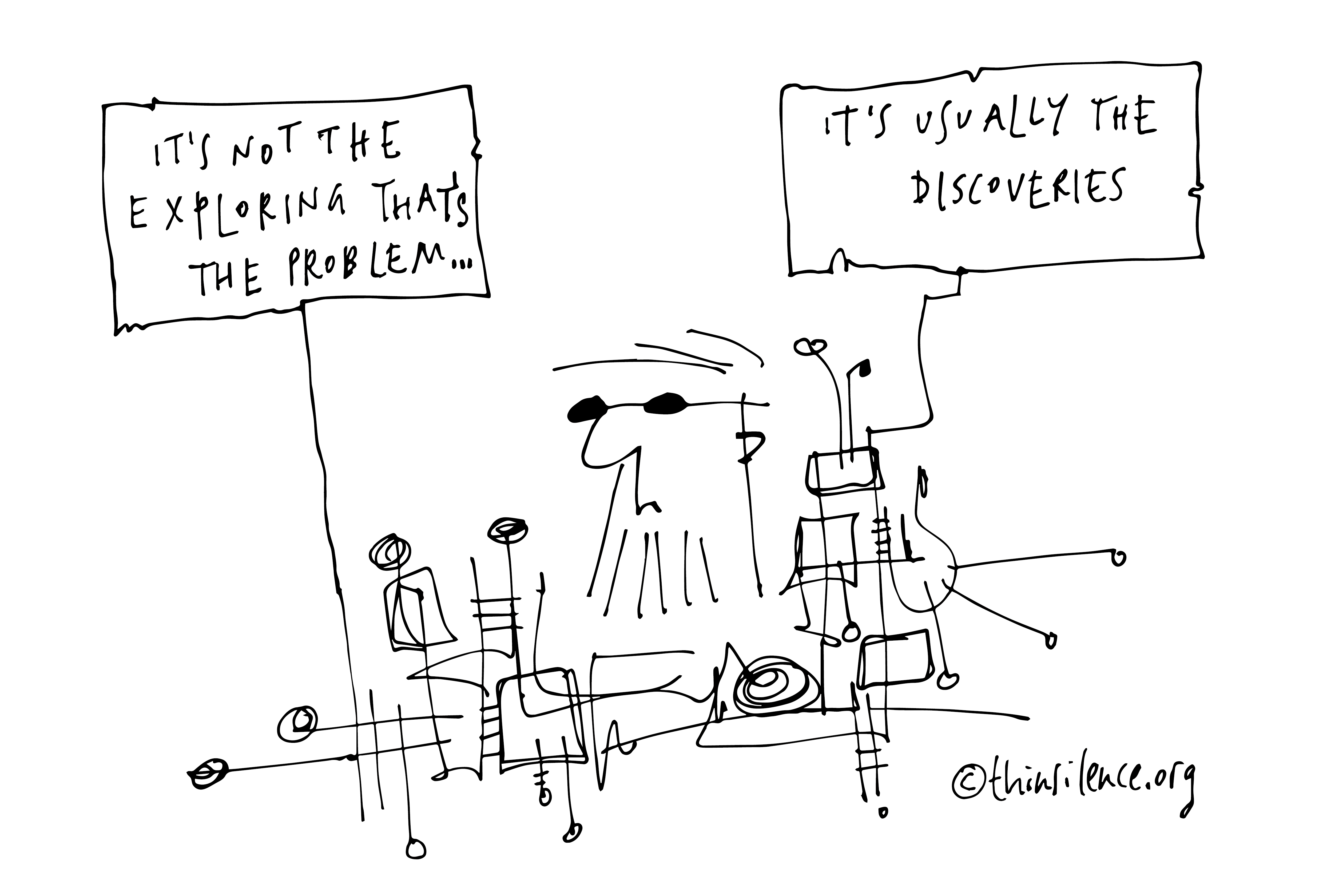
Process over inspiration

Creativity is a dialogue between the ideas and the media in which they are being formed.*
(Ken Robinson)

Great storytellers hone their craft by having the courage to tell unpolished stories.**
(Bernadette Jiwa)

We must find our most flourishing environments.

Some years ago, I kept a note of all the most energising moments in a day. I didn’t sit down and concentrate to create the list, but carried it with me for about three weeks so that I could add to it when something happened that energised me.^

I would note down any or all of the following: what I was doing, why I was doing it, who I was doing it with or for, and when I was doing it – for instance, was I starting something.

What I was noticing were the experiences that were most satisfying and fulfilling to me. In noticing them, I would have the ability to make more of them happen with an increasing dexterity and knowledge.

When I reflected on my list’s noteworthy experiences I found three themes that have become my enriching environments:

To begin the day journaling as I expose myself to ideas from disparate sources: I love the idea that people who may never have a conversation in real-time for various reasons, end up having a conversation in my journal.

To begin turning these ideas into something that will be useful to others: this blog and doodle has become an expression of this as I explore possibilities; it also means bringing something into my work with others as soon as I can.

To work with people in 1:1 conversations of possibility completes my trio of enriching environments. These are not fixed experiences, but are intended to be open to surprise, for me as well as the other.

These three environments, or media as Ken Robinson would name them, can also be understood to be processes or systems.

Each has its shape and order that I can trust to produce something: I don’t have to hang around for inspiration.

I love inspiration, but it usually arrives as a result of one or more of these environments. Robert McKee identifies the work of research for a writer in a similar vein:

The mastery of story demands the invention of far more material than you can use, followed by astute choices of inclusion and exclusion. Why? Because experienced writers never trust so-called inspiration.^^

You can begin to keep your list today.

You’re looking for extremely energised experiences and you will probably notice these before or after you have been living them.

In a few weeks time, you’ll probably have twenty to thirty experiences on your list. You’re ready for the next stage.

For this, you may try the following method. Write each of your notes on a separate piece of paper and pop similar experiences into piles. Is there a phrase within each pile that summarises what it contains? If not, come up with one. What are you left with?

Do some of the themes fit together? In which case bring them together and come up with a new label. Take another look.

I tend to work with threes when it comes to things like this, being both memorable and providing complexity. Themes can be: connecting with nature, centring or grounding activities, talking with others about ideas in an open way, working deeply by yourself without interruption … .

Take these for a test run. Come up with one small articulation for each environment or medium and see how it goes in a day.

Robinson sees two dimensions to creative processes: the generative and the evaluative, anticipating John O’Donohue’s words on imagination:

The imagination has a deep sense of irony. It is wide awake to the limitation of its own suggestions and showings.*^,

Here are four questions you can ask of our experiences:

Am Is successful when I do this?
Do I do this intuitively?
Do I grow as a result of doing this?
Does this meet a need in me?

Have fun.

*From Sir Ken Robinson’s Out of Our Minds;
**From Bernadette Jiwa’s What Great Storytellers Know;
^I also kept a list of things that robbed me of energy in a more than normal way;
^^From Robert McKee‘s newsletter: Where To Find True Inspiration;
*^From John O’Donohue’s Divine Beauty.

Reconfiguring mystery

The imagination works through suggestion, not description. … Suggestion respects the mystery and richness of a thing. All it offers are clues to its nature. Suggestion keep the mystery open ad extends us the courtesy of inviting us to see a thing for ourselves.*
(John O’Donohue)

We think we tell stories, but often stories tell us.**
(Rebecca Solnit)

There are times when we need to provide a description of who we are and what we do for others to understand.

Yet we are far more than a description, no matter how thorough.

Beyond description lies mystery.

A place of unfolding change, some think endless possibility.

It is where I hope to journey with others.

*From John O’Donohue’s Divine Beauty;
**Rebecca Solnit, quoted in Bernadette Jiwa’s What Great Storytellers Know.

Trust your dream

The imagination reveals truth in such a way that we can receive and integrate it.*
(John O’Donohue)

Never be limited by the small dreams others have for you.**
(Bernadette Jiwa’s mum)

Dreams are not goals, they’re bigger.

They’re about making your future bigger than your past and, as life isn’t over until it’s over, there’s still time.

You can wait for the right moment to come along or you can make this moment the right one.

Choosing someone to walk with you is a really good place to begin: this morning I received a message from someone choosing me as their mentor or dream-guide.

If I can help, you’re welcome to drop me a line.

*From John O’Donohue’s Divine Beauty;
**Bernadette Jiwa’s mum, quoted in her What Great Storytellers Know.

Commonplace yet unique

There is a vitality, a life-force, and energy, a quickening that is translated through you into action and because there is only one of you in all of time, this expression is unique. And if you block it, it will never exist through any other medium and be lost.*
(Martha Graham)

I don’t think of it as art – I just make things I like bigger, assuming that if I like them some other people might too. Some do. Some don’t, and that’s okay too.**
(Corita Kent)

The commonplace book or commonplace is a traditional way for noting and collecting knowledge of peculiar interest to the owner. The combination of quotes, recipes, pictures, ideas and more would make each of these unique:

Each one is unique to its creator’s particular interests but they almost always include passages found in other texts sometimes accompanied by the compiler’s responses.^

It’s a visual reminder for us of all we’ve been gathering throughout our lives and have the chance to make bigger, that is, to develop and curate and make available to others.

It’s not a bad reminder to begin keeping a commonplace.

I love the thought that it’s okay to be commonplace because it’s how we make it unique that really counts.

It’s why I love my work helping people remove the blocks.

*Martha Graham, quoted in Sir Ken Robinson’s Out of Our Minds;
**Corita Kent, quoted in Austin Kleon’s blog: Corita Day;
^From Wikipedia: Commonplace book.

So many worlds

There is another world that exists only because you exist: the world of your own private consciousness, feelings and sensations. Your world is one in which, as the psychologist R. D. Laing put it, there is only one set of footprints.*
(Ken Robinson)

Experimentation, adventure and innovation lure us toward new horizons.**
(John O’Donohue)

Early in our lives, we discover that we live in our own world; some would say from the moment we begin to say “No.”

We grow our world as we move from dependence to independence, becoming a person with values and talents and energies:

What if our life skills had more value than our worldly possessions? The most content human by far is one who can create a world out of nothing.^

This world becomes a unique take on the reality of the greater world we are born into, and even if we were to put together the experiences of our species’ 7 billion worlds at this moment in time, we still wouldn’t be able to fully know the world we live in.

How we desire to grow and grow our own world but then we find it isn’t enough, or can never be complete, or reaches a point of implosion because we’re empty at our core, unless …

Unless we can grow from independence into interdependence, for which Brian Eno’s scenius offers itself as a good place to begin:

a whole scene of people who are supporting each other, looking at each other’s work, copying from each other, speaking ideas, and contributing ideas.^^

Which brings to mind the African proverb:

If you want to go fast, go alone; if you want to go far, go together.

*From Sir Ken Robinson’s Out of Our Minds;
**From John O’Donohue’s Divine Beauty;
^From Keri Smith’s The Wander Society;
^^Brian Eno, quoted in Austin Kleon’s Show Your Work.

Right under our noses

I settled on a game called I am a contribution. Unlike success and failure, contribution has no other side. It is not arrived at by comparison.*
(Ben and Roz Zander)

We look but we do not see, because our traditional assessment of abilities distracts us from what is actually there.**
(Ken Robinson)

We all have treasure we can bring out from ourselves and contribute into the world.

It’s actually there, right under our noses, waiting to be noticed. The difference may be looking through our own eyes rather than someone else’s.

What we notice, we can develop, into what Frederick Buechner named our deepest gladness, with which we can meet the world’s greatest need, which may also be right under our nose, Henry Eyring suggesting:

When you meet someone, treat them as if they were in serious trouble and you will be right more than half the time.^

Another thing I love about contribution: when made with a rascally glint in the eye, it creates disequilibrium, inviting something out there to shift or tilt towards better.

The imagination awakens the wildness of the heart.^^

*From Benjamin and Rosamund Zander’s The Art of Possibility;
**From Sir Ken Robinson’s Out of Our Minds;
^Henry Eyring, quoted in Benjamin Hardy’s Personality Isn’t Permanent;
^^From John O’Donohue’s Divine Beauty.

Am I real or did I just make me up?

That which we call imagination is from the first an attribute of the senses themselves; imagination is not a separate mental faculty (as we so often assume) but is rather the way the senses themselves have of throwing themselves beyond what is immediately given, in order to make tentative contact with the other sides of things that we do not sense directly, with the hidden or invisible aspects of the sensible.*
(David Abram)

The imagination is my daemon because it is my best friend and my worst enemy. It is my twin because I am my own best friend and worst enemy.**
(Mary Ruefle)

I made this up and it’s a real blog.

A moment ago, it didn’t exist but now it does.

Life is powered by imagination, flying behind everything humans have ever made and done, good or bad, as Mary Ruefle helps us to acknowledge.

The more we know – from our seeing, hearing, touching, smelling, tasting, wrapped in thinking and feeling – the more we’re able to imagine.

More than ever in human history more people have access to knowledge and are able to connect this to the natural world though which they pass sensuously.

Every day is pregnant with possibility.

Michael Bhaskar writes about curation, which is another word for story,

Curation is where acts of selecting and arranging add value. … At its broadest curation is a way of managing abundance.^

Margaret Wise Brown declared,

The first great wonder at the world is big in me.^^

That’s quite something for an adult to claim, and wonderful, too. This is Brown’s story for herself: it’s made up and it’s real.

Imagination is how we touch the invisible or not-yet and bring it into being.

Imaginationn is real, it’s there to be grown each day and it’s good for us:

The imagination keeps the heart young. When the imagination is alive, the life remains youthful.*^

(This blog is powered by books, solitude, journaling, blogs, pictures, long gazes, God, the universe and porridge.)

*David Abram, quoted in Maria Popova’s Brain Pickings: Ecologist and Philosopher David Abram on the Language of Nature and the secret Wisdom of the More-Than-Human World;
**From Mary Ruefle’s On Imagination;
^From Michael Bhaskar’s Curation;
^^Margaret Wise Brown, quoted in Bruce Handy’s Wild Things;
*^From John O’Donohue’s Divine Beauty.

The open ear

But it starts with a whisper, a call from somewhere far away.*
(Elle Luna)

We are human only in contact , and conviviality, with what is not human.**
(David Abram)

There’s a lot of not-listening around.

We do not listen well to others, nor to the world, and not events ourselves.

Yesterday, I was having a short conversation with someone seeking to arrange a deep listening workshop towards peer-to-peer support in the workplace.

I confess to wanting to be listener, so the thought of preparing a workshop excites me.

Presence and openness and attention are all important to listening, leading to what I am thinking about as listening-questions.

Presence in terms of fully and only occupying the available time.

Openness in terms of not judging and therefore being able to see more.

Attention in terms of what is wanting to emerge.

A really good question is an act of imagination and arises from presence, openness and attention, seeking:

to make tentative contact with the other sides of things that we do not sense directly, with the hidden or invisible aspects of the sensible.**

*From Elle Luna’s essay: The Crossroads of Should and Must;
**David Abram, quoted in Maria Popova’s Brain Pickings: Ecologist and Philosopher David Abram on the Language of Nature and the secret Wisdom of the More-Than-Human World.

A greater narrative

I would like to be able to take a photo of a dream.*
(Hélène Cixous)

Although an initial reaction may be highly negative or debilitating, all painful experiences can be reframed, reinterpreted and ultimately used growing experiences.**
(Ben Hardy)

Dreams and reality: two different worlds. Or are they?

Our stories have far more to say to us than we often notice. We mishear or even unhear them:

everyone’s an expert of something. Often the “something” has nothing to do with what you went to school for or even what’ve been doing for however many years you’ve been working way at a job^.

Something else is happening here and we have to take a longer view of what I have come to understand as a slow journey in the same direction:

the essential thing “in heaven and earth” is … that there should be a long obedience in the same direction; there thereby results, and has always resulted in the long run, something which has made life worth living^^.

It seems there are two narratives for our lives.

There is the day-to-day narrative of work, people, play, illness, anxiety. There is also a greater narrative which we speak of as quest, challenge, struggle, triumph.

When we are able to bring these together more then life seems to change, innovate. All of this has always been there, but we try to notice in a hurry, when we need to notice slowly.

Thankfully, practices of slowness and noticing are re-entering our day to day, after being lost to us for so long:

Most innovation is a gradual process.*^

Moment by moment, day by day.

Our stories haven’t finished with us yet, simply because, when we slow down and notice, we are in a better place to create them.

*Hélène Cixous, quoted in John O’Donohue’s Divine Beauty;
**From Benjamin Hardy’s Personality Isn’t Permanent;
^From Chris Guillebeau’s Born For This;
^^Frederick Nietzche, quoted in Eugene Peterson’s A Long Obedience in the Same Direction;
*^From Matt Ridley’s How Innovation Works.

Stillness still works

I believe there is no difference between thinking and imagination and that they are one. … Anything involving an image in the head is an act of imagination.*
(Mary Ruefle)

I believe profoundly that we don’t grow into creativity; we grow out of it.**
(Ken Robinson)

Be still.

Listen.

Imagine.

Do.

The problem is, imagination is like the air.

It’s so part of life that it’s invisible to us.

This can lead to us thinking others have imagination and we don’t.

Yet this amazing part of human consciousness can be developed by all of us.

Something we desperately need towards making the world a better place for all species and for the planet.

To do, imagine …

To imagine, listen …

To listen …

Be still.

*From Mary Ruefle’s On Imagination;
**From Kern Robinson’s Out of Our Minds.