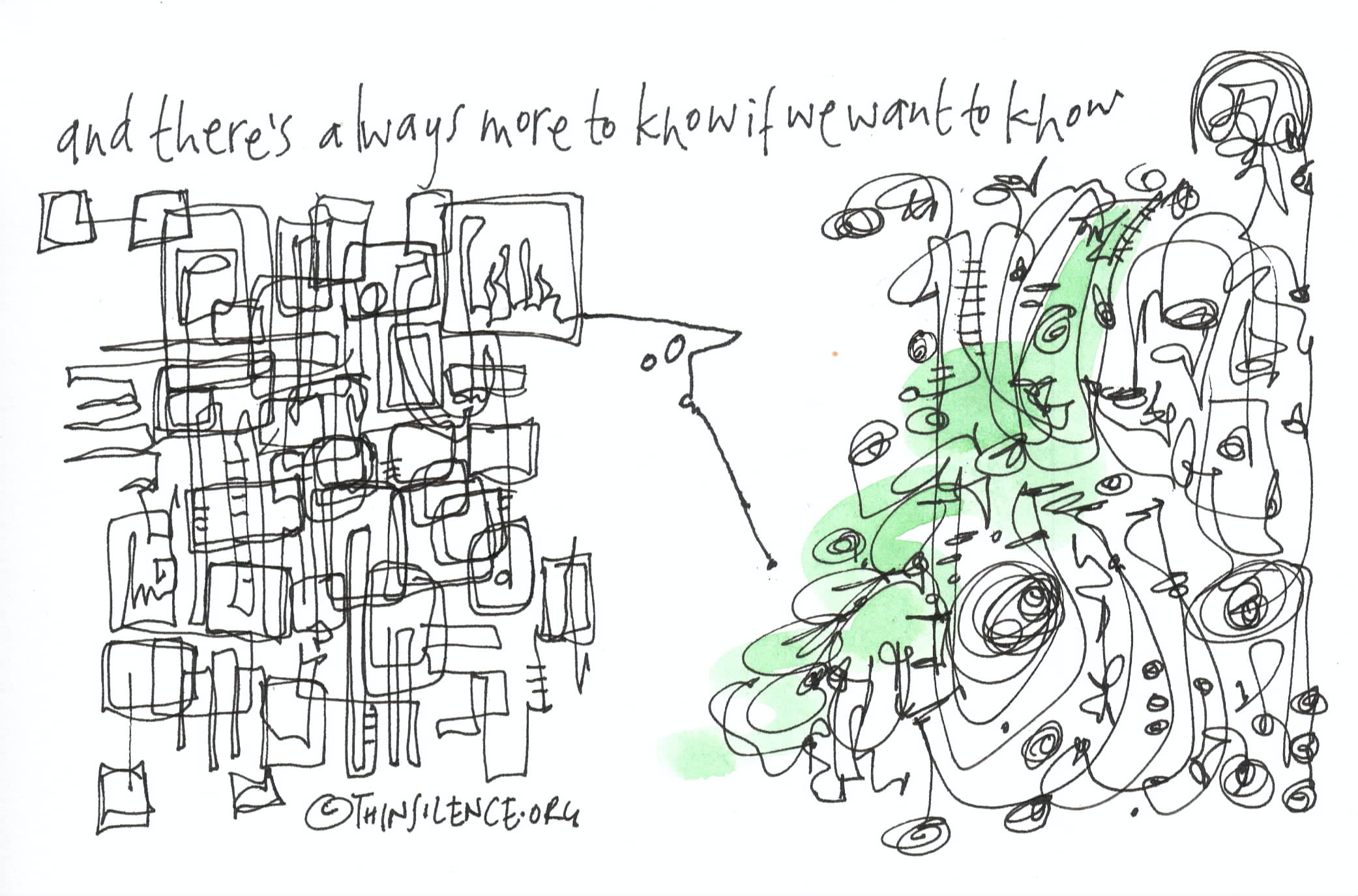
The atelic

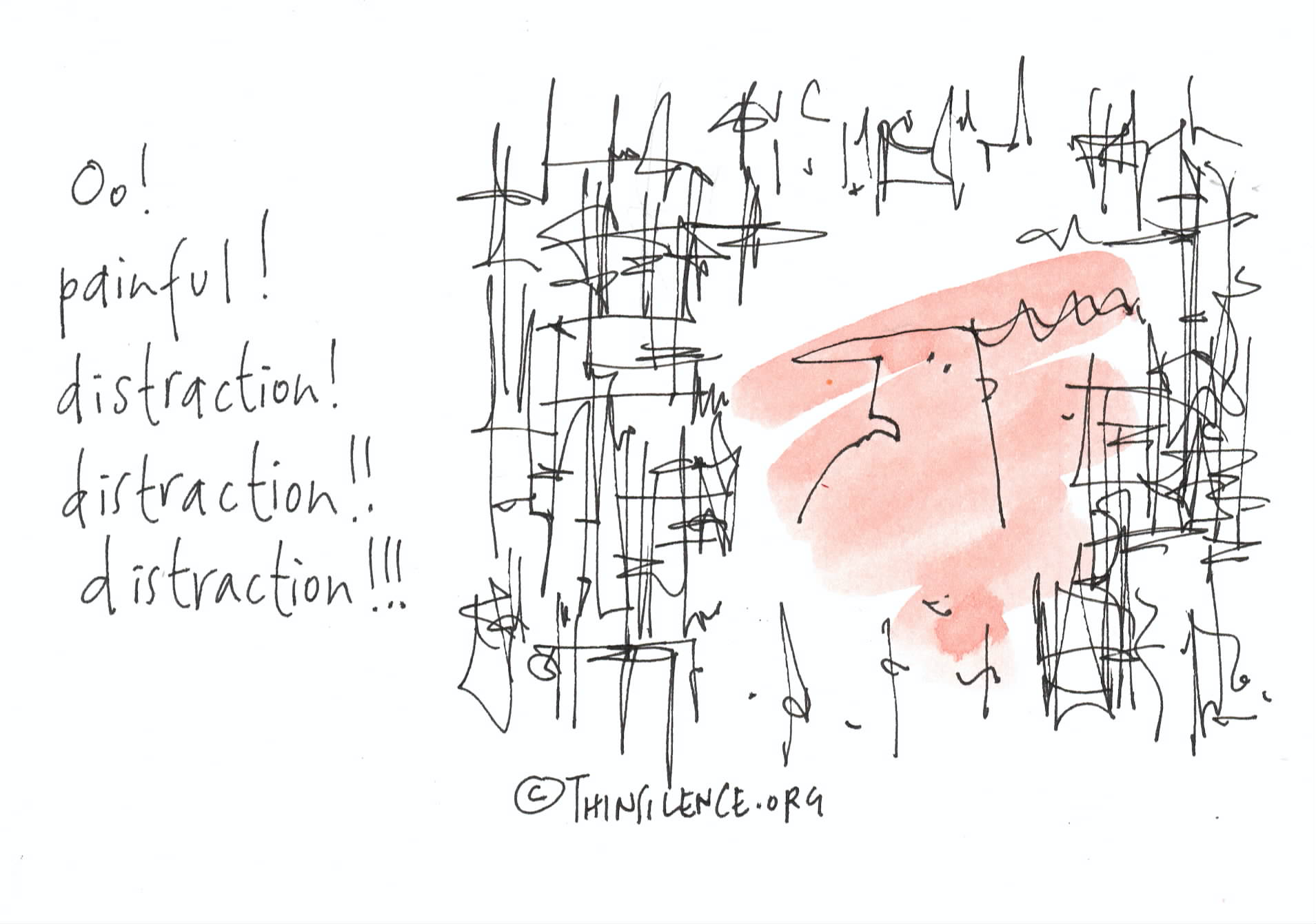
once the attention economy has rendered you sufficiently distracted, or annoyed, or on edge, it becomes easy to assume that this is just what life inevitably feels like*
Oliver Burkeman

You can stop doing these [atelic] things, and and you eventually will, but you cannot complete them.**
Kieran Setiya

It was 8pm and I could finally rest, except that my football team was playing and I wanted to keep watching that alongside the the last episode of the box set that we had to watch and the hotel rooms that needing booking – all before we begin a journey towards sleep in ninety minutes time.

I cram my day with things that have a purpose or outcome, some telos or other, but I know I need to enter into the atelic and find rest.

*From Oliver Burkeman’s Four Thousand Weeks;
**Kieran Setiya, quoted in Oliver Burkeman’s Four Thousand Weeks.

To what end?

One way of understanding capitalism, in fact, is as a giant machine for instrumentalising everything it encounters – the earth’s resources, your time and abilities (or ‘human resources) – in the service of future profit.*
Oliver Burkeman

Who is it he is trying to teach? To whom is he explaining his message? To children weaned from their milk, to those just taken from the breast? For it is: Do this, do that, a rule for this, a rule for that; a little here, a little there.**

Thank you, Oliver Burkeman. I get it.

To be present in this moment and enjoy it for what it is:

Our obsession with extracting the greatest future value out of our time blinds us to the reality that, in fact, the moment of truth is always now – that life is nothing but a succession of present moments, culminating in death, and that you’ll probably never get to a point where you feel yo have things in perfect working order.*

May I reset and start over?

I guess I don’t get the 62+ years back?

Thought not.

We learn ways that take us from the present to rueing the past and worrying about the future, and whilst there is value in reflecting on the past mistakes so as not to make them again and imagining a better future that removes pain for someone, we have developed these out-of-the-present tactics to an industrialised level.

One day, we’ll enjoy life more, we say but until then we must work work work and distract distract distract.

We are taught that everything has to have future value: To what end?

Even mindfulness can be practised with an end goal in mind: one day I will be less distracted, less agitated, more tranquil.

But maybe my enjoying the books I’m reading and the thoughts I’m encountering and the doodling I’m engaging in and the ideas I’m playing with as I write this post are just moments of nowness to be in?

And what you’re viewing is a happy accident from these moments of presence and enjoyment, that I need to keep bringing myself kindly back to for them to be what they can be.

*From Oliver Burkeman’s Four Thousand Weeks;
**Isaiah 28:9-10
.

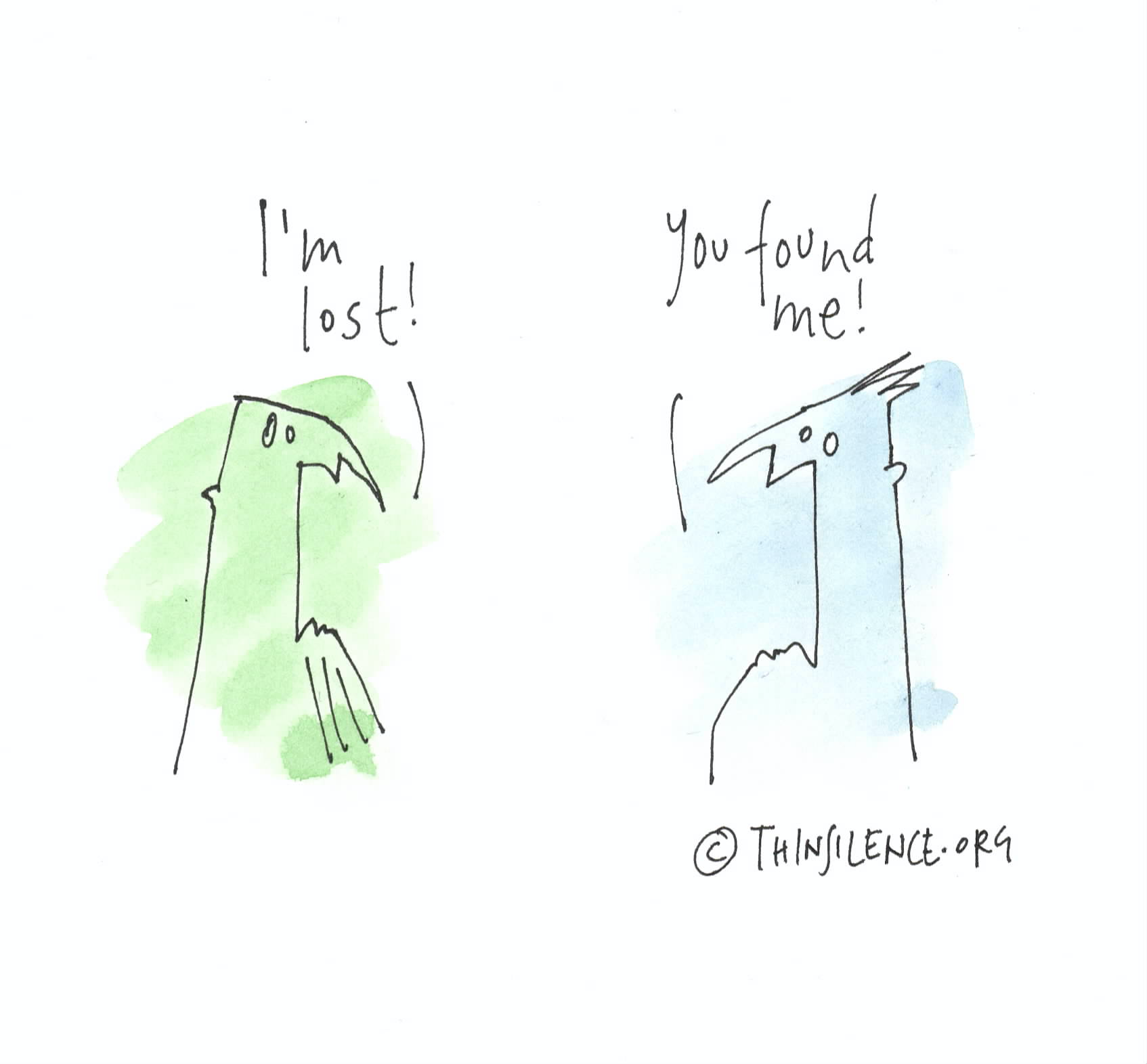
Once I was found but now I am lost

You can’t just be you. You have to double yourself. You have to read books on subjects you know nothing about. You have to travel to places you never thought of travelling. You have to meet every kind of person and endlessly stretch what you know.*
Mary Wells

Attention … just is life: your experience of being alive consists of nothing more than the sum of everything to which you pay attention. At the end of your life, looking back, whatever compelled your attention from moment to moment is simply what your life will have been.**
Oliver Burkeman

We like being found – when we have something to do, a journey has to be made, someone asks a question – but allowing ourselves to be lost is how life becomes, well, more alive.

And as soon as we feel found, it’s time to get lost again.

*Mary Wells, quoted in gapingvoid’s blog: Always open self;
**From OlIver Burkeman’s Four Thousand Weeks.

Oh my, another day for growing

People go out to their work and to their labour until the evening.*

A job is made fun not by turning it into a game, but by deeply and deliberately pursuing it as a job. … We don’t play to distract ourselves from the world, but in order to partake in it.**
Ian Bogost

When the experience is painful, boring, or difficult, we’re tempted to distract ourselves, but, as Seth Godin helpfully identifies,

You can discover overlooked value by measuring things that are difficult to measure.^

All things are playable.

Turning towards the pain may provide personal insight, growth and transformation, turning towards the boring may result into previously unimagined possibilities, turning towards the difficult may lead us into collaborations and breakthroughs.

*Psalm 104:23;
**From Ian Bogost’s Play Anything;
^From Seth Godin’s blog: The easy measurements.

From perfect to good enough

Oliver Burkeman warns against ‘the flawless standards of the imagination’.*

Our problem is that we can imagine multiple perfects.

At first these delight us but soon they tyrannise.

We don’t know where to begin to give expression to what is so wonderfully imagined.

And if we do start, we struggle to finish.

Good enough is a great place to begin, and it may even be more than enough to finish.

And good enough can always get better.

*From Oliver Burkeman’s Four Thousand Weeks.

Life in tension

When you cannot longer turn back, anxiety falls away, because now there’s only one direction to travel: forward into the consequences of your choice.*
Oliver Burkeman

We have unlearned the patience and attention of lingering at the thresholds where the unknown awaits us.**
John O’Donohue

Get the tension right between settling and exploring, and a greater life emerges.

When the tension goes awry, we are left with humdrum as one undesired possibility, or fantasising on unrealised possibilities as another.

Richard Rohr writes about the desire for more is not only good but holy:

It’s a kind of sacred discontent, a holy dissatisfaction, and a holy desire for more life, love, and generativity.^

What this requires of us is for us to give some expression to what matters most while ignoring not what does not matter to us, but what is important to us:

Figure out what it means
to put flesh and blood on it.
In your place,
at your time,
in your world,
figure it out.

You’ll do greater things than these.
Keep engaging,
keep arguing,
keep wrestling,
keep interpreting
keep dancing with it –
never stop turning the gem.
^^

*From Oliver Burkeman’s Four Thousand Weeks;
**From John O’Donohue’s Divine Beauty:
^From Richard Rohr’s The Divine Dance;
^^From Rob Bell’s What is the Bible?

Fully present

Alas, for those what never sing
But die with all their music in them.*

Oliver Wendell Holmes

Find out who you are and do it on purpose.**
Dolly Parton

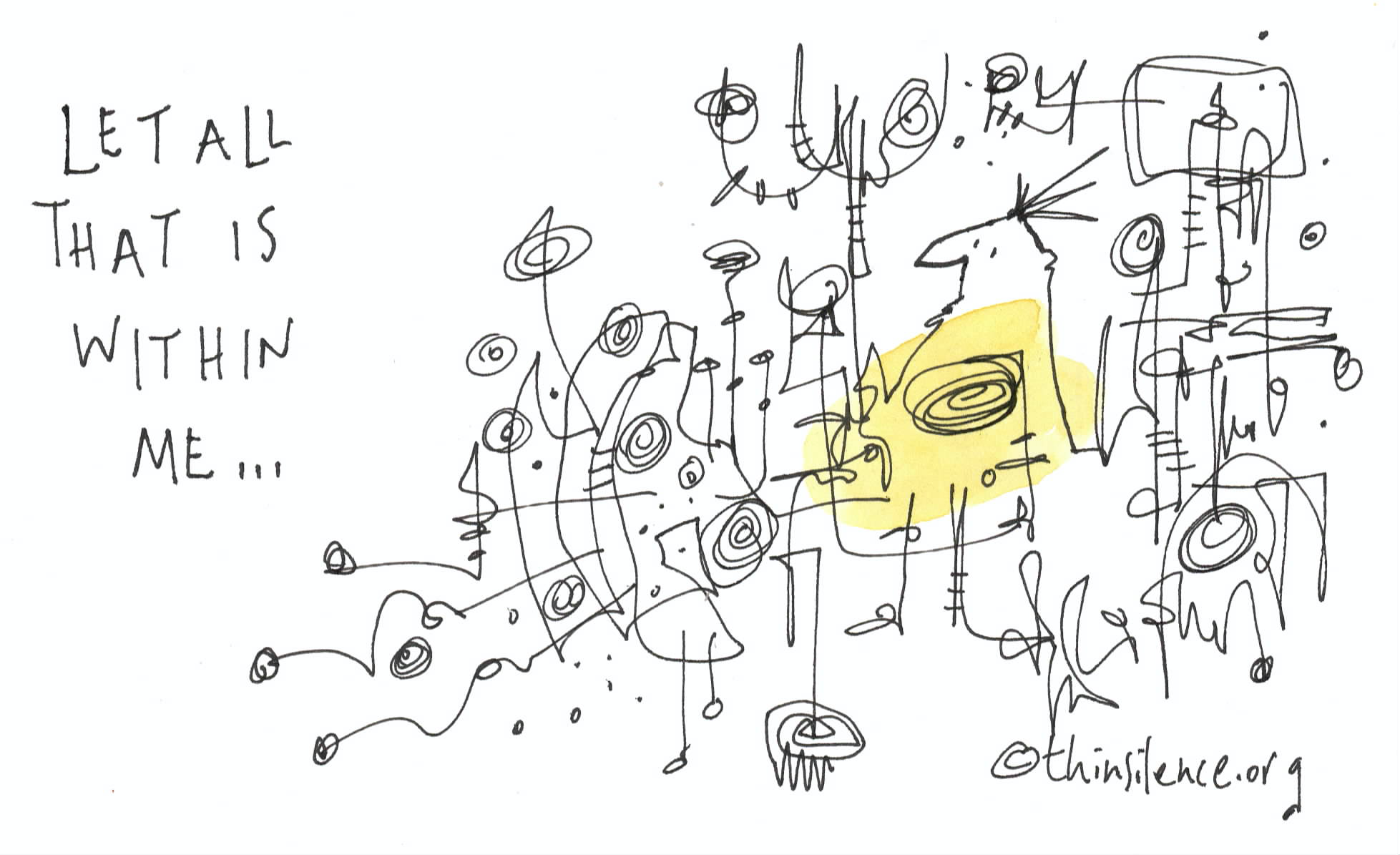
Why wouldn’t we want to take a little time out, look inside, connect with what’s important to us and then get imaginative in how we express this?

*Oliver Wendell Holmes, quoted in Martin Amor and Alex Pellew’s The Idea in You;
**Dolly Parton, quoted in Austin Kleon’s blog: On solitude and being who you are.

Is life a detour?

If you’re merely following [shortcuts], you probably won’t get anywhere interesting. It’s the detours that pay off.*
Seth Godin

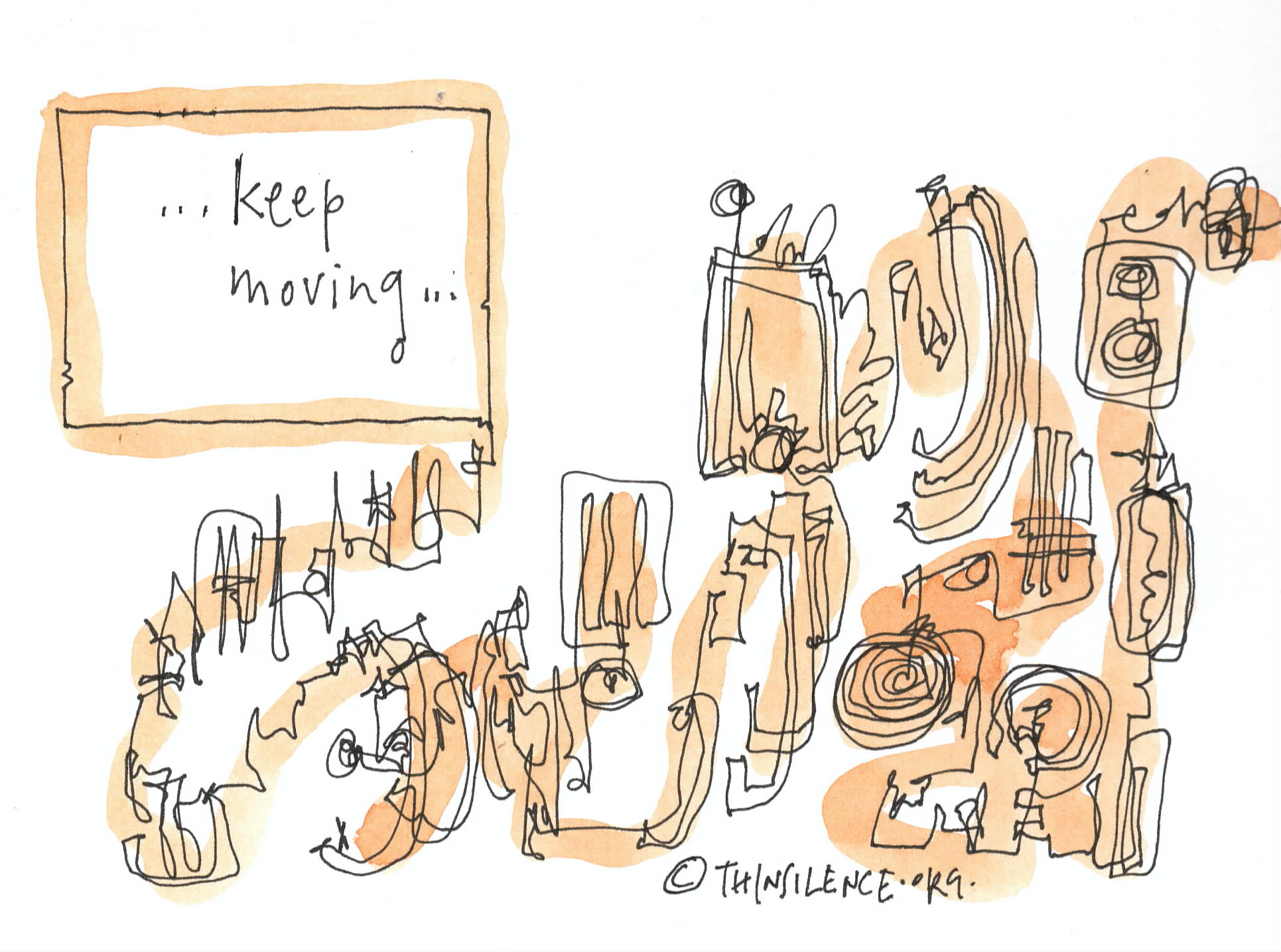
There’ve have been a lot of roadworks on routes I’ve been travelling recently, but no matter how much I wanted to ignore the detour and continue on my anticipated road, the detours turned out to be the most straightforward way for keeping moving.

Somehow these words from Eugene Peterson are connecting here:

As the scholastics used to say: ‘Homo non proprie humanus sed superhumanus est – which means that to be properly human, you must go beyond the merely human.**

*From Seth Godin’s blog: Actual shortcuts often appear to be detours;
**From Eugene Peterson’s Run with the Horses.

Just a doodle 15

One finger, one thumb, one hand, one arm, one leg, 
One nod of the head, then turn around, keep moving. 
One finger, one thumb, one hand, one arm, one leg, 
One nod of the head, then turn around, keep moving. 
One finger, one thumb, one hand, one arm, one leg, 
One nod of the head, then turn around, keep moving. 

Man and society are resurrected every moment in the act of hope and of faith in the here and now; every act of love, of awareness, of compassion is resurrection; every act of sloth, of greed, of selfishness is death.*
Erich Fromm

*From Erich Fromm’s The Revolution of Hope.

Just a doodle 14

First, pay close, foolish, even absurd attention to things. Then allow their structure, form, and nature to set the limits for the experiences you derive from them. By refusing to ask what could be different, and instead allowing what is present to guide us, we create a new space.*
Ian Bogost

*From Ian Bogost’s Play Anything.