The idea is simple: You have a purpose so big and inspiring it transforms your entire life.* Ben Hardy
An overnight success almost never is. Might as well plan for the journey.** Seth Godin
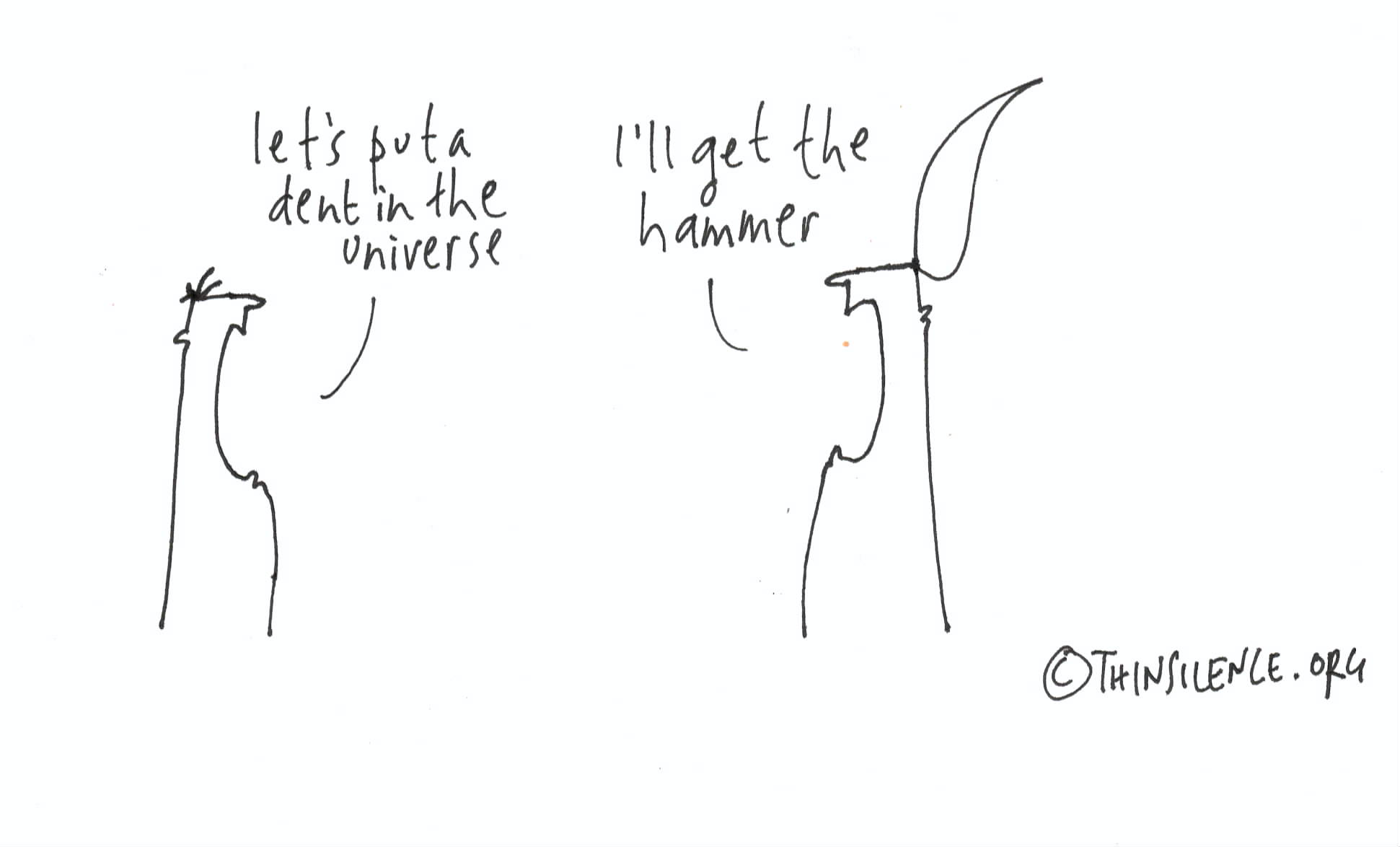
We’re told it’s possible to put a dent in the universe.
This is highly unlikely.
The only one I can think of is the collaborative dent we’re presently working on by messing up your only home.
That being said, it doesn’t mean we can’t live a meaningful life: human consciousness asks of us that we do.
We may search for meaning in ourselves but we’ll be disappointed:
An ethnographer studies others; a flâneur searches for self in others.^
meaning has to be located outside ourselves – discovered in the world rather than in our own psyches … the more we forget ourselves, by dedicating ourselves to an external cause or to people we love the more we actualise ourselves. “Self actualisation,” [Viktor Frankl] sums up, “is possible only as a side-effect of self-transcendence.”^^
So we look around –
Look with all your eyes, look.*^
and we begin to notice we are more curious and interested in some things over others, with echoes of these turning up in our values, our talents and our energies, and so we choose to begin living in these directions.
[C]atastrophization is a reasonable response–until it begins to undermine the work we need to do. … The best way to care is to persist in bending the culture and our systems to improve things over time.* Seth Godin
A hero is someone who has given his or her life to something bigger than oneself.** Joseph Campbell
“Don’t turn a mountain into a molehill.”
Bad things happen, but we cannot live in catastrophe: for something to be a catastrophe there has to be a lot of inaccuracy, even untruth present: “I messed up at work, now I’m gong to lose my job.”
The valuable but hard work is using the issue, problem, difficulty, to grow ourselves into our “suchness:”
Here lies the connection between beauty and truth. Beautyis not the opposite of the “ugly,” but of the “false”; it is the sensory statement of the suchness of a thing or a person.^
The opposite of a catastrophe may not be a molehill but one of your finest moments.
their end-of-the-day fatigue comes from satisfying work and endeavours, not from being shut up in too small a mind-set, job or relationship* Clarissa Pinkola Estés
because I have eyes, I have the need to see; because I have ears, I have the need to hear; because I have a mind, I have the need to think; and because I have a heart, I have the need to feel. In short, because I am a man, I am in need of man and of the world** Erich Fromm
Clarissa Pinkola Estés’ wild women are not out of control, but in their true nature. Equally, Erich Fromm’s multi-gendered “man” is similarly connecting.
We may think of smart phones as providing incredible connectivity, but we have always been instruments of deep connection, as Kelly Bird makes visible when she observes:
Source: Life force. Around us, in us, a wellspring of energy to tap into at any minute.^
As John Muir understood more than a century earlier:
This was my method of study. I drifted from rock to rock, from stream to stream, from grove to grove. … When I discovered a new plant, I sat down beside it for a minute or day, to make its acquaintance and try to hear what it had to say. …. I asked the boulders I met, whence they came from and whither they are going.^^
We may judge this strange talk, but there is nothing stranger than a creature denying its creatureliness, its natural state … disconnected.
Start by learning to recognise what interests you. Most people have been taught that what they notice doesn’t matter, So they never learn how to notice, Not even what interests them. Or they assume that the world has been completely pre-noticed, Already sifted and sorted and categorised By everyone else, by people with real authority. And so they write about pre-authorised subjects in pre-authorised language.* Verlyn Klinkenborg
You know what I’m gong to say:
You don’t have to be a writer for these words to lead you into your future.
When you notice what you are noticing and give expression to this, you are forming the path you must walk.
No two human beings ever experience two sensations, experiences, feelings, or thoughts identically. Everything changes. Everything is always different* Keith Haring
If your music comes from your heart and soul, and if you feel it inside yourself, it will affect others in the same way.** Robert Schumann
Difference and sameness.
These contrary words from Keith Haring and Robert Schumann set me on a journey of thinking about the general and the specific this morning, taking me back to the beginning of this journey I have find myself on. Knowing the general thing I needed to be about in my work, but not the specific, the thing needing to be discovered within it.
Richard Sennett writes about two people whose lives were generally connected by their valuing of walking, but specifically were quite different:
[Jean-Jacques Rousseau] portrays walking as a spur to contemplation; just for this reason Rousseau liked walking in the country, without the distractions of the city. A contrary kind of walker appeared in the person of Rétif de la Bretonne, Rousseau’s contemporary, who walked the city like a miner prospecting for gold, hoping to enrich his self through immersing himself i unfamiliar scenes.^
The general is important as a place to begin, but the specific is more important as a way to continue.
I have often described my specific path as a journey in the same direction, and, coming upon some words again from Lauren Elkin this morning, have been helped to see how a path can have many turns and directions and yet lead in the same direction, which is towards the centre:
But a labyrinth is actually an arrangement of paths that lead you to their centre. You can’t get lost in them; they are comprised of only one winding corridor. It slows you down. That’s all.^^
The slowness is very important, enabling us to notice more, towards becoming more specific, otherwise we’d keep hurrying generally along.
In a labyrinth, it is possible to feel ourselves very close to the centre but as we continue along its path, we are flung out towards the edges, only later to find ourselves moving towards the centre again. It can feel like many paths for this reason, but we come to understand it to be only one, and it is here that the deepest of changes, the most wonderful of beginnings, can take place.
You will know when it is time to bring to birth the new creation. The signs will be all around you, urging, insisting: Now is the time. You have to know just when to bear down And concentrate on one thing onl. It takes labour, hard, hard labour to bring to birth something new.*^
The boundary lines have fallen for me in pleasant places; I have a goodly heritage.*
Given the uniqueness of each of us, it should not be surprising that one of the greatest challenges is to inhabit our own individuality and to discover which life-form best expresses it.** John O’Donohue
Home inventionibus: one who quests.
Within our industrialised systems of education, work and society, there is a distinct possibility that we live well within our boundary lines and heritage.
Our quest, then, is to rediscover these, not only for ourselves, but also for each other.
Here are some words that came together in my reading this morning:
Heroes use systems, they aren’t held back by them.^
Not the usual way we think of heroes. Yes, there’s the danger of watering down the power of heroism, but there is also the possibility of missing the ordinary, often subserve, deeds that people bring into every day.
Oliver Burkeman writes of those who immerse themselves in a hobby:
In an age of instrumentalisation, the hobbyist is a subversive: he insists that some things are worth doing for themselves alone, despite offering no pay-offs in terms of productivity or profit.^^
No productivity!
No profit!
Aaagh!
Philip Newell writes of our quest to rediscover our boundary lines and heritage in nature:
There is hope for the human journey to the extent that we come back into true relationship with the earth’s wildness.^^
Clarissa Pinkola Estés writes of the quest of women to find the wildness of their boundary lines and heritage:
[Women] were kept as fallow gardens … but thankfully there was always wild seed which arrived on the wind.^*
I found myself contemplating this morning’s rising sun as being subversive while it seeped through the trees near my home on an otherwise overcast day: the branches and buds shone like gold. It was on a quest to transform.*^
May you explore to the edges of your boundary lines and goodly heritages, and enable others to rediscover theirs.
One cannot help being suspicious that often the attraction of the computer-man idea is a flight from life and from humane experience into the mechanical and the purely cerebral.* Erich Fromm.
The more specific the vision, the more clear the path and the more potent the motivation. You choose your purpose and then you give your whole soul to that purpose. In due time, you’ll transform.** Ben Hardy
My gut feeling is that the things that will move us into the possibility of being the most human we can be are likely to be more low-tech than high-tech: journals and pens, books, places of silence, spaces for making, disciplines and habits, mutual relationships.
if we get these things right then the high-tech stuff supports us and works for us, get it wrong and the technology crushes our less developed interior.
There is … a peculiar modern phenomenon that might best be described as a culture of competitive trauma. In recent times, the touching human longing for sympathy, that impulse to have our suffering recognized and validated, has grown distorted by a troubling compulsion for broadcast-suffering and comparative validity. Personhoods are staked on the cards dealt and not the hands played, as if we evolved the opposable thumbs of our agency for nothing. Maria Popova
We can be pushed around by our unhelpful thoughts and feelings, believing the only thing left to us is to distract ourselves in some way.
Of course, these thoughts and feelings are our own lives trying too protect us, but in a really unhelpful way.
We end up a victim forgetting our opposable thumbness, our imaginations often being the first victim of anxiety and stress.
Here’s one way to become an agent rather than victim:
Write the thought down in a succinct way
Sit with this thought a moment and feel the discomfort or pain it brings.
Write it out again, with the words “I am having the thought that … ” in front of it; pause and notice any difference.
Then write the second sentence again, perhaps in a coloured pencil, with the words “I am noticing that … ” in front of it; pause and notice any difference.
If this has been helpful, what will have happened is that you will have unhooked somewhat from the thought, which is helpful because a thought isn’t how things are, but simply a thought.
If you would like to take this further, try some mindful doodling.
One way is to turn the unhelpful thought into its positive and helpful opposite. This will become the text for your doodle.
Doodling because we can all do it and the idea is that it only has to take a few minutes.
And it’s still your thought, which is why this is a valid thing to try.
Write this out where you want it to sit on your sheet of paper. Perhaps along the top or bottom, top left, bottom right in a box?
I pencil a lot of my doodles out first of all, just to play with the basic idea.
You can also work with the original thought in an ironic or satirical way, which also allows you to be the agent rather than victim.
They don’t know what they don’t know, until they find out they don’t know it.* Dave Trott
A deep life is a good life.** Cal Newport
Georges Perec spent three days in October 1974 exhausting all he could see in a place in Paris.
He wasn’t focusing on the buildings and monuments as a tourist would, but what around and between these:
A 96 goes by. An 87 passes by. An 86 passes by. A 70 passes by. A “Grenelle Interline” truck passesby. Lull. There is no one at the bus stop.
A 63 passes by. A 96 passes by.
A young woman is sitting on a bench, facing “La demure” tapestry gallery; she is smoking a cigarette.
There are three mopeds parked on the sidewalk in front of the café.^
Even so, I can only imagine Perec missed many things, including days four, five and six. And what if I were to replicate his experiment today?
There is so much to be observed and Perec captured these three days in such a way so that I am able to see what he was seeing almost forty eight years later.
We may not want to spend three days observing a public space in the town or city where we live, but Perec’s experiment is valuable providing the basic means and practice to be open to where we are: a situation we inhabit, a person we meet, a problem that challenges us.



 THIN|SILENCE
You must be logged in to post a comment.