Making generative oddkin

If all matter in the universe were the Gobi desert, life would be but a single grain of sand.*
Maria Popova

Maria Popova’s dramatic and critical measurement
reminding us of our smallness,
Hidden, as we are, amongst all that is,
Also served to bring a happy memory from yesterday
when I noticed two book titles sitting side by side on my bookshelves
for no other reason than I had misplaced one of them by author –
My simple way of putting my library together.

Too Big to Know by David Weinberger
followed by
Too Small to Ignore from Wess Stafford.

The former explores the future of knowledge in a connected world,
In which “the smartest person in the room is the room,”**
Whilst the latter tells the story of the children’s charity Compassion International,
Including the words of a Haitian child that shocked Stafford:
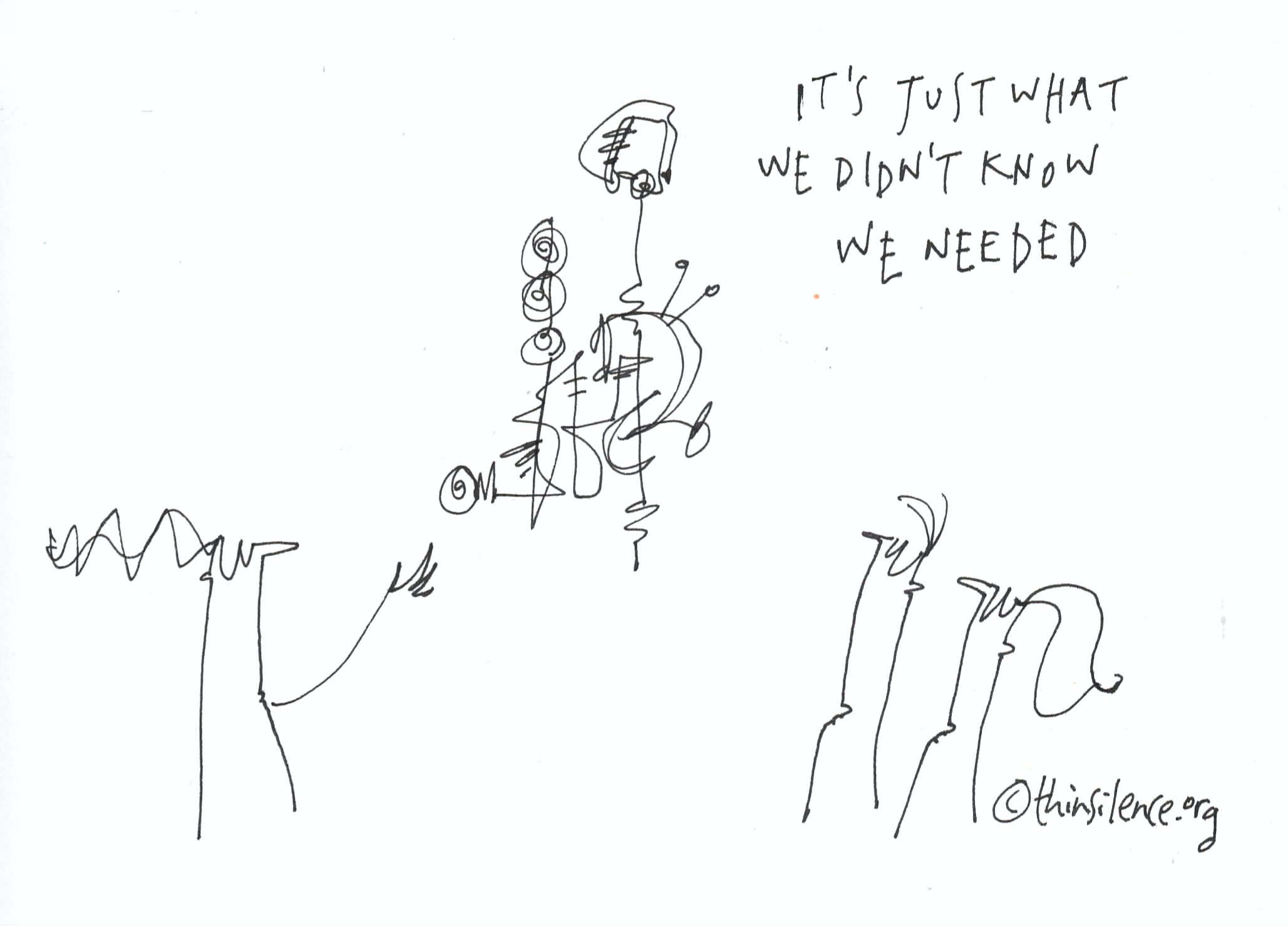
“I have nothing you need.”

No-one knows everything, but we all know something,
And our connection is imperative.
Hence generative oddkin,
A phrase Alan Jacobs passes on from writer Donna Haraway,
A call to be open to the other
and to stay awhile.

*From Maria Popova’s The Marginalian blog: Highlights in Hindsight: Favourite Books of the Past Year;
**From the subtitle of David Weinberger’s Too Big to Know.

Persons of density

I am going to try to convince you that the deeper your understanding of the past, the greater personal density you accumulate.*
Alan Jacobs

The more we only live in the present
the lighter we are,
The more weightless we become –
If we only listen to ourselves,
Or to people who are just like us.

The past makes it possible to be what Angela Duckworth describes as becoming
people with grit:
Possessing both passion and perseverance,
More than what we are,
Also what we might become.

When we get it wrong –
And we will get it wrong –
Knowing the past also helps us to know where to go for the forgiveness we need
to start over.

*From Alan Jacobs’ Breaking Bread with the Dead.

Adding some whimsy to the flimsy

whimsy
/ˈwɪmzi/
noun
1. playfully quaint or fanciful behaviour or humour.
2. a whim.

Meeting at an international chaplains conference,
We were talking about how to help art students
step out of the pressure of producing.

I mentioned mindful doodling,
Ruth remarked on how this sounded flimsy,
Proffering go with the flimsy.

I so had to doodle that,
Adding a little whimsy along the way.
Ruth came to me the next morning with a poem.

You’ve got to love what’s possible
in the flimsy.

Go with the flimsy

Go with the flimsy

Hold it lightly

Let joy dance on your fingers

Channel the mischievous 

Go with the flimsy

The flighty

The firmly fun

Forget the final

You are more than what you produce

Enjoy the process

Of letting go

Of pen on paper

Of heart and head connection

Imperfection is freedom

(Ruth Wells)


I’ll share more tomorrow about this tomorrow.

Don’t be a stranger

And no matter how hard you look, you’re almost invisible
to yourself,
Camouflaged by familiarity.*

Verlyn Klinkenborg

When you feel the rush of fear as you put your point of view, your art, or your idea out into the world, this is not an invitation to step back into the shadows; it’s a sign that you’re at the edge, right where you should be, exploring how things might be.**
Martin Amor and Alex Pellew

It is too easy to hide.

Some hide in quietness,
Like me,
Others in noise.
Some hide in fear,
Others in a belief
they have nothing to bring.

But there is more to each of us,
More than we know ourselves,
More than a whole lifetime can uncover
in the hidden, secret, dark places of our lives.

I tell myself,
There is still time to stop hiding –
This is certainly true.
There is even more if I begin today.

*From Verlyn Klinkenborg’s Several short sentences about writing;
**From Martin Amor and Alex Pellew The Idea in You.

On originality

There is no blank slate upon which works of true originality are composed, no void out of which total novelty is created. Nothing is original because everything is an influence; everything is original because no influence makes its way into our art untransmuted by our imagination.*
Maria Popova

Each of us is an artist of our days; the greater our integrity and awareness, the more original ad creative our time will become.**
John O’Donohue

Open the space of your originality,
Be as open as open as possible
to as many and as much
for as long as possible.

May you find the relationship with all that is,
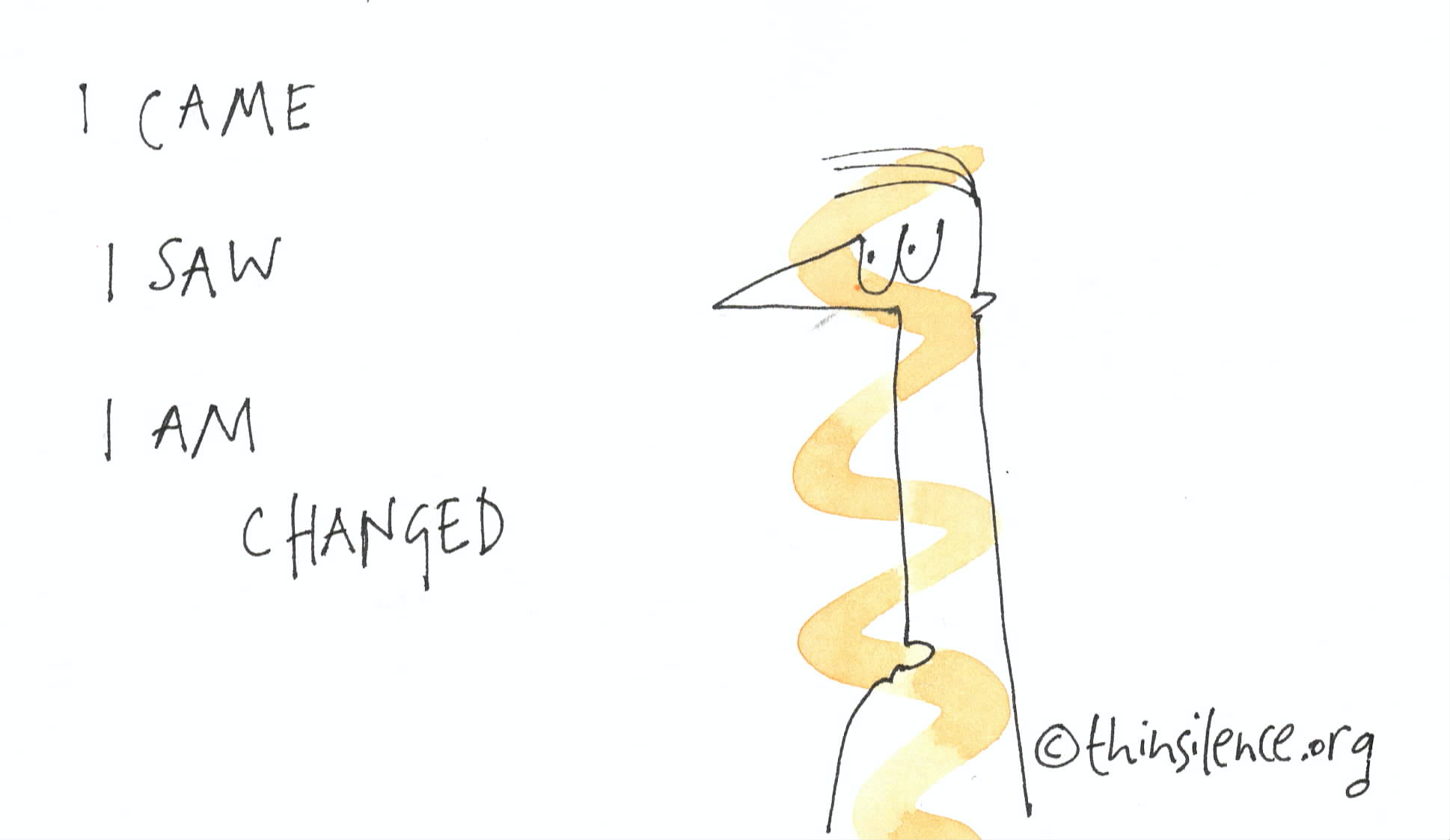
So that you will be both changed
and changer.

*From Maria Popova’s The Marginalian blog: Nick Cave on Creativity, the Myth of Originality, and How to Find Your Voice;
**From John O’Donohue’s Benedictus.

How to become a sorcerer

No vulnerability. No courage. We have to show up and put ourselves out there.*
Brené Brown

Once you decide you can’t, you’ve pretty much guaranteed you won’t.**
Kelvy Bird

Sorcerers are not magicians.

They know nothing of trickery and illusion,
Or finding a lamp with three wishes within.

They do know that it’s about turning up,
Staying longer than everyone else,
Failing, learning, trying again,
Before turning what they have into something
beautiful and hopeful.

*From Brené Brown’s Braving the Wilderness;
**From Kelly Bird’s Generative Scribing.

Me and my dragon

When you have named your dragon, how will you face it?

Stephen Gilligan and Robert Dilts name six archetypes:

a. The Innocent (doesn’t know the dragon exists)
b. The Orphan (overwhelmed or consumed by the dragon)
c. The Martyr (persecuted by the dragon)
d. The Wanderer (avoids the dragon)
e. The Warrior (fights the dragon)
f. The Sorcerer (accepts the dragon)*

You will see how it is possible to be all of these at some point
in facing our dragon,
But arguably the healthiest,
or so it seems to me,
Is to become a sorcerer,
Using our alchemistic powers
to receive and transform the dragon.

(More to follow on what makes a sorcerer.)

*From Stephen Gilligan and Robert Dilts’ The Hero’s Journey.

A community of saints

Carl Jung used to say that one of the most important tasks for each person was to develop what he called a “community of saints.”*
Stephen Gilligan

I am grateful to those who accompany me on this journey.

For those I know as friends,
Whose conversations search me.

And for those I meet through their writings,
Some accompanying me for the length of a single book,
Others across years in a line of many tomes and blogs.

Openers of my mind and stirrers of my heart,
Helping me create and
making it possible to navigate the unpredictable course.

*From Stephen Gilligan and Robert Dilts’ The Hero’s Journey.

The power of one

There is something in every one of you that waits and listens for the sounds of the genuine in yourself. It is the only true guide you will ever have.*
Howard Thurman

The relationships of thinking and feeling are at the heart of the creative process in all fields, including the arts and the sciences.**
Ken Robinson

This is the story we find ourselves in.

Members of the hive,
Each is also one,
Genuine,
Unique.

Your genuine is not mine
and my genuine cannot be yours,
The somethingdifferent in every
one
of us.

In our thinking,
But beyond it.
In our feeling,
And yet beyond it.
Beyond,
In our openness to all
and everything
and everyone.

*Howard Thurman, quoted in Brian McLaren’s God Unbound;
**From Ken Robinson’s Out of Our Minds.