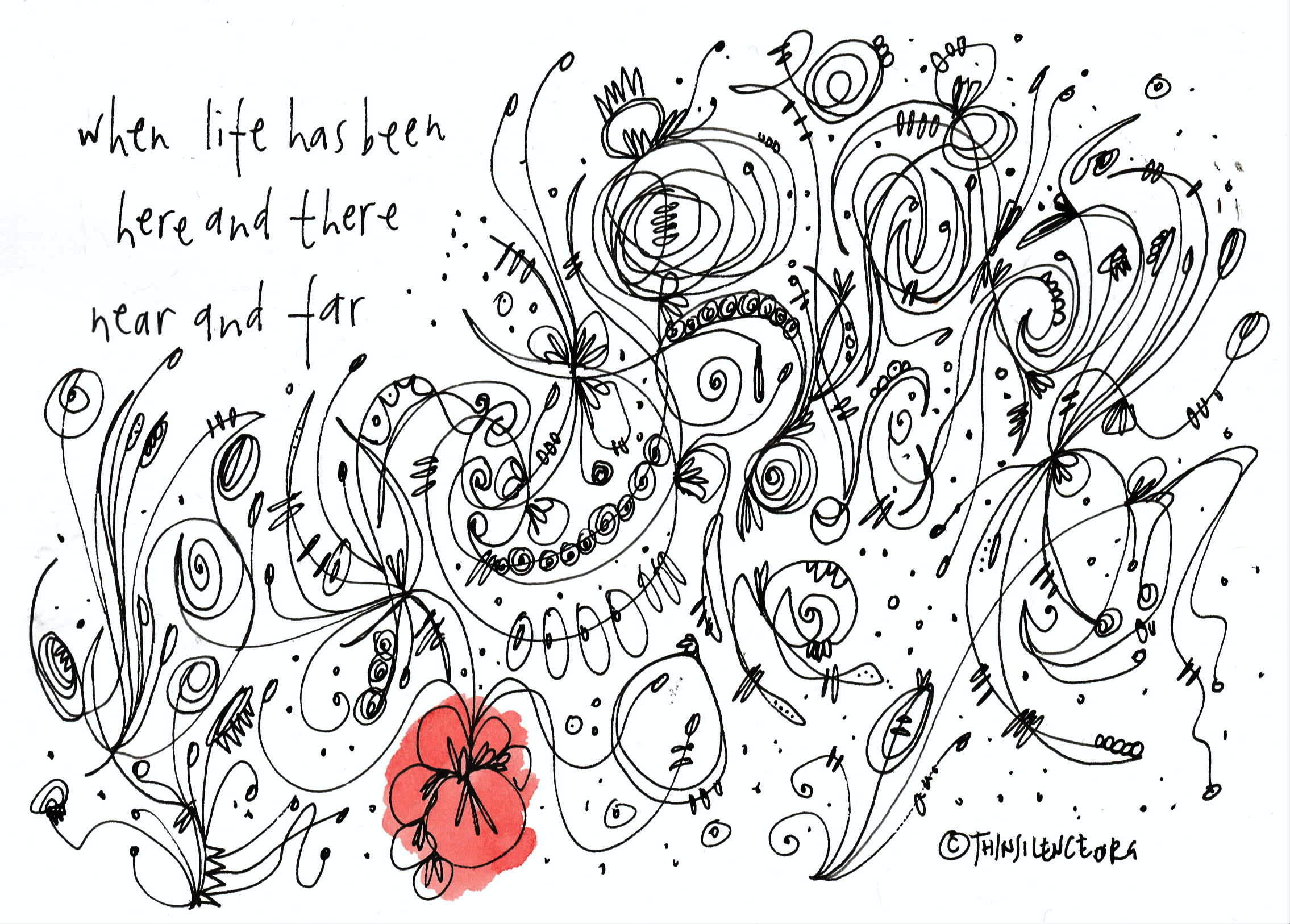
Give your awe a chance

Wonder is the heaviest element on the periodic table. Even a tiny fleck of it stops time.*
Diane Ackerman

Curation is the ultimate way of transforming noise into meaning.**
Rohit Bhargava

Through awe, we
shrink and
the world becomes
BIGGER.
Awe can be tripped by many
different things –
LARGE and small – from
the natural world to
human ideas and inventions.
Here are three benefits proffered by Jonah Paquette:
Among the different ideas that have been proposed, three explanations stand out today: awe strengthens our social bonds, makes us kinder and more generous to others, and fosters a sense of curiosity about our world.*
The trouble is, our opportunities for awe
are reducing.
Robert Marfarlane shares the findings of a report that
between 1970 and 2010, the area in which British children were permitted to play unsupervised shrank by 90 per cent. The proportion of children regularly playing in ‘wild’ places fell from one in two to one in ten.^
Perhaps a useful option,
Alongside all the fancy New Year resolutions, is to
take a slow walk more often –
We’ll not know where they lead until we
venture out.

*Jonah Paquette’s Awestruck;
**Rohit Bhargava’s Non Obvious 2019;
^Robert Macfarlane’s Landmarks.

Doorways and dens

As well as opening doors, the children made dens: the doors allowing access and adventures, the dens permitting retreat and shelter.*
Robert Macfarlane

Most of us then default to one of a handful of templates and filters for all their experiences; everything gets pulled inside what my little mind already agrees with.**
Richard Rohr

It seems that
the older we get
the more dens and fewer doors
populate our lives;
More of the familiar,
Less of the unfamiliar.
This need not be so – I hold on to the truth that
people are amazing, and
ought to know why –
This is both my joy and my work –
So we find our doorways and dens,
And begin moving between the two –
To leave the known for the wonder:
awe truly is all around us, if only we take the time to look,^
And to return into the secret place for reflection because we suspect,
the opposite of contemplation is not action – it is reaction^^.
So this movement to and fro creates
a larger story emerges,
A life continues to grow
amazingly.

*Robert Macfarlane’s Landmarks;
**Richard Rohr’s The Divine Dance;
^Jonah Paquette’s Awestruck;
^^Richard Rohr’s Immortal Diamond.

A year of playful practice

there’s a chance to work on our filters, our habits and our instincts*
Seth Godin

with panache: still be scratchy and instinctive, and badly behaved*
Quentin Blake

There’s a reason why the people you admire can
do what they they do.
Whatever their craft may be,
They’ve practised it,
Not only again and again,
But also from different angles and in
different media and modalities,
Developing new ideas and
innovative expressions along the way.
The good news is,
We can all practise.

*Seth Godin’s blog: The world as it is;
**Jenny Uglow’s The Quentin Blake Book
.

What’s grace got to do with it?

won’t you celebrate with me
what I have shaped into
a kind of life? i had no model.

i made it up
here on this bridge between
starshine and clay*

Lucille Clifton

Grace makes both the giver and the recipient more beautiful.**
Erwin McManus

I love Quentin Blake‘s simple drawing style,
something he came upon early in his days cartooning
for Punch magazine.
With a few lines and a little watercolour,
He is able to tell a story.
It holds an important truth
for us,
That when we find the lines and
add a little colour,
We come alive. These lines include
our abilities and
values and
energies,
And then we can make our own lines.
Whilst there’s nothing special about the
1st January 2023,
It can become defining if we want it to:
“From this day,
And for the following year, I will
…”
We all have lines and
colours; sometimes what we
only need to extend to
ourselves and to others is
a little grace.

*Maria Popova’s Figuring;
**Erwin McManus’ The Genius of Jesus.

Childlike

All he wants to do is draw. He is, thank goodness, unstoppable.*
Jenny Uglow

[I]t is another language altogether; impossible for adults to speak and arduous for us to understand. We might call that language ‘Childish’: we have all been fluent in Childish once, and it is a language with a billion or more native speakers today – though all of those speakers will in time forget they ever knew it.**
Robert Macfarlane

Though unstoppable,
He is also 90;
He is Quentin Blake.
Robert Macfarlane may be right to assert
we all lose our fluency, and then, remembrance
of that language Childish,
But I wonder whether there are some
amongst us, like Blake,
who retain more than a few “words and phrases” – of
curiosity and awe, of
wonder and imagination, of
questions and playfulness –
That they form and shape into that language
we might name Childlike,
To use garrulously throughout their years.

*Jenny Uglow’s The Quentin Blake Book;
**Robert Macfarlane’s Landmarks
.

How will you save the world?

Men wanted for hazardous journey, small wages, bitter cold, long months of complete darkness, constant danger, safe return doubtful, honour and recognition in case of success.*
Ernest Shackleton

In that special silence, you get a strong sense of something that wants to happen the you wouldn’t be aware of otherwise.**
Joseph Jaworski

Here’s a playful exercise,
Figuring out how what you do on a day-to-day basis would
save the world:
What do you want to save the world from?
What are your superpowers?
Who helps you to do this?
Who are you helping?
Directly or indirectly,
For large numbers or for the one –
We can all make the world a better place.
Adventures do not require us to
risk our lives crossing
Antartica,
More often, they’re available as we
turn up in our very familiar worlds
with greater intention as a result of
noticing more,
inwardly and outwardly.

*Maria Popova’s Figuring: it’s not clear whether Ernest Shackleton actually subscribed to such an advertisement;
**Peter Senge, Otto Scharmer, Joseph Jaworski’s Betty Sue Flowers’ Presence.

The burden of entitlement

“Oh, Mr Campbell, you just don’t know about the modern generation. We go directly from infancy to wisdom.” I said, “That is great. All you’ve missed is life.”*
Joseph Campbell

For by the grace given to me I say to everyone among you not to think of yourself more highly than you ought to think, but to think with sober judgement, each according to the measure of faith that God has assigned.**
The Apostle Paul

My father was born in 1909,
His father, whom I never knew, was
born in 1872.
This span of time has provided me a sense of how
much has changed
across the generations,
each having more than the one before.
Though I can easily forget,
I try to hold on to the wisdom from the past
that can help me to become more, rather
than to have more,
Wisdom I keep before me especially in these lines –
Which, counterintuitively, enlarge rather than constrict life:
Life is hard,
You are not as special as you think,
Your life is not about you,
You are not in control,
You are going to die.

Joseph Campbell gave his life to
understanding how critical myths are to us,
These stories helping us to find our
bliss,
Enabling us to live larger lives through
humility – the world doesn’t revolve around us, and
gratitude – we have so much if we bother to notice, and
faithfulness – serving one another:
Life is an expression of bliss.*

Few of us inherit the rich and complex mythologies that the Sanū pass on – the sense of the world alive around us, and of ancestors keeping a gentle watch residing in the very rocks were stand on, the very wind that buffets us. Most of us have to make our own, if we think to do it at all.^

*Joseph Campbell’s The Hero’s Journey;
**Romans 12:3;
^Katherine May’s Wintering.

It’s possible

School and work push us to avoid real dreams. Dreamers are dangerous, impatient and unwilling to tolerate the status quo. Existing systems would prefer we simply fit in. The dreams we need to teach are the dreams of self-reliance and generosity. The only way for us to move forward is to encourage and amplify the work of people who are willing to learn, to see and to commit to making things better.*
Seth Godin

Every move an infinite player makes is towards the horizon. Every move made by a finite player is within a boundary. Every moment of an infinite game therefore presents a new range of possibilities.**
James Carse

It’s not that some have way more attributes than others,
It’s that some know how to
make the most of what
they have noticed about themselves:
They have stepped towards the horizon and
the horizon has moved.
Seth Godin references the two dreams of
self-reliance and generosity;
These align with Theory U’s two questions –
Who is my True Self? and
What is my contribution?
And with Joseph Campbell’s two myths that we need,
These being the personal
and the social.
When we emphasise these in our lives,
then something new begins spinning
around and between the two:
possibility.

*Seth Godin’s blog: Our dreaming opportunity;
**James Carse’s Finite and Infinite Games.

The 12 days of doodling

Before writing and drawing were separated they were conjoined.*
Scott McCloud

Pictures and words together make a third thing.**
John Baldessari

It had been suggested that I write something
about doodling for a Christmas-time blog
at the University of Edinburgh,
So I thought that I would share this here – 
It’s a great time to doodle – So here we are: 
Twelve good reasons for doodling and 
twelve doodling things to do – 
all you need is a black pen and paper. 
Merry Doodling Christmas!

Day 1
Doodle comes from dawdle, 
It is a great way to come aside from all the
busyness and noise and slow down: 
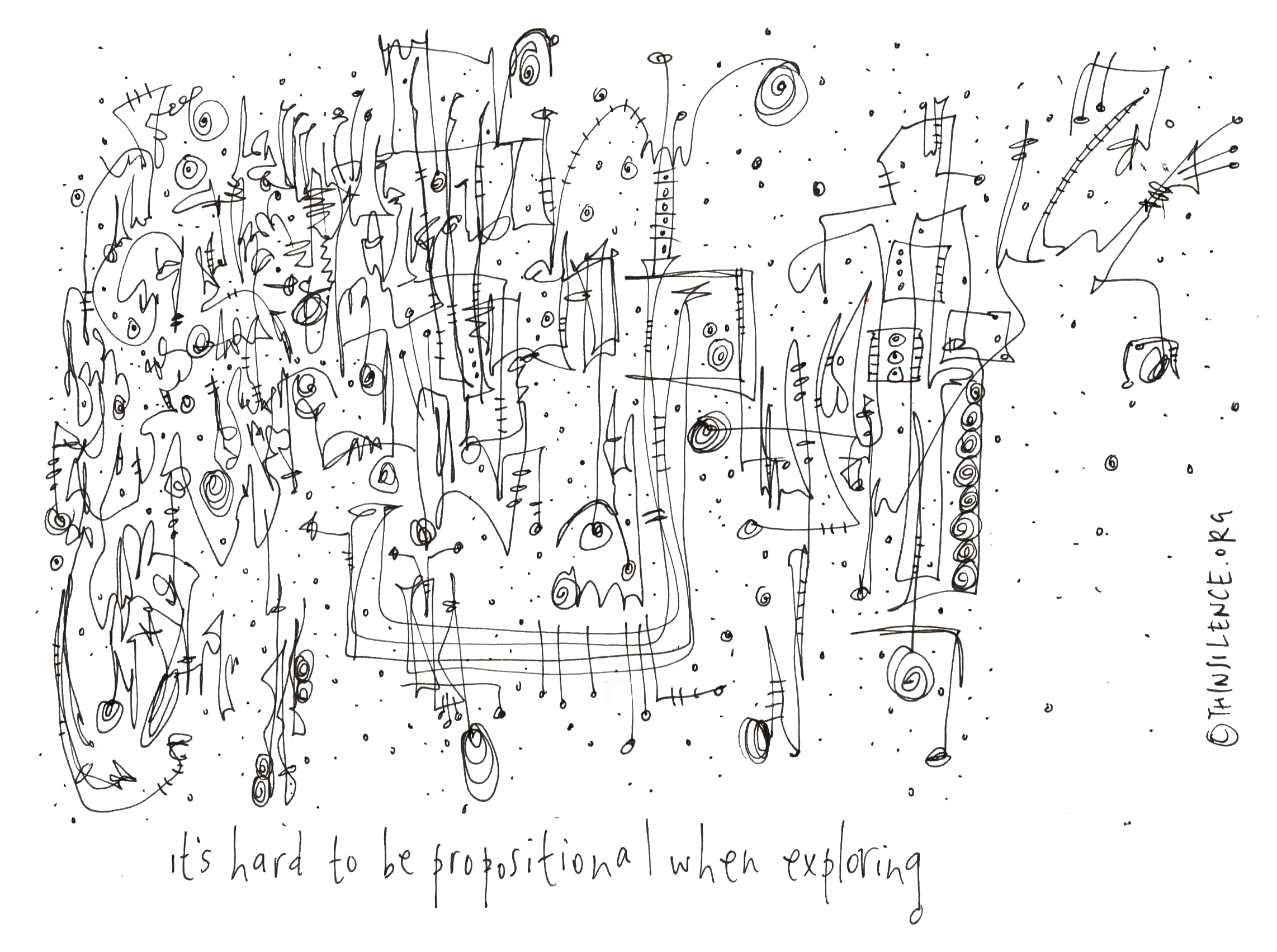
Use the doodle alphabet to create an abstract illustration,
Filling a 10x10cms square.^
Make it busy.

Day 2
Colouring in a doodle is for
relaxing. 
Slowly use crayons, pencils or pens to 
colour in yesterday’s doodle, and
see how it changes; 
Notice how you change:
Changing what the body does can change our feelings, perception, and thoughts.^^

Day 3
Colouring is for relaxing,
Doodling is for listening,
But there are six other art-for-learning skills:
A means to record,
Understand better,
Create something, 
Present something.
Add your doodle to the following text by way of illustration:
Before writing and drawing were separated they were conjoined.*

Day 4
Doodling is one of the smallest ways of moving,
And moving is one way we extend our minds 
and keep our thoughts moving.
Draw an A5 frame on a sheet of paper:
You have one line with which to fill this shape – 
You can’t break contact, so
You’ll be able to use all the shapes from the doodle alphabet except 
the dot: 
Write the words, “Keep Moving” on your sheet. 

Day 5 
Doodles and text together take us 
into the world of semiotics, 
In this case,
Conveying meaning in as few words of possible,
Enhancing with a doodle.
Try copying this doodle from Hugh Macleod*^ 

Day 6
We remember more when doodling: 
One study found that people who were directed to doodle while carrying out a boring
listening task remembered 29 percent more information than people who did not doodle,
likely because the latter group had let their attention slip away entirely.^^
Write out the following Jean Rhys quote,
Create a doodle to go with it
The hide this and recall all the objects, 
Including those you imagined to be present: 
I got a box of Jnibs, the sort I liked, an ordinary penholder, a bottle of ink and a cheap ink-stand.  Now that old table won’t look so bare, I thought.^*

Day 7
Just about everything looks better with an illustration;
Check out the novels of Edward Carey
For which he prepares both
illustrations and sculptures to help his writing process. 
Create a character or two of your own by firstly
copying Quentin Blake’s illustrations

Day 8
There are doodling shapes everywhere. 
I took a load of pictures of buildings and spaces whilst on holiday 
in Florence and at a conference
in Washington, which I later used to create
a colouring book.
Why not get out your holiday pictures and 
use the features of buildings and spaces to create 
your doodle for today? 

Day 9
You can doodle anywhere – 
All you need is a small notebook and a black pen.
Hugh Macleod began doodling on the back of 
business cards, and still creates images that are this size.
Play with small doodles by cutting out some paper
or card
the size of a bank or loyalty card. 

Day 10
You never know where doodling will lead you.
I ended up with illustrating requests for books and 
even a board game. 
Doodle often, don’t worry about what others think, 
Don’t look at likes or anything, just 
doodle.
Create a doodle with the text:
Doodling with attitude. 

Day 11
Everyone can doodle;
It’s simply a sad fact that
someone, somewhere, told us that we couldn’t draw:
How old do you have to be to make a bad drawing?
If you can remember who or when,
Create a doodle that has on the left when you 
stopped drawing and on the right has 
today’s date – 
Then go crazy doodling. 

Day 12
Doodling is for Christmas; 
For several years now I have created a Christmas card. 
Here’s your turn for Christmas 2023 – 
or Yule or Winter or Solstice or Hannukah or 
Dongzhi or Shab-e Yalda. 
Have fun and a great holiday however you
celebrate.  

*Scott McClooud’s Making Comics;
**Austin Kleon’s blog: A brief appreciation of John Baldessari:
^The doodle alphabet comprises a: square, circle, straight line, curved line, wavy line, dot, ellipse, cloud, zigzag, swirl, loop, arch; everything you need to create a doodle;
^^Annie Murphy Paul’s The Extended Mind
*^Hugh Macleod triggered my doodling; copying his work is a great place to develop our own doodling; 
^*Lauren Elkin’s Flaneuse.  
⁺Lynda Barry’s Making Comics.