There’s a lot of truth around and we all have some of it, but no-one has all of it

On a quest, the process of transformation is at least as important, maybe more so, than the destination we’re trying to reach.*
Sunil Raheja

“So far” and “not yet” are the foundation of every successful journey.**
Seth Godin

“But it’s true!”
So what,
Badness is true, but we don’t want more of that,
We want
more goodness –
Humility, gratitude and faithfulness are truths that show
much promise.
The best truth transforms us in this direction
and is always a work in progress.
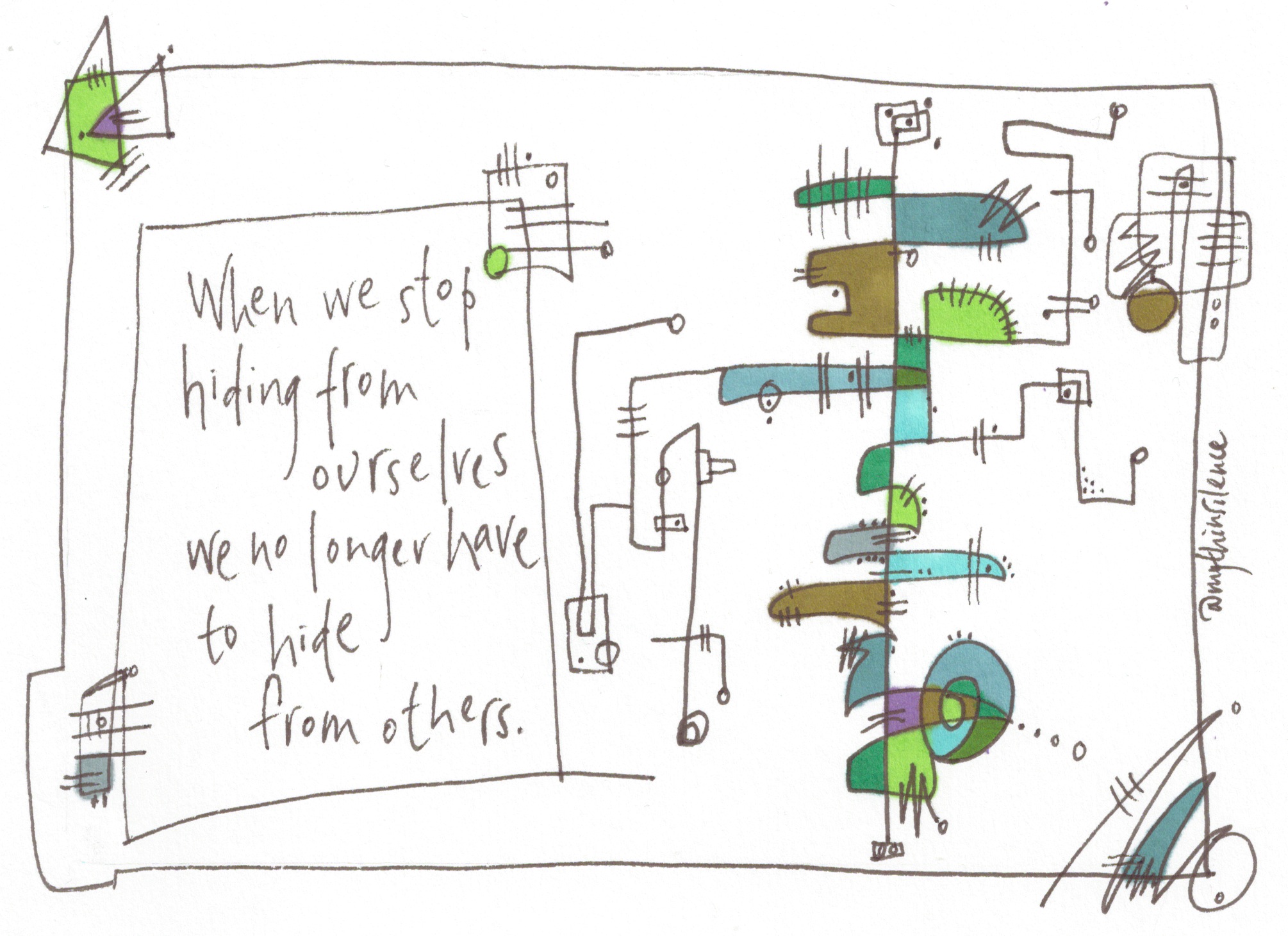
If I see you’re really trying hard with your truth
then it may well set me a little more
free.

*Sunil Raheja’s Dancing With Wisdom;
**Seth Godin’s The Practice.

Something wildly wonderful in you

The best stories are vulnerable but not raw; they come from scars not wounds.*
Bruce Feiler

Almost everyone is screwed up, broken, clingy, scared, and yet designed for joy.**
Anne Lamott

The things we’ve got wrong,
The messes we’ve made,
The errors we’ve perpetrated,
The flaws that adorn and decorate our lives,
These work against us,
Dictating our teleos,
Reducing our options –
Right?
It seems not;
There is not only reality but also
imagination –
Story,
And when these play together, something
wildly wonderful emerges.

Mythology opens the world so that it becomes transparent to something that is beyon speech, beyond words – in short, what we call transcendence.^

*Bruce Feiler’s Life Is In the Transitions;
**Maria Popova’s The Marginalian: Anne Lamott on Forgiveness, Self-Forgiveness, and the Relationship Between Brokenness and Joy;
^Joseph Campbell: from Joseph Campbell and Bill Moyers’ The Power of Myth.

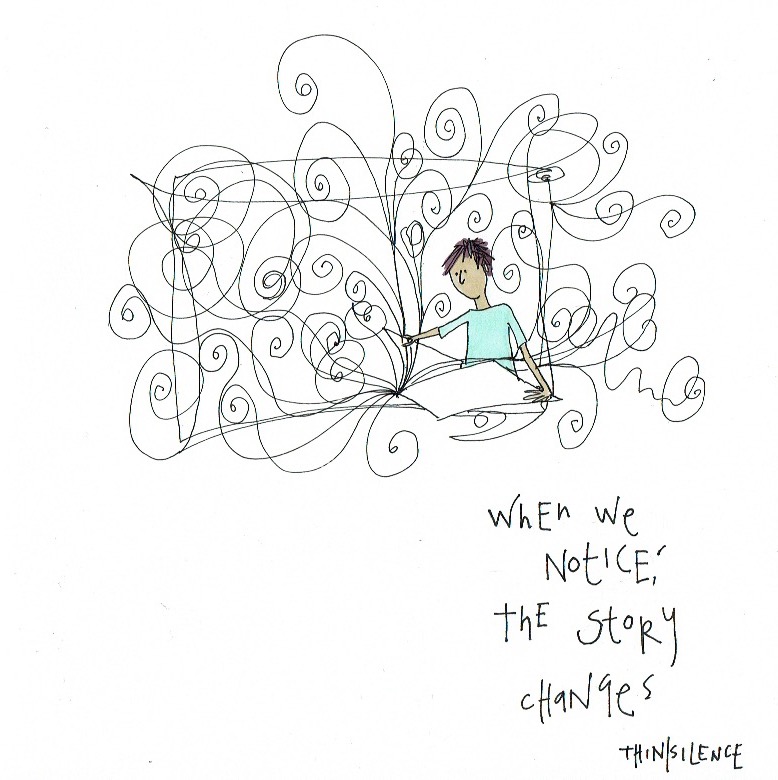
Trying on a new story

As our circumstances change, we need to tell our stories differently in order to bring out their timeless truth.*
Karen Armstrong

That’s what humans do: we make and remake our stories, abandoning the ones that longer fit and trying on new ones for size.**
Katherine May

Our ego, or false self, is the
enemy,
restricting, constricting
us to be less than we can be.
Each one of us struggles with false versions of our self,
Sunil Raheja’s^ four signs of egocentricity helping us to see
just how:
Playing the comparison game,
Defensiveness,
Needing to display our brilliance,
Needing to be liked and accepted.

These shape a story we find ourselves living within,
But the good news is that we can tells our stories differently.
It is possible to be the brilliant and unique person that
you are,
Shaped by
humility and
gratitude and
faithfulness.
Perhaps counterintuitively,
These remove the restrictions,
Setting us free.

*Karen Armstrong’s A Short History of Myth;
**Katherine May’s Wintering;

.^Sunil Raheja’s Dancing With Wisdom

Keep moving

Acknowledging the reality of the extended mind might well lead us to embrace the extended heart.*
Annie Murphy Paul

You have the right to remain silent. But I hope you won’t. The world conspires to hold us back, but it can’t do that without our permission.**
Seth Godin

I’ve been asked to write a blog about
doodling at Christmas,
So I thought to share
one of the things here that I’ll be including:
Doodling extends the mind.
And by Annie Murphy Paul’s argument,
Potentially the heart –
I would also add the will.
Here’s Paul’s list of mind extensions:
Interception (being more aware of what our body sensations are telling us),
Movement,
Gesture,
Natural settings,
Designing built environments,
Space of ideas,
Thinking with:
Experts,
Peers,
Groups.
Doodling appears as an expression of movement,
When we are stuck with text, we can keep our hand –
And our mind –
Moving with a doodle.
When we’re doodling, we’re listening,
We’re moving with what we’re listening to:

One study found that people who were directed to doodle while carrying out a boring listening task remembered 29 percent more information than people who did not doodle, likely because the latter group had let their attention slip away entirely.*

There are lots of other reasons why
doodling is good for us,
But I thought you’d like to know this one and
have a play.

*Annie Murphy Paul’s The Extended Mind;
**Seth Godin’s The Practice.

The game

Art is what we call it when we are able to create something new that changes someone.*
Seth Godin

Our society doesn’t teach us how to be an effective giver of gifts. The schools don’t emphasise it. The popular culture is confused by it.**
David Brooks

The maths are straightforward:
There’d be a whole lot more
good things in the world if
we were looking to give rather than get –
Things we haven’t even imagined as yet.
Another dimension to this is that
we don’t set up places to give what they can, because of
imposter syndrome” or “stereotype threat,”
We all miss out and the world
is a poorer place.
But the fact is
you’re in the game,
And that changes everything.

*Seth Godin’s The Practice;
**David Brooks The Second Mountain
.

What is the word for that?

Puhpowee, she explained, translates as “the force which causes mushrooms to push up from the earth overnight.”*
Robin Wall Kimerer/Keewaydinquay Peschel)

What lies behind us and what lies before us are tiny matters to what lies within us.**
Henry Stanley Haskins,

English does not have a word for the specific energy of a mushroom
but Potawatomi does.
Each person should have a special word to describe
their own unique energy.
A word can sometimes help us to see a thing more fully,
Not only what something is but what it also can be;
Find your energy,
Name it,
Live it,
Bababoom!

*Robin Wall Kimerer’s Braiding Sweetgrass;
**Sunil Raheja’s Dancing With Wisdom.

Give me the full story

when we listen to a story, our brain experiences the action as if it was happening to us*
Annie Murphy Paul

Julia Cameron’s morning pages help unlock something inside. Not the muse or a magical mystical power, but simply the truth of our chosen identity. If you do something creative each day, you’re now a creative person. Not a blocked person, not a striving person, not an untalented person. A creative person.**
Seth Godin

Stories are not only for
entertainment,
Research is showing that we learn more when the facts are presented
as a story,
We also remember more.
It’s why dreamwhispering doesn’t bring a person
to a list list of
talents, energies and values, but to
their story.
When we write these down, not only do we find clarity,
We also find intent:
On your marks,
Set,
Go.

*Annie Murphy Paul’s The Extended Mind;
**Seth Godin’s The Practice.

A collage of words

The human soul is hungry for beauty; we seek it everywhere – in landscape, music, art, clothes, furniture, gardening, companionship, love, religion and in ourselves.  No one would desire not to be beautiful.  When we experience the Beautiful, there is a sense of homecoming.*
John O’Donohue

Living a good story … is more like writing a good story. And writing a good story happens when a writer has created the disciplined habit of sitting down to do the work.**
Donald Miller

A collage usually involves pictures being used
to create a new image,
But why not do the same with words?
I am encouraging people who begin dreamwhispering
to firstly find and commit to some form of writing out their experiences and thoughts, also
bringing the best of what they are reading or
listening to, and also
mixing some doodles in.
Writing connects our inner and outer worlds in
powerful ways.

*John O’Donohue’s Divine Beauty;
**Donald Miller’s Hero On a Mission.

Something somewhere

Tackling the correspondence problem involves breaking down an observed solution into its constuituent parts, and then reassembling those parts in a different way … an ability to apply that underlying principle in a novel setting.*
Annie Murphy Paul

We don’t want to feel less when we have finished a book; we want to feel that new possibilities have been opened to us.**
Madeleine L’Engle

When the pressure’s on
us
or on a
system,
we see the truth of
how things are:

“Connais-toi pour t’ameliorer” (“Know yourself to improve yourself”).^

Then follows the decision:
Do we accept this or
do something about it?
If we want to do something about it,
A good place to begin is by
copying others,
To imitate those who are ahead of us.
Dreamwhispering does this,
Borrowing from anywhere and
everywhere.
This is solving the
“Correspondence problem,”
How that over there might work over
here.
Of course, we’re doing this all the time
in many small ways –
Such as changing something about yourself after reading a book;
What this is suggesting is that
we do it in big ways, too.
To be able to innovate in this way is itself a
creative act.
Towards copying,
Don’t see the way something is being expressed or used
as being the only way;
even words used for a totally different purpose
than the one you have in mind
can inspire and guide:

When you get past making labels for things it is possible to combine and transform element into new things. Look at things until their import, identity, name, use, and descriptions have dissolved.^^

Whatever the reality you are facing,
There is something, somewhere,
Waiting to improve things.

*Annie Murphy Paul’s The Extended Mind;
**Madeleine L’Engle’s Walking on Water;
^Alain de Botton’s Religion for Atheists;
^^Corita Kent, from Corita Kent and Jan Steward’s Learning By Heart.

Always asking, always seeking

It is about discovering and living all that we are intended to be, with awe and wonder.*
Sunil Raheja

I praise you, for I am fearfully and wonderfully made. Wonderful are your works; that I know very well.**

To live in awe and wonder is our
mission,
Our quest.
Yet there is no such thing
as a “quest superstore”
in which we browse the shelves until we find the quest
to suit us best of all (job done),
Even though our education system suggests this is
how it is –
We must try things and notice things and
pursue things.

It is not objection to say that a man is not merely a person in general, but a person finding himself in a particular situation. … He only exists by changing himself, and only by remaining unchanged does he exist.^

Alain de Botton speaks the truth we need to hear:

good art is the sensuous presentation of those ideas which matter most to the proper functioning of our souls – and yet which we are most inclined to forget, even though they are the basis for our capacity for contentment and virtue^^.

There is something in each of us that
matters deeply to us and which
we cannot shake,
Even though we may sometimes forget,
And when we do
then we must go to the deep places of our lives:

Though so much else is in motion in the mind and the senses, the hidden heart never loses sight of us.  If we ever feel lost or overwhelmed, all we have to do is become still and listen in to our heart and we will soon find exactly where we are.*^

*Sunil Raheja’s Dancing With Wisdom;
**Psalm 139:18;
Alain de Botton’s Religion for Atheists;
^^John O’Donohue’s Benedictus.