and i saw the earth turn

19-everyones-in-such

Reported by a journalist attending a presentation by Leon Foucault in 1851 intended to show, by means of a rotating pendulum, that the sun was not moving around the Earth, but the Earth was moving invisibly around the Sun.

It still is.

Many things are invisible to us, and we have to slow down to notice them and sometimes indirectly.

I watched the people streaming into the long gallery, their eyes carried immediately to the figure of Michelangelo’s David standing high above the crowd of people taking their pictures.  For an hour I obseRved so many people quickly moving moving along to join the crowd, past the unfinished statues By Michelangelo that I had come to see.

What these figures show is what had to happen to the block of marble that once was David before he would be completed.  All the hard work, innumerable chisel strokes, hours and even years of work.

I was was thinking about our lives, how there’s so much invisible work we cannot bypass or ignore, and how, in so many ways, we’re never the finished article.

We cannot be rushed.  We are a mystery.

‘And I hope that there will always be an edge between the known and the unknown, beyond which lies strangeness and unpredictability and life.’*

(*From Alan Lightman’s The Accidental Universe.)

it’s time

18-two-words-that

“I will not die an unlived life, I will not live in fear of failing or catching fire.”*

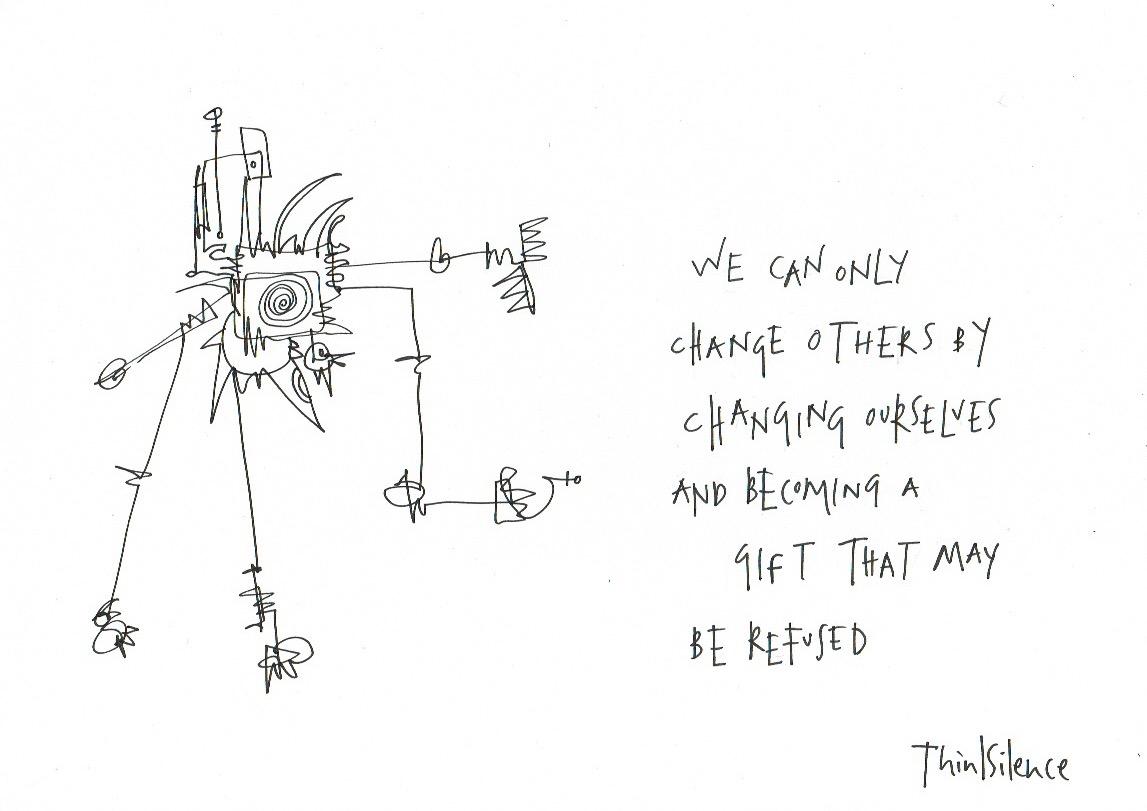
‘Between the time a gift comes to us and the time we pass it along, we suffer gratitude.   Moreover, with gifts that are agents of change it is only when the gift has worked in us, only when we have come up to its level, as it were, that we can give it away again.’**

We live in a very big universe, and it seems a shame not to explore it’ though, we can explore only the tiniest part of it with our physiclly.  The rest of it must be explored by extending ourselves through our imaginations and in our thinking, and then, in our living on this Earth.

By this, I think we can be marvellously altered.

While we live, each of us has a particular gift to bring into the world.  While the gift reposes within us, it’s a potential gift, when we reposition the gift by developing it, then we can pass it on.

It’s taken four years to get here, but today it was time to view some of Michelangelo’s statues whose descriptions captured my imagination as soon as I read about them.  I’ve never physically seen them – until today.   Often mentioning these unfinished figures wresting themselves from the stone that appears to  hold them fast, they illustrate how each of us has the gift of a unique life and perspective to bring into this world.

(*Dawna Markova, quoted in the Northumbria Community’s Morning Prayer.)

(**From Lewis Hyde’s The Gift.)

the banquet of surprises

17-life-in-tension

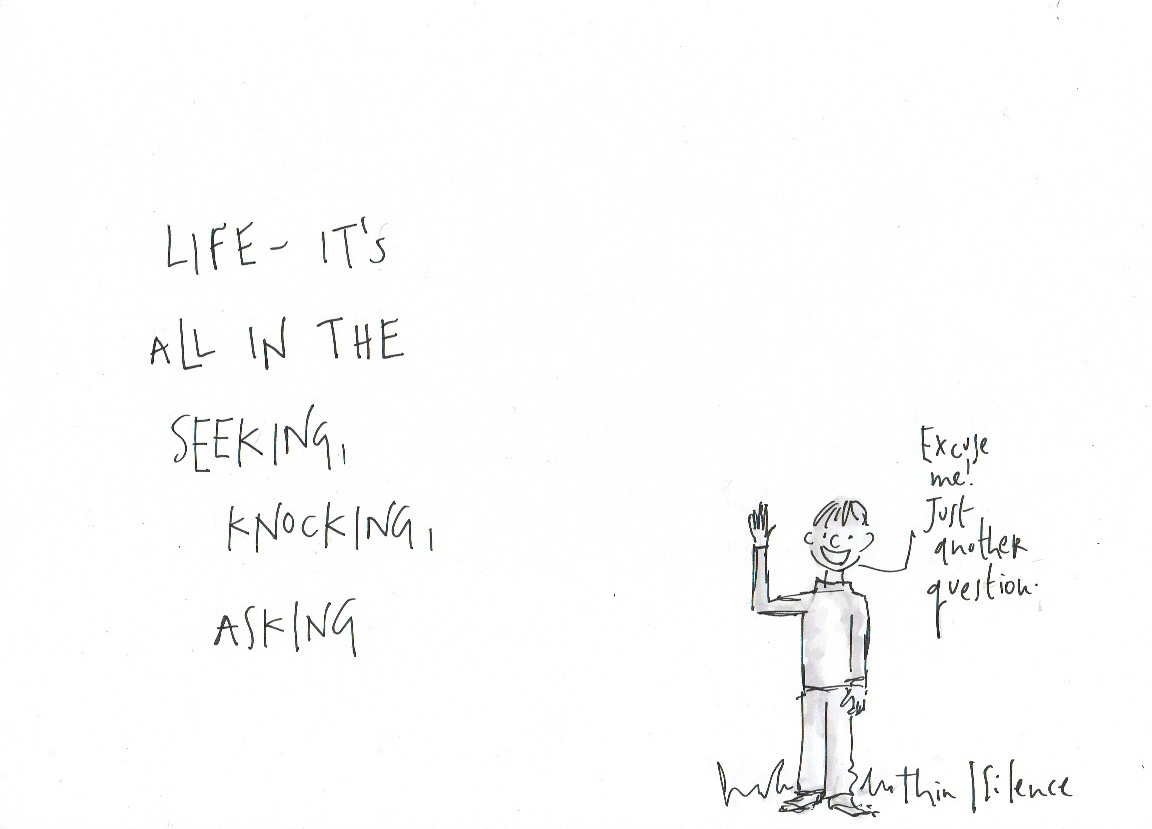
“Curiosity pleases me.  It evokes … a readiness to find strange and singular what surrounds us; a certain relentlessness to break up our familiarities.”*

‘This view is about turning toward instead of turning away.  But that doesn’t give you a method.  It is about allowing yourself to be curious and finding that enthusiasm to lean in, rather than escaping the bad feelings.’**

When we turn up with curiosity we will be surprised and enthralled by what we find – something about life in all its fullness.  Beyond  “It’ll never happen,” and “This is the way it always is,” and “They’ll never change” … such a universe of possibilities awaits us.

Healthy curiosity is both inward and outward.

Finding more within is opened up by the more we find without, and the more without by the more within.  Being only fascinated by what is not us means we will never develop.  Only being fascinated by ourselves means we will never find our generative presence in the world.

Last year, I witnessed a lifeboat launch.  In a few moments the crew had arrived, kitted up, and were on the water.  I found myself pondering how they didn’t get to choose who they were rescuing: it was everyone and anyone.  It was not about them.  It’s a helpful metaphor.

(*Michael Foucoult, quoted in Alan Lightman’s The Accidental Universe.)
(**From Pema Chodron’s Fail, Fail Again.)

renaissance

 16-life-has

Almost six centuries ago, Florence was the most exciting city in the West, with a proliferation of new art and thinking challenging and driving ever new heights I  what was to be called the Renaissance.

There are those who believe we’re on the cusp of a new Renaissance, one that is more democratised and has more for everyone to play with.  We get to look around us and imagine what might come about if we put this with this, if we introduce this person to this person, if we stretch what it is we can do to some new place or person.

‘Trend curators don’t seek needles, they gather the hay and stick a needle into the middle of it.’*

We take the artefacts we find all around us – things that others have made or thought – and we understand the cultures in which we find ourselves, and we bring our passion and creativity, and make something new.**

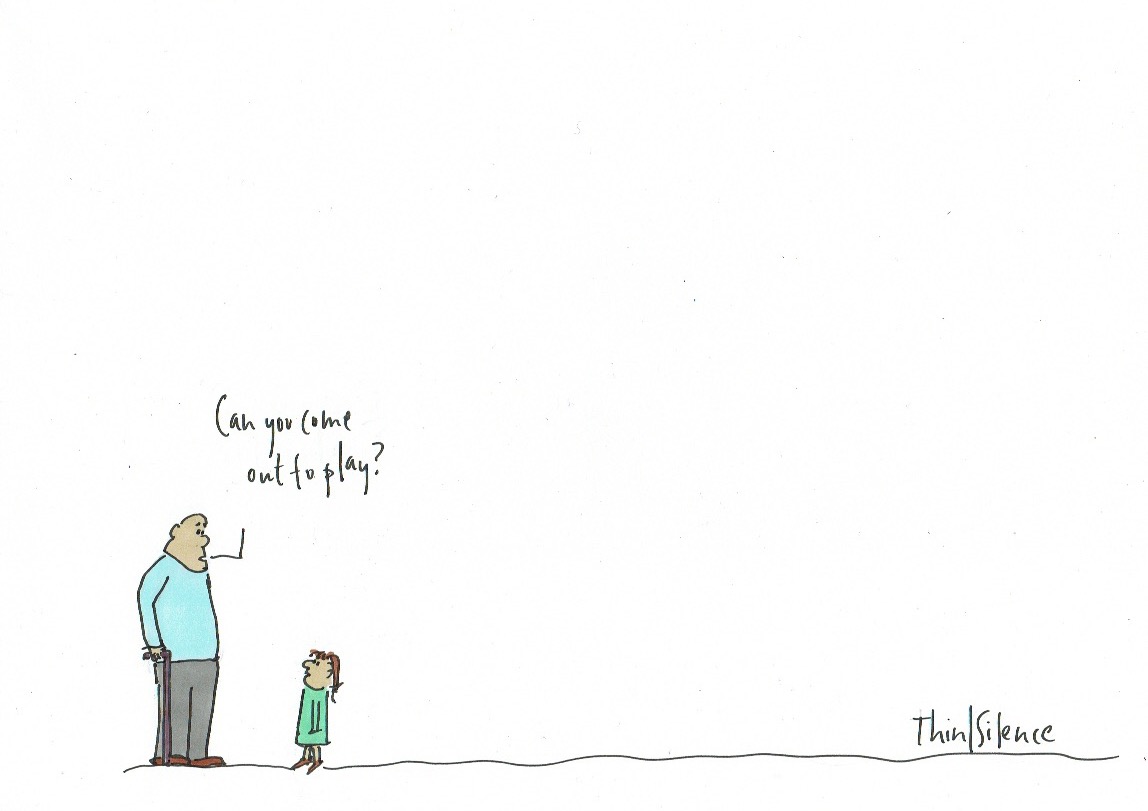
Many of these things will not be large or be noticed by millions, but that’s not the point.  The point is to be human, and humans make things.

(*From Rohit Bhargava’s Non-Obvious.)

(**See Alex McManus’s Makers of Fire.)

(Today’s doodle came from a conversation with Nikki Callander, a passenger on the plane to Italy, a massage therapist who finds herself helping people who are increasingly stressed with their work and are using coping techniques to get through.)

tinkering

15-gezmek

‘When engaging in tinkering, you incur a lot of small losses, then once in a while you find something rather significant.’*

This is about flanering, or wandering, from the man who introduced me to the concept. Engaging with life in a curious and intentional way, finding the rather significant something, or what Rohit Bhargava might call the elegant proof: ‘they are simple, ingenious, concise, and persuasive; they have an unexpected quality, and they are very satisfying.’**

Elegance involves flow; it’s what makes your giftedness flow to others in a simple and beautiful way.  You will find it by tinkering, wandering, flanering.

Have fun.

(*Nassim Taleb, either from The Black Swan.)
(**From Rohit Bhargava’s Non-Obvious.)

personal heuristics

14-consider

‘They don’t know who they really are and what they’re capable of.’*

‘First, find something you feel deeply passionate about creating.  Second, choose something the crowd is passionate about seeing come into existence.’**

Everyone has some or other graceful gift to discover and share.  Something which has about it the feeling of being an eternal, creative, joyful movement in our lives.  In Pamela Slim’s words, it will likely be something “an inch wide and a mile deep.” ^

An inch wide means we can miss it, of course.  To make this journey into a larger universe of what our lives can be, we have to lay aside, or step outside of, our personal heuristics – the things we have come to think of as defining our lives.  There is more to all of us than we know and, when connected to a dream, something special is about to be released.

Lewis Hyde^^ reminds me that the graceful gift is alive when it is what it is, when it embodies a spirit or dream, and when it creates a community.  If it doesn’t do these things, the likelihood is that its been commoditised – perhaps a skill to be sold in the labour market, something disconnected from our family and friends and the rest of life.

The laws of nature are basically gravity, magnetism, electricity, and nuclear force – everything that is finds itself governed by these laws.

And against these laws, we play out our lives.  However, there appear to be some secondary laws for human life to be lived beyond heuristics: we need to be autonomous, express our unique skilfulness, and live for a purpose greater than ourselves.

(*From Donald Miller’s Scary Close.)
(**From Peter Diamandis and Steven Kotler’s Bold.)

(^See Pamela Slim’s Escape From Cubicle Nation.)
(^^See Lewis Hyde’s The Gift.)

when do we ever have time?

13-not-all-those-who-wander

“As acceleration accelerates, individuals, societies, economics, and even the environment, approach meltdown. … [T]he notion of ‘continuous improvement; is conceptually incoherent”.*

‘Science has vastly expanded the scale of our cosmos but our emotional reality is still limited by what we can touch with our bodies in the time span of our lives. … We admire principles and laws.  We embrace reasons and causes – some of the time.  At other times we value spontaneity, unpredictability, unlimited and unconstrained behaviour, complete personal freedom’**

We’re still trying to bring the energies of the universe and the energies coursing through our lives together.

We try to mirror the laws of the universe in our educational, political, and business worlds.  But our expanding domain of knowledge, our rapidly altering cultures and societies, and our morphing industries and workplaces are hurtling us towards a future we do not want nor can we control: there are predictable outcomes and crazy positive and negative spontaneities all mixed up together.

We promise ourselves to have a good, hard, long look at all of this, but when do we ever have the time?

The future is not a given.  It is something we are capable of shaping with foresight, intention, and love.  When we find the time to lift our eyes we’ll be able to search the horizon and dream of things which do not yet exist.  This capability has been there all the time.

When do we ever have the time?  All the time.

‘The gifted artist obtain the vitality of [her] gift within the world, and therefore makes it available to others.’^

(*Firstly Mark Taylor and secondly Stefan Collini, quoted in Maggie Berg and Barbara Seeber’s The Slow Professor.)
(**From Alan Lightman’s The Accidental Universe.)
(^From Lewis Hyde’s The Gift; and we are all capable of being gifted artists.)

12 october 2016

12-i-now-see-that-i-do-not-see

Is the title of the movie.

‘[T]he dramatis personae exists not for the customers but the players, and not just for the stars but those who never set foot onstage during a performance … gaffers, key grips, and foley artists: the dramaturge, scriptwriters, technicians (not to mention the casting director).*

At the end of today, the closing credits will run, small white font on a black background, running quickly through, towards whatever it is that exists at the end but we never see.

How many and who are the people who have made today work for us?

Not only the people in the meeting, or heaving shoulder to shoulder with us, but those we hardly notice, without whom today would have been quite a different “production,” for home the dramatis personae says “I see you.”

(Normally, I write a first draft of Thin|Silence in the morning and tidy it up in the evening, so today I’ve been trying to be mindful of the people who comprise today’s dramatis personae for me: people by bus stops, bus drivers, people I stepped off the pavement for, those talking loudly in a cafe, some folk begging, the person who let someone else know I’d arrived for a meeting – I soon became overwhelmed with the numbers of people who made today happen in the way it did for me.)

Joseph Pine and James Gilmore point to how we’re increasingly employing “experience coaches” to enhance our experience of life, from spiritual directors to professional therapists.  The tour of a sports stadium, the hen party, the photofari, the team-building exercise are all expressions of this – and all valuable – to experience more, towards seeing more.

When we keep our eyes open to more of what fills our day, we avoid life-commoditisation.  We are increasingly open to the wonder of it all, otherwise:

‘Welcome to the commoditisation of experiences, best exemplified by the increasingly voiced phrase, “Been there, done that.”*

No dramatis personae.

(*From Joseph Pine and James Gilmore’s The Experience Economy.)

what is it about the meek and the future?

11-theres-a-difference

“And the point is to live everything.  Live the questions now.”*

‘In one study, dieters who kept a food diary lost twice as much weight as dieters who didn’t bother.’**

This isn’t about dieting but about the magic of journalling.

Journalling can take many different forms – online, notebook, image, word, public, private, long, short – but one of the brilliant things it allows us to do is fexplore a question, to reflect upon the journey.  It makes it possible to embrace incoming information and turn it into outbound action.

A friend told me yesterday about half a group of professionals being led through a journalling exercise rebelling, refusing to take part.  Of course, people are free to do this, but it’s an odd response.

Can there be a decent answer without fully exploring the rabbit-hole of questions – there’s never only one – or there be a destination without an engaging journey?

Although journalling doesn’t have to take up a lot of time, it allows us to slow down to notice, to be honest and face reality, and to understand there’s more about us than meets the eye, the fullness of meekness.  And meekness awakens the future.

‘Yes, we are broken, but at the same time we are awakening to our brokenness.’^

(*Rainer Maria Rilke, quoted in the Northumbria Community‘s Morning Prayer.)
(**From Gretchen Rubin’s The Happiness Project.)
(^From Alex McManus’s Makers of Fire.)

the speed of breathing

10-lifes-perfect-tense

‘If we set ut for the nearest star beyond our solar system at [the speed of a plane – five hundred miles per hour] it would take five million years to reach our destination.  If we travelled in the fastest rocket ship ever manufactured on Earth, the trip would take one hundred thousand years, or at least a thousand human life spans.’*

We can only see so far out into the universe.  The known universe is as far as our telescopes can reach out.  We do not know how much more universe lies beyond this.

Like the universe, our lives are expanding, and, we too can only see so far.  Unlike the universe, though, instead of peering into the past the further we look out into space, when we peer through the known universe of our lives, into the unknown, we are looking into our personal future.

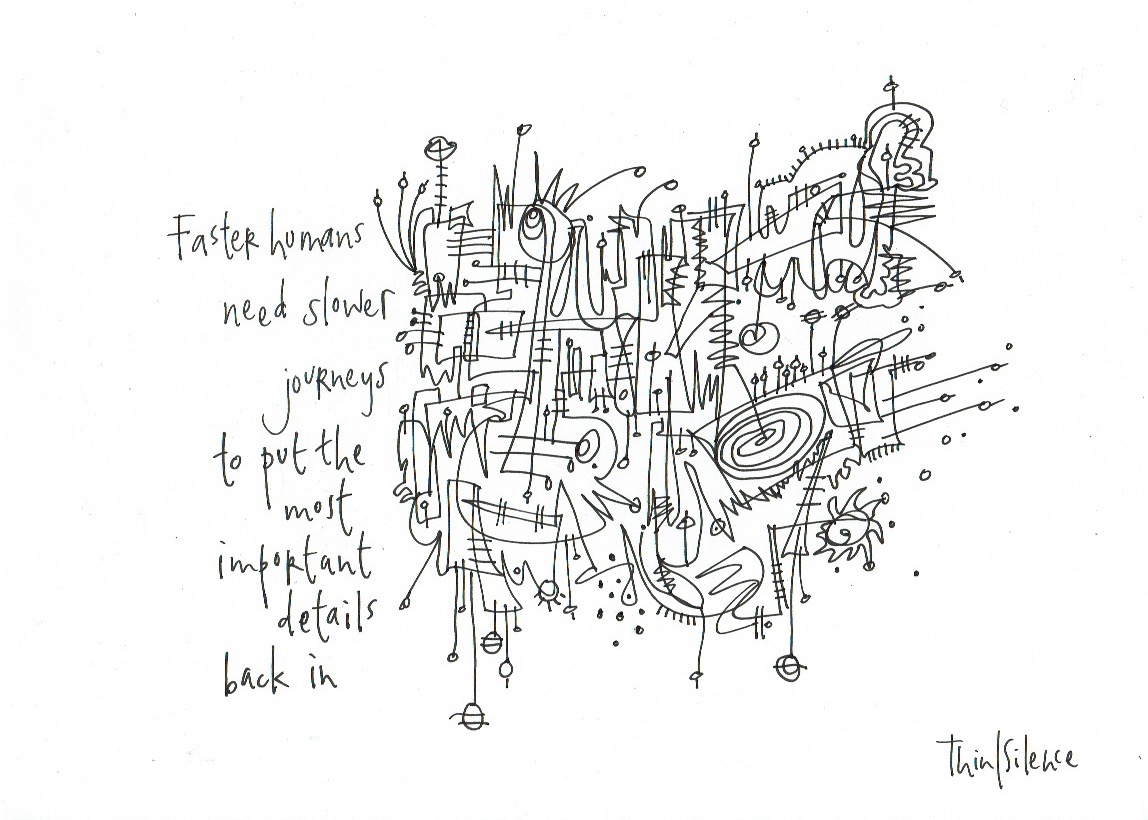
With the physical universe, we will have to discover or invent ways of travelling faster.  In the personal universe the trick seems to be to travel more slowly.

‘Our breathing tells us how fast or slowly we are travelling.  If you haven’t taken the time to notice you’re breathing, you already known you are travelling too fast.  When you begin to notice your breathing, see how slow you can take it.  Notice the things that come into view as you reflect on your life within and engage without your life in purposeful conversations and explorations with others.

(*From Alan Lightman’s The Accidental Universe.)