Relight your fire

sometimes it only takes a stranger in a dark place … to make us warm in the coldest season*
(Neil Gaiman)

Creating the future does not begin with a plan. It begins with a dream. And when someone acts on a dream, it creates a spark.**
(Alex McManus)

A dream outlives a plan – indeed, will live in many plans.

In his renowned speech, Martin Luther King Jr. did not declare “I have a plan.” We would not remember the words of a plan almost 60 years later but we remember a dream – this morning, I am touched by the thought that I have stood on the place where King gave this speech of a little over six minutes on the steps of the Lincoln Memorial – that’s the power of a dream.

We are made for reality and imagination, not only one or the other. When we cannot imagine and dream life can become suffocating and have a terrible affect on the human psyche.

What to do, then?

These words from Tavi Gevinson caught my attention:

Being a person is tricky, but other people do it, too – all people, in fact! – and they’ve recorded how. Their words reach a higher-pitched buzz if resonance in my brain once I’ve held them in my hands, put them on a shelf, passed them everyday. Or copied them down into a journal, a book of my own, ’cause seeing them in my handwriting is more effective than just filing them away in my brain.^

Let us read books and watch movies that feed the imagination (I’ve put together a short list of my favourites, below.) Journal to record and reflect in order to make sure these things don’t disappear like morning mist. Connect with people who have benevolent imagination, and share imaginatively with others. Never be apologetic for keeping your fire burning.

(*Neil Gaiman, quoted in Maria Popova’s Brain Pickings: Bloom: A Touching Animated Short Film about Depression and What it Takes to Recover the Light of Being.)
(**From Alex McManus’ Makers of Fire.)
(^From Tavi Gevinson‘s letter to young readers in aMria Popova and Claudia Bedrick’s A Velocity of Being.)

A SHORT BOOK LIST (as well as those listed above, here’s a very diverse list of some of my favourites)
Elle Luna’s The Crossroads of Should and Must
Benjamin and Rosalind Zander’s The Art of Possibility
Anything by Roald Dahl: my favourites are Danny, Champion of the World, The BFG and Matilda
Austin Kleon’s three books: Steal Like an Artist, Show Your Work, and Keep Going
Peter Reynolds’ Ish
Erwin McManus’ The Artisan Soul
John O’Donohue’s Eternal Echoes
Seth Godin’s The Icarus Deception (and Stop Stealing Dreams)
David Schenk’s The Genius in All of Us
My own Slow Journeys in the Same Direction


A story is not a plan, nor a plan a story

We don’t know what that book or that project is like until we experience it, but we have to decide now, so we tell ourselves a story.*
(Seth Godin)

Successful brands have a great story long before they have a grand plan.**
(Bernadette Jiwa)

I read bedtime stories to help me go to sleep. The books I read in the morning are to help me live the day wide awake.

It’s how I get to my best stories, and it’s how I hope to help others get to their best stories – that is, with the help of others.

Thao Nguyen in her letter to young readers tells of how she didn’t like having to write book reports when she was at school, so, in the third grade, she wrote a rap song after reading Charlotte’s Web, and, in eighth grade, she wrote a song with guitar after reading Lord of the Flies. Nguyen is now a singer-songwriter which made me wonder where our books will take us:

Happy, happy trails going wherever books take you. May they inspire you to show your love and understanding however you will.^

We may have a plan for the day, the list of things we have to do – whether in work, rest or play – but we also need a story. Our stories will carry us to places and activities plans never will. They hold disparate information and inspirations and thoughts and possibilities that otherwise would remain separate or scattered, instead weaving these together into stories that just have to be lived every day.

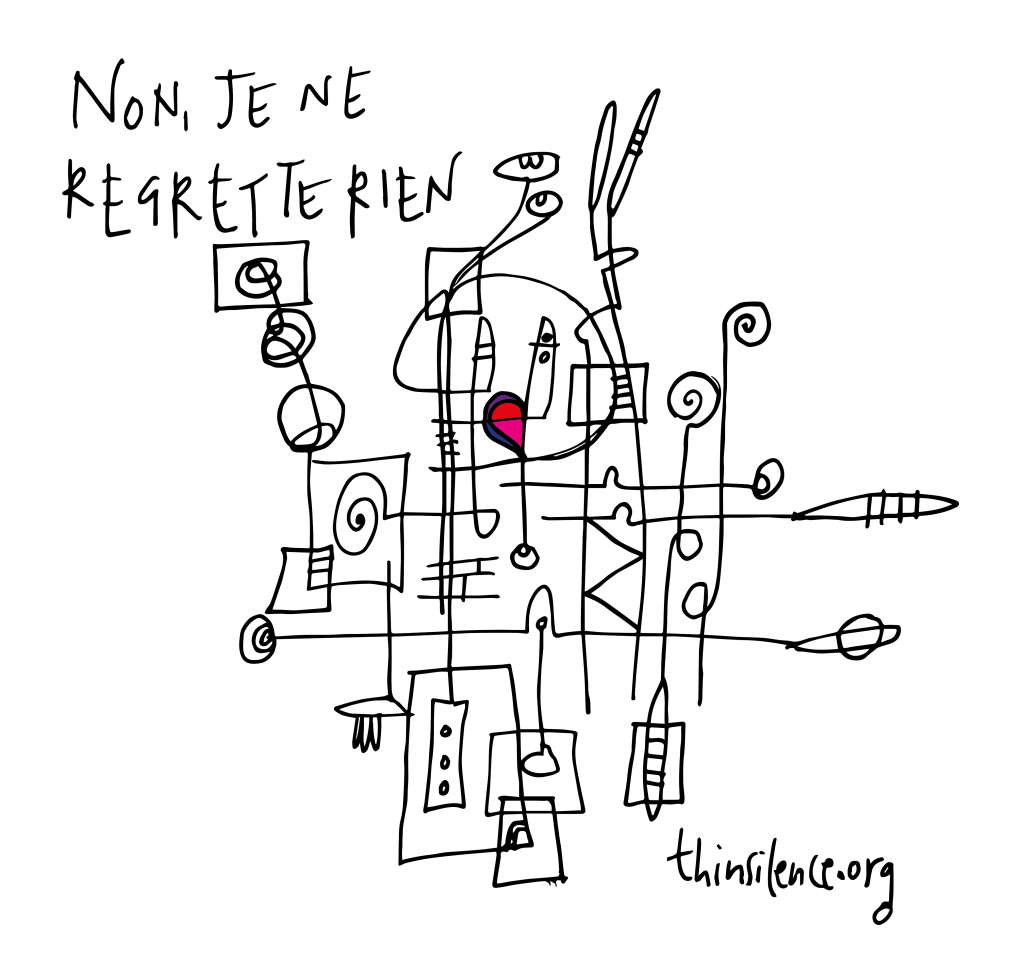
(Of course, a story needs a plan, but a plan first needs a story. The doodle could also have said: In the story there is a beginning.)

(*From Seth Godin’s blog: And there’s a story at the heart of it.)
(**From Bernadette Jiwa’s The Story of Telling: Good Stories Drive Great Strategy.)
(^From Thao Nguyen’s letter to young readers in Maria Popova and Claudia Bedrick’s A Velocity of Being.)

To see things differently, why not write a poem?

Poetry is not only dream and vision; it is the skeleton architecture of our lives. It lays the foundation for a future of change, a bridge across our fears of what has never been before.*
(Audre Lorde)

Scribes draw to either relieve or increase tension, and thus facilitate the pace of change in conversation.**
(Kelvy Bird)

We may not have the words we need to take us to new places. This is where poetry helps: finding new words^ or using words in different ways brings breakthroughs in reality and imagination.

Finding the words to describe reality is tricky enough; finding words to describe what is not yet is even more difficult.

We can also add illustrations-with-attitude.

If we believe we can fully express ourselves within our present vocabulary then we’re probably missing a trick.

There’s always more to see than meets the eye.

(*From Audre Lorde’s The Master’s Tools Will Never Dismantle the Master’s House.)
(^From Kelvy Bird’s Generative Scribing.)
(^Check out Gerard Manley Hopkins‘ poetry for new words.)

You can’t beat a good story

With vision above and reality at the base, creativity resides beteen the two.*
(Kelvy Bird)

We live within many different stories and we carry many more within us. The large majority of these will never be written down but we couldn’t get by without them. We couldn’t live our lives as lists of data, although our stories do contain lots of information.

We despair when we are treated as a number, a fact; we want to be treated as a person with a name and a story. Numbers and facts bring clarity but stories help us to know and understand why we do things.

In his letter to young readers, Chris Anderson outlines what makes us different to other species – and it’s not language or using tools or being kind to others outside of our families:

What is your superpower? […] You dear child, can create worlds that don’t exist.**

Some of the most amazing things happen when we share our stories with others:

But even more amazingly, you can conjure up that same world in someone else’s mind. You know how you do that? With words. You just tell them about it. Gently, carefully, piece by piece. Until they can see it as clearly as you can.**

These remain stories inside our heads so we need to do something more to make them real and become something we can actually live inside:

And when two or more humans can see the same imaginary world, extraordinary things can happen. They can play with it together. The can get excited about the event that might take place int hat world. They can dream of stories and inventions and almost limitless possibilities. And sometimes, they can act to me our own work more like their imaginary world.**

This is the creative place between the imagination and reality, and it’s why love stories so much and will never give up on telling them.

(*From Kelvy Bird’s Generative Scribing.)
(**From Chris Anderson’s letter to you readers in Maria Popova and Claudia Bedrick’s A Velocity of Being.)

Unexpected rites of passage

these economic craftsmen have treated the crash as a rite of passage*
(Richard Sennett)

Cherish your curiosity. It is your questions that will shape you.**
(David Delgado)

Beyond birthdays and various ceremonies that tend to be more party than trial, we probably don’t encounter many rites of passage.

And yet they’re out there, in the more more difficult things that happen to us: rejection, dismissal, loss, hardship … .

Some may be of our making, many are not. They do not define us, rather how we respond defines us.

Here’re five elemental truths that may help us frame and explore these moments when they come in our lives; these are: life is hard, we’re not as special as we think, our lives are not about us, we’re not in control and we are going to die.

These are posed to us in many of the experiences we face, but they need to be completed.

How we complete each tells us whether an experience has become a rite of passage for us, when, instead of turning away from what has happened, we turn towards it.

(*From Richard Sennett’s Together. These were men and women in the financial sector who’d become victims of the financial crash of 2008.)
(**From David Delgado‘s letter to young readers in Maria Popova and Claudia Bedrick’s A Velocity of Being.)

Let’s keep talking

More generally, the dialogic conversation flourishes through informality; the odd twists and turns of these conversations can result in win-win exchanges.*
(Richjard Sennett)

We never know what will come out of a difficult situation we find ourselves in or who we thought the unlikeliest person to help us or someone who’s chalk to our cheese.

Often we walk away or stop talking too soon or exchange questions for telling them what we know.

(*From Richard Sennett’s Together.)

The opportunity

The geneticist Stephen Gould […] developed the concept of ‘punctuated equilibrium’ to highlight the fact of collective disruption; in his analysis, environmental ruptures occur suddenly, disorganising previously established patterns. This is to to say that chaos rules, that there is no equilibrium in the environment, but simply that it is a stay against time.*
(Richard Sennett)

truth is stranger than fiction because fiction is never that complex**
(Hugh Macleod)

My calves are killing me.

I’ve just begun run again after struggling with an injury some years ago. I’m not covering much ground, but, boy, do my calves hurt.

Jim Loehr and Tony Schwartz point out that we’re likely to back off when we encounter pain but:

Stress is not the enemy in our lives. Paradoxically, it is the key to growth.^

If I just let my muscles recover each time then I’ll be able to keep on developing them.

What is true of our physical muscles, Loehr and Schwartz remind us, is also true for our emotional, mental and spiritual muscles – all of which we’ll need for the days ahead.

In our opening quotes, Richard Sennett and Hugh Macleod are pointing out how we ought not to be surprised by randomness in our world.

Stephen Gould’s punctuated equilibrium finds us living in one of the most disruptive stories of modern times, but we may have been offered one of our best opportunities to be disruptive back, individually and collectively.

I wonder what may be some of the things you’re noticing through these days and wanting to see change in what will be a different future to the one most of us imagined only three or four months ago?

Business, education and government will all look somewhat different in the future. I wonder if they will be enough to more equitably share profits, improve educational possibilities for all and shape a safer and fairer world.

I made Richard Sennet’s book Together my read for May partly because we can’t get together right now, but I also wonder how we’ll come together in new and different ways in our different future. With his engaging thoroughness, Sennett explores the “rituals, pleasures and politics of cooperation,” including taking a look at competition and cooperation through history before moving on to look at how today’s equilibrium includes many inequalities, including that of education, being one affecting each of us:

I’ll look at two dimensions of social inequality: first, inequalities that are imposed on children, not of their own making or desiring; secondly, inequalities which are absorbed and naturalised, so seeming to become part of the child’s self. One way in which children naturalise inequality does something quite special to their psyche: they can become more dependent on the things they consume than on other people.*

Resonating with Ken Robinson’s views of industrial education, Sennett warns:

A child of ten will pass a watershed in absorbing these external realities: economic facts and social institutions will in the course of a few short years shape the sense of self.*

Streamed from a very early age, for many it will be impossible to recover within their lifetimes.

Perhaps, beyond the lockdown, we’ll have the opportunity to reflect on many of these things and begin to imagine different ways to live our lives and live together.

It begins with how we allow our own stories to be disrupted, which, is both a painful and a growing thing, but makes it possible to disrupt back.

(*From Richard Sennett’s Together.)
(**From gapingvoid’s blog: Why we wrote Angrynomics – Mark Blyth.)
(^From Jim Loehr and Tony Schwartz’s The Power of Full Engagement.)

Chef d’œuvre

A crisis is there to be managed or waited out. The goal of each day is to simply get through it. Until things are back to normal. But sometimes we’re dealing with a slog. […] During a slog, we have a chance to accept a new normal, even if it’s temporary, and to figure out how to make something of it. […] When we get to the other side of the slog and look back, what will we have contributed, learned and created?*
(Seth Godin)

We may be disappointed if we think this is going to be over soon.

The chef d’œuvre was the name given to a piece of work produced at the completion of a medieval apprenticeship. Seven years of training and this piece would determine whether the apprentice would move on to become a journeyman or have to try again. They were not allowed to explain their work, understanding the things they crafted to be alive and able to speak for themselves The question for those judging was whether this piece was lively enough to pass:

The event exemplifies the classic rite of passage ritual: a young person is taken outside of himself, exposed to danger, then reconfirmed as a valued member of the community. In medieval craftsmanship, the maker’s things took the journey for him.**

If you look up the meaning of chef d’œuvre now, you’ll probably come upon a definition alike this:

chef-d’œuvre/ʃeɪˈdəːvr(ə)/noun

  1. a masterpiece.”the painting was made after a number of preliminary studies as a self-conscious chef d’oeuvre”

Some of our most important work – within and through our lives – can take a lifetime, following multiple experiences we may consider to be “preliminary studies.”

In the movement of Methodism that I belong to, a minister may retire when they have either “travelled” (it’s an itinerant ministry) for forty years or reach retirement age. At this point they ask permission of their local colleagues to “sit down,” offering a testimony of their work within this process.

The term chef d’œuvre caught my eye because next year it’s my turn. I’ll have completed forty years of travelling and wonder what I’ll say. There have been a lot of slogs along the way and yet I hope these have been embraced as important studies with their own value that eventually led me to the work that I love most of all – which is helping people to discover how amazing they are: fearfully and wonderfully made, “a mystery, wrapped in a question” as my friend Alex^ would say.

If you were to us this term of chef d’œuvre to reflect on what’s happening right now, how are things going, what’s coming into view, what’s the most important thing that you keep moving towards using everything as a means of contributing, learning, creating?

(*From Seth Godin’s blog: A situation vs a slog.)
(**From Richard Sennett’s Together.)
(^Alex McManus.)

A long way from home

We shall to cease from exploration
And the end of all our exploring
Will be to arrive where we started
And know the place for the first time.*

(T. S. Eliot)

From our lonely corner of the cosmos we have used creativity and imagination to shape words and images and structures and sounds to express our longings and frustrations, our confusions and revelations, our failures and triumphs.**
(Brian Greene)

We are the curious ones, seekers and explorers all.

Sometimes we forget.

We walk this earth within billions of everyday stories and yet we have our heads among the stars, a drama sometimes hidden in the repeating theatre of life:

the central animating force of our species, the wellspring of our joy and curiosity, the restlessness that gave us Whitman and Wheeler, Keats and Curie, is the very fathoming of this fathomless universe — an impulse itself a marvel in light of our own improbability.^

When we remember – through something we read or a picture we look upon or a life-lived-large or a walk through nature or some science or maths or music or … – we resume the path through earth and stars that will carry us home.

(*From T. S. Eliot’s Little Gidding.)
(**Brian Greene, from Maria Popova’s Brain Pickings blog: Until the End of Time.)
(^From Maria Popova’s Brain Pickings blog: Until the End of Time.)

Conversations with the best self

Maybe you work with an organisation. They have systems and charts and boxes. […] Perhaps you work with an organism instead. An organism constantly changes. The cells develop, die and are replaced. It adapts to the current environment or goes away.*
(Seth Godin)

Changes in the environment run ahead of genetically patterned behaviour; among social animals, no single institution, like the family, can guarantee stability.**
(Richard Sennett)

Change happens. We know this only too well.

We have to adapt. When we work together, we’ll need to be more organism than organisation.

When considering cooperation and competition, Richard Sennett explores a spectrum of exchange beginning with altruism and moving through win-win, differentiating exchange, zero-sum, to winner-takes-all.

It’s the first three of these that will help us work together towards a new future.

When it comes to altruism it seems we’re helped by being more reflective:

altruism is performed for a ‘shadow self,’ a shadow companion with who one conducts a conversation about how to behave.**

Erwin McManus writes about three quests – for honour, nobility and for enlightenment. The quest for nobility helps us discover our generative heart through gratitude for what we have. We understand ourselves to be whole, generative beings capable of great generosity. The language may be different to that of Sennett but it’s a reflective journey and the product is the same^

(*From Seth Godin’s blog: What kind of org?)
(**From Richard Sennett’s Together.)
(^From Erwin McManus’ Uprising.)