walk a mile in my shoes

Bernadette Jiwa writes about how a hunch for an entrepreneur is a combination of curiosity, empathy, and imagination.

The important thing to notice is that each of these can be grown … though never in a hurry.

“Everything around you that you call life was made up by people who were no smarter than you.”*

(*Steve Jobs, quoted in Bernadette Jiwa’s Hunch.)


interactions and distractions

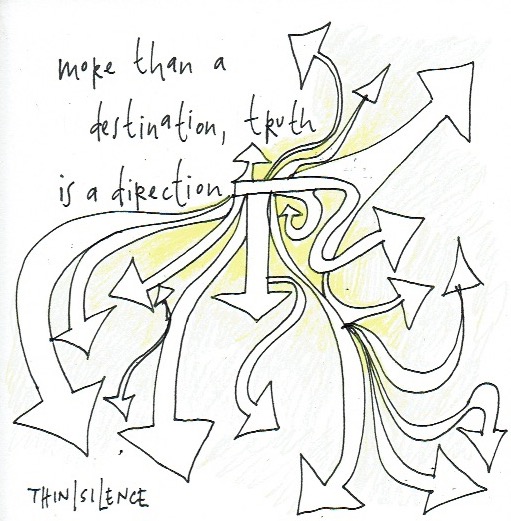
I don’t mean truth is what we make it.

Nor that there aren’t truths that affect everyone and everything.

I do think there’s a lot more truth to discover yet.

And a lot more truth to create together.

We are made for truth.

We just give up on it too soon, distracted by easier things.

Here are a couple of thoughts I read this mornin – encouragement to keep exploring truth:

‘Ignore distractions – and distractors.*

‘Every time I see a toddler in a [buggy] with an internet device in hand, I shudder.’**

And here’s a little more from someone who living a hundred years ago:

‘And the point is to live everything.  Live the questions now.’^

(*From gapingvoid’s blog: Make yourself irreplaceable.)
(**From Sth Godin’s blog: Seeing and believing.)
(^Rainer Maria Rilke, quoted in the Northumbria Community‘s Morning Prayer.)

we are the seasons

At the close of his book Dance for Two, Alan Lightman writes:

‘The earth wobbled imperceptibly on its axis, as bits of cosmic debris randomly bombarded it from space.  One such piece of debris, billions of years in the past, had struck with unusual force and cocked the planet over, producing a tilt of twenty three degrees, producing uneven heating as the earth orbited the sun, producing the seasons.”*

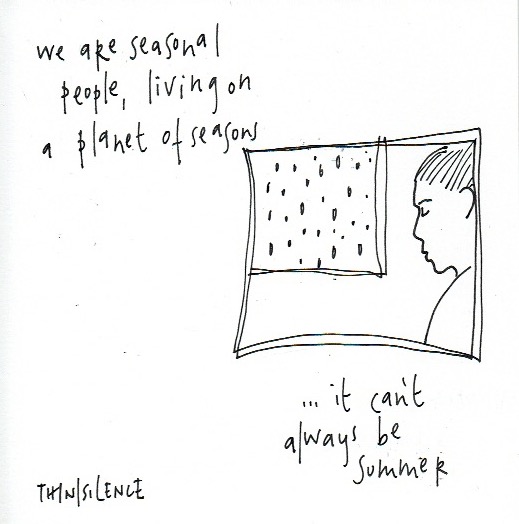
We are seasonal people, the product of our world.  Sometimes it’s summer, other times winter – this is our story.  And through the seasons we produce our stories.  Anne Lamott’s honesty more than reminds me of the reality of our seasonality.  She writes:

‘We’d prefer routine, predictability, to never be ashamed or afraid, let alone aghast. […] In lovely closed systems, timers are set: tick, tick, tick.’**

Though life becomes longer it also becomes emptier.

(*From Alan Lightman’s Dance for Two.)
(**From Anne Lamott’s Hallelujah Anyway.)

opportunities and ideas

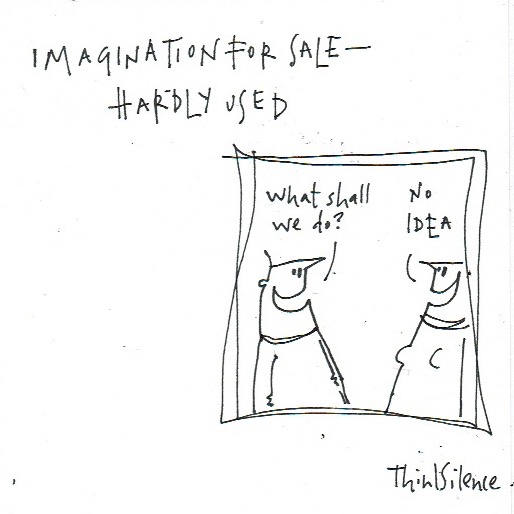
We’re always having ideas.

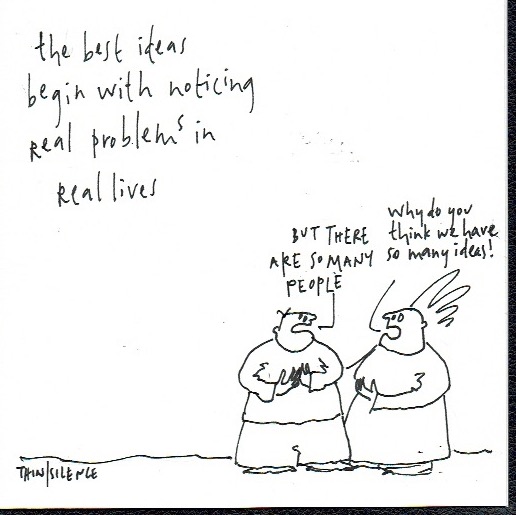
Our capacity to turn ideas into reality is now creating a glut of products.  What Bernadette refers to as ‘solutions in search of problems.’*

There are also those ideas that respond to ‘problems begging for a solution.’*

As i said, we’re always having ideas.

(*From Bernadette Jiwa’s Hunch.)

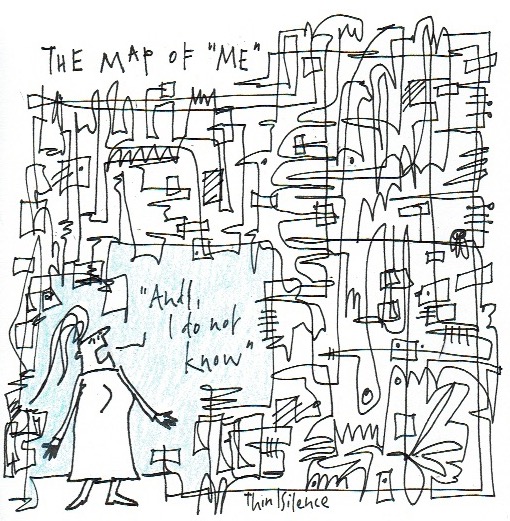
if our lives were maps

It used to be that mapmakers filled in all the spaces on maps as if they knew what was there – with all kinds of rubbish.  They didn’t know.

When they began to leave blank spaces they were really saying “We have no idea but we’re going to find out.”

I wonder if it’s the same with our lives, admitting we don’t know everything opening up new worlds of possibility?

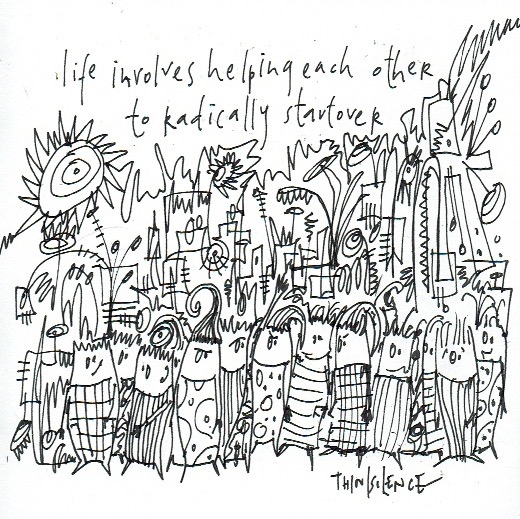
startovers

Starting on a new path will likely involve others.

We will read their books, listen to them speak, meet them spend time with them.

It’s about seeing all of these things as opportunities to do something new.

Nothing wasted.

the usefulness of hierarchies?

‘Fearful that we’ll expose our incompetence, we hide.  Remembering the lessons of childhood, we wait to be picked.  But the Peter Possibility points out that we’re far more competent than we imagine.  That once we pick ourselves, we have precisely what we need to do generous work.’*

Seth Godin is here turning the Peter Principle around into the Peter Possibility.

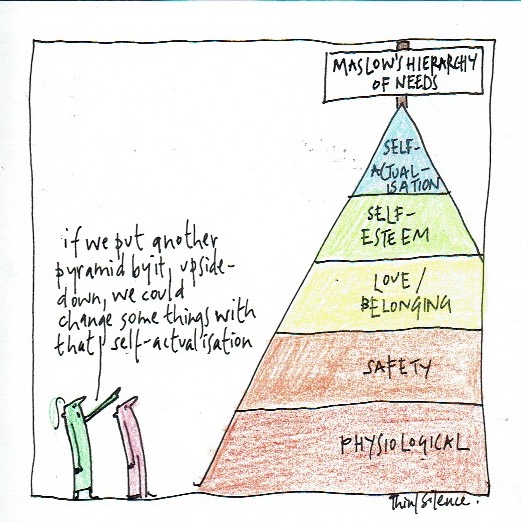
Michael Bhaskar introduces me to #firstworldproblems – such as the “pain” we experience when the wifi isn’t working fast enough.  Citing Abraham Maslow’s hierarchy of needs – physiological, safety, love/belonging, esteem, self-actualisation, and acknowledging we’re at the top of the pyramid, he writes this about our first world problems:

‘It’s all a big joke and quite how vacuous we have become.  Yet it also reflects something significant.  That problems really have changed.  That more is not always more.’**

Bhaskar questions whether the things creativity produces at the top of the pyramid is always a net positive.

I’m not a lover of hierarchies but perhaps there is an exception at play here.  To see this, we need to place an inverted pyramid alongside Maslow’s original.  Now we see the possibilities of creativity in each of the levels of need being useful in needs of the adjoining, just as we have most probably benefitted from someone’s creativity in the pyramid adjoining our own.

Bernadette Jiwa captures something of this when she writes about innovation in this way:

‘True innovation isn’t about finding an alternative that gets us from A to B; it’s about envisaging news As and Bs.  It’s about being open to redefining where problems begin and where solutions must end and working out why it matters that we make these new connections or forge different paths.’^

(*From Seth Godin’s blog: The Peter Possibility.)
(**From Michael Bhaskar’s Curation.)
(^From Bernadette Jiwa’s Hunch.)

(I’m going to be taking a break for a couple of days but I’ll aim to put up a few doodles after the weekend.)

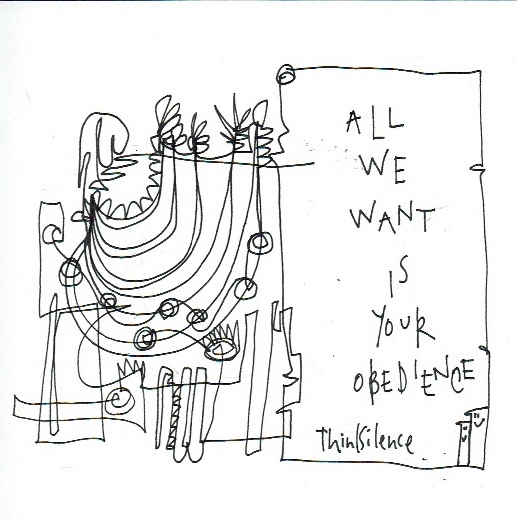
obedience is another word for …

… doing!

‘We define ourselves as doers.  Changers.  People who push on towards a goal. […] To be a doer is more than a name; it’s an action-by-action choice. […] We’ve chosen to be doers – so we get things done.’*

We’re here.  It’s as if the universe, our god, our muse has given an “A” to us and waits to see what we’ll do with it.  We’ve stumbled on obedience.

Obedience is what happens when we begin to weave stories, to make things live.

I thought about doing this so I tried it and guess what!

Obedience feels very different when it swells up from inside us rather than being forced upon us from outside.  This obedience is about doing what our lives tell us we must do – it still requires effort but it’s the kind of stuff that changes the world.

Bernadette Jiwa tells the story of Susan Beal who visited 500 families that’d experienced the loss of their baby to SIDS (Sudden Infant Death Syndrome).  I can’t imagine what this felt like, to visit these families in the first, most raw hours following a baby’s death, but the findings led to public education that is saving hundreds of thousands of lives.**

This feels very much like a story of obedience, the thing Susan Beal knew she MUST do.

Peter Senge helps us to see why this kind of obedience is so necessary when he writes:

‘the vast changes required by a regenerative society will not be achieved just by reacting to crises after they arrive.  They will require inspiration, aspiration, imagination, patience, perseverance, and no small amount of humility’.^

Jonah Lehrer perhaps puts a finger on why this kind of obedience to our lives is so hard when he writes:

‘The art that makes us feel is the art that makes us hurt.’^^

Joseph Campbell frames this in a different way when he speaks of our need to make sense of our lives:

‘To be in accord with the grand symphony that the world is, to put the harmony of our own body in accord with that harmony.’*^

Eugene Peterson offers what I think is another layer of seeing to this:

‘all life is given and must continue to be given to be true to its nature’.^*

(*From gapingvoid’s blog: Doing the Authentic.)
(**See Bernadette Jiwa’s Hunch.)
(^From Peter Senge’s The Necessary Revolution.)
(^^From Jonah Lehrer’s Proust was a Neuroscientist.)
(*^Joseph Campbell in Jospeh campbell and Bill Moyers’ The Power of Myth.)
(^*From Eugene Peterson’s Run with the Horses.)