storylines: completing belief

There’re so many things to believe in, we have to choose what we’ll act upon.

Listen to your life.  See it for the fathomless mystery it is … in the last analysis all moments are key moments, and life itself is grace.”*

The most tragic of lives is the one failing to complete belief in anything.  We can think of this as completing a story.

In the morning, I gather up whispers from different places and people.  Often these are whispers anyone can collect but they may be overlooked or they weave together in permutations others cannot see.  I wonder how they may be woven into my life and the lives of others.  This is my story but the same things happen in all our lives.

I hear the things I hear because I’m following my storyline – you may call yours something different.

Native Australians have songlines, or dreaming tracks.  Gwendolyn Brooks speaks of our poems.  John O’Donohue of our prayers.  And Warren Berger of our questions.

‘Write a prayer that is worthy of the destiny to which you have been called.’**

‘Instead of hoping that you’ll emerge from a meeting with “the answer” (which almost never happens and thus leaves people feeling frustrated), the goal is to come out of it with a few promising and powerful questions – which is likely to provide a sense of direction and momentum.’^

Questions are what we have in abundance, from where we find ourselves touching the earth and the lives within it – O’Donohue reminding us of our incredible opportunity:

‘We have received everything, even the opportunity to come to earth and walk awake in this wondrous universe.’**

Brooks writes her life as a poem:

“Yet I know
that I am Poet!
I pass you my Poem.
[…]
My poem is life, and not finished.
It shall never be finished.
My poem is life, and can grow.”^^

The words of our poems (storylines, songlines, prayers, questions) are not pleasant and sweet things, they emerge from our real lives.  They begin here not there:

“This is the time for Big Poems.
Roaring up out of sleaze,
poems from ice, from vomit, and from tainted blood.
This is the time for stiff or viscous poems.
Big and Big.”^^

Brené Brown reminds us we are storytelling animals and sometimes our stories are complete fabrications: why we did what we did, why they did what they did.  Our need for honour, nobility, and enlightenment causes us to rewrite the truth about our motives, thoughts, feelings, and actions.  But, as Brooks reminds us, our story begins here not there, and this is a thing of hope.

When we get defensive we also get stuck.  Good storylines help get us unstuck, help us complete our belief.

Joseph Campbell speaks of our need for societal and personal myth.  He also speaks about how life is so fast these myths aren’t forming for us.  Myths aren’t untruths.  They are great stories that lead us out of our stuckness.  Karen Anderson describes myths in their original sense:

‘A myth was an attempt to express some of the more elusive aspects of life that cannot easily be expressed in logical, discursive speech. […] The myth of the hero told people what they had to do to unlock their own heroic potential.”*^

Our storylines help us to identify and live out the most important beliefs we have.

Chris Guillebeau offers some useful advice for where to begin:

‘Be attentive to what happens when you lose yourself in the moment.’^*

You’re likely touching your storyline already.  And the more people who do this, the greater the possibility that we’ll change some things.  Seth Godin’s list of systems, here, could be longer but he reminds us well enough, systems are only people:

‘There is no industry, no economy, no market.  Only poeople.  And people, people can take action if they care.’⁺

(*Frederick Buechner, quoted in the Northumbria Community‘s Morning Prayer.)
(**From John O’Donohue’s Eternal Echoes.)
(^From Warren Berger’s A More Beautiful Question.)
(^^Gwendolyn Brooks, from Maria Popova’s BrainPickings.)
(*^From Karen Anderson’s Twelve Steps to a Compassionate Life.)
(^*From Chris Guillebau’s The Happiness of Pursuit.)
(⁺From Seth Godin’s There is no ‘The Industry‘.)

weird light

“And above all, if you must, shine!”*

When the day has dawned, especially, I can see you.

At the end of the day the light fades, the darkness overcomes the day and I cannot see you any longer.  Every day we need new light, we rely upon a fresh dawn.

It’s a metaphor for how we need new people to bring their light.  Peter Diamandis and Steven Kotler describe the benefit of a prize for helping us to look at problems in new ways, but they could be describing the promise of a new dawn:

‘Prizes attract new players – outsiders mavericks, and other innovators unlikely to work within a traditional research setting.’**

It’s as if the prize acts as a light-source, making it possible for people to contribute their own weird light.^  Diamandis and Kotler provide quite a list of benefits created by a prize: it makes a problem visible, reconfigures what we think is possible by transcending societal constraints, and changes the paradigm of what people believe is possible.

This isn’t about having to offer a prize, it’s about connecting to the Source of our light and bringing our weird light into the everyday adventures we can find ourselves in.  As my friend Alex McManus, reminds us, this comes with being human:

‘By virtue of conscious self-awareness, we are connected to the mystery from which we emerge.’^^

We also have this encouragement from choreographer Twyla Tharp to believe in our light:

‘I cannot think of a more compelling reason to foster the creative habit.  It permits me to walk into a white room … and walk out dancing.’*^

My friend Alex once put a little video together for me – a hazy image of a person walking with Alex’s voice providing the narrative: each of us has a unique perspective to bring to our world.  When our life ends that perspective is lost.

This is our light: our way of seeing, of feeling, of doing.  I find the same thinking with Eckhart Tolle when he writes:

‘Each person’s life – each life form, in fact – represents a world, a unique way in which the universe experiences itself.  And when your form dissolves, a world comes to an end – one of countless worlds.’^*

When we connect to our Source – be it our muse, myth, dream, god – we become more than reflectors of light – we are generators of light.  We let it gain brightness we need to begin.  Poet Gwendolyn Brooks wrote about our “light” as our poem:

“In writing your poem, tell the truth as you know it .  Tell your truth.  Don’t try to sugar it up.  Don’t force your poem to be nice or proper or normal or happy if it does not want to be.”⁺

Which I guess is to say, let it be weird.

The light comes with questions because that’s what light does – it brings out our curiosity: What’s that?, What are they doing?, Where are you going?, How does that work? …

‘As in writing itself, life is not about finding the right answers.  Rather it’s about asking the right questions.’⁺⁺

(*Kerry Hillcoat, quoted in the Northumbria Community‘s Morning Prayer.)
(**From Peter Diamonds and Steven Kotler’s Bold.)
(^I borrow the idea of weird from Seth Godin’s We Are All Weird.)
(^^From Alex McManus’s Makers of Fire.)
(*^From Twyla Tharp’s The Creative Habit.)
(^*From Eckhart Tolle’s A New Earth.)
(+Gwendolyn Brooks, quoted in Maria Popova’s BrainPickings.)
(++From K. M. Weilands.)

choosing words carefully

Our lives want to tell us far more than our heads often allow.  Richard Rohr captures this when he describes the affect of contemplation and reflection:

‘This awareness deepens on the cellular level, breathing level, hearing level, touching level, aroma level.  This is what is being refined in a regular “contemplative sit.”  the thinking level will be the last to “fall” because it always overstates its own importance and represses the other sources.’*

What these other sources allow us to be is more present to what is, when we’ll be required to find new words or to use old words in unexpected ways.

We can’t be in this “contemplative sit” all the time but to find times to practise it – there are many different ways and means including those we make for ourselves – makes it possible to take more contemplative perspective when we need to, when we’re in danger of mistaking the reality we find ourselves in and making poor decisions.

Hugh Macleod questions our hold on reality when the pressure is on:

‘It’s rare that urgent deadline is totally inflexible.  It’s rare that need to take is as disastrous as you think.  And the world?  It’s never as serious as it seems.’**

Practising a contemplative way allows us to find different words for where we are right now.  Words open up or close down possibilities. Yes and no are the most obvious but there’re many more.  Words help us see things differently, as Ursula Le Guin describes for us:

“We are a wordy species.  Words are the wings both intellect and imagination fly on.  Music, dance, visual arts, crafts of all kinds, all are central to human development and well-being, and no art or skill is ever useless learning; but to train the mind to take off from immediate reality and to return to it with new understanding and new strength, nothing quite equals poem and story.”^

Rebecca West underlines how art is far more fundamental to human existence than we think:

“art is not a plaything, but a necessity … a cup into which life can be poured and lifted to the lips and tasted”.^^

Without these skills, we are, at best, responsive in a limited way, at worst. reactive to what is happening around us.  With these skills, though, we become innovative and are able to reinvent and initiate.  There feels to be a link here with what Nassim Taleb is imagining as movement from the fragile, through resilience, to antifragility.*^  The first breaks or is diminished under stress, the second manages to maintain integrity under stress, whilst the third grows.  Le Guin underlines the possibility of learning such skills:

“All of us have to learn how to invent our lives, make them up, imagine them  We need to be taught these skills, we need guides to show his how.  Without them, our lives get made up for us by other people.”^

This development of skills, though, demands our interaction with others.  Just last night I was with some sixty or so people exploring hopeful conversations in which words will be used differently; we came into new worlds as we listened to how we each shared what made bad and good conversations:

‘Listening is an act of community, which takes space, time, and silence.’^

In his novel about creation, Alan Lightman shares through his character Uncle Deva how important it is to see every thing’s essence without comparison, and I would say every one’s, too:

‘Why should you compare? said Uncle.  Each thing possesses its own special essence, which has nothing to do with anything else.  Understand the essence of a thing said Uncle, and you know everything you need to know.’^*

We need more words.

To describe the essence of a person requires even more.

(*From Richard Rohr’s The Naked Now.)
(**From Hugh Macleod’s gapingvoid.)
(^Ursula Le Guin, quoted in Maria Popova’s BrainPickings.)
(^^Rebecca West, quoted in Maria Popova’s BrainPickings.)
(*^See Nassim Taleb’s Antifragile.)
(^*From Alan Lightman’s Mr g.)

imagine that

Imagination is how we make sure we fill our lives with meaningful things.

It is how we connect our passions with the needs of others.

In-between the two lies an apprenticeship of the imagination where others help us to become more the person we can be and hone the work we want to do.

I am not thinking about formal apprenticeship schemes, though these may count, and I am not primarily thinking about young people, though everyone is included.

There are people all around us who can be our mentors, helping us become the people we dream of and to use the talents we’ve been shaping.

We need words to describe all of this.   Our forms of words will hold us prisoner or allow us to fly.

The best words will make it possible to imagine more.

extreme language

We have plenty of words for the stuff in the middle or mass of our lives but not the extremes.

More words are needed for the extremes, though, where change happens.  There are basically two forms of extreme: the really purposeful things we want to do and the things that get in the way.

When we use more words, it means we’re seeing and feeling and experimenting better.

The best way to to identify and explore extreme words is to develop our personal stories every day.

easy and valuable

Easy is only valuable if you can work out a way of selling it to others; “Six simple steps to the life you’ve always wanted.”

Otherwise easy is seldom valuable.

Difficult, on the other hand, often is.

Imagination and creativity are essential human attributes but they take time and effort to develop.  For whatever reason, they’re not part of our educational curriculum.  Instead, we recognise these to be characteristics of some and not of others, a school report perhaps spotting, “Freda shows great imagination” … “Kofi is extremely creative,” when we ought to be asking of everyone else, “Why is their imagination and creativity being held back?”

ignoramus

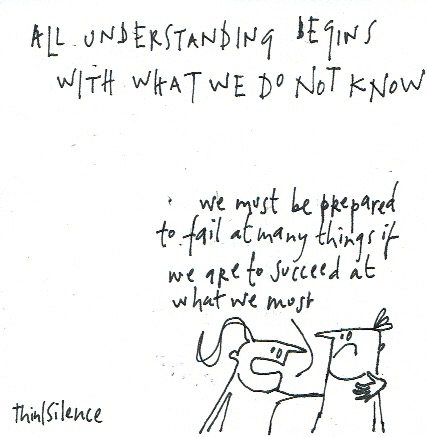
None of us knows everything there is to know.

Admitting this opens possibilities of discovering some new things and some new things about old things.

The Scientific Revolution began when some people admitted, “We do not know.”  Officially ignoramus, they began discovering all kinds of things that have changed our understanding of being human and our universe.

I don’t doubt that some will look back on us from a future two hundred years away and see those who admitted afresh that they are ignoramuses, opening new and new-old possibilities we cannot even imagine this morning.

One of the things that has changed is the way we can all be part of this journey with imagination and innovativeness.  There’s never been a better time not to know.

perception

There are alternatives to journeying great distances for an adventure.

See more deeply.

Imagine the future and bring it back to the present.

The benefit is, adventures are there every day with those around us.

the good fight

Or the gilded cage?

We used to have dreams and then they turned into something else.

Sometimes that something else turned into a nightmare and we wish we could wake up.

Stories come to our rescue.  Telling us this is not what you think, or this could be something else.

We’re surrounded by stories – movies, songs, poems, novels – but lack the most important one.  Our own.

We know a story is good when it’s dramatically unfolding, when the characters deepen and change, when they fight for what they hold dear.

Then it’s our turn, to fight the good fight for our dreams.