Getting away from it all

“I will not live and unloved life, I will not live in fear of falling or catching fire.” (Dawna Markova)

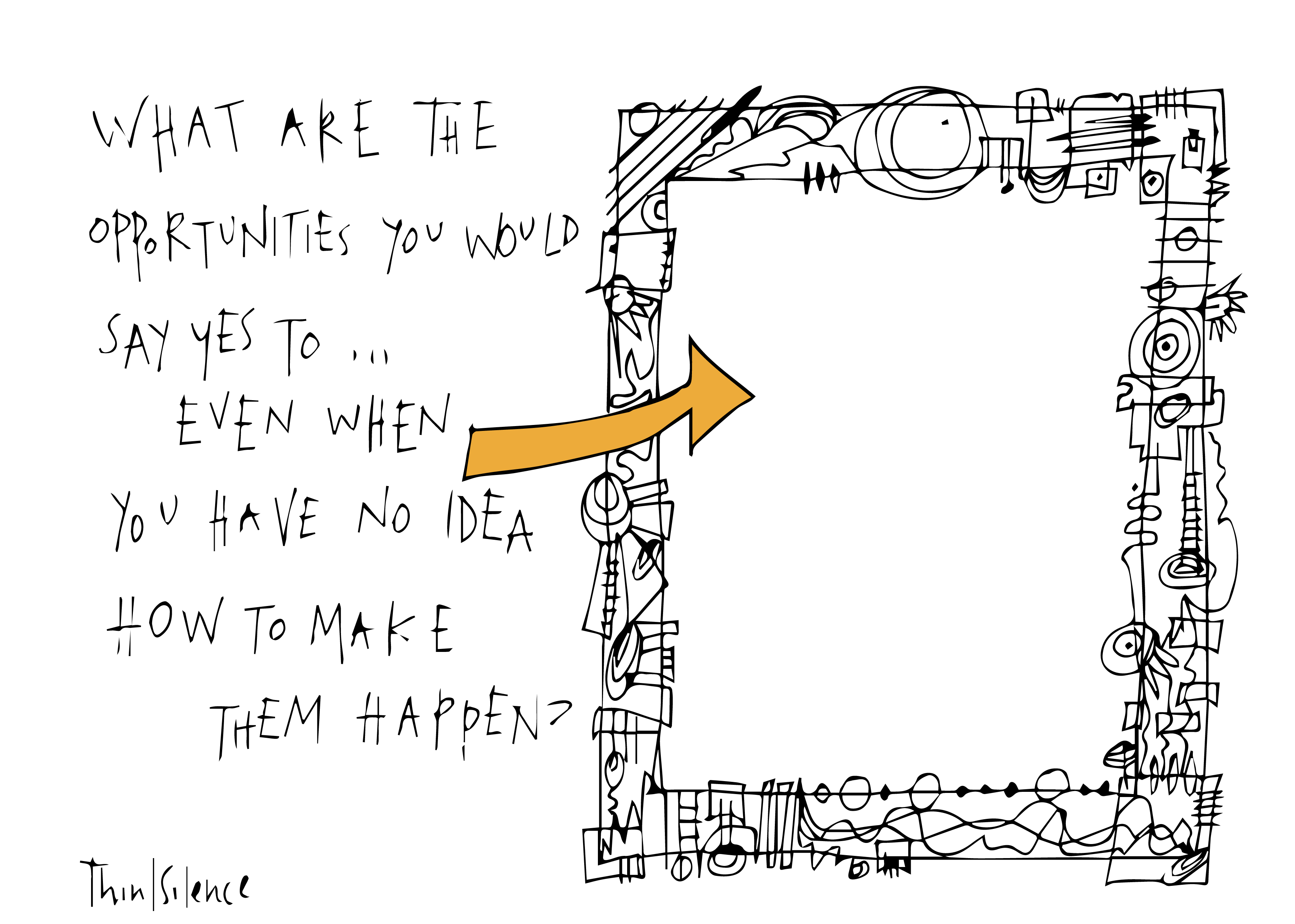
‘Never opt out of the opportunities that move you in the direction of your dreams, your purpose, your passions.’** (Erwin McManus)

There are basically two ways of getting away from it all.

Number one is through escapism – we simply want an easier place to live.

Number two is towards what we are wanting our lives to be about but we know we need to sometimes slow down to catch our breath, to see more clearly.

When it comes to what we must do with our lives, there’ll always be difficulty and pain, but well-used silence and slowness helps us to see it for what it is – more a teacher than a foe.

The first way of getting away from it all may simply be a symptom of not choosing the second.

(*Dawna Markova, quoted in the Northumbria Community‘s Morning Prayer.)
(**From Erwin McManus’ The Last Arrow.)

The prime connection

‘Far more often, competence involves the humanity required to connect with other people, in real time.’* (Seth Godin)

‘As dream, robots reveal our wish for relationships we can control.’** (Sherry Turkle)

We cannot control people the way we control machines, but there can be a wonderful serendipity arising from the opening of minds, hearts, and actions.

Our interactions are more and more wrapped in technology: we text, message, and email one another long before we pick up a phone, never mind meeting up.  Sherry Turkle warns of what she sees the real issue to be in our expectations for technology:

‘we transgress bot because we try to build the new but because we don’t allow ourselves to consider what it disrupts or diminishes.  We are not in trouble because of invention but because we think it will solve everything’.**

What technology does allow is to see what we can do when we connect; it then offers itself to us as a means of making things happen.

Erwin McManus tells of when he received an invitation to attend the 2014 Football World Cup Final in Rio de Janeiro.  The bad news was there were only a few days to get there and a visa would take weeks, not to mention there was nowhere to stay in the city.  The good news was that he was chosen by the people with the tickets because they believed him to be someone who would rearrange his life with a moment’s notice.  Technology would make it possible to get everything in place for the trip to be made, even making it possible to find somewhere to stay on arriving.  Erwin would see Germany beat Argentina but also spends a leisurely breakfast with the family that  first put him up, and he wanders through the city taking in the sights and the feelings.  These are the things technology cannot replace or reproduce.

‘How can you pull people together from across different systems in order to do something inspiring, fun and meaningful?’^

‘Creating a space collaboratively is the best recipe for creating a collaborative space.’^^

At the moment, I’m reading through someone’s book manuscript with an eye on where I might provide an illustration or two and some thoughts on collaboration got mer thinking about what it makes possible:  we each have a contribution to make; we recognise how we are  different to each other and so understand the complementary nature of each person’s contribution; what we do will have more impact; and, what we do will develop and grow more.

I mention this alongside Erwin’s story because of what he goes on to say following relating his story:

‘I could not help but think of how many times in life are are invited into an extraordinary adventure and into opportunities that only exist in our imaginations and we let them slip away.’*^

Erwin loves football and so the World Cup final wasn’t something to turn down.  I found myself thinking about what I love to be about and what I do when opportunities and adventures are provided, even when I don’t know how I can make that happen.  Just as Erwin’s story was made possible by many people, so ours will be.  Lewis Hyde encourages us to think in this way:

‘constant and long-term exchanges between many people may have no “economic” benefit, but through them society emerges were there was none before’.^*

I believe we’re only beginning to understand how we can use our new technologies of connection but one of the things it has helped us to see is the wonder of a human life and what can happen when people get together to make something happen.  It has always been the case, as Karen Armstrong helps us see in identifying Joseph Campbell’s hero as a means for understanding and unleashing our own heroic potential.  I leave the final words to Armstrong:

‘Joseph Campbell has shown that every single culture developed its own myth of the hero, an exceptional human being who transformed the lives of his people at immense cost to himself.  The story always takes the same basic form, so must express a universal insight.  In all these tales, the hero begins by looking around his society and finding that something is missing. […] He can find no ready-made solution, so he decides to leave home, turn his back on everything safe and familiar and find a different answer.  His quest is heroic because it demands self-sacrifice: the hero will experience pain, rejection, isolation, danger and even death.  But he is willing to undertake the journey out of love for his people – a devotion that does not consist of wordy declarations but of practically expressed altruism.’⁺

(*From Seth Godin’s blog The confusion about compliance.)
(**From Sherry Turkle’s Alone Together.)
(^From U.Lab.)
(^^From Scott Doorley and Scott Witthoft’s Make Space.)
(*^From Erwin McManus’ The Last Arrow.)
(^*From Lewis Hyde’s The Gift.)
(⁺From Karen Armstrong’s Twelve Steps to a Compassionate Life.)

What time is it?

It is always now.

And there’s more to now than meets the eye, as Henry David Thoreau points us to, for now is where our past and vast future meet:

‘In any weather, at any hour of the day or night, I have been anxious to improve the nick of time, and notch it on my stick too; to stand on the meeting of two eternities, the past and the future, which is precisely the present moment, to toe that line.’*

This line Thoreau made his goal is where we will find a meeting of the familiar and unfamiliar.  Those who investigate life from such a perspective have something different to bring, may be considered outsiders to the everyday living of insiders – Seth Godin points out that if we are into comparisons, this will always produce that:

‘You can’t have outsiders unless you have insiders.’**

But there’s a way of being open to what the future brings, to what others who are not like us bring.  Derek Sivers reminds me:

‘When you make a dream come true for yourself, it’ll be a dream come true for someone else.’^

I don’t read this as meaning we adopt the dreams of others but when someone realises their dream, there is a knock-on effect for us,  encouraging and enabling us to do and to bring what it is we desire.

Ken Mogi unwraps the importance of wa (harmony) for the Japanese way of finding purpose (ikigai).  Wa means  this person doesn’t have to be a threat (this meeting of our past and our future may be materialising for us in this person right now), and this new idea may not be as proposterous or ridiculous as we thought:

‘Living in harmony with other people and the environment is an essential element of ikigai.’^^

We are always moving towards a better line to toe.  It begins with each of us finding and feeding our desire:

‘Once you achieve a state of blissful concentration, an audience is not necessary.  You enjoy being the here and now, and simply go on.^^

We have lost the need for comparison to prove ourselves.  We do need to turn up each day living the story we have been shaping and unfolding.  Perhaps Rohit Bhargava helps us to see something of what happens in such a person when he describes the future in this way:

‘Learning to predict the future had an even more predictable side effect: you will become more curious, observant, and understanding of the world around you.’*^

I undertand predict here to mean choosing or curating, and his side effects certainly sound harmonious.

This may not be how it feels if we value being the insiders and part of that insider-ness is competence.  As Seth Godin points out, when change happens, we lose our competenc, indeed:

‘Competence is the enemy of change.’^*

To understand ourselves as competent is to perceive the universe as fixed.

When we meet the future, what happens may look like mischief but that is not the intention.  I leave the final words to Ken Mogi who encourages our intention in this way:

So make music, even when nobody is listening.  Draw a picture when no-one is watching.  Write a short story that no one will read.  The inner joys and satisfaction will be more than enough to make you carry on  with your life.’^^

(*From Henry David Thoreau’s Where I Lived, and What I Lived For.)
(**From Seth Godin’s blog Outsiders.)
(^From Derek Sivers’ Anything You Want.)
(^^From Ken Mogi’s The Little Book of Ikigai.)
(*^From Rohr Bhargava’s Non Obvious.)
(^*From Seth Godin’s Whatcha Gonna Do With That Duck.)


Pick or choose

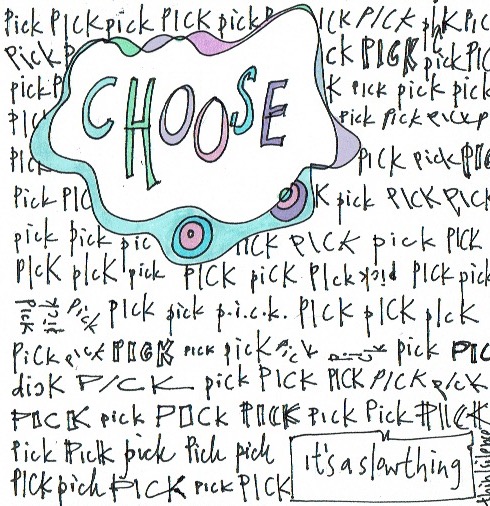
Picking tends to happen quickly, arbitrarily, or without consideration for others.

We pick holes in things and others, pick sides, pick fights, nit-pick, are picky picky picky, pick up bad habits, buy some “pick your own fruit,” act in a “cotton-picking” way, cherry-pick, remind people that “sweetie-pickers wear bigger knickers” (sorry about that one), or enjoy Brain Pickings (this one’s good, there’s always an exception).

There are some things in life we should do in a hurry but not as many as we think.

To choose is to be more noticing and thoughtful.  More can emerge from the small, life happens in the little.

‘Ichigo ichie is the appreciation of the ephemeral character of ny encouters with people, things, or scents in life.  Precisely because an encounter is ephemeral, it must be taken seriously.  Life, after all, is full of things that happen only once.’*

‘When we say that ‘the whole is greater than the sum of its parts,’ we are usually speaking of things that ‘come alive’ when their elements are integrated into one another.’**

Just pick something  can be tantamount to saying anything is better than nothing.  Choosing slows us down allowing us to spot something where we thought there was nothing.

(*From Ken Mogi’s The Little Book of Ikigai.)
(**From Lewis Hyde’s The Gift.)

Overloaded

‘Lisa has what I call an overload problem.  Overload problems are when issues occur not because of having too little, but because of having too much.’*

Perhaps stuckness isn’t no movement but slow movement.

Instead of needing more, we have too much.

Then the best thing we can do is show up and curate: what do we need, what do we not need?

‘No, the jumping frogs aren’t merely and unfortunate hassle for the frog trainer.  They are, in fact, the entire point.’**

.(*From Michael Bhaskar’s Curation.)
(*Seth Godin, source lost.)

Who will go with the thoughts and ideas no one else will go with?

‘The affirmation of one’s own life, happiness, growth, freedom is rooted in one’s capacity to love, i.e. in care, respect, responsibility, and knowledge.’*

‘Saying Yes more slowly means being willing to stay curious before committing.’**

Let us remember what it is we love at the beginning of every day.

May we find ways to stay connected to what is so important to our lives throughout each day.

Then, when opportunities arise, let us seize them.

(*From Erich Fromm’s The Art of Loving.)
(**From Michael Bungay Stanier’s The Coaching Habit.)

We are not alone …

We are together.

It’s a creative act to turn information into knowledge into understanding into wisdom.

Critical to a more imaginative future is the finding of one another.  Austin Leon shares Brian Eno’s concept of a scenes:

‘Under [Eno’s] model, great ideas are often birthed by a group of creative individuals – artists, curators, thinkers, theorists, and other Tastemakers – who make up an “ecology of talent […] a whole scene of people who were supporting each other, looking at each other’s work, , copying from each other, stealing ideas, and contributing ideas.”‘*

Whilst not demeaning the individual talents brought into the scenius, if you think you have to be pretty darn exceptional to belong twith others you’d be wrong.  It’s the softer skills that become far more important:

‘Being a valuable part of a scenius is not necessarily about how smart or talented you are, but about what you have to contribute – the ideas you share, the quality of the connections you make, and the conversations you start.’*

Whether it’s to work on something personal, some idea or hope for the future, or something that’s vexing us with work, finding each other is simply a better way of moving forward.

‘Scarcity appears when wealth cannot flow.’

(*From Austin Kleon’s Show Your Work.)
(**From Lewis Hyde’s The Gift.)

In this together

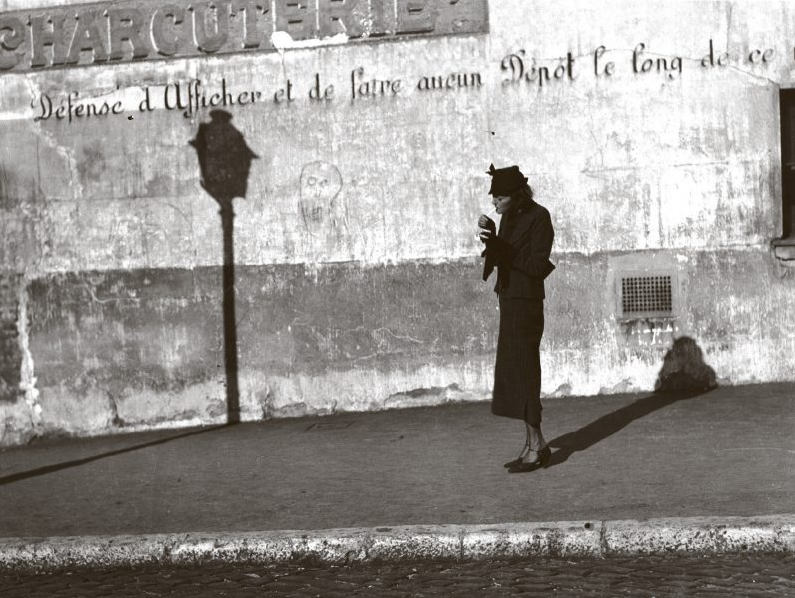
‘Défense d’afficher.  Do not advertise.  And yet there she is.  Elle s’affiche.  She shows herself.  She shows up against the city.’*

Others might do that but we don’t.

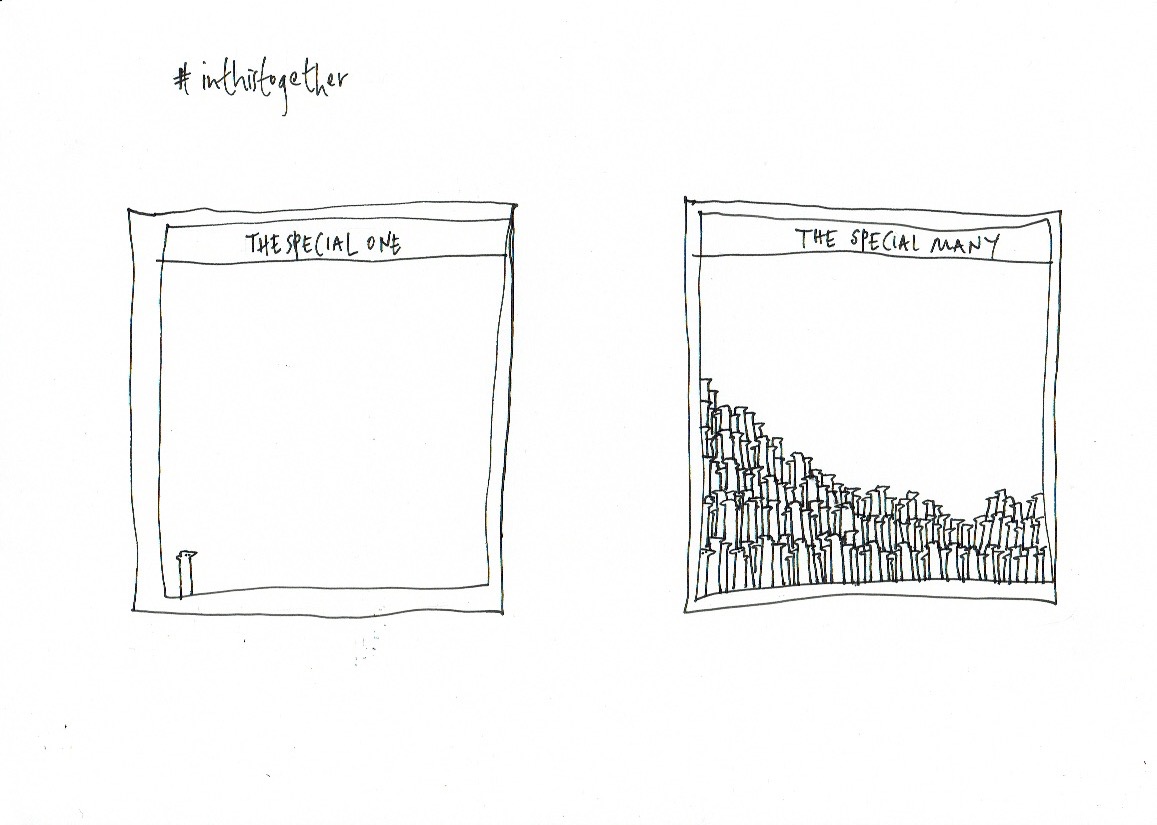
We’re different, better, special.

At least, this is the story we tell ourselves.

It’s 1929 and a woman stops to light a cigarette in front of  a notice saying “do not advertise.”  Photographer Marianne Breslauer captures this moment.  I reflect, when we simply do what we must do others may notice.

Edgar Schein writes about the importance of helping to what it is to be human:

‘Helping is, therefore, both a routine process of exchange that is the basis of all social behaviour and a special process that sometimes interrupts the normal flow and must be handled with particular sensitivity.’**

We are not different.  We are everyone, and there’s a way of expressing ourselves within this reality that generally and specifically makes the world a little better.

“What do you want to bring into being [hiddenly]?”^

(*From Lauren Belkin’s Flaneuse.)
(**From Edgar Schein’s Helping.)
(From U.Lab – hiddenly added by me.)

What’s that in the way?

‘All those meetings you have tomorrow – they were just cancelled.  The boss wants you to do something productive instead.

What would yo do with that time?  What would you initiate?’*

Ken Mogi writes about the flow people experience in their work when they focus on the here and now, telling the story of Japanese whisky being produced in a country that has no barley or peat.  Apparently theses weren’t big enough obstacles to interrupt a passion.

‘Time is eternity living dangerously.’**

Says John O’Donohue.

Flow isn’t about size but about pursuing something that’s exceptional and exquisite, and when something gets n the way then we need to remove it.

Elle Luna writes of this:

‘it starts as a whisper, a call from somewhere far away’.^

A year before I had read these words, I’d found myself wondering whether there are two whispers: the one from inside and the one from outside.  What is calling to you and what are you calling and responding to?

Friedrich Nietzsche wrote about how we must not let anything get in the way of this:

“The essential thing ‘in heaven and earth’ is […] that there should be a long obedience in the same direction; there thereby results, and has always resulted in the one run, something which has made life worth living.”^^

We’d grab the chance of having the unimportant being cancelled by someone else, but the reality is we have the opportunity to do some of the cancelling ourselves.

(*From Seth Godin’s blog Cancelled.)
(**From John O’Donohue’s Anam Cara.)
(*From Elle Luna’s essay The Crossroads of Should and Must.)
(^^Frierich Nietzsche, quoted in Eugene Peterson’s A Long Obedience in the Same Direction.)

It’s not a race

‘Winning a yoga race.

It makes no sense, of course.

The question this prompts is: Are there places you feel like you’re falling behind where there’s actually no race?’*

‘Like the discovery of neorogenisis and neural plasticity, the discovery that biology thrives on disorder is paradigm-shifting. […] Chaos is everywhere […].  Like a cloud, life is highly irregular, disorderly and more or less unpredictable.”‘**

I really like Seth Godin’s idea of a yoga race.  And I also like Jonah Lehrer pointing to the impact of retrotransposons on individuality: ‘junk genes that randomly jump around the human genome’.**  Many of the finishing lines we see are ones we have created, and many of us are running races we don’t need to.

John O’Donohue introduces a thought that shifts our thinking about Life  with a capital L and our life:

‘Friendship is the sweet grace which liberates is to approach, recognise and inhabit the adventure.’^

Turning “the competition” into a friend in order to enter the adventure is not a bad idea.  This is to play the infinite game, though, I am not unrealistic.  There are times when we have to play finite games but that’s quite different to thinking it’s the only game – and wherever possible we can defer to the infinite – to include as many as possible for as long as possible, and when the rules threaten this, to change the rules.

Here are some ways we can turn the competition into the friend:

Be a mind-opener, introducing others to new thinking.

Be a navigator, helping others to steer through challenges or crises.

Be a collaborator, working with others.

Be a champion, watching their backs.

Be an encourager, being a positive space for others to enter.

Be a builder, helping others to develop.

Be a connector, introducing others to other others who may help them.

Be a companion, getting together just for being together.^^

Life makes much more sense as friendships than it does as a race.

(*From Seth Godin’s blog Winning a yoga race.)
(**Froom Jonah Lehrer’s Proust was a Neuroscientist, quoting Karl Popper.)
(^From John O’Donohue’s Anam Cara.)
(^^From Tom Rath’s Vital Friends.)