The night is large and full of wonders*

That’s how you are going to fix the world – with your own gifts and talents.**

I have just read of three people with different missions.

Colin Kaepernick is the American footballer who wants to bring attention to racial injustice and is the face on Nike’s controversial advertising campaign, an embodiment of the campaign’s slogan:

“Believe in something.  Even if it means sacrificing everything.”^

Tim DeChristopher is an environmental activist who, in 2008, became Bidder 70 in Utah’s Bureau of Land Management land auction, purchasing 22,500 acres for a price tag of $1.8 million against the fracking companies (he didn’t have the money):

‘He had successfully interrupted the auction.  In a brave and imaginative act of civil disobedience, one your man with a love of wilderness and a message from his generation on how fossil fuels are contributing to climate can change, thus robbing them of a lovable future, not only exposed the cosy relationship between industry and government, but challenged it.’^^

Evelyn Glennie shares in a TEDtalk of her life-goal:

My aim is to teach the world to listen.’*^

Three quite different and meaningful missions towards a better world.

This better world will not arrive by one big-all-encompassing mission or purpose but by thousands upon thousands of small and meaningful ones, like yours.

In our night, these are the many wonders.

(*Lord Dunsany, quoted in the Northumbria Community‘s Morning Prayer)
(**Ken Sleight, quoted in Terry Tempest Williams’ The Hour of Land.)
(^Quoted in Bernadette Jiwa’s blog: Making Sense of Nike’s Controversial A Campaign.)
(^^From Terry Tempest Williams’ The Hour of Land.)
(*^From Evelyn Glennie’s Tedtalk: How to Truly Listen.)

Dear Mr Campbell …

In my own life, mostly it comes from books, though I have had a long series of magnificent teachers.*
(Joseph Campbell)

Dear Mr Campbell,

I read these words only this morning in The Power of Myth which you co-authored with Bill Moyers.  Your words are true for me as you are one of my magnificent teachers.

Other words had already captured my attention:

‘I don’t think there is any such thing as an ordinary mortal.  everybody has his own possibility of rapture in the experience of life.  All he has to do is recognise it and then cultivate it and get going with it.  I always feel uncomfortable when people speak about ordinary mortals because I’ve never met an ordinary man, woman, or child.’*

When I read this, I’d just been thinking about how the quests for honour, nobility and wisdom are open to all and I believe the truth of your words is more accessible now than ever before in human history.

I am writing to you from 2018 but you spoke these things in 1986 just before you died.  Only a few years later the Internet would herald a bold new world of connection and information for turning into knowledge and action through their imagination and creativity. There’s always been formal and informal learning but the possibilities of learning from beyond the institutions of education have become exponential.  Even now I am engaging in a Bootstrappers Workshop (I think you’ll enjoy exploring what these blue words make possible) in which I watch videos from a thoughtful practitioner (another of my magnificent teachers), after which I’m encouraged to engage in some personal work and connect with hundreds of others through message boards.

You knew this about humans because of your love of mythology.  Some see myths as untruth but I read somewhere** that myths are true in generally true, though not specifically true.  If I may quote you back to yourself, this appears to dovetail with what you are saying here:

‘No, mythology is not a lie, mythology is poetry, it is metaphorical.  It has been well said that mythology is the penultimate truth – penultimate because the ultimate cannot be put into words.’*

Out of this love of mythology emerged your hero’s journey, ‘the adventure of being alive’* – another idea of yours that has been misunderstood.  Nassim Taleb has described himself as a “sceptical empiricist” but he understands what you’re saying, one time writing in a book inspired by the myth of Procrustes:

‘A man without heroic bent starts dying at the age of thirty.’**

Taleb is writing from his understanding of the universe as a random and even chaotic place, and you are also writing these things I’ve been quoting back to you in relation to a life of chance and how we need to find our centre within:

‘The place is find is within yourself. […] There is a centre of quietness within, which has to be known and held.  If you lose that enter, you are in tension and begin to fall apart.’*

In the Bootstrappers Workshop there’s a little video extra from Elizabeth Gilbert and she is distinguishing between hobbies, jobs, careers and vocations – and I’m thinking hobbies for interest, jobs for income, careers for purpose and vocations for legacy.  I believe it’s our myths, though, that hold these together – how we connect to ourselves and to others and to our world.

Perhaps one of the greatest things you have taught me is how people the world round have common hopes and aspirations and meanings and they have been exploring these in myths and stories for thousands of years.  Our myths are where we’ll find or greatest plans and hopes for humans and our world.

I close my letter of gratitude with some words from the writer Neil Gaiman:

‘Albert Einstein was once asked how we could make our children intelligent.  “If you want your children to be intelligent,” he said, “read them fairy tales.  If you want them to be more intelligent, read them more fairy tales.”‘^^

Yours gratefully,

Geoffrey Baines.

(*Joseph Campbell, from Joseph Campbell and Bill Moyers’ The Power of Myth.)
(**See Karen Armstrong’s Twelve Steps to a Compassionate Life.)
(^From, Nassim Taleb’s The Bed of Procrustes.)
(^^From Neil Gaiman’s Art Matters.)

A life of multiple perspectives

I am facing the mountain, this glorious indifference.  I am watching as someone is watching me.*
(Terry Tempest Williams)

You’re finding out something as you read that will be vitally important for making your way in the world.  And it’s this: THE WORLD DOESN’T HAVE TO BE LIKE THIS. Things can be different.**
(Neil Gaiman)

Rush is a perspective, slow is another.  Kind is a perspective, so is indifference and “rules-first.”  When we notice our perspectives, we can change them for better ones.

Brian Solis writes:

“Once you see things through a lens of possibility and growth, you’ll wonder why you didn’t see it sooner.”^

He continues:

“I’m learning to see that perspective is a gift.”^

We’re very gifted.

As Richard Rohr writes, everything changes when we are able to see things differently:

‘So get ready for some new freedom, some dangerous permission, some unexpected happiness, some stumbling stones, some radical grace and some new and pressing responsibility for yourself and for your suffering world.’^^

If the world isn’t as you hope or want, change perspective, see it from a different place.

Another perspective is love:

‘Love is not primarily a relationship to a specific person: it is and attitude, and orientation of character which determines the relatedness of a person to the world as a whole, not toward one ‘object’ of love.’*^

It feels like Martin Buber is writing on love as perspective when he pens:

‘Love is a cosmic force.  For those who stand in it and behold it, men emerge from their entanglement in busy-ness; and the good and the evil, the clever and the foolish, the beautiful and the ugly, one after another become actual and a You for them, that is liberated, emerging into a unique confrontation.’^*

Perspectives are learned, we can change them, the purpose for which Neil Gaiman makes, above, and Alan Burdick points us towards, here:

“But empathy is a sophisticated trait, a mark of emotional adulthood: it takes time.  As children grow and develop, they gain a better sense of how to navigate the social world.  Put another way, it may be that a critical aspect of growing up is learning how to bend our time in step with others.”⁺

Another perspective is closer, to move closer to what has caught our attention, to notice more, and maybe then it will reach our hearts.  This in turn will bring us to another perspective, that of experimenting or actioning, from where we see differently again.

Our perspectives make it possible to make more of life, not only for ourselves but also for others.

(*From Terry Tempest Williams’ The Hour of Land.)
(**From Neil Gaiman’s Art Matters.)
(^Brian Solis, writing for gaping void’s blog: The importance of an open mind.)
(^^From Richard Rohr’s Falling Upward.)
(*^From Erich Fromm’s The Art of Loving.)
(^*From Martin Buber’s I and Thou.)
(⁺Alan Burdick, quoted in Maria Popova’s Brain Pickings: Empathy is a Clock that Ticks in the Empathy of Another.)

Where egos die

Awe is the moment when ego surrenders to wonder.  This is our inheritance – the beauty before us.  We cry.  We cry out.  There is nothing sentimental about facing the desert bear.  It is terrifying beauty.*
(Terry Tempest Williams)

You are only as good as the love you have for other people. […] We are only as much as what we can give to others.**
(Hugh Macleod)

Monica Hardy encourages me to:

“Notice, dream, connect, do.”^

To notice, to step out of the normal into the unnoticed excites our generative souls, stimulates our imagination and innovativeness, and we turn what we notice into what we are able to give to the other, even if it is simply to draw their attention to what we have seen and perhaps they have not.  Nassim Taleb counsels us in this direction in his inimitable style:

‘What fools call “waiting time” is most often the best investment.’^^

To notice, to feel, to care, to know.  In this vast universe, we’re such tiny creatures and yet there is within us such powerful things.

T. S. Eliot asks,

“Dare I disturb the universe?”*^

Dare we even look?

It is where Williams takes her violent mind:

‘To care is to lament. […] The grasses I am weaving together remove me from my mind, my terrible, violent, creative mind.  The storm brewing inside me is passing.  I have made a small mat of grass as a resting place for larks.  In wilderness, we are defined by the body, not the mind.’*

Unlike Williams, I am not in the Gates of the Artic National Park in Alaska, but in a city, being reminded by the weeds (that ought to be, plants) breaking through the pavement that the wildness will be here after I am long gone.

This isn’t a threat but a pressure-release.

In the city, surrounded by human invention, I feel myself an expert needing to deliver, but the plant underneath my feet reminds me that I am really, and always will be, an amateur, one who loves.  Richard Sennett may be thinking of people of craft but his words speak well here when we are thinking more widely about our species and the Other:

‘Closer to modern times, the amateur gradually lost ground, especially with the dawn of the Industrial Age – the amateur’s foraging curiosity seeming of lesser value than specialised knowledge.’^*

There are many egos living within us, and the wildness challenges each: personal, national, political, religious, economic, to name a few.

Egos struggle to survive in wild places, where the eyes that are watching us are not human:

‘I return to the wilderness to remember what I have forgotten, that the world can be wholesome and beautiful, and the harmony and integrity of ecosystems at peace is a mirror to what we have lost.’*

We step into the wonder and awe that is not only without but within each person.

(*From Terry Tempest Williams’ The Hour of Land – my price read for this month.)
(**From gapingvoid’s blog: Empathic compassion.)
(^Monica Hardy, quoted in Seth Godin’s What to Do When it’s Your Turn.)
(^^From Nassim Taleb’s The Bed of Procrustes.)
(*^T. S. Eliot, quoted in 99U’s Make Your Mark.)
(^*From Richard Sennett’s The Craftsman.)

The collector

Live the questions now.*
(Rainer Maria Rilke)

Curiosity led me to adopt and live by the belief that “nothing is wasted” – a belief that shapes how I see the world and my life.**
(Brené Brown)

None of us can know everything, but we can all know more of something – the things we collect along the way as we follow the question that leads us.

A wiser world is simply one that figure out lots of different ways of bringing all of this together.  It is often our disregard or disresepect for what each is wanting to bring that gets us into trouble.

(*Rainer Maria Rilke, quoted in the Northumbria Community‘s Morning Prayer.)
(**From Brené Brown’s Rising Strong.)

Sell your art, not your soul

I am leaving my own species and ten thousand years of human history. […] I just need a break.  I want to be absorbed into some place larger and expansive for the human brain.*
(Terry Tempest Williams)

You don’t become completely free by just avoiding to be a slave, you also need to avoid becoming a master.**
(Nassim Taleb)

Each day, we must find the time and space that works for us so that we may enter into what we have to be about with our lives.  Bernadette Jiwa reminds us:

‘Your purpose is not what you do, but why you do it.’^

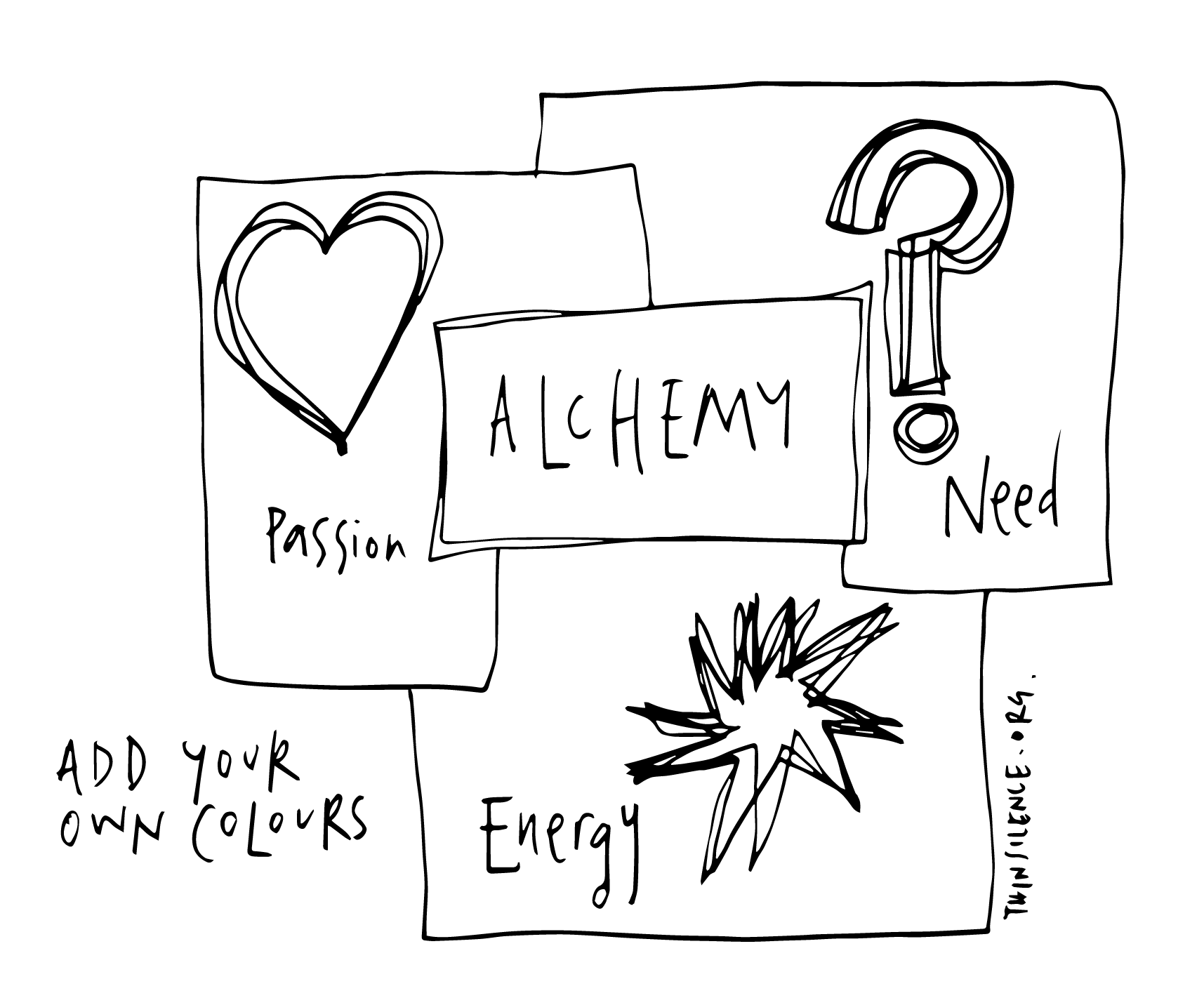
To sell our soul is to abandon our most creative self, our “den of alchemy.”

(*From Terry Tempest Williams’ The Hour of Land – my prime read for September.)
(**From Nassim Taleb’s The Bed of Procrustes.)
(^From Bernadette Jiwa’s Hunch.)

Inconveniently yours

As in the case of lines, you are likely to stop when you are no longer sure you should go further – at the rear edge of the region of uncertainty.*
(Daniel Kahneman)

I suspect that the mind, like the feet, works at about three miles an hour.**
(Rebecca Solnit)

The heart, too, I suspect.

Slow is inconvenient.

It’s taken me more than twenty years to arrive at what I’m penning today, but if I value what I’m discovering and integrate it into my life and can help others, too, then maybe all that time is worth it.

The better future will be, I believe, the inconvenient one.

(*From Daniel Kahneman’s Thinking, Fast and Slow.)
(**From Rebecca Solnit’s Wanderlust.)

In the morning, I will remember

Creating a monument is a matter of taste and values and the means to get it made.  Once you monumentalise a person, a place, or thing, you run the risk of worship.*
(Terry Tempest Williams)

I have so much to remember.  It comes with modern living.  And it means I forget so much.

I hope that I remember the important things and forget the unimportant.  In a way that’s living, unfolding, vibrant.

The danger of remembering in a fixed or monumental way is that we leave out or forget the most salient and critical elements, even leaving in the ‘half-truths and, in many cases, lies.’*

It’s no way to live.

(*From Terry Tempest Williams’ The Hour of Land.)

Out of the ordinary

Skill builds by moving irregularly, and sometimes by taking detours.*
(Richard Sennett)

The world always seems brighter when you’ve just made something that wasn’t there before.**
(Neil Gaiman)

There are so many things that do not yet exist that will make the world a better place.

Perhaps you and I will be amongst those who bring these many things into being, not by holding firmly to the past but through a respectful but loose grasp of it and an imaginative openness to the future.

If Mitch Joel is correct in describing us as having ‘bumpy, weird, strange, funky and fascinating lives’^ then you have to imagine the wonderful questions that may emerge when we turn towards the future./  As Seth Godin suggests:

‘If you ask someone a question that causes them to think about something unexamined, that challenges them to explore new way of seeing the world or making connections, you’ve already cause a change to happen’.^^

A better future is perhaps more likely to come through irregular and detouring questions:

“If you don’t have that disposition to question, you’re going to fear change.  But if you’re comfortable questioning, experimenting, connecting things – then change is something that becomes an adventure.  And if you can see it as an adventure then you’re off and running.”*^

Bernadette Jiwa sees that we have have an important perspective, if we can set it free:

‘there are things you can say and do that can’t be copied because those things are only true for you’.^*

It’s a special blend of knowing and openness, as Frans Johansson proffers:

‘You have to think you know what you’re doing while still opening yourself up to serendipity.’⁺

I may look like I’m stacking quotations to make some kind of point – they certainly stacked up for me this morning – but they lare really about is asking better questions, being open to possibilities that do not yet exist but we’re all capable of imagining.

‘Ideas spring up where you do not expect them, like weeds, and are as difficult to control.’**

(*From Richard Sennett’s The Craftsman.)
(**From Neil Gaiman’s Art Matters.)
(^From Mitch Joel’s Ctrl Alt Delete.)
(^^From Seth Godin’s blog: The trick question.)
(*^John Seely Brown, quoted in Warren Berger’s A More Beautiful Question.)
(^*From Bernadette Jiwa’s blog: The Art of Differentiation.)
(⁺From Frans Johansson’s The Click Moment.)

Required learning

Opening yourself up to the world, to new experiences and themes and inputs, will push you to a new place.  And that push?  That’s growing.*
(Hugh Macleod)

Don’t ever think the dead aren’t playing with us.  They use us for their unfinished business, even if it’s something as simple as telling their story.**
(Liam McKone)

We cannot understand what we do not want to understand.  If we judge what is new according to what we already know with the words we already use, then nothing new can squeeze in.

I worked for many years with an organisation that would have said it encouraged seeking, knocking on closed doors and asking questions, yet these very things were a daily struggle for many.

On a personal level, I was ready to move on from learning in 1975 and then in 1978 and again in 1983, but now I’m hungry to keep on learning until the day I die.

That push is our required learning.  Nurturing our curiosity will means we are always hungry, helping us to be open to the other, to struggle to know and to understand and to live more wisely.  Perhaps we’ll be able to say with Mary Oliver:

“When it’s over, I want to say: all my life
I was a bride married to amazement.
I was a bridegroom, taking the world into my arms.

I don’t want to end up simply having visited the world.”^

(*From gapingvoid’s blog: The magic of give and take.)
(**American Civil War reenactor Liam McKone, quoted in Terry Tempest Williams’ The Hour of Land.)
(^Mary Oliver, quoted in Philip Newell’s The Rebirthing of God.)