The fruits of our labour

Specialisation, as I will keep insisting, comes with side effects, one of which is separating labour from the fruits of labour.*
(Nassim Taleb)

When we are talking about emergence, disruption, discontinuous storylines, and points of divergence and convergence, I light up.)**
(Anthony Weeks)

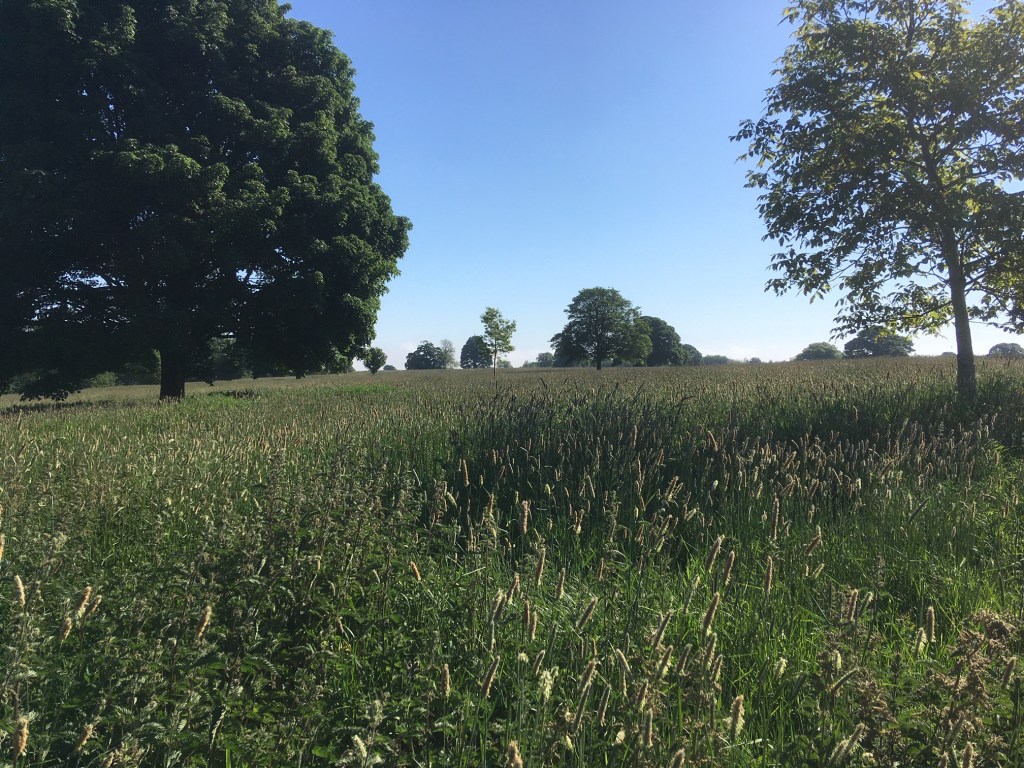
Because we are not different to nature but we are nature then we have a lot to learn from our natural environments. One is that a plant is a plant from beginning to end: first the seed, then the shoot, then the sapling, then the tree, then the seed … .

It’s how oneness flows.

Modern life doesn’t feel like this. We often find ourselves doing one small thing within something far larger, often through separation.

Each of us is capable of beginning something, nurturing it into something sustainable and watching the fruits grow.

Being involved in something from beginning to end gets us to where the unexpected and interesting things emerge.

What’s your thing?

(*From Nassim Taleb’s Skin in the Game.)
(**Anthony Weeks from Drawn Together by Visual Practice.)

Back to the two questions

You may not know in your mind where you are going, but you know it by doing*
(Nassim Taleb)

These are the two questions that lie at the heart of the work I am involved in with people, and they belong together:

Who am I?
What is my contribution?

Without these two questions most of the books ever published would vanish – and those about their subsequent states of identity: clubs, parties, team, nations … .

Out of these questions form the myths or stories we live by when we are alone and when we are with others.

One question without the other is unhelpful. We cannot do something that matters unless it is intrinsically part of who we are, and we cannot know who we can be unless we do something that puts soul in the game.

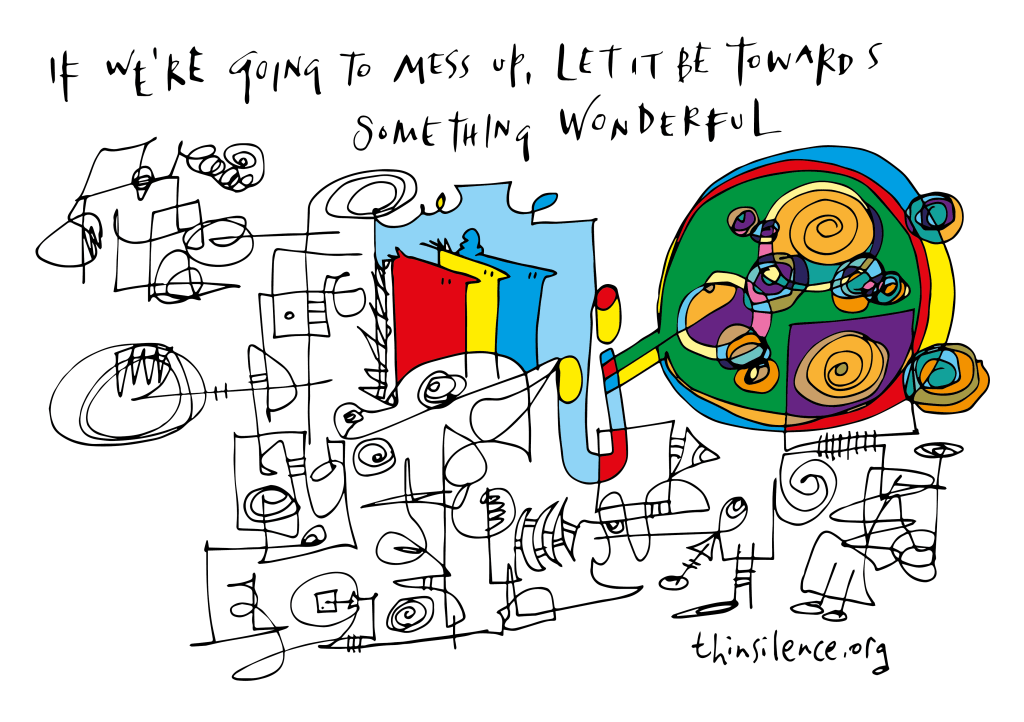
When we do something and reflect, do something and reflect …, things begin to happen.

(*From Nassim Taleb’s Skin in the Game.)

Not there yet

The reason it’s difficult to learn something new is that it will change you into someone who disagrees with the person you used to be. And we’re not organised for that. […] The alternative is to sign up for a lifetime of challenging what the self believes. A journey to find more effectiveness, not more stability.*
(*Seth Godin)

Most of us then default to one of a handful of templates and filters for all their experiences; everything gets pulled inside of what my little mind already agrees with.**
(Richard Rohr)

The important thing is not what you’re passionate about but that you own and explore your passion.

Passion is your key to opening new rooms and worlds and universes. Connect with it and you’ll find within it what you must do next, though many miss this:

I walked away remembering passion was a rare commodity.^

The remarkable thing about all of this is that when we live our passion large, we find ourselves transported into places and spaces we never imagined going before, into the rooms and worlds and universes of others.

Welcome to a year of everything getting bigger.

(*From Seth Godin’s blog: Defending myself.)
(**From Richard Rohr’s The Divine Dance.)
(^From Erwin McManus’ Uprising.)

Unfinished business

Just in case you have some unfinished business with the future.

Today is where your past and future meet.

Maybe leaving regrets, errors and failures behind …

to do something new ..

to freshen something up …

to explore the fullness … .

Happy New Year!

We are the solution and we are the problem

I am the reason the birds are missing… I am made of dirt and grit and stars and river, skin, bone, leaf, whiskers and claws. I am a part of you, of this, nothing more or less. I am mycelium, petal pistil and stamen… I am energy and I am dust. I am wave and I am wonder. I am an impulse and an order.*
(Eve Ensler)

Consumption is an activity so different from gainful labour that it showed itself in the mode of leisure, even indolence. We display the success of what we have done by not having to do anything. The more we use up, therefore, the more we show ourselves to be winners of past contests.**
(James Carse)

At the same time as struggling with the cause and affect dynamic, we have been able to exponentially increase the magnitude of the cause.

Eve Ensler comes to terms with 2.9 billion birds begin lost in only fifty years in North America and writes an apology to the Earth taking her share of the responsibility:

Mother, I am the reason the birds are missing. I am the cause of salmon who cannot spawn and the butterflies unable to take their journey home. I am the coral reef bleached death white and the sea boiling with methane. I am the millions running from lands that have dried, forests that are burning or islands drowned in water.*

If we are to be the solution then we must first see that we are the problem, not someone else only, not the system only, not big business only, not governments only – governments would be far happier leading green change if they thoughts people would vote for them:

The art of solving problems often involves spending time and energy on what you’ll do when you don’t actually solve the problem.^

(*Eve Ensler, quote in Maria Popova’s Brain Pickings: Losing the Birds, Finding the Words … .)
(**From James Carse’s Finite and Infinite Games.)
(^From Seth Godin’s blog: “I don’t know how it could fail.”)

On the benefits of being lost

[Freedom] evolves once man is a complete being, when both of his basic impulses [of change and immutability] have developed, and it will therefore be absent so long as man is incomplete and excluded from one of his two impulses; and should be capable of restoration by all that returns him to completeness.*
(Friedrich Schiller)

One never reaches a horizon. It is not a line; it has no place; it encloses no field; its location is always relative to the view.*
(James Carse)

The important thing about being lost is to admit when you are.

Don’t pretend you still know where you are or where you are headed.

Then you begin to see the benefits.

One of the problems with our lives as we have come to find them is that we can be too found, which would be too much of Friedrich Schiller’s immutability impulse and not enough of the change impulse, and too much of James Carse’s boundaries and not enough horizons.

Lost is good sometimes.

We pay more attention.

We are open to more possibilities.

Sometimes we find ourselves lost and when we notice this, wondering how we got to where we find ourselves, the contents of our days and the contents of our life, then we can use this towards something more, different, better … .

We can also get lost on purpose; it’s where we find who we really are and what we have to gift:^

My Lord God,
I have no idea where I am going.
I do not see the road ahead of me.
I cannot know for certain where it will end.^^

(*From Friedrich Schiller’s On the Aesthetic Education of Man.)
(**From James Carse’s Finite and Infinite Games.)
(^Check out Rebecca Solnit’s A Field Guide to Getting Lost and Keri Smith’s The Wander Society.)
(^^Thomas Merton, quoted in the Northumbria Community‘s Morning Prayer: Day 23.)

In summary …

Nothing is one thing […] If you’re focusing on the part of your day that was “fine,” then you’re ignoring the parts that were a miracle, or disappointing, or thrilling.*
(Seth Godin)

The only problem is that when you are different, people can laugh at you, or even worse. Sometimes people don’t like what’s different.**
(Bertolt)

We’re tempted to summarise in order to know, or to explain and even to be.

Everything is so much more than a summary, including you.

Going beyond the summary would be a brilliant way of spending 2020, not. Not only would you come up with many more words to describe yourself, but you’ll also find more words to describe others.

(*From Seth Godin’s blog: Nothing is one thing.)
(**From Jacques Goldstyn’s Bertolt.)

Boundaries and horizons

[A] society is defined by its boundaries; a culture is defined by its horizons. […] A horizon is a phenomenon of vision. One cannot look at the horizon; it is simply the point beyond which we cannot see.*
(James Carse)

When it’s your turn, it’s your turn. You own it. Your choice. Your freedom. Your responsibility.**
(Seth Godin)

Boundaries are vertical, horizons are horizontal.

Boundaries exist because of some resistance on the other side of the line, horizons are open, we can never reach them

The future will be more about horizons than boundaries, if we want it to be.

(*From James Carse’s Finite and Infinite Games.)
(**From Seth Godin’s What to Do When it’s Your Turn.)

To finity and beyond

[I]t is only through the part we have access to the whole, only through the limited that we have access to the unlimited, only through passivity that we have access to activity; but it is only through the whole that we have access to the part, only through the unlimited do we have access to the limited, only through activity do we have access to passivity.*
(Friedrich Schiller)

Perhaps Jung’s most compelling contribution is the idea of individuation, that is, the lifelong project of becoming more nearly the whole person we were meant to be – what the gods intended, not the parent, or the tribe, or especially, the easily intimidated or inflated ego.**
(James Hollis)

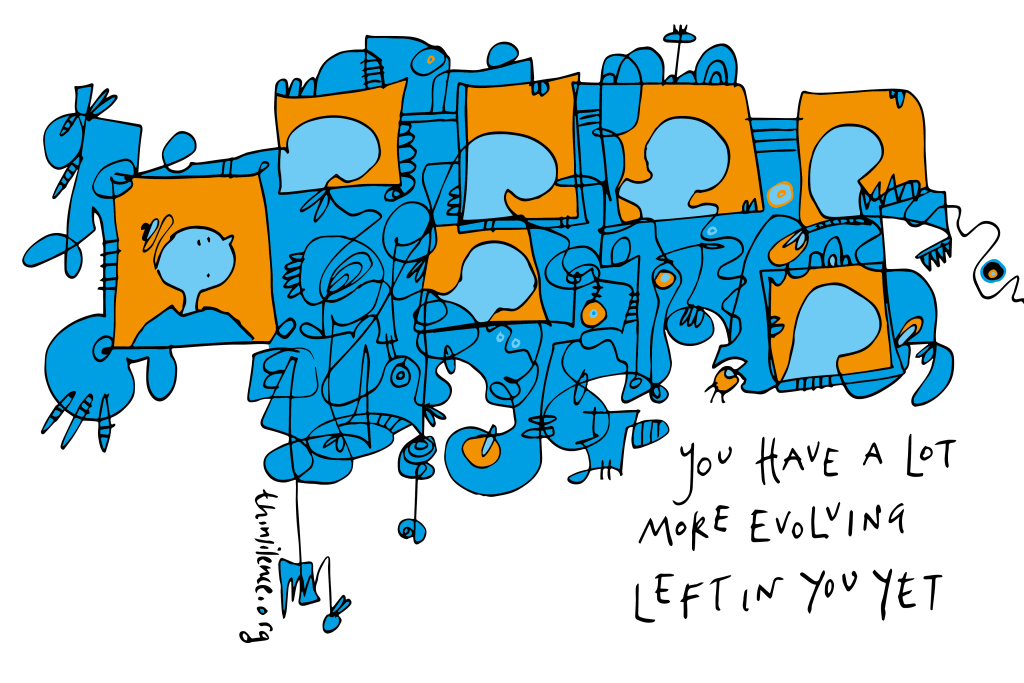
We ought to have no idea of who we can become over a lifetime.

If it were scripted from the beginning then it would be limiting. Our limitations are only a doorway to the unlimited. And your myths as expressions of the unlimited and, as such, are doorways to the limited:

Infinite players are not serious actors in any story, but the joyful poets of a story that continues to originate what they cannot finish.^

Buzz Lightyear wants to explore infinity and beyond infinity, and perhaps what he’ll find is “finity” – for we need both. The trick is to not only to hold the finite in the infinite but also the infinite within the finite: the infinite within the finite within the infinite.

(*From Friedrich Schiller’s On the Aesthetic Education of Man.)
(**James Hollis, quoted in Brené Brown’s Rising Strong.)
(^From James Carse’s Finite and Infinite Games.)