A creative person. Initiating, enacting. Out of personal being. Using his lifetime to find his original face, to awaken his own voice, beyond all learning, habit, thought: to tap life at its source. When the human community finally knows itself, it will discover that it lives at the centre. Men will be artists in their life and labour.* (M. C. Richards)
Do not rush into the day.
Connect with your joy, follow your curiosity, form your questions.
The surface of the earth itself acts to transmit the presence of the beloved. The earth vibrates like a wire with his step, and sees the impulse directly into the body of the poet. It is the nature of the earth and of our dust to be in constant contact with the impulses of life. If we listen, we will hear the continuous tread of love, moving up our limbs like sap, like an electric current, impelling us as well to “stir and step out.”* (M. C. Richards)
it is the heart that makes us human. The heart is where the beauty of the human spirit comes alive. Without our heart, the human would be sinister’** (John O’Donohue)
How do we come to the day?
With our art – artfully, artisanly?
With our “to do” list – functionally?
The former is more demanding, knowing nothing is at it appears on the surface It knows it must ask more, search more, knock more, more conscious, more intentional to the impulses of life:
How much of the beauty of our own lives is about the beauty of being alive? How much of it is conscious and intentional? That is the big question.^
Crises tend to accelerate society along.* (Hugh Macleod)
Will we wake up in a few months and lament that we haven’t made more of this time in isolation? There are two questions we can ask ourselves at the end of each day. What did I do today that I’m proud of? What am I glad I did today?** (Bernadette Jiwa)
When we went into lockdown, we didn’t leave behind the things that matter to us most, the difference we want to make. These are always with us because they’re part of us. It’s proving to be a testing time for all of us, with extremes for some, but we may be surprised at what comes out of this. Robert McKee encourages writers to take notes whilst in lockdown because there’ll be some intriguing stories to tell:
This will pass. We’ve been through such things before; there have been plagues, the Spanish flu, and more. The important thing is that in time, this will pass. In the meantime, we will discover who the good people are, and which people are evil. People who we thought were selfish and venal might turn out to be heroic and self-sacrificing. People who we thought were loving and selfless might turn out to be greedy. Either way, we will find out who people really are by the way they act in the face of adversity. […] take notes.^
We may not be writers wondering how to work through the lockdown but we can all daily reflect on how we’re responding and what we would like to be about to “accelerate society along” both now and also in the new future.
This is about finding or reconnecting to our true Self, our best response to what is happening, as Frederick Buechner reminds us:
The original, shimmering self gets buried so deep that most of us end up hardly living out of it at all. Instead we live out all the other selves, which we are constantly putting on and taking off like coats and hats against the world’s weather.^^
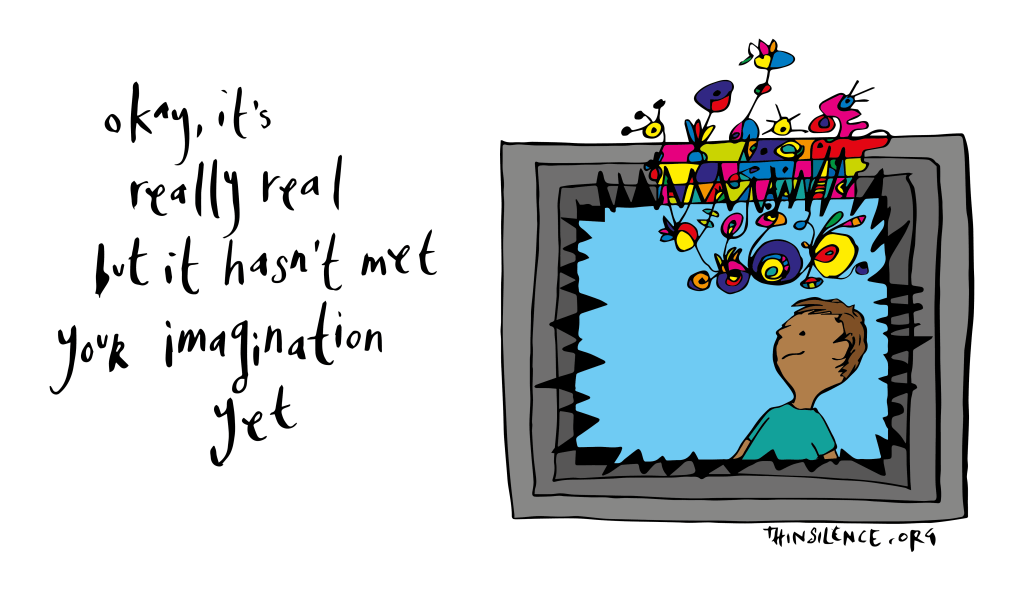
We find hope where the reality of what is meets our imagination.
Use your senses. Open your eyes, your ears, your smeller, your taste buds, your skin, your throat, your lungs, your heart, your blood, your interstices. Listen. If we listen, we will not have to ask. If we listen, we will find ourselves at the centre of the entertainment.* (M. C. Richards)
first take the log out of your own eye, and then you will see clearly to take the speck out of your neighbour’s eye** (Jesus of Nazerath)
Normally I begin the day following whatever path emerges from the different things I’m reading. This continues to find its shape as I move it from journal to blog.
This morning, though, I tried to force the path. I wanted to explore the theme of gratitude for something I will be writing with four university colleagues.
Along the way, I slightly altered a closing from John O’Donohue, replacing unforgiven with ungiven:
May all that is ungiven in you Be released.
May your deepest fears yield Their deepest tranquilities.
May all that is unloved in you Blossom into a future Graced with love.^
That kind of worked but I knew there was so much I was not hearing or seeing about how someone or something wanted to be seen and heard but it was as if I was wearing glasses made out of logs and everything I saw looked like wood.
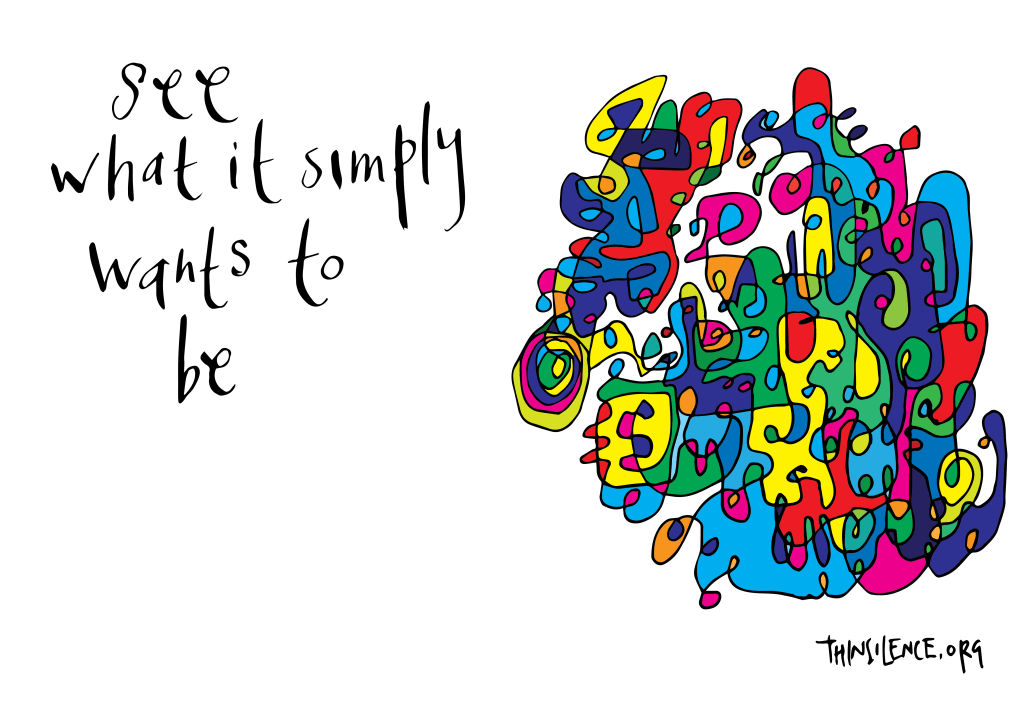
And doesn’t gratitude begin when we see someone or something simply as they or it wants to be?
If you spot something interesting, look closer.* (Rob Walker)
We want our minds to be clear – not so we can think clearly, but so we can be open in our perceptions.** (M. C. Richards)
We are both free and trapped in our seeing, being able to see so much and yet miss even more.
M. C. Richards writes, ‘the laws of physics are the laws of our nature:’
We can only receive what we already have! We can only become what we already are! We can learn only what we already know. It is a matter of realising potentialities.**
Yet we come to the aid of each other.
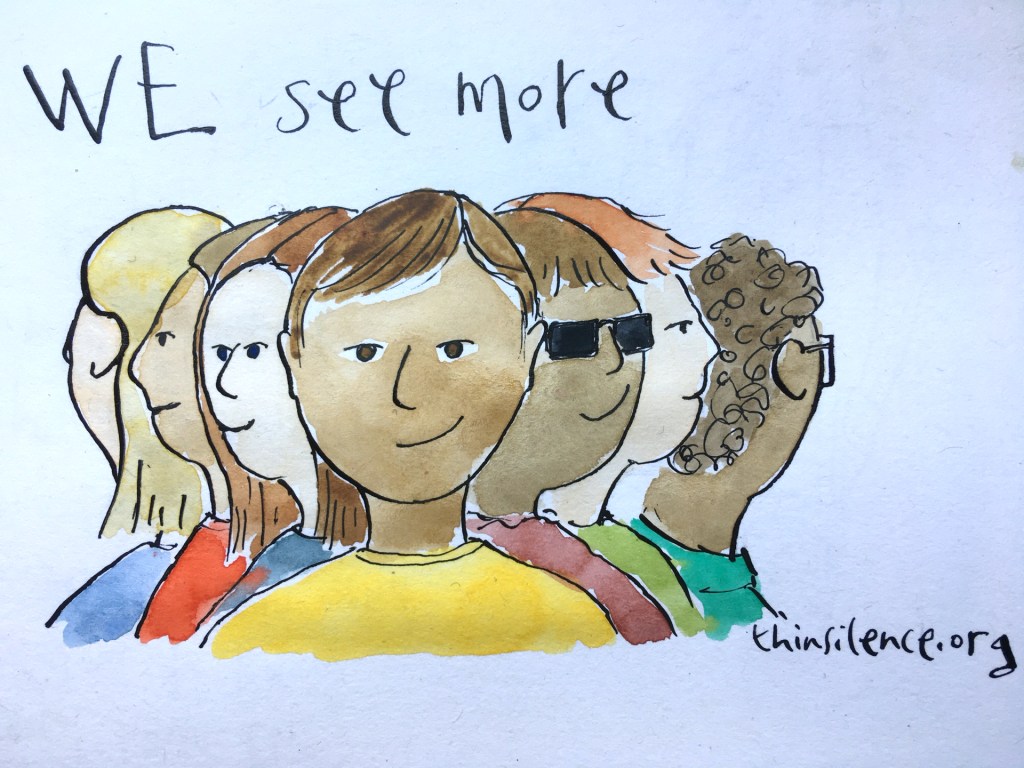
Whilst being prepared to see, being present to see what is there and even prescient in seeing what is not there, being open to what others see seems to me to be critical. It is also very difficult because our own ways of seeing try to dominate and yet seeing more through each other is the reality of we are:
We see that it is not a matter of trying to be related but rather of living consciously into the actuality of being related.**
Asking open and generous questions of what each other sees is one of the most helpful ways for developing this openness.
What we also notice, over time, is how our ability to see more is growing.
(*From Rob Walker‘s The Art of Noticing newsletter: Look Out.) (**From M. C. Richards’ Centering.)
The future is dynamic, active, interconnected. For some reason many of us would rather know the future than create it.* (Erwin McManus)
The world is alive, generous, and waiting patiently for us to figure it out.** (Tom De Blasis)
Gifts help us to create the future; they create disequilibrium and wait to see what effects they may have caused.
Everything we are can be used in this direction:
We are only as much as what we can give to others.^
It turns out that when we give ourselves some space and engage our imagination we’re a lot.
It is quite possible that more happens when a gift is not commoditised, when it is able to stay free to not only be the gift, to also contain the spirit of the gift and the community of the gift.
EducAid runs an educational network comprising of free schools, teacher training, and tertiary programmes in Sierra Leone. We provide distinctive, personalised, top-quality, holistic education and support to vulnerable young Sierra Leoneans. We are a UK registered charity which believes thatthe education of young men and women is essential to: unlock human potential, overcome poverty, improve wellbeing, build democracy, and that it is the cornerstone of stable development. Our vision is a democratic, dignified and prosperous Sierra Leone, where poverty is eliminated by educated citizens who are able to develop their personal, social and economic wellbeing.* (EducAid)
Covid-19 is hurting everyone and especially the most vulnerable. Schools have closed for an indefinite period in Sierra Leone and EducAid is trying to keep its community of students safe whilst also trying to continue their education in innovative ways. They face massive challenges at the best of times and you can read more about how the charity is coping here.
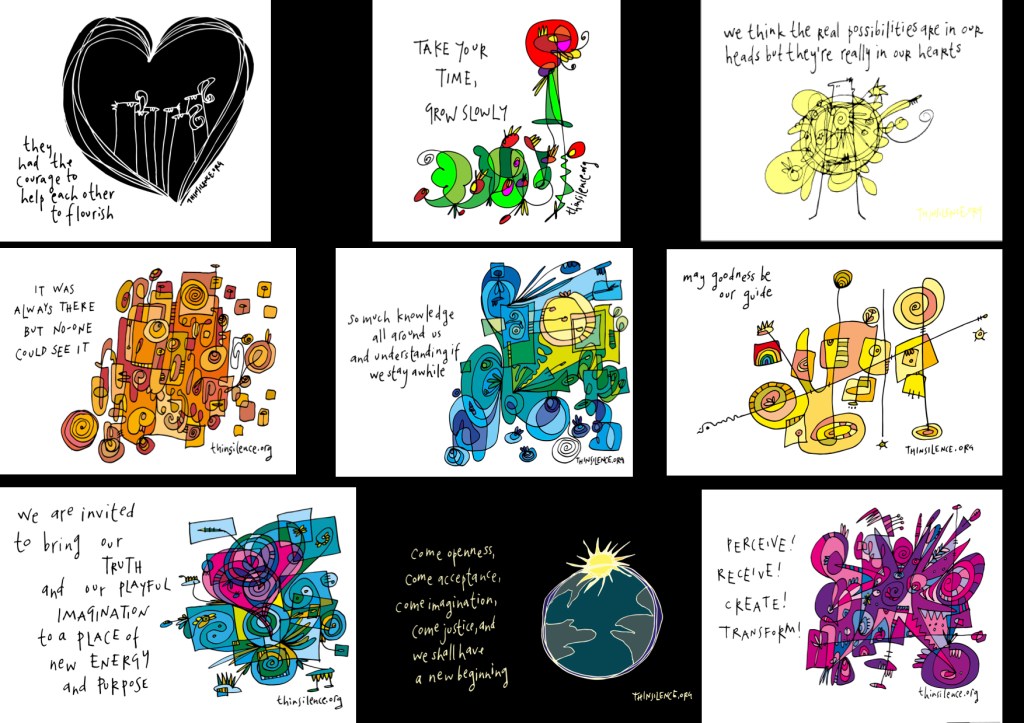
To help raise funds, I’m selling some of my favourite doodles from the last couple of years to be made up into large canvases for £100 each and are suitable for homes, offices and businesses, depending on the message.
After the cost of printing the canvas, and postage and packing, all monies will go to EducAid. The shape of the doodle determines the size of the doodle but square doodles will normally be 50×50 centimetres and rectangular ones 60×40.
The canvases will be made up on the heaviest frame and delivered to your home by Photobox. The doodles shown here are my suggestions, though you can use my thin|silence blog as a catalogue to order from – just let me have the date of the blog and I can take it from there.**
To order yours, drop me a line at geoffrey@thinsilence.org identifying the image and providing your email for the order to be completed.
(*From EducAid’s website.) (**You can find some more of my favourites here: 1.1.20, 24.1.20, 12.2.20, 23.2.20, 1.3.20, 6.3.20, 11.3.20, 20.3.20.)
A hero sets off in search of something elusive that has the power to change both their life and the world.* (Chris Guillebeau)
Does this path have a heart? If it does, the path is good; if it doesn’t, it is of no use. Both paths lead nowhere; but one has a heart, the other doesn’t. One makes for a joyful journey; as long as you follow it, you are one with it. The other will make you curse your life. One makes you strong; the other weakens you.** (Carlos Castañeda)
The most important path you will ever walk is invisible to everyone but you. (I don’t mean that the path is fixed: it is dramatic and changes as you step out on it.)
Others may think they can see your path but they cannot, just as you cannot see theirs. The guide knows this and comes alongside to help you see what they cannot, to help you have good eyes
The guide knows that good eyes come from opening your mind, your heart and your will; they will help you connect with your values, identify your talents and sense your energy.
The rest is up to you:
To be yourself in a world that is constantly trying to make you something else is the greatest accomplishment.^
Sooner or later we must distinguish between what we are not and what we are. We must accept the fact that we are now what we would like to be. We must cast off our false, exterior self like the cheap and showy garment that it is […] We must find our real self, in all its elemental poverty, but also in its great and very simple dignity […].* (Thomas Merton)
As the circle of light increases, so does the circumference of darkness.** (Albert Einstein)
These last few days I have found myself reflecting on my limitations, feeling the animated challenge to further embrace who I am rather than who I am not.
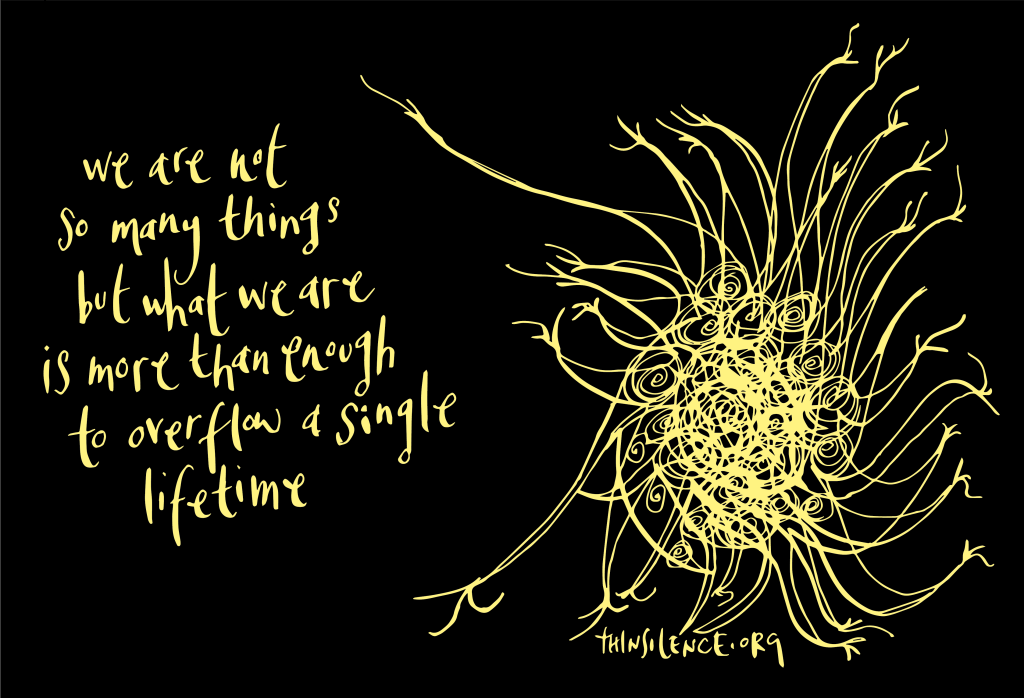
I am convinced this to be a daily and lifelong adventure because as we know our true self better we also come close to the unknown possibility of who we can become in that direction.






You must be logged in to post a comment.