A generative life

The Generative Self work suggests that you can do this by integrating the three minds – somatic, cognitive, and the field – to forge a higher state of consciousness.*
Stephen Gilligan

Being creative is not only about thinking: it is about feeling. … Feeling, hunches, subconscious perceptions and intuitions can all play a central part in creative work, and not only in the arts.**
Ken Robinson.

A generative life is a
deeper
life;
It does not lie around on the surface of the
ordinary and everyday.

It is openness and connection that brings us to our generative self:
Openness of mind, of heart, of actions towards all:
Perhaps that was the real quest of this adventure,
the infinite quest for connection with
everything, everyone, everywhere, always –
the quest to let down my barriers,
let go of my agendas and expectations,
and simply open to who and what may come.^

This deeper life equates to
the hero’s journey,
Our protagonist leaving their ordinary existence
for a special world,
Discovering their life not only has an everyday plane,
But also a mythical level through which they see
themselves and everything in a transcending way:
I find … that when we’re in mythic
or spiritual levels of consciousness,
we become citizens of a larger universe
with regard to perception, time, space,
dimensionality, and possibility.^^

What are you going to make?

*Stephen Gilligan and Robert Dilts’ The Hero’s Journey;
**Ken Robinson’s Out of Our Minds;
^Brian McLaren’s God Unbound;
^^Jean Houston’s A Mythic Life.

The whisperer and their dream

Essence is not a place or time, an insight or state of mind. It’s the deepest part of our nature, an actual presence that is innate and inborn.*
Jean Houston

entelechy, a Greek word meaning the dynamic purpose that drives us toward realising our essential self*
Jean Houston

There they are again,
Embodied in Jean Houston’s
essence and entelechy:
Theory U’s two inseparable questions –
Who is my True Self?, and
What is my Contribution?;
Also, Joseph Campbell’s equally indivisible
personal and social myths.

We are more than we know,
Makers of beauty and usefulness;
Though we may say we may claim
we are no-one with nothing to bring,
Only surviving a hard life,
It may be exactly here we find our response
To the two questions:
But true healing and transformation
come from being able to sponsor the wound,
Sponsor the demon,
sponsor the shadow.**

Your story and my story –
There’s more to write,
As we turn our attention and imagination
towards our reality:
The problem out writers face isn’t writing.
It’s consciousness.
Attention.
Noticing.^

Carl Jung leaves us with this encouragement
to pay attention:
I am not what happened to me.
I am what I choose to become.
^^

So I pursue the purpose in my dream
to help people notice who they are
and what they have, and I become
a whisperer.

*Jean Houston’s A Mythic Life;
**Robert Dilts; Stephen Gilligan and Robert Dilts’ The Hero’s Journey;
^Verlyn Klinkenborg’s Several short sentences about writing;
^^Ken Robinson’s Out of Our Mind.

In-fluence

If you’re serious about changing yourself and your life, you must change your environment.*
Ben Hardy

Influence is itself a watery word: … “The action or fact of flowing in; inflowing, inflow, influx, said of the action of water or other fluids, and of immaterial things.”**
Robert Macfarlane

An environment can be
a person, an idea, a role, a place, a narrative, a group, an influencer, a book, and more –
When we appreciate how environments
are places of influence, then
it makes sense to choose carefully and wisely.

The best environments are completely
interactive and mutual –
We must be careful around those that are not,
Especially when we are that environment
to others.

*Ben Hardy’s Personality Isn’t Permanent;
**Robert Macfarlane’s Landmarks.

Deeper time

Time is where eternity unfolds. The contemplative has always recognised the morning as the time to welcome the new day with a sense of creative expectation and openhandedness.*
John O’Donohue

[I]t is essential to put yourself in the unconditional service of the future possibility that is wanting to emerge. Viewed from this angle, presencing is about dialogue with the future possibility that wants to emerge.**
Otto Scharmer

At around 6.45am each morning,
I begin gathering thoughts and ideas from
many people and places,
Sifting and mixing the past, the present and
the future, cooking up
an anticipation and expectation of
what might be possible,
Something I can bring to another as a gift today.

When you dance on the edge of infinity,
there’s always enough …
because you aren’t taking opportunity
from anyone else, you’re creating it.^

*John O’Donohue’s Benedictus;
**Otto Scharmer’s Theory U;
^Seth Godin’s The Song of Significance.

Found you

I must know that I am, at least in part, the very thing that I am seeking.*
Richard Rohr

We become more original through practice.**
Seth Godin

If only we were like that person,
Or if we could do what they are capable of,
Yet the powerful and wonderful thing is to
find and embrace who we are,
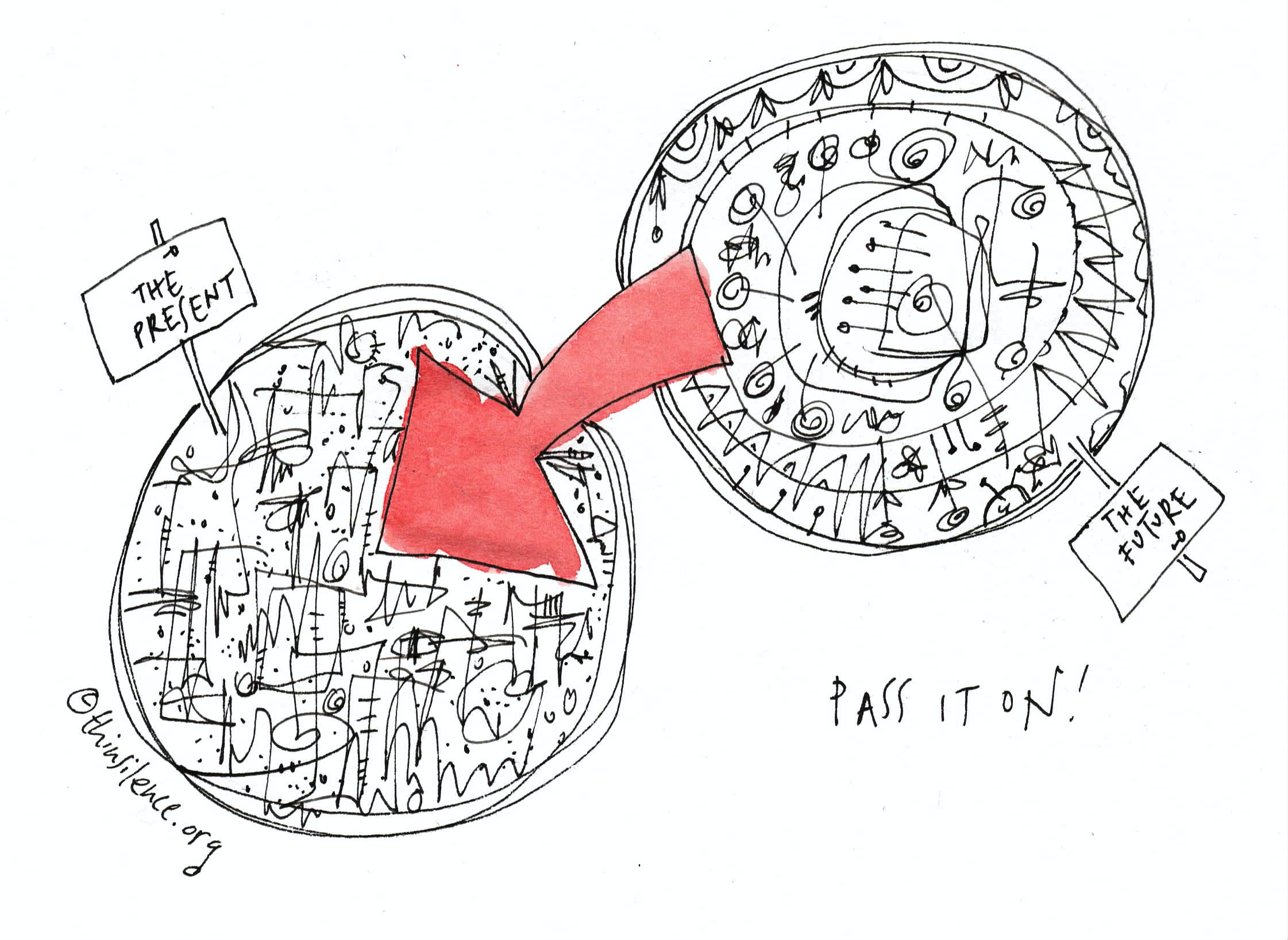
Bringing our future self into the present.

*Richard Rohr’s Eager to Love;
**Seth Godin’s blog: Two kinds of practice
.

Future present

The poet places himself where the future becomes present.*
Lewis Hyde

Who can remind me that the journey is possible, and offers support when I need it? Who are my teachers, my mentors, my sponsors, my awakeners?**
Robert Dilts

Poets, guides, teachers, mentors, sponsors, awakeners –
They come from our future;
They enable us to see and know what we presently
do not:
Those phenomena with which
we have no affinity and in which
we are not in some sense ready to see
are often not seen at all.^

When our understanding is opened, then
the future becomes possible in the present.

*Lewis Hyde’s The Gift;
**Stephen Gilligan and Robert Dilts’ The Hero’s Journey;
^Thomas Kuhn: Scott McCloud’s Making Comics.

The unvisited threshold

We inherit in our bodies and nervous systems the remnant of the earliest vertebrates as well as the fruits of mammalian evolution. And we also contain as latency the substance of what we will yet become.*
Jean Houston

So your threshold is the point at which you’re going into a new and challenging territory that you’ve never seen before, and there’s no turning back.
Robert Dilts

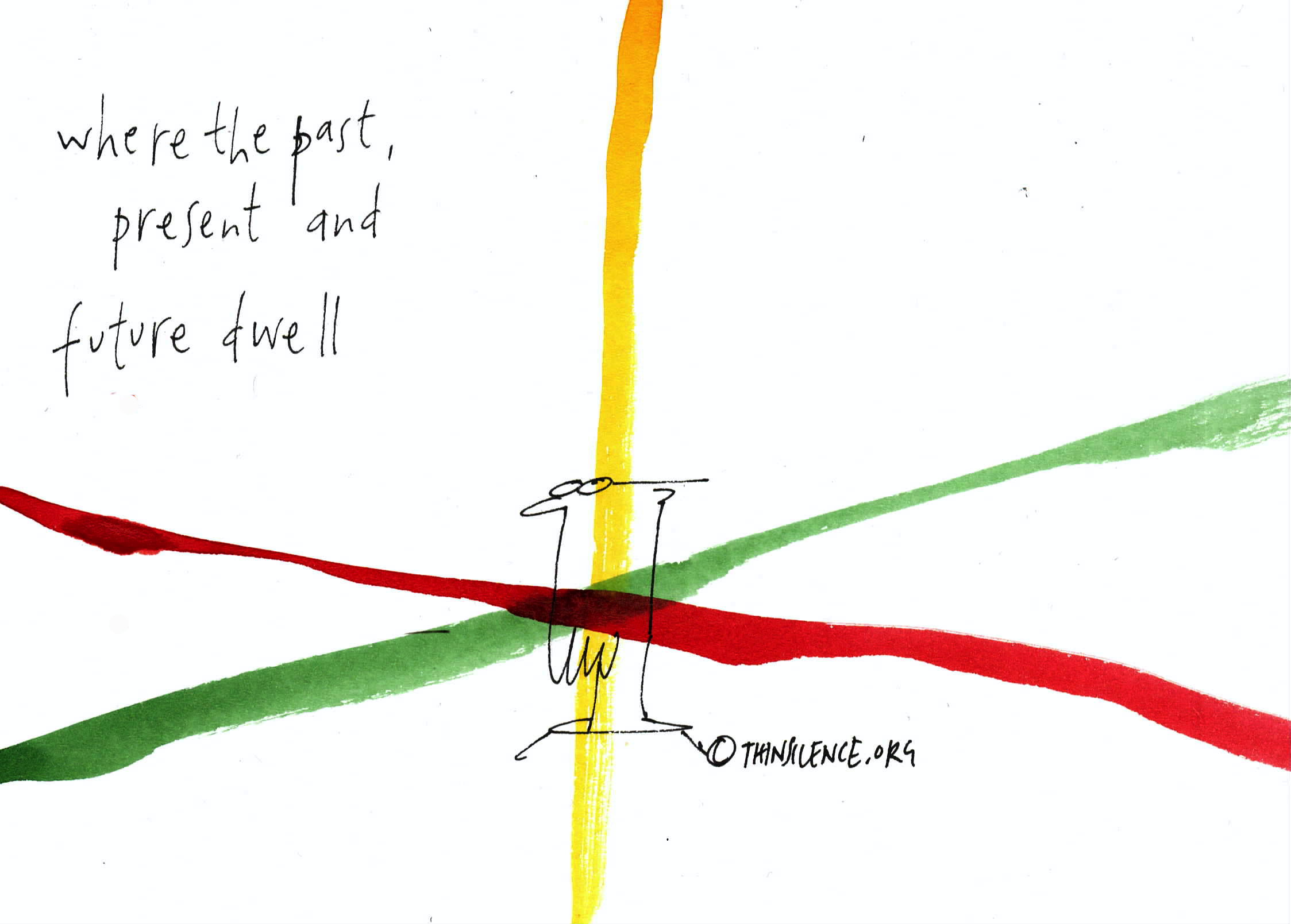
In this moment,
We contain our past and present
and also our future,
Different, larger, richer than
simply repeating the past and
replicating the present.

There’s a psalm that proffers:
He raises the poor from the dust,
and lifts the needy from the ash heap^

It’s as though our lives are coming
to their close prematurely,
Being rebsorbed by the ground
from which we have emerged:
“earth to earth, ashes to ashes, dust to dust.”

This is often the result of reducing our
environments, held within
smaller worlds, but
there’s always a new environment, another
threshold to cross, and this is how we come upon
a further state of personal evolution to explore.

*Jean Houston’s A Mythic Life;
**Stephen Gilligan and Robert Dilts’ A Hero’s Journey;
^Psalm 113:7.

I’d forgotten all about that

We don’t come into this world to sleep. We come to awaken, and awaken again, and to grow and evolve. So the calling is always a calling to grow, to contribute, to bring more of that vitality of life energy into the world or back into the world.*
Robert Dilts

A year ago,
I told the story of how Togonese women would
create a song for newborn babies,
To be sung to them at times in their lives when
they had forgotten their truth.

At the close of a dreamwhispering journey, I ask
my dreamwhisperers to tell me the story
emerging from
the discoveries of our journey of conversations together.
Last night, I found myself awake and
contemplating my own story,
And I thought to recite it
before I fell asleep once more as I realised that
I had never spoken it in this way before.

It didn’t take me too long,
And to “speak” it rather than write it was helpful;
I found myself making new connections promising
new possibilities,
A story that continued to ask for my heart and soul.

Why not remember your story, and
if I can help, let me know.

*Stephen Gilligan and Robert Dilts’ The Hero’s Journey.

Learning-lines

We imagine a wild theology that doesn’t limit itself to Plato and Aquinas but also consults the wisdom of rainbow trout and sea turtles, seasons and tides.*
Brian McLaren

We recognise the achievement when we learn as much as we can
within some field or domain or speciality;
It is something greater still to learn from someone else’s.
Although we cannot possibly learn everything,
Something quite extraordinary becomes available to us:
The present emerging ecology of minds and psyches,
our availability to each other,
and our ability to dream one another’s dreams
and experience one another’s biographies
are part of the interpenetrating fractal wave
of the current time, psyche, and memory.
We are being rescaled to planetary proportions,
as we become fractal resonant
and intimate with our own depths.**

We are learners of the universe.
Perhaps there is a learning-line for each of us,
A path of learning that chooses and calls us
when we open ourselves to curiosity and discovery,
Lines crossing the boundaries and barriers
we ordinarily lay down:
“Blessed are the curious for
they will have adventures.”*

*Brian McLaren’s God Unbound; quote anonymous);
**Jean Houston’s A Mythic Life.