Flamboyance

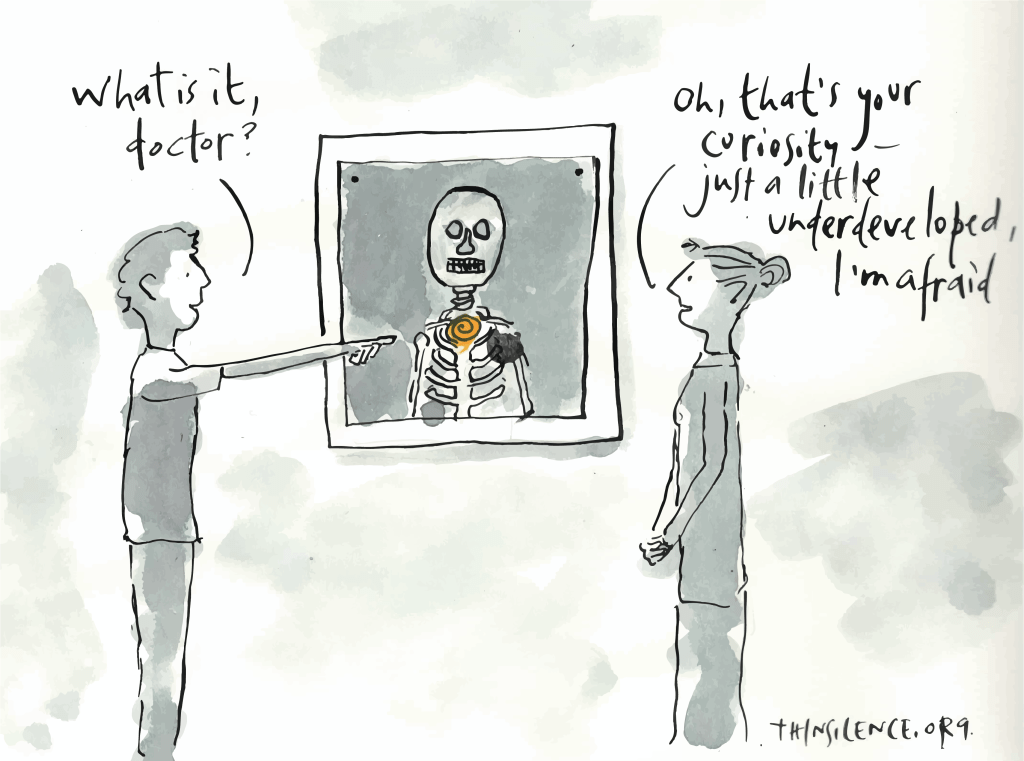
Let’s stop trying to be so productive all the time and make an effort to be more curious.*
(Rob Walker)

What if it was the case that the world revealed whatever goodness it contains in precise proportion to your desire for the best?**
(Jordan Peterson)

Curiosity brings light.

Light is a servant; it does not bring attention to itself but to all it gives its light to.

Attention is the companion of curiosity, energy brought to what we are noticing:

Attention is like energy in that without it no work can be done and in doing work it is dissipated. We create ourselves by how we invest this energy.^

When we pay attention we are bringing our particular light.

Alacrity is attention, energy that does not necessarily know what it will discover.

Each person’s alacrity is different, the make-up of their energy, their light, shaped by their curiosity. This is their flamboyance – their blazing, their flaming:

A “flamboyant” worker, exuberant and excited, is willing to risk control over his or her work: machines break down when they lose control, whereas people make discoveries, stumble on happy accidents.^^

What is all this light all about?

Enlightenment.

Wisdom.

We need a wiser world.

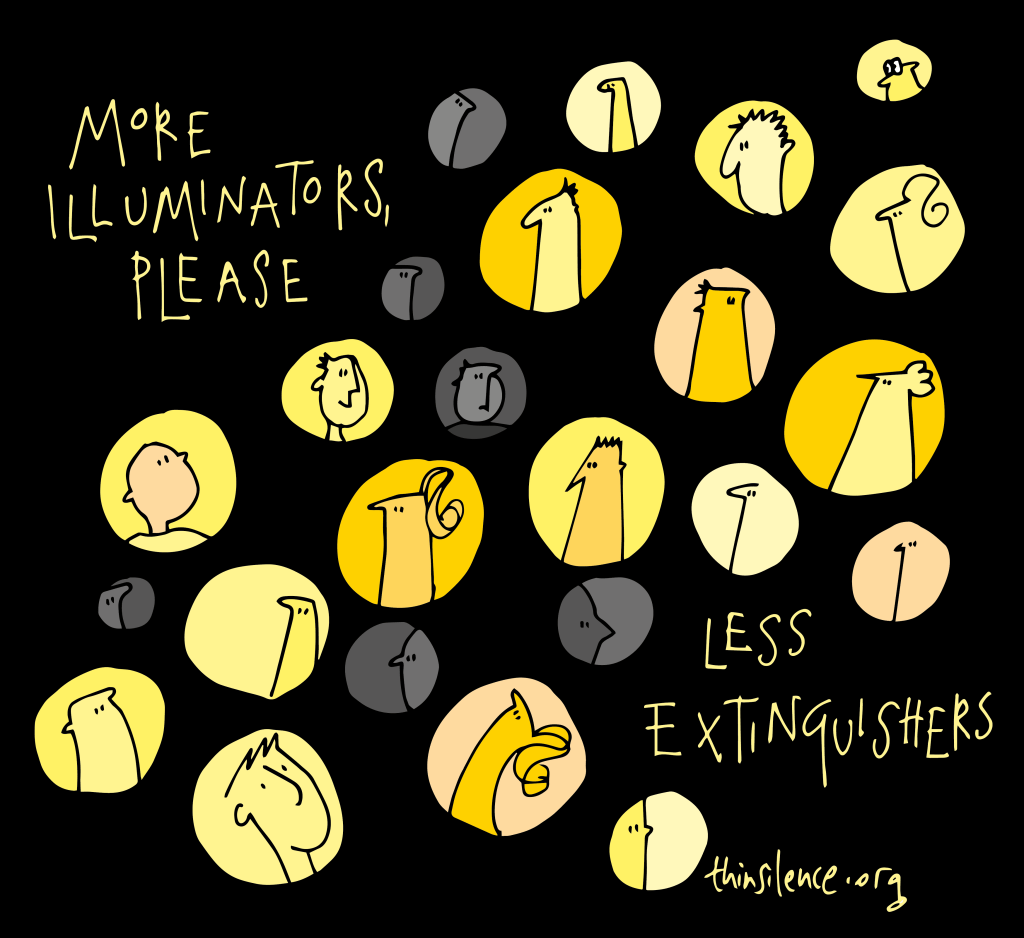
We need illuminators, not extinguishers.

(*From Rob Walker’s The Art of Noticing.)
(**From Jordan Peterson’s 12 Rules for Life.)
(^From Mihaly Csikszentmihalyi’s Flow.)
(^^From Richard Sennett’s The Craftsman.)
What’s that in the way?

It’s time to let go. It might even be time to sacrifice what you love best, so that you can become who you might become, instead of staying who you are.*
(Jordan Peterson)

Our mistake […] is our inability to be ambitious for each day.**
(Bernadette Jiwa)

It is quite possible that we hold onto as the best is less than we are capable of.

It is not by accident that we write stories, legends and myths that speak to us of something more lying beyond what we know and have. For as long as humans have been exploring their higher consciousness, they have wondered about who they are and what they can achieve.

Jordan Peterson, whose words open today’s post, writes,

The price you pay for that utility, that specific focused direction, is blindness to everything else [(…] getting what we currently want can make us blind to higher callings). […] Since you’ve ignored so much, there is plenty of possibility left where you have not yet looked.*

The places we have been ignoring or avoiding are the very places we should be looking. The very thing in the way may be what we are doing every day and we need to follow our curiosity into something more.

Let’s slow down enough to notice our curiosity and then follow it where it leads.

(*From Jordan Peterson’s 12 Rules For Life.)
(**From The Story of Telling: On Ambition.)

Better with design

Thinking metaphorically is common in design.*
(Brian Mau)

We’re born designers.

We love metaphors.

These make for an interesting mix – nothing is as it seems, everything can be reimagined. Live a different metaphor and things happen.

Enjoy thinking about today differently.

(*Brian Mau, quoted in Warren Berger’s Glimmer.)

Yes?

We can wonder whether we have made the right choices, said yes to the right things.

Here’s a triage I found myself pondering earlier:

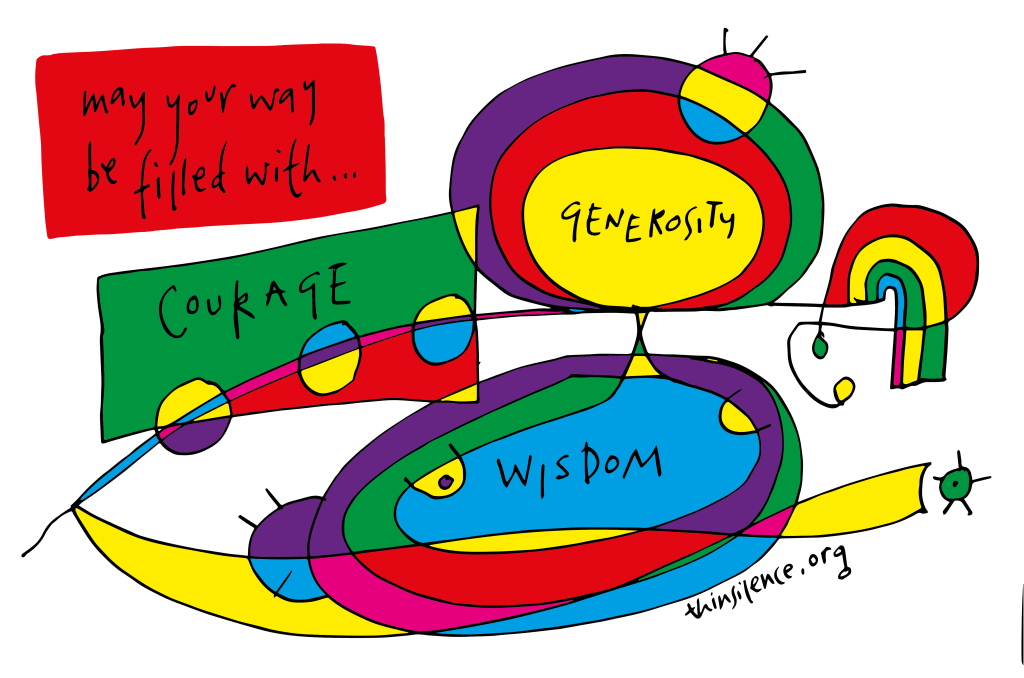
Am I courageous for what I am doing; would I do it even if I didn’t get paid for it?
Am I most generative and generous when I am doing this?
Am I becoming wiser in that I know things that work in life and make a difference for the better?

I didn’t ask if this way is easier or more comfortable; they’re the wrong questions.

Show me

When people see a concept presented visually, they tend to understand it in a way that goes beyond words.*
(Brian Mau)

It must be one of the oldest and most universal phrases.

I can’t see it; can you show me.

People have been drawing pictures for each other millennia.

Designer Brian Collins defines design as hope made visible.** Where there once was nothing, possibility appears.

Doodling and sketching create a conversation between the hand and the mind. First the hand draws something, the mind thinks about it and suggests tidying it up, and so on, and something takes shape.

Of course, we’re also living doodles of hope to one another.

(*Brian Mau, quoted in Warren Berger’s Glimmer.)
(**From Warren Berger’s Glimmer.)

The game of found

So then the journey for peace begins within our hearts. This is why we must face our fears, stand-in in our pain, and walk courageously into the uncertainty and mystery of a better future.*
(Erwin McManus)

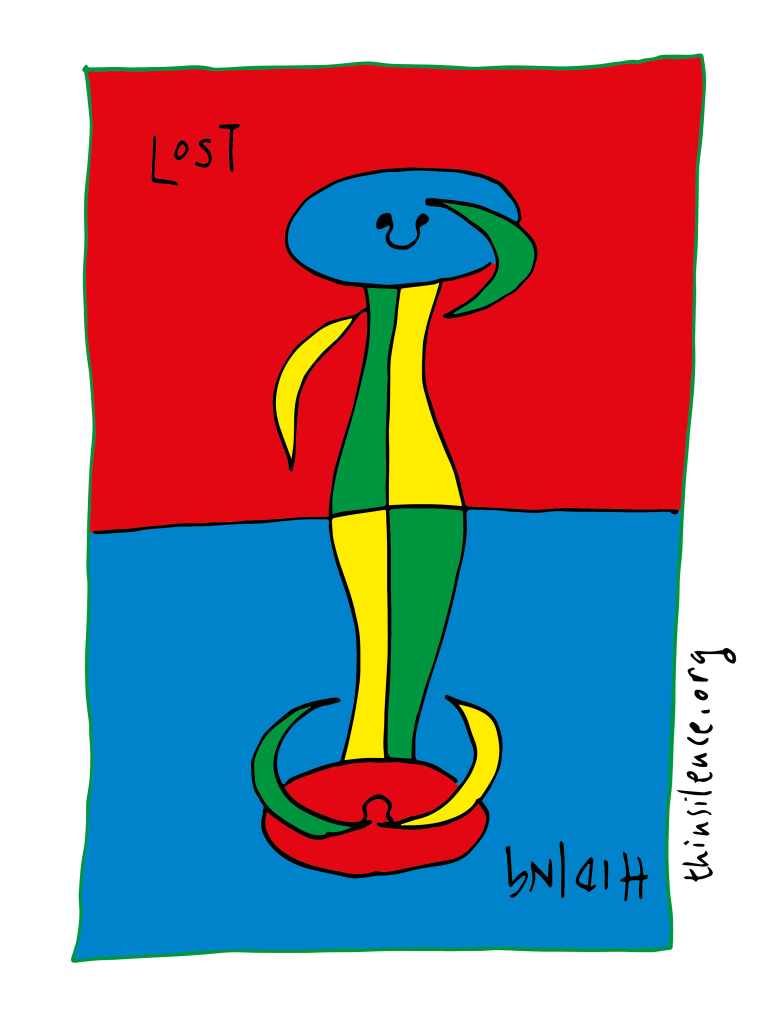
Some who think they are lost are really hiding. Others who tell themselves they are hiding are really lost.

We can all be found, though.

Good news.

(*From Erwin McManus’ The Way of the Warrior.)

Information is faster than inspiration

When you don’t know what should be done, or how something is supposed to work, it’s a brief pocket of possibility. You’re free to speculate on something, unencumbered by the conventional structures.*
(Brian Mau)

be curious, be observant, be fickle [not fixated], be thoughtful, be elegant**
(Rohit Bhargava)

Inspiration requires space and time; information is certainly way faster and easier.

That can be our problem.

Perhaps inspiration will come up with a better solution.

Trust yourself: give yourself some time and space.

Go with the flow rather than the know.

(*Brian Mau, quoted in Warren Berger’s Glimmer.)
(**From Rohit Bhargava’s Non Obvious 2018.)

The summary and the full story

It is very difficult to practice what we agree in theory. And it is very difficult to be modest in our scorn of the gap between what we dream and what we do, and to persevere patiently in our efforts to bridge it. This battle is daily and specific and basic.*
(M. C. Richards)

Often it’s the growth we can’t see that is the making of us.**
(Bernadette Jiwa)

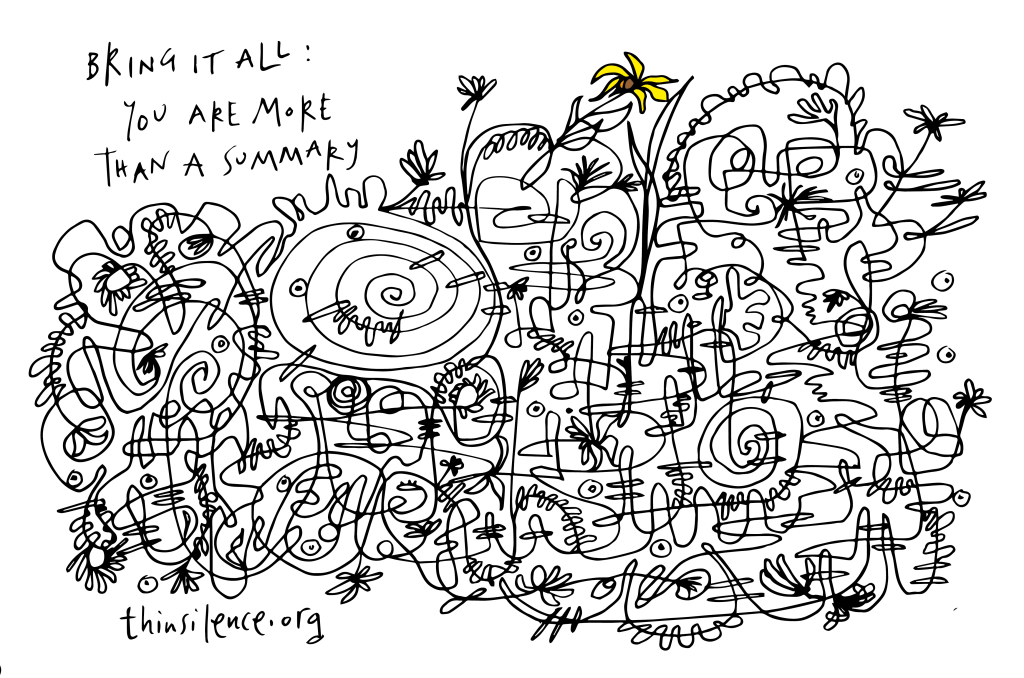
The summary is often neater and more impressive than the full story which contains a lot of messiness and failure and fragility. Both are important if we use them in the right way.

A summary allows us to appreciate what has been achieved, how far we have come, but the big problems, including problems of personal development, cannot be solved summarily. The important turns and moves, the difficulty and the mess of closing the gap between dream and reality has need of the full account, to which we bring our strongest ways of reflection.

Erwin McManus, exploring the way of the warrior as a means of finding peace within and peace without our lives, understands the value of being someone prepared to tell the whole story:

The warrior […] understands that wisdom is not gained in a moment but in an endless number of moments in which choices must be made.^

(*From M. C. Richards’ Centering.)
(**From The Story of Telling: Imperceptible Growth.)

(^From Erwin McManus’ The Way of the Warrior.)

Designers

If something is beautiful, it may be easier to use. […] Designers […] build “forgiveness” (a wonderful name for a design principle) to help us avoid mistakes and recover easily from them.*
(Warren Berger)

We can grasp the fact that at any moment what seems most certain to us is an illusion. It is an illusion in that it precedes a further revelation of ourselves.**
(M. C. Richards)

Given that

research suggests that we simply respond better, on a gut level, to smooth, curved, and symmetrical designs as opposed to rough, angular jagged, or uneven shapes*

here are some more features we can build into our operating stories to make life smoother for others and for ourselves:

compassion
kindness
humility
meekness
patience
forbearance
love
harmony.

We are all designers.

(*From Warren Berger’s Glimmer.)
(**From M. C. Richards’ Centering.)