An ever-changing story

I think what we’re seeking is an experience of being alive, so that our life experiences on the purely physical plane will have resonances within our own innermost being, so that we actually fell the rapture of being alive.*
(Joseph Campbell)

Only the storyteller can transmute information – be it in the form of “objective” fact or “subjective” experience – into wisdom.**
(Maria Popova)

At that point at which we seek to combine our life experiences with our innermost being, we will always find religion, politics, science, economics, arts, education, philosophy, sport and probably more, and, not only between but within each, there is argument.

Brian McLaren wrestles with his innermost voice’s questioning, which he personifies as a guineafowl puffer fish fleetingly encountered on his Galapagos trip:

Why can’t you admit that when you’re arguing about your God concepts, just as when you’re arguing about politics, you’re really arguing about the way you want to live, the future you desire for yourself and your descendants? Why can’t you see that these struggles, whether in religion or in politics or in philosophy or wherever, are essential to your struggle for survival – essential to your cultural evolution and all that it entails?^

Human life and all things contained by human life are evolving.

We struggle, though, to connect our life experiences with our innermost being. Two things that create a problem for us are speed and information.

Hugh Macleod writes about how hunter-gatherers would have to conserve their energy in dry seasons (he’s likening this to the coronavirus lockdown we find ourselves n):

But all of this non-movement had an upside; it gave one an opportunity to sit. And think. And reflect.^^

And tell stories.

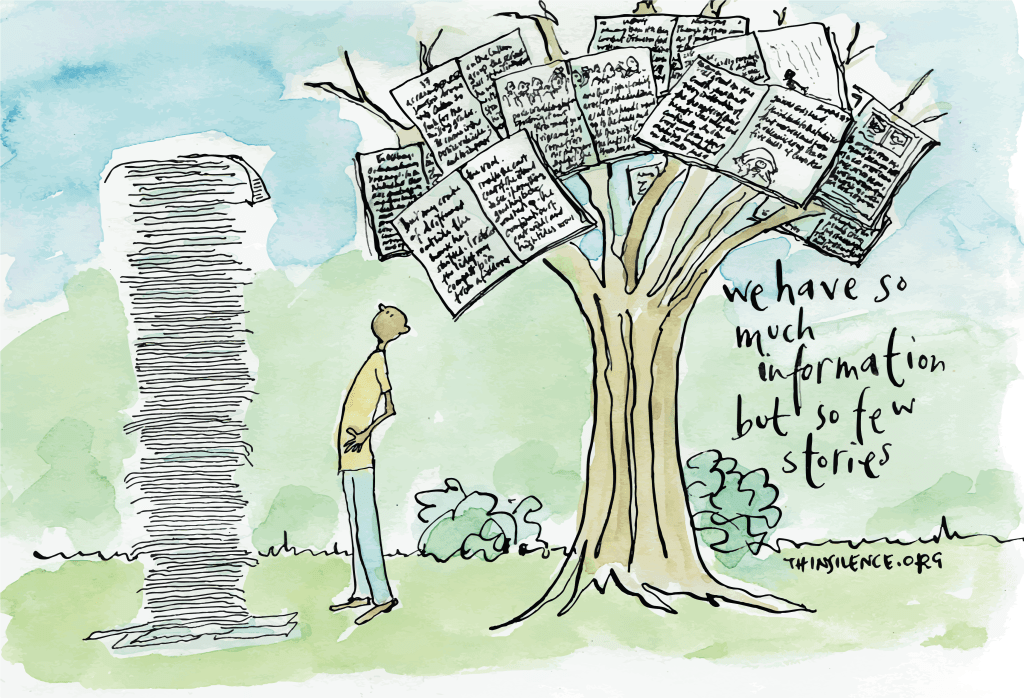
In our modern world, many of us have lost the seasons, protected against the ups and downs of the weather and food harvests. It’s all the same and it’s all fast. And our storytelling has suffered as a result. It is being replaced by information. Our arguments are over information. Maria Popova has argued that only story can transmute information into wisdom and explains her concern:

The death of storytelling […] is both the result and a further cause of this gaping rift between wisdom and information – a concern even more valid and worrisome today, in our story-yelling era driven by the illusion that the latest and the loudest are the most significant and most deserving of our attention.**

Great storytellers do not provide explanation – the very thing we want information to do – but allows the listener to make their own sense, connections and find their flourishing in what is being shared:

Actually, it is hard the art of storytelling to keep it free from explanation as one reproduces it … .*^

We need stories that allow for each person’s life experience and innermost being to connect, to be able to feel alive, to deal with the information constantly thrown at us and shape our evolution in a healthier direction.

(*From Joseph Campbell and Bill Moyers’ The Power of Myth.)
(**From Maria Popova’s Brainpickings: Walter Benjamin on Information Vs. Wisdom and Storytelling as the Antidote to Death by News.)
(^From Brian McLaren’s God Unbound.)
(^^From gapingvoid’s blog: Living through the dry season.)
(Walter Benjamin, quoted in Maria Popova’s Brainpickings: Walter Benjamin on Information Vs. Wisdom and Storytelling as the Antidote to Death by News.)

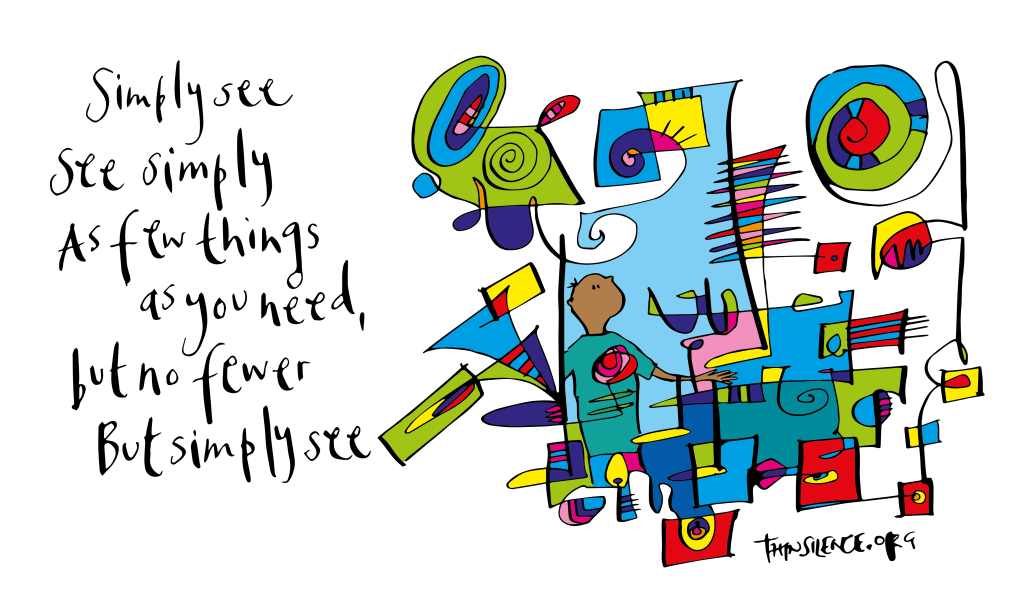
The generous look

Everything changes once you see how the universe is designed for abundance and not for scarcity. It not only changes the condition of your life but it changes you.*
(Erwin McManus)

Formal learning – classrooms and workshops – is the source of only 10 to 20 percent of what people can learn at work.**
(Jay Cross)

When we look more generously at others and our world something quite astonishing happens. It’s as though a great abundance has only been waiting for the invitation of a generous look to joyfully show itself and be seen, that is, to be known fully.

The generous look takes a lifetime of practise, requiring us to be open-minded, open-hearted and open-willed for as long as possible. It’s hard but it’s worth it:

People are wonderful. And they can be hard.^

(*From Erwin McManus’ The Last Arrow.)
(**From Jay Cross’ Informal Learning.)
(^From Brené Brown’s Braving the Wilderness.)

Gloria in ekstasis

Iris Murdoch (1919-1999) used to say that love was the sudden realisation that somebody else absolutely exists.*
(Karen Armstrong)

Perhaps that was the real quest of this adventure, the infinite quest for connection with everything, everyone, everywhere, always – the quest to let down my barriers, let go of my agendas and expectations, and simply be open to who and what may come, now and next.**
(Brian McLaren)

There are two important things emerging from the time of coronavirus lockdown for me which need to be pursued as we emerge into a new future: #blacklivesmatter and hope for the young unemployed. Both are concerned with recognising the beauty, wonder, dignity and contribution of every person.

It is not a matter of wondering whether this will become a pivotal moment in history; we must make it so.

A number of texts came together this morning and I share them here.

I love the description of Brian McLaren for his trip to the Galapagos Islands because they also describe the life-quest we find ourselves within: to be fully connected and open to the possibility of a new humanity and a new earth.

Wendell Berry expresses how this quest begins in solitude:

One’s inner voices become audible. One feels the attraction of one’s most inner sources. In consequence, one responds more clearly to other lives.^

When life finds us out, we can go to great efforts to avoid looking within at our own embarrassment, guilt or shame and yet it is within that we find our seed of hope, and this far more powerful than anything we may hide from.

Karen Armstrong describes the growth of this seed in ekstasis: “the state of being beside one’s self or rapt [carried away] of one’s self:”

The aim of this step is threefold: (1) to recognise and appreciate the unknown and unknowable; (2) to become sensitive to over-confident assertions of certainty in ourselves and other people; and (3) to make ourselves aware of the numinous mystery of each human being we encounter during the day.*

Here is a journey I also came across in Theory U, taking us from the centre of ourselves to the edge and then to step beyond the edge and into the other where co-possibility is to be found in co-imagination, co-operation and co-creation:

Gloria in ekstasis!

(*From Karen Armstrong’s Twelve Steps to a Compassionate Life.)
(**From Brian McLaren’s God Unbound.)
(^Wendell Berry, quoted in Maria Popova’s Brain Pickings: Wendell Berry on Solitude and Why Pride and Despair Are the Two Great Enemies of Creativity.)

Evolving

So transformations cannot be extracted, made, delivered, or even staged, they can only be guided.*
(Joseph Pine and James Gilmore)

It’s not the strongest of the species that survives, nor the most intelligent that survives. It is the one that is the most adaptable to change.**
(Charles Darwin)

One of the most amazing things you will discover about yourself is that you are capable of endless adaptation.

Let me know if I can help.

(*From Joseph Pine and James Gilmore’s The Experience Economy.)
(**Charles Darwin, quoted in Brian McLaren’s God Unbound.)

Mercy me … life just got interesting

We either agree with Macbeth that life is nothing more than a “tale told by an idiot,” a purposeless emergence of lifeforms including the clever, greedy, selfish and unfortunately destructive species that we call Homo sapiens. Or we believe that, a Pierre Teilhard de Chardin put it, “There is something afoot in the universe, something that looks like a gestation and birth.*
(Jane Goodall)

Blessed are the merciful, for they will receive mercy.**
(Jesus of Nazareth)

Most creatures in our world just do what they do, but we’re strange animals; we have options and choices.

This can make life complicated and difficult, but it also makes it very very interesting. Nothing is as it first seems in such a world as this in which we hold out hope for something better from one another towards our collective future.

Over to your imaginations.

(*Jane Goodall, adapted by Brian McLaren in God Unbound.)
(**Matthew 5:7)

Almost here?

[I]t is essential to put yourself in the unconditional service of the future possibility that is wanting to emerge. Viewed from this angle, presenting is about a dialogue with the future possibility that want to emerge.*
(Otto Scharmer)

Many people feel there’s a new future wanting to emerge and we get to be a part of creating this.

In her letter to young readers, Morley Kamen writes about the difference books made for her, but it’s her dream that I most want to focus on:

I was able to see I was not alone in my feelings but in believing that everyone, including nature, has a birthright to be respected and free. I learned that what I envisioned for humanity has been envisioned many times before I was even born. This validated me is some personal way and gave me permission to keep leaning into love and justice as I grew up.**

Here is a future that has yet to fully appear because, whilst there’s unfolding natural future, there’s also a human-led future. Kamen sees how many have been working towards this, leaving us maps; it is now our turn to add to these, to extend our knowledge of each other – and all fauna and flora:

When we learn about each other, we are less afraid of each other – I am thankful to those who have come before and those who are now actively providing us maps to get to where we need to go as a human family. We are all connected and our freedom to love, learn, laugh, dream, dance is all tied up to the freedom of everyone and every living things around us.**

I wrote of one of these maps in a recent post, realising I had stood on the spot where it had been revealed. We are all standing in a special place, sacred ground, in this moment, following the death of George Floyd, when the future that Kamen and so many others have dreamed and worked for wants to emerge, wants to breathe.

God says breathe!
The universe says breathe!
The science of physics and
chemistry and biology says breathe!
The oceans say breathe!
The trees say breathe!
And we bless each other, saying, breathe!

(Kamen includes a breathing exercise on her website, here.)

(*From Otto Scharmer’s Theory U.)
(**From Morley Kamen’s letter to young readers from Maria Popova and Claudia Bedrick’s A Velocity of Being.)

The humble perspective

The purpose of life is to see.*
(Jack Turner)

It was less like seeing than like being for the first time.**
(Annie Dillard)

When Jesus of Nazareth said that the meek will inherit the earth there must have been those who thought this the most ridiculous thing they’d heard. I’m wondering, though, whether Jesus was encouraging us to embrace humility as a way of positioning ourselves better to all that is, being able to see more, feel more and, whenever and wherever possible, do more – as Seth Godin counsels:

We become original through practise.^

We’re not looking on the kind of humility that denies its own talents but knows its talents precisely and develops them, and, knowing others have talents, wants these to be known precisely and developed, too – even towards making it possible to collaborate.

It is this journey of seeing, feeling and doing more that brings us to ourselves and to others most fully: presence as Theory U has it, made possible by opening the mind, the heart and the will to the other:

I must know that I am, at least in part, the very thing I am seeking.^^

This works on a national scale, too, challenging so-called national pride to name precisely its talents and responsibilities, whilst also respecting and encouraging other nations to do the same, all towards a wonderful cornucopia of wonderfully original contributions.

This kind of humility is never a dead-end and always a portal of possibility for inheriting the earth.

(*Jack Turner, quoted in Terry Tempest Williams’ The Hour of Land.)
(**Annie, Dillard, quoted in Brian McLaren’s God Unbound.)
(^From Seth Godin’s blog: Two kinds of practice. I’ve altered the original “practice” to “practise.”)
(^^From Richard Rohr’s Eager to Love.)

Redefining abundance

An apt Wendell Berry quote comes to mind, about there being no such thing as sacred and secular places, but rather sacred and desecrated places.*
(Brian McLaren)

Those phenomena with which we have no affinity and which we are not in some sense ready to see are often not seen at all.**
(Thomas Kuhn)

Brian McLaren points out that we live in a very narrow space, only a few miles deep, between the solidity that covers a core-heat similar to that of the sun’s surface and the deep cold of space. Yet everything we have need of is here – we have abundance, though it is not ours.

We share it with thousands upon thousands of other species, worlds upon worlds, worlds within worlds.

We so often define abundance as making more faster – not so much in our words but in our practices. McLaren has named this a suicidal system because we are using all of this earth’s resources and half of another world’s: 11:57 is his song about the system.

We must redefine abundance. Michael Bhaskar suggests that for our wellbeing what we want is to know we have choice:

Our wellbeing is dependent in the ability to exercise choice, but too much choice backfires. The feeling of choice, rather than its reality, is what we want.^

Just because we can choose, over and over again in a modern day, doesn’t mean we have to.

Exercising “because-we-can” choice desecrates and despoils the abundance we see and the abundance we do not see: the plethora of love available for everyone, the richness of comfort for those who mourn, the oceans of ideas for solving fauna and flora problems … .

In her wonderful poem for opening eyes Today, Another Universe, Jane Hirshfield begins with the diagnosis of the human on the condition of a tree:

The arborist has determined:
senescence      beetles      canker
quickened by drought
                           but in any case
not prunable   not treatable   not to be propped.

And so.

The branch from which the sharp-shinned hawks and their mate-cries. 

The trunk where the ant.

The red squirrels’ eighty-foot playground.

The bark   cambium   pine-sap   cluster of needles.

The Japanese patterns      the ink-net.

The dapple on certain fish.

Today, for some, a universe will vanish.
First noisily,
then just another silence.

The silence of after, once the theater has emptied. 

Of bewilderment after the glacier,
the species, the star.

Something else, in the scale of quickening things,
will replace it,

this hole of light in the light, the puzzled birds swerving around it.^^

(*From Brian McLaren’s God Unbound.)
(**Thomas Kuhn, quoted in Lynda Barry’s Making Comics.)
(^From Michael Bhaskar’s Curation.)
(^^From Maria Popova’s Brain Pickings: Today, Another Universe: Jane Hirshfield Reads Her Stunning Perspectival Poem of Consolation by Calibration.)

Wonderful

We are, in fact, worshippers on this boat. We worshiped the Mola mola this morning, and the black sea turtle, the sea lions, and birds, not to mention thirty or more different kinds of reef fish. We worshiped them be determining that they were worthy – worthy of our time, our attention, our pursuit, our availability. We worshiped them by forgetting ourselves in their presence, humbling ourselves to be benign elements of their environment.*
(Brian McLaren)

Freedom is presence, not absence.**
(M. C. Richards)

When we take ourselves away from centre-stage, wonder breaks in. We have all caught glimpses of wonder in our world, in the beautiful things we make and in each other, but when we get out of the way … oh my! Anything other than humility as a way into wonder proves to be a shortcut, and a dangerous one.

I have heard some heavy machinery nearby this morning. For more than two months this new housing site has been silent. I know there are plans to build on the field I posted a picture of on Monday and I am reminded of how easy we find it to destroy what has taken hundreds and sometimes thousands of years to create:

About the time we started to destroy the world, industriously shrinking it to the size of a theme park or a shopping mall, we started riding about worlds out in space and their alien beings and ways.^

More than a starship, Brian McLaren’s suggests we need worship – worth-ship – to help us into humility and into, connecting with some words I read this morning from M. C. Richards; she begins:

Man has many hungers. But they all seem to me to be versions of a twofold one: hunger for freedom, and hunger for union, a dance of each individuality with the world.**

These aspirations, Richards admits, are fallen or sick, producing ugliness, but, she says, we also aspire to wellness:

And we redeem them, not by wrestling with them and managing them, for we have not the wisdom nor the strength to do that, but by letting the light to shine upon them. And where does this light come from? It seems to shine in all created things, but in our sickness we are often opaque to it. It is our task to make ourselves permeable to light by yielding ourselves up to it.**

This is what McLaren is opening himself to as he explores the creatures of the Galapagos Islands. Our humility, taking the human from centre-stage, allows the light to make us well, for nature to heal us and centre us. It’s all around us: the sky, the birds, the trees, even the grass of a field:

Wonder.

Wonderful.

(*From Brian McLaren’s God Unbound.)
(**From M. C. Richards’ Centering.)
(^From Ursula Le Guin’s Words Are My Matter.)

The labyrinth of care

In a labyrinth one can be farthest from the destination when one is closest […].*
(Rebecca Solnit)

You will never regret offering dignity to others.**
(Seth Godin)

The greatest human achievement will be to live together with mutual dignity and respect – by respect I mean deeply seeing and valuing the other.

Albert Einstein widened this to all of nature, stating this to be the human task:

A human being is a part of the whole, called by us “Universe,” a part limited in time and space. Our task must be to free ourselves from this prison by widening our circle of compassion to embrace all living creatures and the whole of nature in its beauty.^

When we look back over history at our behaviour towards those who are different to us, we may feel we have made great progress, which we have, but the labyrinth-effect tells us that when we think we’re close to where we should be we’re probably not and must keep moving forward if we are to become fully human, something only possible together.

(*From Rebecca Solnit’s A Field Guide to Getting Lost.)
(**From Seth Godin’s blog: Justice and dignity, too often in short supply.)

(^Albert Einstein, from Brian McLaren’s God Unbound.)