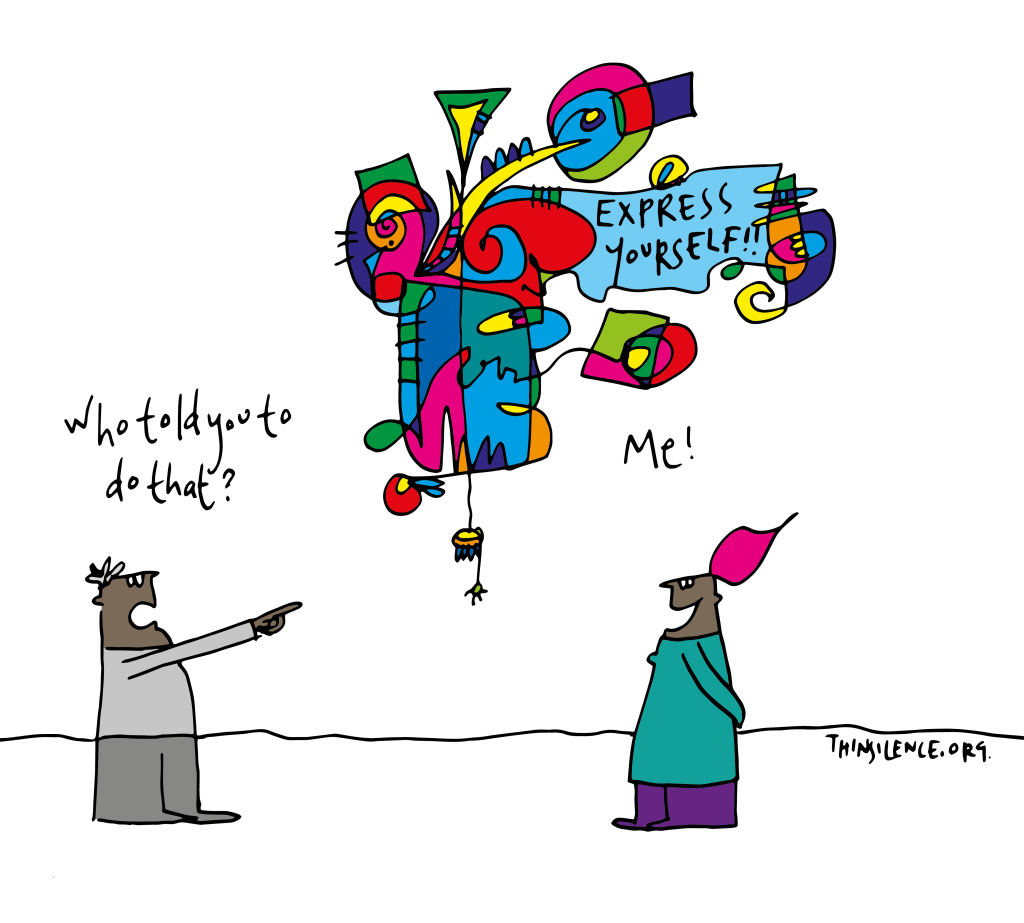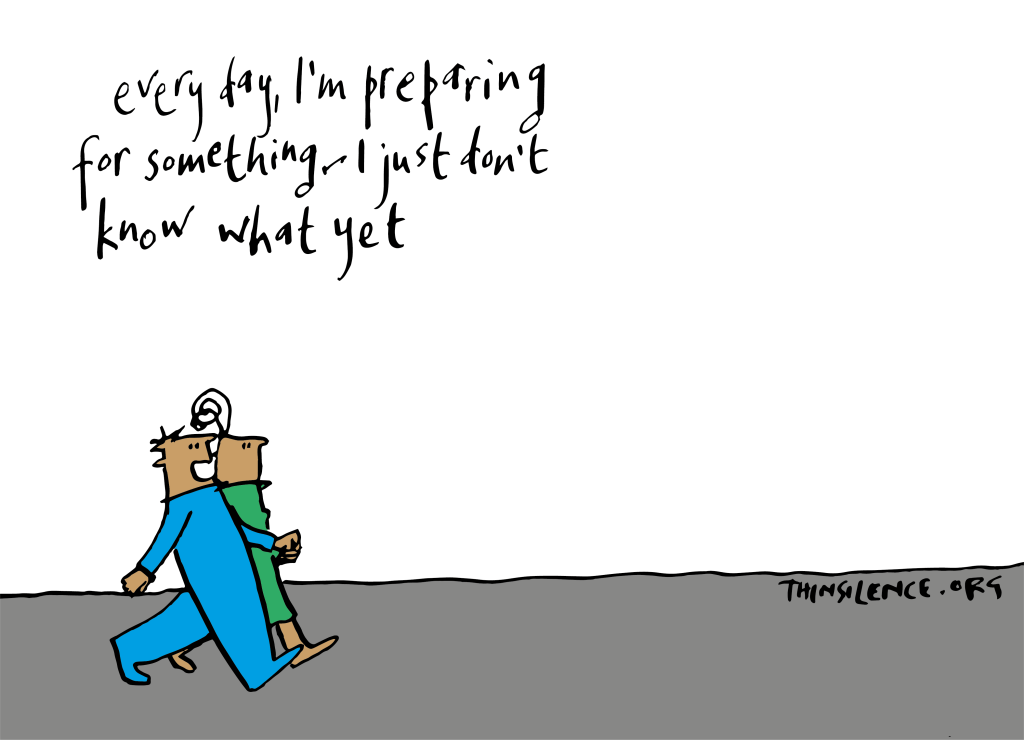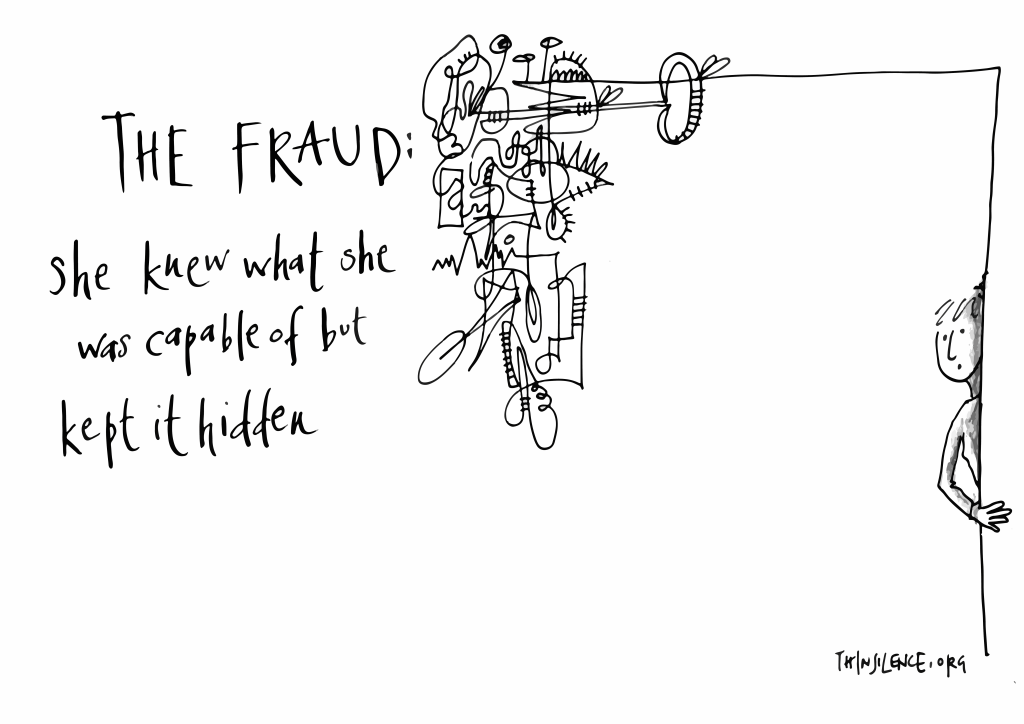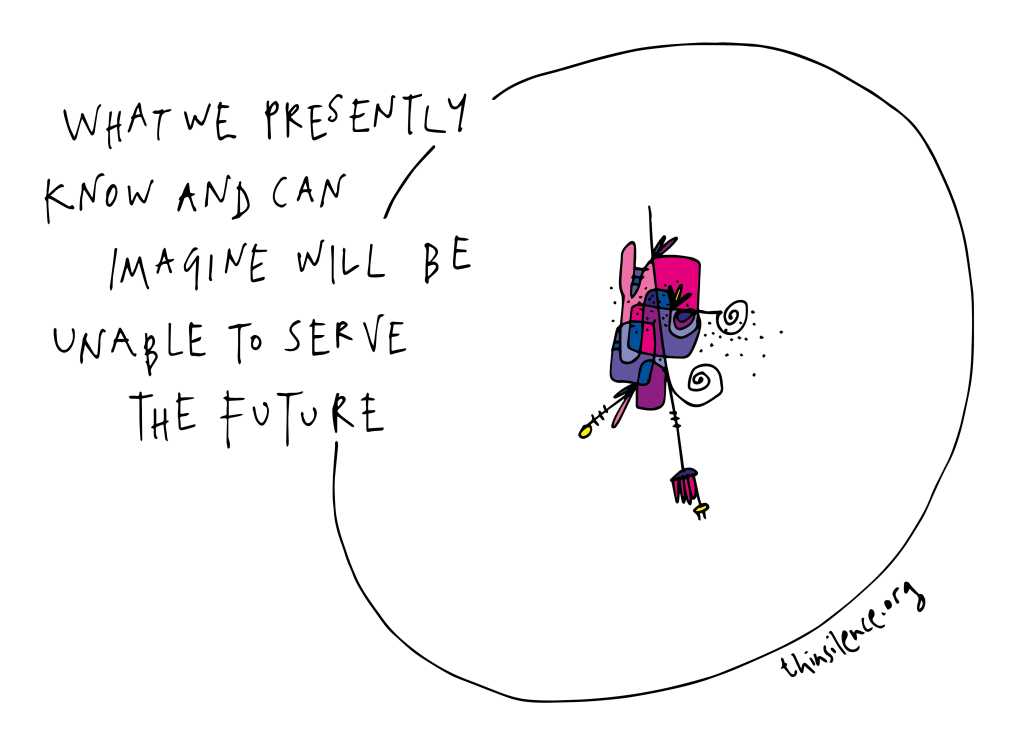
The actor*

As your muscles deteriorate, your brain is also deteriorating. Other malign changes occur too – in personality, in mood, in the very structure of the brain. And yet we have this wonderful in-built correction mechanism, a form of self-administered medicine, one without adverse events: movement.**
(Shane O’Mara)

We all want big changes, but the best way to achieve this is to start small. Give Love, Take Pride.^
(Hugh Macleod)

Beyond imagining a possibility and being energised about it, when we put some action into it, we’re not only making something invisible visible but we’re also affecting change within ourselves at many levels.

When you think about it, that’s a big and wonderful thing. Just think about what we’ll imagine next.

It’s about turning up to what really matters^^ to us and let the small things accumulate.

There’s never been a more opportune moment in history to explore this, including it’s never too late for any of us to begin.

(*The music playing in my head to the doodle is Elton John’s Sorry Seems To Be the Hardest Word.)
(**From Shane O’Mara’s In Praise of Walking.)
(^From gapingvoid’s blog: Celebrate small wins.)
(^^As in where our deepest joy meets the world’s deepest need – thank you to Frederick Buechner for that wonderful thought.)
Wide awake

Today. We only get it once. Why waste it? We can spend it in fear, or we can create possibility for the next person. […] It only takes a day to make change happen. The ocean is made of drops.*
(Seth Godin)

The more people have to attend to, the harder it is to get their attention. Attention is a precious resource. […] What if instead of showing up to get attention, we showed up to give it, without expectation? Imagine the resources we could build if we spent the majority of our time attending to how we could help instead of trying to be seen.**
(Bernadette Jiwa)

Why sleep through a day, download another yesterday, autopilot the hours away … then wonder, How did I get here?^

Each day is full of wonder waiting to be discovered, knowledge to enrich our experiences and those of others. Attention behaves like a muscle: it can be developed. Each person’s attention has its own natural curiosities and interests, and these need to be explored.

I have my awakeners to all of this. People like Seth Godin and Bernadette Jiwa are my regulars and then their are “guests” like Brian Eno:

The enemy of creative work is boredom, actually […]. And the friend is alertness. Now I think that what makes you alert is to be faced by a situation that is beyond you control so you have to be watching it very carefully to see how it unfolds, to be able to stay on top of it. That kind of alertness is exciting.^^

Not only is boredom the enemy of creative work and the enriched life, so is speed. I came across Jim Loehr and Tony Schwartz first of all in their book On Form, a gift from a friend; I am now just beginning to read their book The Power of Full Engagement – here’s how they begin:

We live in digital time. Our rhythms are rushed, rapid fire and relentless, our days carved up into bits and bytes. We celebrate breadth rather than depth, quick reaction more than considered reflection. We skim across the surface, alighting for brief moments at dozens of destinations but rarely remaining for long at any one. We race through our lives either passing to consider who we really want to be or where we really want to go.*^

Their point will be: time is not our most precious resource but energy.

Alertness and attention are all about aligning our lives with our energy.

Have fun exploring this.

(*From Seth Godin’s blog: Today.)
(**From The Story of Telling blog: Giving Attention Vs. Getting Attention.)
(^In the UK, the triangular road-sign is one of warning.)

(^^Brian Eno, quoted in Tim Harford’s Messy.)
(*^From Jim Loehr and Tony Schwartz’s The Power of Full Engagement.)

Together will never be the same again

There is but one infinite game.*
(James Carse)

a city is composed of different kinds of men; similar people cannot bring a city into existence**
(Aristotle)

Once upon a time, a farmer would sow seeds, harvest the crops, transport them to market and be the salesperson to those passing their stall. Today there’s a lot more people involved. As John Green was eating his broccoli, he found himself thinking about all the people who made it possible to get that vegetable onto his plate.

As we figure out how to work through the pandemic Covid19, we realise how working together will be essential – even when it means we stop seeing each other in the ways we have taken for granted.

We are appreciating not only our need to connect but also our desire to be connected – everything is connection:

Reading didn’t just offer escape; it offered connection.^

We have evolved to walk together, and social walking is demonstrative: it sends signals to others about our shared intentions and collective goals.^^

A good conversation is a constant stream of unexpected responses.*^

Here are three comments on connection I happened to come upon in my reading this morning: reading to find ourselves through the words of others, walking in rhythm with others and a conversation akin to a dance in which the choreography appears as we step out together.

If James Carse is right and there’s only one infinite game – in which we are all included and there is no single goal and we get to change the rules to include everyone for as long as possible – then there can be no “them” and “us.”

Then Aristotle’s words come to us as a lively challenge because although there is one game we are all different and yet our cities are evidence of our willingness to connect and work together.

Through the weeks and months ahead I believe we’ll see many ways being imagined for connecting and being together. When we are finally able to to be together in person once again, together will be quite different, hopefully altering us at a genetic level.

One way to connect, for those having to work at home, has been made available by Seth Godin. I’ve enrolled and look forward to connecting with people alongside the other ways and means.

(*From James Carse’s book Finite and Infinite Games.)
(**Aristotle, quoted in Richard Sennett’s Together.)
(^Emily Levine in her letter to young readers from Maria Popova and Claudia Bedrick’s A Velocity of Being.)
(^^From Shane O’Mara’s In Praise of Walking.)
(*^From Tim Harford’s Messy.)

You’re responsible

Taking regular aerobic exercise enhances blood flow through the brain, as sell as making a marked difference to the structure and function of the brain.*
(Shane O’Mara)

You have been given a task, have to come up with an idea, it’s your responsibility.

What do you do?

Freeze your brain with panic?

Cut out all distractions and sit in one place scrunching up your face with focus until an idea comes?

Or do you take a walk?

Shane O’Mara’s work uncovers how we have the ability to both focus on details and to mind-wander. There is a real possibility that creativity occurs when we perform these tasks simultaneously.

We’re full of ideas and information and experiences with millions of permutations for how these may come together:

One possibility as to why the flickering between these two modes of thinking lies at the core of creativity arises from the notion that in order to create something new, you must combine ideas some form of novel association. Mind-wandering allows the collision of ideas, whilst mind-focusing allows you to test whether it is nonsensical or interesting and new.*

Next time you’re responsible, why not take a notebook and pen and go for a walk? It’s what I’m going to be doing later today.

(*From Shane O’Mara’s In Praise of Walking.)

Got a problem?

It is not possible to experience a feeling of control unless one is willing to give up the safety of protective routines.*
(Mihaly Csikszentmihalyi)

“It won’t work.”

The trouble is, the new is often measured by the old, even though it’s now struggling.

Someone, at some point, has to go try out the new and see what happens, to help it escape the gravitational pull of the old.

Maybe you?

(*From Mihaly Csikszentmihalyi’s Flow.)

This life

All of us have to learn how to invent our lives, make them up, imagine them. We need to be taught these skills; we need guides to show us how. Without them, our lives get made up for us by other people.*
(Ursula Le Guin)

Myths, told for their own sake, are not stories that have meanings, but stories that give meanings. […] We resonate with myth when it resounds in us. A myth resounds in me when its voice is heard in mine but not heard as mine.**
(James Carse)

We put our lives together from people we’ve met, places we have been, events we have immersed ourselves in, books that we have read, experiments that we have explored – there is no such thing as hermetically developed meaning and purpose.

Our guides are all around us.

We mix all of these together in a never before imagined way of creating a never-to-be-repeated life.

It’s not once and for all, which means, we haven’t missed our opportunity. It can happen any time in life and is possible every day.

This journey is nothing less than exhilarating.

(*From Ursula Le Guin’s Words Are My Matter.)
(**From James Carse’s Finite and Infinite Games.)

Honour, nobility, enlightenment

In normal times, it’s easy to get into a rhythm of simply responding. Someone else setting the agenda. When things are uncertain, it’s easy to react. But now, right now, is the single best time to initiate. We’re in for a slog, but there will be an end to it.*
(Seth Godin)

I’ve been trying all my life to find out what my limits are and I have never reached them yet. But then the universe doesn’t really help, it keeps expanding and won’t allow me to know it entirely.**
(J)

Yes, there are times when we will need to react in order to stay out of trouble, other times when we will need to do as we are asked, but if we are not initiating, we will not develop as we are able to, nor will we bring this to others.

It’s how the universe provokes us.

Illustratio, nobilitatis, honorem!

(*From Seth Godin’s blog: React, respond, or initiate?)
(**The character J in Paulo Coelho’s Aleph.)

Set?

Reading teaches me the answers to problems I haven’t had yet, or to problems I didn’t even know how to describe.*
(Alexander Chee)

“Set!” comes between “On your marks!” and BANG! (or Go!).

“On your marks!” is about being in the right place at the right time, but it doesn’t mean we’re necessarily “Set!” which is about having the wherewithal to go when called upon.

Reading isn’t the only way to be set, but it’s a big one** – or equivalents: podcasts, TEDtalks, MOOCs, etc. I think that everyone has a book in them, though, so conversations with interesting people is also a great way to be “Set!,” also running with ideas and experimenting and reflecting.

As we turn up to do these things each day, we may even find that we don’t have to wait for anyone else the fire the starter’s gun.

(*Alexander Chee’s letter to young readers from Maria Popova and Claudia Bedrick’s A Velocity of Being.)
(**I’ve recently replenished my shelves with the following books:
Together (Richard Sennett)
The Power of Full Engagement (Jim Loehr and Tony Schwartz)
Understanding Comics (Scott Macleod)
Born For This (Chris Guillebeau)
The Work of Art in the Age of Mechanical Reproduction (Walter Benjamin)
Deep Work (Cal Newport)
The Idea in You (Martin Amor and Alex Pellew)
Centering (M. C. Richards).)

The means of transformation

[E]very person is a unique source of transformative insight and human potential. Our lives are a process of constant discovery and invention. Each of us lives a unique human life.*
(Bill Sharpe)

The kingdom of heaven is like a mustard seed that someone took and sowed in his field; it is the smallest of all the seeds, but when it has grown it is the greatest of shrubs and becomes a tree, so that the birds of the air come and make nests in its branches. […]‘The kingdom of heaven is like yeast that a woman took and mixed in with three measures of flour until all of it was leavened.**
(Jesus of Nazareth)

The thing about the two short stories about the mustard seed and yeast is that something very small was able to transform what was already there. It was likely that the particular mustard plant clambered over existing plants and trees and the yeast needs flour to work its magic.

It is true for the individual as it is for the society.

We need to find the (often) small thing that will transform what is already present in our lives.

It may be an idea, a story or a person:

An animateur (from the root animer) is someone who “brings to life” a new way of thinking, seeing, or interacting that creates focus or energy.^

Stories that have enduring strength of myths reach through experience to touch the genius in each of us.^^

When we connect with and transform what is already within us then we become animateurs to others.

Beneath the way things are, we find deeper things from which everything new is possible:

Myth provokes explanation but accepts none of it. […] Explanations establish islands, even continents of order and predictability. But these regions were first charted by adventurers whose lives are narratives of exploration and risk. They found them only by mystic journeys into the wayless open. When the less adventuresome settlers arrive later to work out the details and domesticate these spaces, they easily lose the sense that all this firm knowledge does not expunge myth but floats on it.^^

I love James Carse’s phrase “into the wayless open” and this is exactly where we find ourselves – stepping into yet undiscovered continent’s of life-in-all-its-fullness.

(*From Bill Sharpe’s Three Horizons.)
(**Matthew 13:31-33.)
(^From Peter Senge’s The Necessary Revolution.)
(^^From James Carse’s Finite and Infinite Games.)

Who’s teaching who?

Whatever your idea ends up becoming […] the process of bringing it into being will change your life. […] All you need to do is start …*
(Martin Amor and Alex Pellew)

We need some kind of reflective practice to best bring into being what it is we believe and feel we must.

Twenty two yeas ago I heard someone describe their own reflective practice and being 38 years old and not having then found one that really worked for me, I decided to copy it.

All these years later, it’s developed a lot into something quite different, and it means that for around the last 8,000 days or so, I have had some way of reflecting on my life and my work.

No doubt the practice will keep on changing, but I wonder where things might be if I’d resisted copying, if I wanted to find something original and unique to me.

Steal and copy to find your own way because it provides you with a place to start and, once started, it’s likely that you will overtake your teacher and become the the new teacher we need.

This morning, I was struck by David Whyte‘s words to a young reader because they are about openness and newness and possibility through the practice of reading, and, when it comes to the adventures of reflection, no less will be the excitement for those who begin and what treasures they will have to share:

I wish, I wish, I wish, I wish; I wish I were in your shoes now, I wish I were standing where you are standing now, I would swap everything I have learned through my reading, I would swap my entire library of a thousand books, every journey and adventure I have taken through their pages, all the insights about the world and myself, all the laughter, the tragedy, the moments of shock and relief, all the books that have amazed me and that have made me reread them again and again, to be at the beginning as you are, so that I could read them all again for the first time […] to walk through the incredible territory we call writing and reading and see it all again with new eyes.**

(*From Martin Amor and Alex Pellew’s The Idea in You.)
(**David Whyte‘s letter to young readers from Maria Popova and Claudia Bedrick’s A Velocity of Being.)