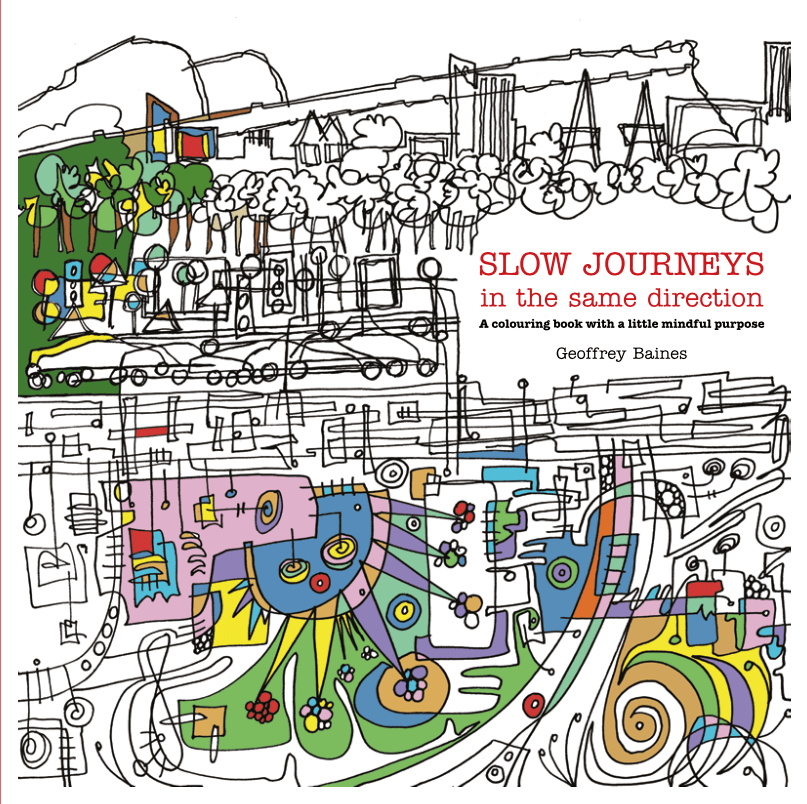
Here are some more expressions of Thin|Silence, beginning with my colouring book Slow Journeys in the Same Direction. As far as I am aware, this is the only colouring book with online content to guide you through each doodle’s texts, including things you can try out. It’s available from Methodist Publishing at £4.99 plus postage; it’s still a great price compared with other colouring books available in shops.
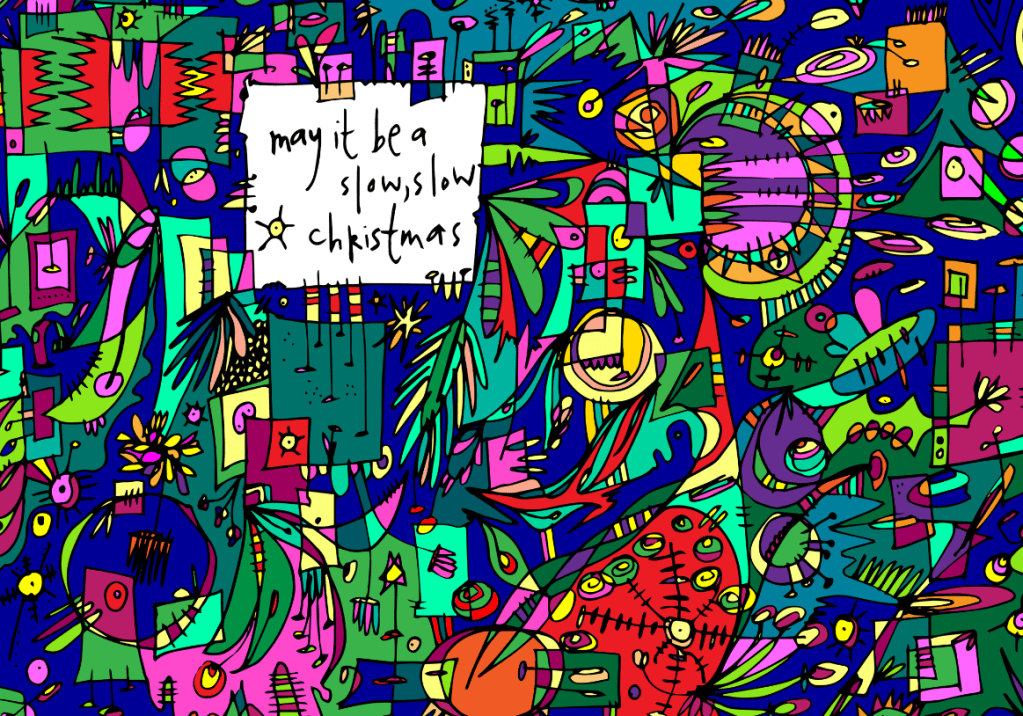
Thank you to those who have ordered my Christmas card design May it be a Slow, Slow Christmas; this is now with the printers.
I want to “test the waters” to see if there would be interest in the same design as a tea-towel. It would be a limited run of 36 and the price of each would be £10 plus postage. If you are interested, email me by Monday, 25th November at geoffreybaines@gmail.com.
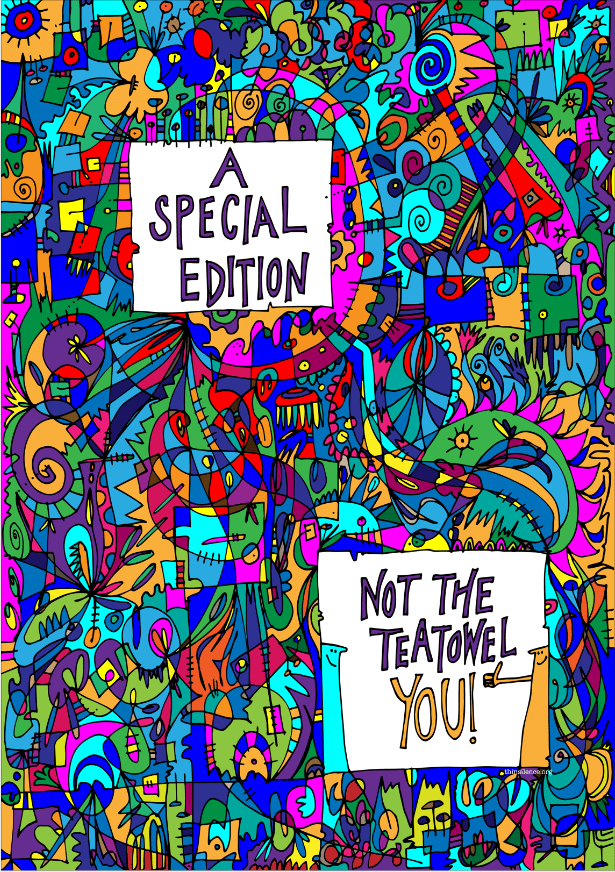
I also have a small number of my A Special Edition tea towels – though a smaller number from last week – from a limited run of only 37 which come with a gift card in the same design. These are £10 plus any postage and packing.
And why are we joyful? Because this is who we are? This is how the gods designed us to be. Producers. Makers. Artists. Effective.* (Hugh Macleod)
I found that what I had desired all my life was not to live—if what others are doing is called living—but to express myself.** (Henry Miller)
We can mistakenly focus on what we haven’t got rather than what we have.
The result is that we bury an awful lot of interesting things. I know because this is my work. In every person I meet there’re incredible things life had entrusted them with. These are uncovered in our conversations and I find myself wondering whether they will value and give expression to them.
This morning I read a short blog post from Steven Pressfield telling of how fame and wealth and all that go with them are of no interest to him:
The only thing that allows me to sit quietly in the evening is the completion of a worthy day’s work. What work? The labour of entering my imagination and trying to come back out with something that is worthy both of my own time and effort and of the time and effort of my brothers and sisters to read it or watch it or listen to it.^
Pressfield’s words resonate because of my work as it plays with two questions: Who am I? and What is my work (or contribution, not job)?, the latter carrying the understanding that our best work benefits others. He continues, describing the asymmetrical nature of this work, disrupting both ourselves and others:
I’m not saying this way of life is wholesome or balanced. It isn’t. It’s certainly not “normal.” By no means would I recommend it as a course to emulate.^
This kind of work is unreasonable, but it is, as Henry Miller has it in the opening to this post, the truest expression of our lives.
We know there’re easier ways to walk and work, but there still remains the thing we must give shape or form to most of all:
Nor did I choose this path for myself, either consciously or deliberately. I came to it at the end of a long dark tunnel and then only as the last recourse, the thing I’d been avoiding all my life.^
Listen to your life. Value it for the amazing thing it is, all it contains, and may you come to the moment when to move towards the fullest expression of your life is easier than avoiding it.
So learning isn’t quite what we teach inmates inside the high-security prisons called schools. In biology, learning is something that, through the filter of intergenerational selection, gets imprinted at the cellular level – skin in the game, I insist, is more filter that deterrence Evolution can only happen if risk of extinction is present.* (Nassim Taleb)
Around me the trees stir in their leaves and call out, “Stay awhile.” The light flows from their branches. And they call again, “It’s simple,” they say, “and you too have come into the world to do this, to go easy, to be filled with light, and to shine.”** (Mary Oliver)
Photosynthesis is how trees turn light and carbon dioxide and water into food. They do it because they’re hungry.
Learning is our photosynthetic process of taking information and knowledge and turning it into understanding, which, as Nassim Taleb reminds us in his inimitable way, involves living it.
The next time you’re feeling hungry, it may not be for food – or clothing, shelter or entertainment – but for understanding, to do something new, different, meaningful.
(*From Nassim Taleb’s Skin in the Game.) (**From Mary Oliver’s poem Among the Trees, quoted in Maria Popova’s Brain Pickings: Amanda Palmer Reads When I Am Among the Trees by Mary Oliver.)
School trains people to work as maintainers. […] A few people somehow avoid these lessons and become instigators, impresarios and disruptors instead. They’re not only dancing with infinity but completely unsure what’s going to work, and yet they are hooked on leaping forward.* (Seth Godin)
May the Angel of Awakening stir your heart To come alive to the eternal within you, To all the invitations that quietly surround you […} May the Angel of Wildness disturb the places Where your life is domesticated and safe, Take you to the territories of true otherness.** (John O’Donohue)
It’s time to show up, to do what only you can do, to give your heart and should for something, to become a living brand of something you care passionately about and makes a difference for others.
When it comes to your purpose here, don’t be anonymous: bad work can’t be corrected and good work cannot be rewarded.
We may not realise yet that we want what you are bringing but that’s just the kind of asymmetry we need.
noblesse oblige [-] the very status of a lord has been traditionally derived from protecting others, trading personal risk for prominence* (Nassim Taleb)
It used to be that only the rich and powerful got to play the “noblesse oblige game,” but we’ve moved on a little since then and many more of us find ourselves with the possibility of playing.
In some words I often find myself reflecting on from Frederick Buechner, we find our purpose or calling where our deepest joy meets the world’s deepest needs.
More than having a great idea, more than feeling passionately about something, it is about having “skin in the game,” as Nassim Taleb puts it.
Ironically, it can be a promotion that takes us out of our “deepest joy” which loses our particular skin in the game.
The testing question is: Is this still not about me?
A thought that does not result in an action is nothing much, and an action which does not proceed from a thought is nothing at all.* (George Bernanos)
For the first time – literally – substantial and rapidly growing numbers of people have choices. For the first time they have to manage themselves. And society is totally unprepared for it.** (Ben Hardy)
There are waitings we have to make because someone else has to make the call or take the lead.
There are waitings to make when we’re the one initiating but things haven’t lined up.
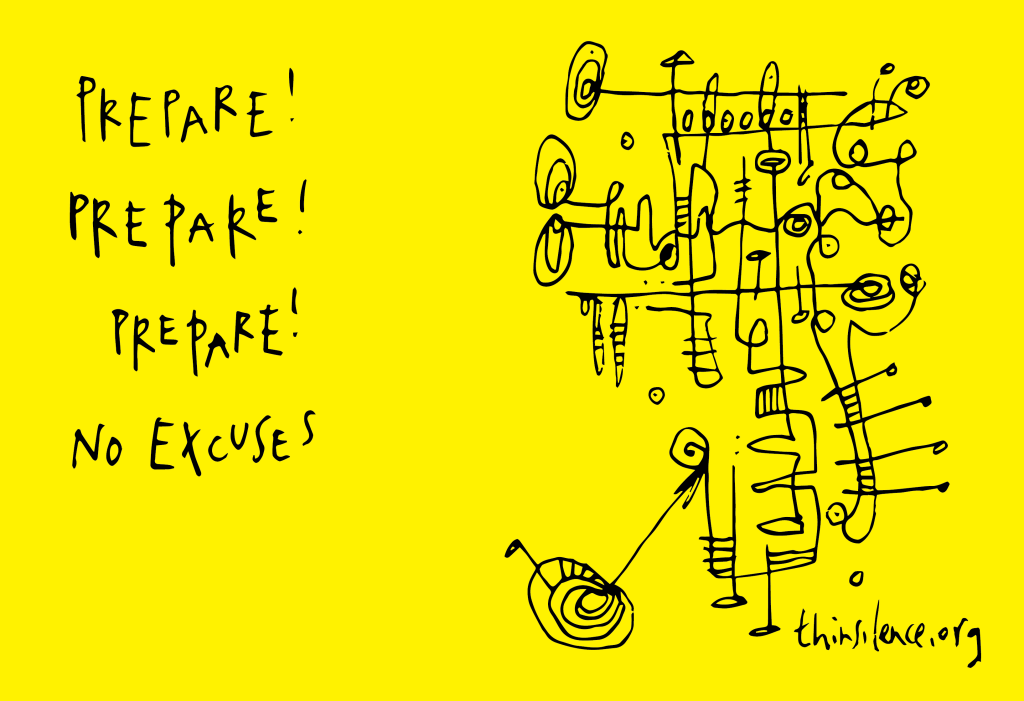
Either way, we need to be prepared. There are basically two ways of preparing: generally and specifically. When you can’t specifically prepare you can always do so generally.
Many opportunities and possibilities have been missed because we haven’t been prepared.
I am taking orders for a limited run of Christmas cards, the design of which I doodled last Christmas Day. This will come with a side fold and envelopes. If you would like to find out more, drop me a line by Monday, 11th November at geoffrey@thinsilence.org or geoffreybaines@gmail.com.
I also have a small number of tea towels from a limited run of only 37 which come with a gift card in the same design. These are £10 plus any postage and packing.
Economic logic suggests that more is better. Psycho-logic often believes that less is more.* (Rory Sutherland)
Affordance is a property or feature of an object which presents a prompt on what can be done with this object. In short, affordances are cues which give a hint how users may interact with something, no matter physical or digital. For example, when you see a door handle, it is a prompt you can use it to open the door.** (UX Planet)
I love products that can be figured out instinctively: simple on the outside yet complex within.
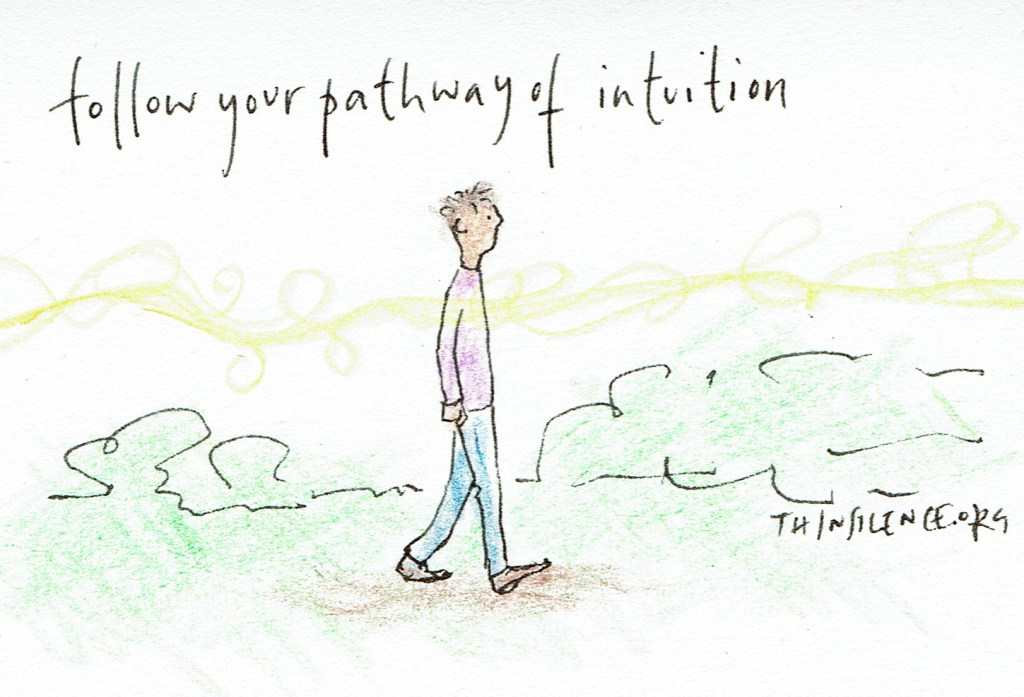
It feels as though life comes to us this way, with instinctual clues as to who were are and what we ought to be doing: curiosities, talents, energies. Follow these and we move into the deep and ever-more complex. I’ll borrow some words from Nassim Taleb to describe aspects of this: life becomes more dynamic rather than static, multi-dimensional rather than one-dimensional, and interactional rather than “actional.”^
The journal is an intuitive tool towards this. Where we begin is not where we end up – with its blank pages, you only need begin writing and are led to amazingly complex places:
Writing is more powerful than simple meditation for the same reason that writing down your goals is more powerful than leaving them in your head.^^
We don’t value things. We value their meaning. What they are is determined by the laws of physics, but what they mean is determined by the laws of psychology.* (Rory Sutherland)
Pleasure is found in meaning, but it doesn’t necessarily work the other way around.
A single joy doesn’t mean one joy, but a focus or concentration of joy opening a plethora of wonder.
Nan Shepherd’s singleness of joy was given expression within her beloved Cairngorms. I have only driven through these mountains, but I enjoy her delicious descriptions of nature and draw these into my own joy; here, the odour of trees:
Birch, the other tree that grows on the lower mountain slopes, needs rain to release its odour. It is a scent with body to it, fruit like, brandy, and on a wet warm day, one can be as good as drunk with it. Acting though the sensory nerves, it confuses the higher centres; one is excited, with no cause that the wit can define.**
Reading this, I can’t help but wonder what makes each of us giddy.^ And reading a little of James Carse’s Finite and Infinite Games this morning (in which he considers society to be a finite game with smaller finite games within it, including education – itself a series of finite games) causes me to imagine this single joy to be our infinite game, to be infinite in nature: open, not judging; compassionate, not cynical; and, courageous, not fearful.⁺
Within our single joy is where alchemy can take place, or, more accurately, between our single joy and the world or environment in which we place ourselves, but first the joy, because I happened upon these words from George Appleton also this morning:
O God, as I go down into the deeps of my being[, s]how me the hidden things, the creatures of my dreams, the storehouse of forgotten memories and hurts. Take me down to the spring of my life, and tell me my nature and my name. Give me freedom to grow, so that I may become that self, the seed of which You planted in me at my making.^^
Whether we have a god or not, the reality is we each have an inner world to be explored, in which we discover our single joy – our nature and name.
There is also our environments, which Ben Hardy critically makes us more aware of:
Because the environment prompts our behaviour, it is the environment that needs to be disrupted.*^
We react and respond and initiate according to our environments, and the aim is to find those that are the most fertile for us.
When we begin to make the inner and outer journeys, we are preparing for alchemy to occur.^*
Towards making sense of this, Ben Hardy also provides us with a means – one I’ve used it these last twenty one years:
Recording your history is a crucial component of journal writing. It provides context to your ideas, goals, and plans. […] A key component of writing big-picture is that it reconnects with your why.*^
Journaling provides us with a way of noticing what we might otherwise miss and to follow its thread through our years, attending to how it intertwines with other thoughts and ideas that come to us from different people and places.
Our single joy is always growing and, at this moment in time, we have no idea of what it will become, only that it will.
(*From Rory Sutherland’s Alchemy.) (**From Nan Shepherd’s The Living Mountain.) (^Checking the etymology of the word giddy informs me that it means “insane” or “possessed by a god.” That about sums it up. (⁺For James Carse, a finite game is one that includes a certain number of people playing towards a particular goal and always playing by the rules; an infinite game is one that includes everyone and the aim is to keep playing, and if the rules threaten to exclude or bring the game to an end, they are changed.) (^^George Appleton , quoted in the Northumbria Community‘s Morning Prayer for Day 7.) (*^From Ben Hardy’s Willpower Doesn’t Work.) (^*I don’t mean turning lead into gold, but, primarily, the kind of alchemy that can produce something more from an unpromising candidate like me.)
Thou shalt create complex characters rather than merely complicated story. (Robert McKee)
[M]ost valuable discoveries don’t make sense at first; if they did, somebody would have discovered them already. […] We should test counterintuitive things – because no one else will.** (Rory Sutherland)
To know isn’t the same as understanding and understanding isn’t the same as wisdom. Though wisdom requires both knowledge and understanding, it brings more to the party, getting head and heart and hands to dance together.
When it comes to our lives, we know it’s easier to shape a complicated story than it is to spend the time on developing our character and personality.
Robert McKee’s quote was for a webinar on building story characters and I noted with interest three of the four elements:
Creating a Character from the Outside→In
Creating a Character from the Inside→Out
The Benefits of Combining the Two Approaches^
Wisdom requires we become complex characters but this we cannot become alone, we need help from outside. If we’re not finding this where we are then we need to move:
A drab looking cage produces a drab looking brain.^^
(And hearts and life.)
But we also need to know and understand our inner complexity and allow this to play upon our outer worlds.
When wisdom in all its complexity gets to play in complicated worlds then what follows can be positively unreasonable.






 THIN|SILENCE
You must be logged in to post a comment.