Can you see me?

we are what remains after everything we are not*
(Maria Popova)

What we are beneath the surface of our lives is the gift we bring to others.  In the moment of giving, we are making ourselves the most vulnerable.  As John O’Donohue suggests:

‘Vulnerability risks hurt, disappointment and failure.’^

Like the proverbial iceberg, more is hidden than visible in our lives, even to ourselves but especially to one another.  It takes to time and, yes vulnerability again, for it to be seen:

‘The visible world is an active doorway to the invisible world and the invisible world is much larger than the visible.’**

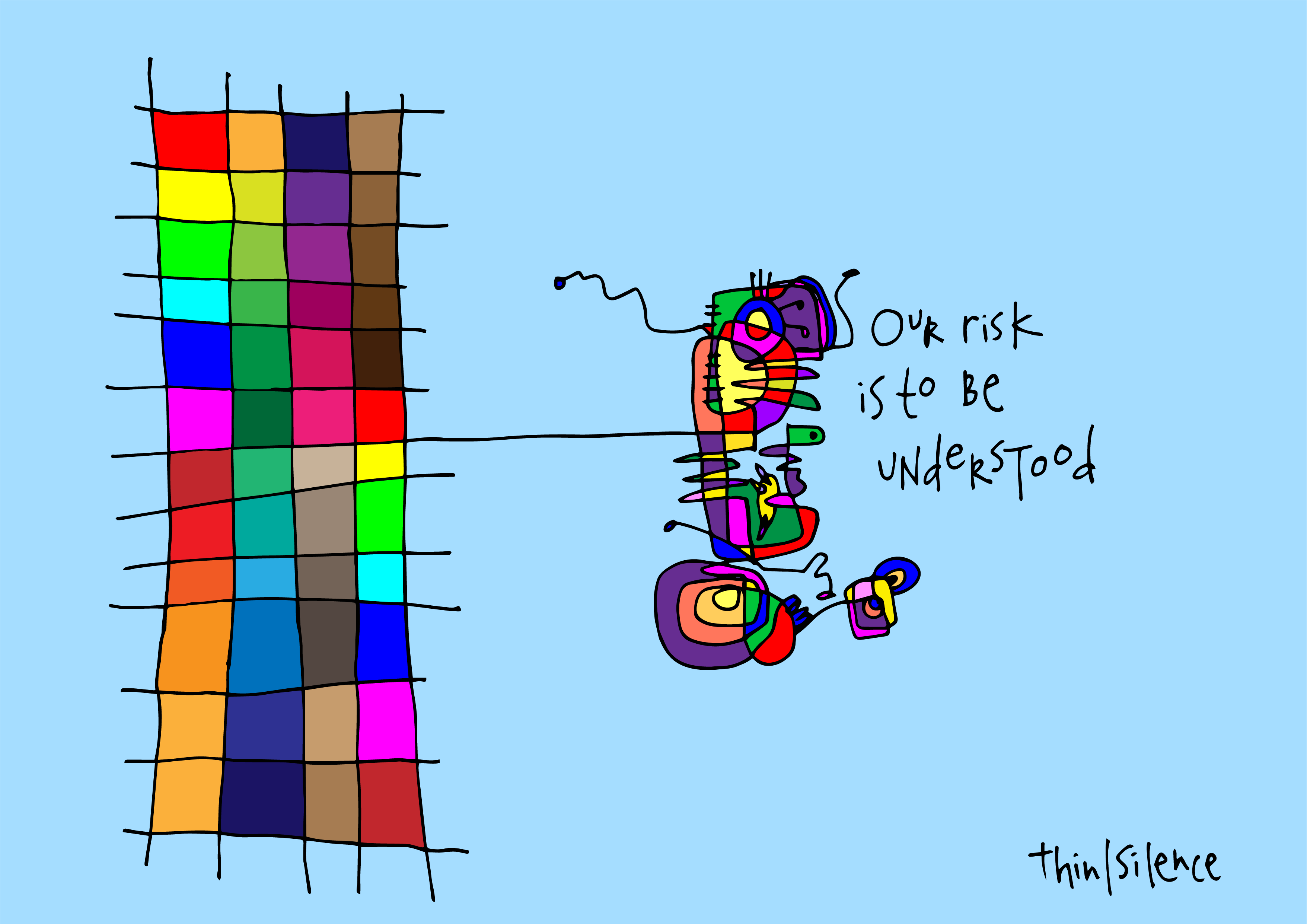
Until then, we are more misunderstood than understood.

Our risk is always to be understood.

(*From Maria Popova’s Brain Pickings: Bear and Wolf: A Tender Illustrated Fable of Walking Side by Side in Otherness.)
(**From Richard Rohr’s Eager to Love.)
(^From John O’Donohue’s Eternal Echoes.)

A convivium of fire

‘Any human power can be resisted and changed by human beings.  Resistance and change often begin in art.  Very often in our art, the art of words.’*
(Ursula Le Guin)

Audre Lorde introduces me to the word moxie:

“I feel I still have enough moxie to do it all, on whatever terms I’m dealt, timely or not.  Enough moxie to chew the whole world up and spit it out in bite-sized pieces, useful and warm and wet and delectable because they came out of my mouth.”**

I look the word up:

“force of character, determination, or nerve.”

I think Lorde is saying that she will not let her cancer of the liver tell her story, that she is determined to tell her own story no matter how hard it is.

I look again at moxie.  The word comes from an American carbonated drink.  There used to be different flavours: cherry cola, American soda, orange cream, but they have gone.  When it comes to human moxie, there are still many flavours.  One isn’t better than the others and they oughtn’t lead us into competition or conflict.  Lorde asks a question that asks us to identify our own:

“Where does our power lie and how do we school ourselves to use it in the service of what we believe?’

[…]

How can we use each other’s differences in our common battles for a liveable future?  All of our children are prey. cHow do we raise them not to prey upon themselves and each other?  And this is why we cannot be silent, because our silences will come to testify against us out of the mouths of our children.”**

A convivium is simply a place we come to in order to figure out how we can live together – con and vivo.  We don’t get watered down, we get fired up:

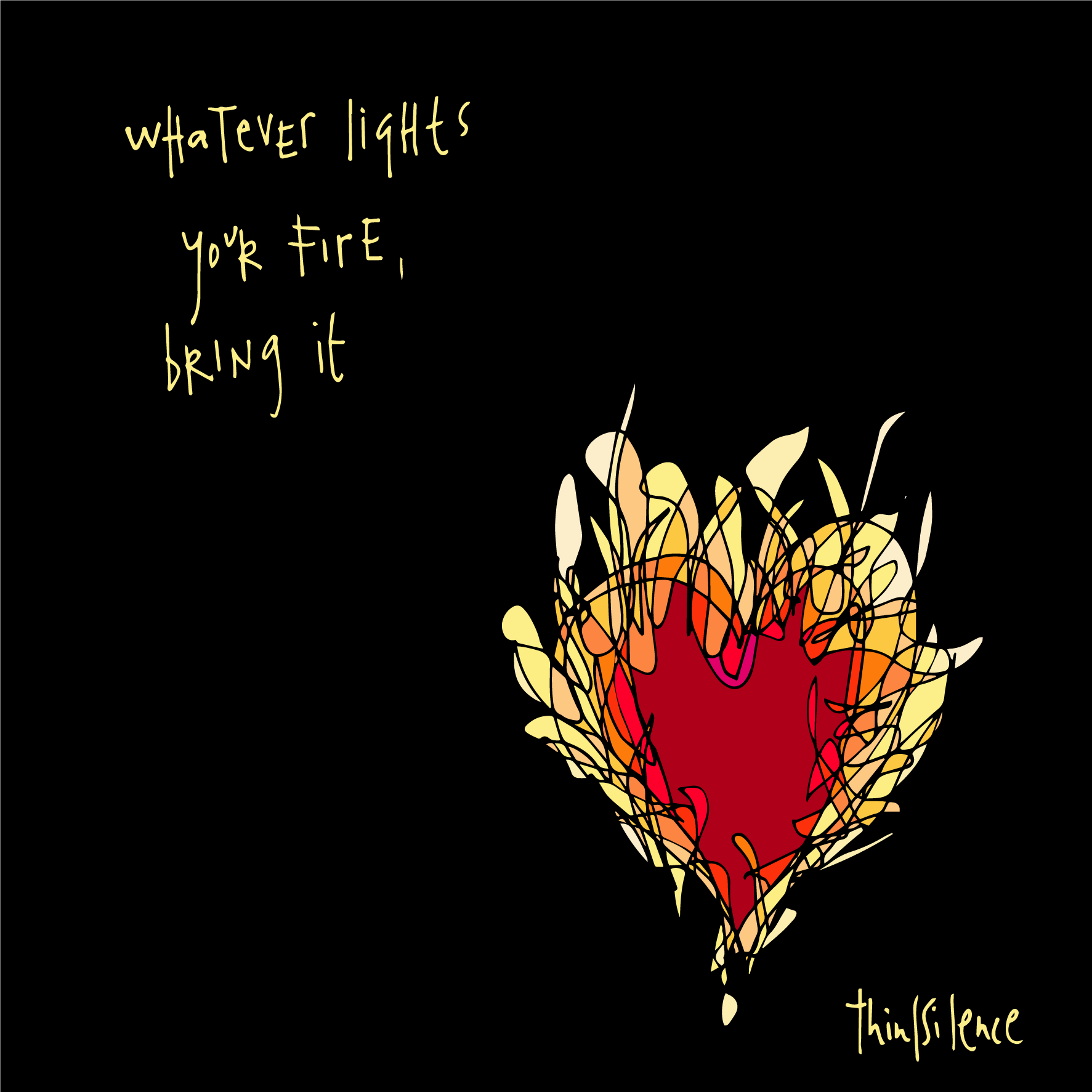
“I am going to write fire until it comes out my ears, my eyes, my noseholes — everywhere.  Until it’s every breath I breathe.”** 

(*From Ursula Le Guin’s Words Are My Matter.)
(**Audre Lorde, quoted in Maria Popova’s Brain Pickings: A Burst of Light.)

In or out

When a diversity of ideas and perspectives come together, innovation is born. […] Keep yourself in a room with different people so that problems can be examined differently.*
(Hugh Macleod)

Migrants not only boost creativity through their own ideas but also through stimulating creativity amongst others […] those with more diverse networks solve problems very much more easily than those with less diverse networks.**
(Douglas McWilliams)

Douglas McWilliams is writing about the transformation a diverse workforce has made to the city of London, people from around the world working together, bringing their ideas and their perspectives.  After Brexit, the essential problems still remain, deep-seated, unquestioned.

It’s not about immigration, it’s about systems that do not value everyone, especially those who struggle within it … leaving educational and training systems unchanged.

Some things are easier to measure than others, however, and our unwillingness to look for other or more complex ways to measure and value will continue to be our trap because we become blinkered:

‘But measurement can cut both ways. […] The minute we choose to measure something, we are essentially choosing to aspire to it.’^

Nassim Taleb puts it in his own inimitable way:

‘The fastest way to become rich is to socialise with the poor; the fastest way to become poor is to socialise with the rich.’^^

(*From gapingvoid’s blog: The new global power.)
(**From Douglas McWilliams’ The Flat White Economy.)
(^From Youngme Moon’s Different.)
(^From Nassim Taleb’s The Bed of Procrustes.)


THINK OF IT AS A CATALOGUE OF POSSIBILITIES

When it comes to life, you get to choose the colours

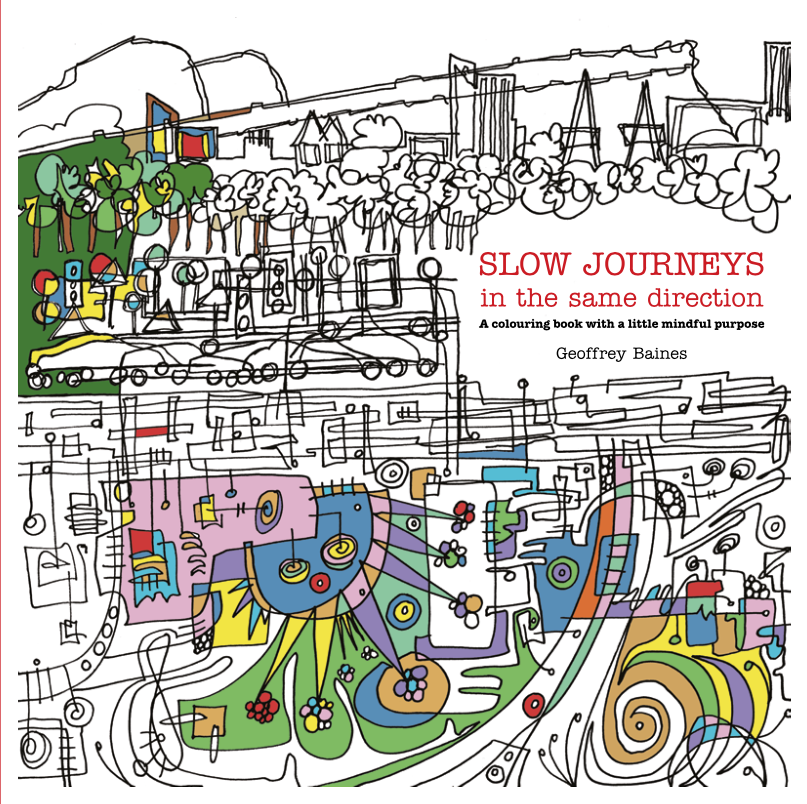
SLOW JOURNEYS IN THE SAME DIRECTION is available from Methodist Publishing for £4.99 plus postage and packing

The cultivated life

We must remain attentive in order to be able to receive.*
(John O’Donohue)

If we stopped doing everything for which we do not know the reason or for which we cannot provide the justification … we would probably soon be dead.**
(Friedrich Hayek)

How can I grow?

We may not say it in just this way.  Perhaps we say, How can I improve my performance?, How can I enjoy my life?, How can I pursue my dreams?,  How can I deal with this challenge?, or in countless other ways.  In a universe where things that are alive, grow, it makes sense and is a healthy thing to ask the questions.

It begins with how much we’re prepared to see or, more precisely, to see what we see.

The cultivated life is one prepared for crops, for fruitfulness.

To be willing to see more is an action that breaks open our lives.  In this, we are saying, we don’t know everything – even about ourselves.  We’re inviting difficulty, pain, incompetence and vulnerability.

Difficult we’re taken outside our comfort zone.

Pain because all muscles (whether physical, mental, emotional or spiritual hurt when pushed further.

Incompetence because we are moving into doing unfamiliar, unpractised things.

Vulnerability because we are exposed by all of these

This isn’t a pleasant place but the positives outweigh the negatives.  Alan Lightman helps us to see what makes a good story:

‘A good novel gets under our skin, provokes us long after the first reading because we never full understand the characters.

[…]

We sweep through the narrative again and again, searching for meaning.  Good characters must retain a certain mystery and unfathomable depth, even for the author.  Once we see to the bottom of their hearts, a novel is dead to us.’^

There’s always more to see.

To keep looking moves us beyond present knowledge and behaviour, pushes us beyond our competency and our comfort zone.  Yet we’re proving to ourselves and those around us that not only are we alive but we’re capable of indefinite growth.  Lightman continues, now emphasising how important it is to hold things in tension if life is to be deeper and richer

‘I learned to appreciate both certainty and uncertainty.  Both are necessary in the world.  Both are part of being human.’^

This healthy life is, ultimately, an infinite game: we refuse to categorise something or someone prematurely or for ease; instead we remain open for as long as possible in order to see what might emerge.  We are made to look.

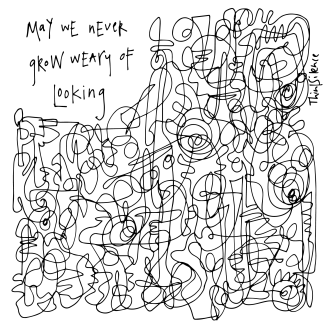
Seeing in this way is not something some have and others don’t have, it’s grown by making ourselves look for longer.

(*John O’Donohue, quoted in the Northumbria Community‘s Morning Prayer.)
(**Friedrich Hayek, quoted in Gerd Gigerenzer’s Gut Feelings.)
(^From Alan Lightman’s A Sense of the Mysterious.)

 

The spring of our life

“The face of afraid keeps changing constantly, and I can count on that change.  I need to travel light and fast, and there’s a lot of baggage I’m going to have to leave behind me.  Jettison cargo.”*
(Audre Lorde)

Audre Lorde is reflecting on her decision not to have a biopsy for treatment for suspected liver cancer.  Instead she sets out from the United States on a teaching trip to Europe.  She also sets out to capture her feelings of fear in her diary.  Lorde catches my attention with her decision to travel light, to jettison cargo, at what was the most difficult point in her life.   She continues:

“I am saving my life by using my life in the service of what must be done.  Tonight as I listened to the ANC speakers from South Africa at the Third World People’s Centre here, I was filled with a sense of self-answering necessity, of commitment as a survival weapon.  Our battles are inseparable.  Every person I have ever been must be actively enlisted in those battles, as well as in the battle to save my life.”*

Lorde causes me to think about how we need to bring together the fullness of who we are and to live for a purpose greater than ourselves.  We save ourselves in saving others.  I cannot live someone else’s life, nor can they live mine.  I can go to the spring of my life, I can only walk with others in their discovery of the spring of theirs:

“Take me down to the spring of my life, and tell me my nature and my name. Give me freedom to grow, so that I may become that self, the seed of which You planted in me at my making.”**

Many things that obstruct the life that wants to flow from the springs of our lives – the things we must “jettison.”  They are different for each of us, but perhaps a common obstruction is the notion that others have a better chance than we do, they have what we do not have.  But it doesn’t matter what others have, only what you have.

I began this morning reading words on curiosity from Hugh Macleod.  Macleod describes a world available to us that was never available to other generations.  Once we have found our curiosity, we can find everything else we need:

‘With all of mankind’s information available at your fingertips, almost anything is knowable. It is something that we have quickly taken for granted. So, being that we are now able to feed our curiosity at any time and in any amount, what is it all for?’^

(*Audre Lorde, quoted in Maria Popova’s Brain Pickings: A Burst of Light.)
(**George Appleton, quote in the Northumbria Community‘s Morning Prayer.)
(^From gapingvoid’s blog: Curiosity is as important as intelligence.)


The impossible dream*

‘Decline starts with the replacement of dreams with memories and ends with the replacement of memories with more memories.’**

When it comes to our impossible dream, it’s sometimes about making something happen and sometimes it’s about being able to receive a possibility when it comes to us.  Either way, it’s about attending to identifiable small steps in the meantime.

Of achieving the impossible four minute mile, Seth Godin remarks on Roger Bannister‘s achievement:

‘He did something impossible, but he did it by creating a series of possible steps.”^

Robert Greene adds to this from the other side; if we’re not prepared to do the small things over a long time, we will never gain the mastery we desirer:

‘The very desire for shortcuts makes you eminently unsuitable for any kind of mastery.’^^

Slow down, spot the small steps and, as Nassim Taleb reminds us with today”s opening words, never stop moving towards your dreams.

(*Andy Williams sings The Impossible Dream.  An occasional dose of this in our dreaming diets is very worthwhile.)
(**From Nassim Taleb’s The Bed of Procrustes.)
(^From Seth Godin’s blog: The Bannister method.)
(^^From Robert Greene’s Mastery.)

Story forwards

‘In our interior experience as individuals, as in the public forum of our shared experience as a culture, our courage lives in the same room as our fear — it is in troubled times, in despairing times, that we find out who we are and what we are capable of.’*
(Maria Popova)

Feel for the person not able to change: unable to move from judgement to openness, from cynicism to compassion, from fear to courage.

Yet, if Maria Popova’s imagery is true for fear and courage, then so it is for all of these and I feel hope.

(*From Maria Popova’s Brain Pickings: A Burst of Light.)

College or collage?

When it comes to learning, we need both.

College comes from the Latin collegium, meaning “partnership.”  Collage is French, meaning “glueing.”

We’re coming into a time of new learning experiences.

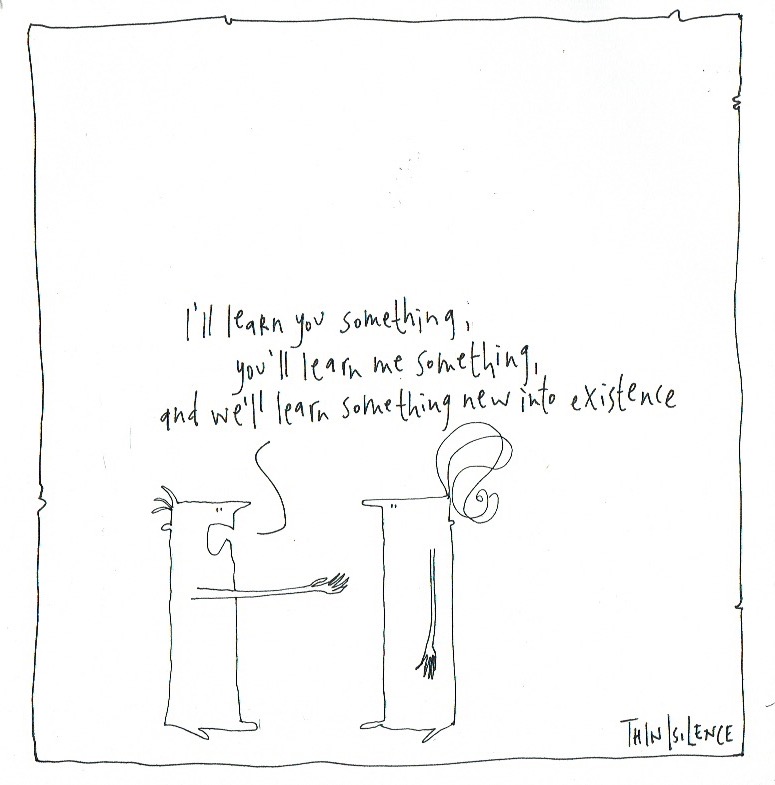
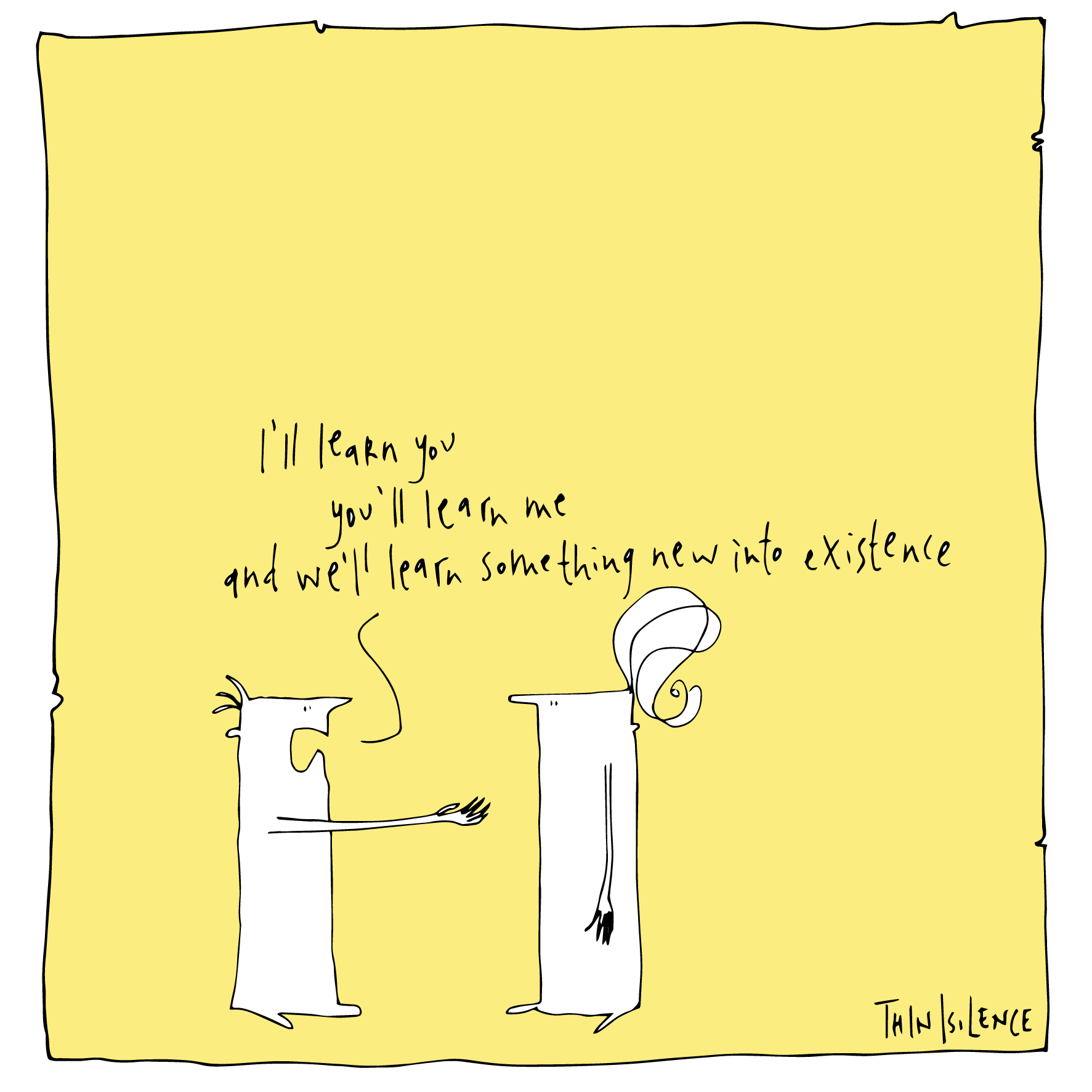
What if small groups of people came together for an agreed set period to learn each other?  That is, everyone brings the things they love and know and can do and share these things in a college and collage experience – we need to glue to partner.

Perhaps around some problem or issue everyone recognises, and everyone sets the curriculum and teaches and learns – an “alchemists’ den”?


HERE’S AN ALTERNATIVE FOR TODAY’S DOODLE

If you want to find out more about how you can use illustration to enhance your work, or about college and collage experiences, drop me a line: whispering@thinsilence.org

For beauty

‘The first recognition of beauty was one of the most significant events in the evolution of human consciousness.  The feelings of joy and love are intrinsically connected to that recognition.’*
(Eckhart Tolle)

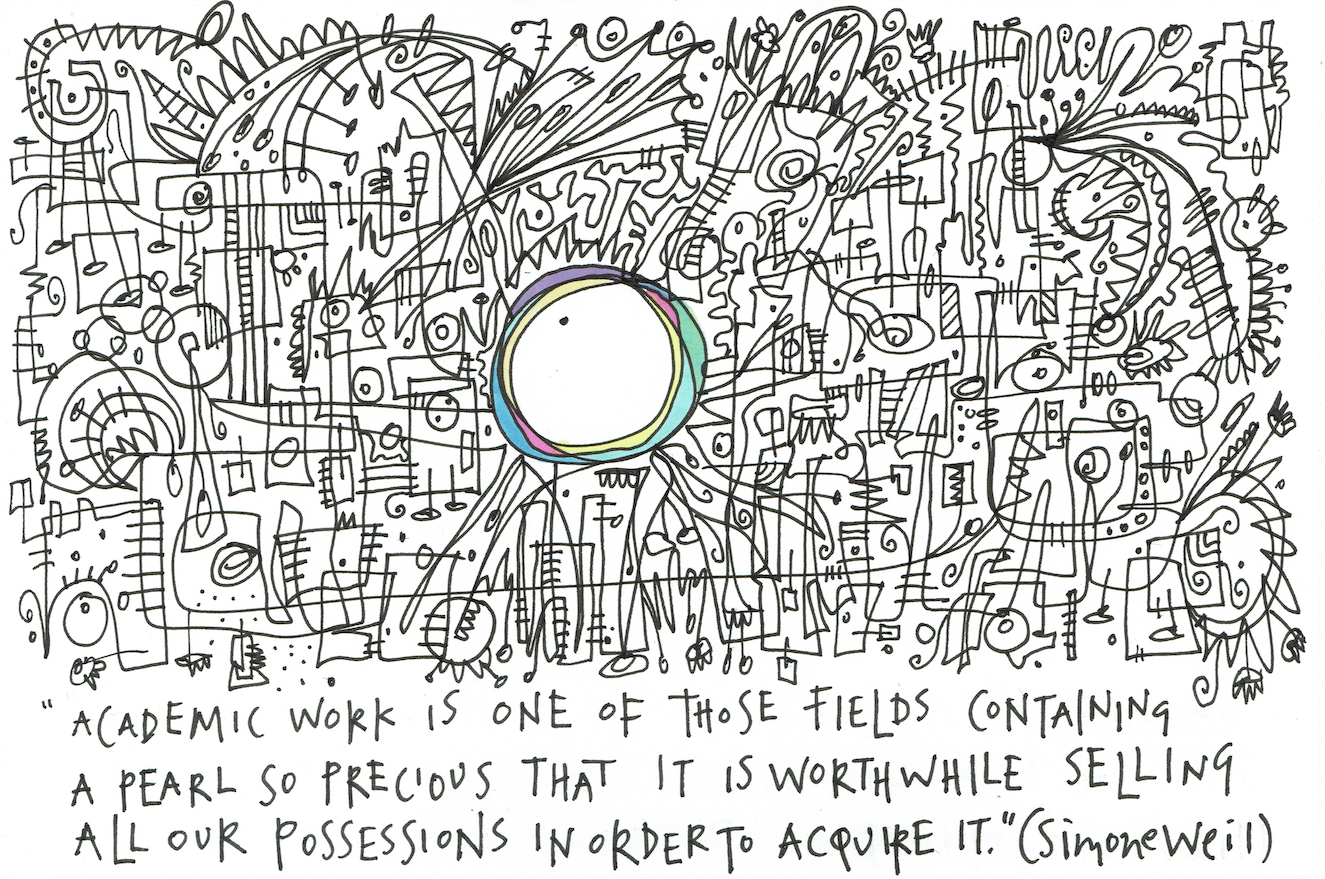
“Or, God’s kingdom is like a jewel merchant on the hunt for excellent pearls. Finding one that is flawless, he immediately sells everything and buys it.”**
(Jesus of Nazerath)

The saying goes that beauty is in the eye of the beholder, and we each see different things as beautiful.

An object can be beautiful but also an idea and a way of relating.  It can be organic or inorganic, made with common or rare materials.  It may be beautiful in a way that many people see or just one person.

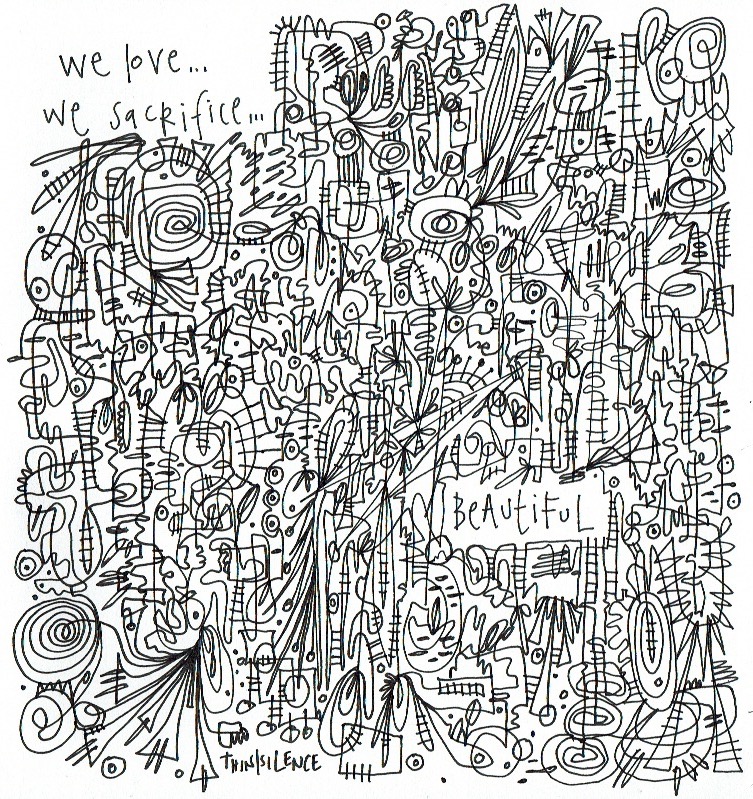
Each of us is also capable of making beautiful things.  Not easily.  Nothing worthwhile appears quickly or easily.  Beauty is costly in terms of time and effort and learning and resources.  Beauty requires love and sacrifice.  For the beauty we behold, we will have had to ignore or give up other beauties.  Nothing can be given up or die easily and this is what required.

Beauty is as much about the process as the result.

(*From Eckhart Tolle’s A New Earth.)
(**Jesus of Nazareth in Matthew 13:46; The Message.)

The fullness of silence

Listen to the silence.

It will teach you.  It will build strength
Let others share it with you.
It is little to be found elsewhere.”
(Frances Roberts)

“Little Things in Life supplant the “great events.””**
(Peter Altenberg)

We live in a society increasingly fearful of silence, or so it seems.  Filling our days with distractions to silence, we do not see how silence is our friend, helping us to see most clearly.  To know ourselves.  To see how we see makes it possible to see more.

Otto Scharmer writes about how we do not see how we see:

‘The way we pay attention – the place from which we operate – is the blind spot in all levels of society.’^

This is about our unique way of seeing, how we can bring it bravely and kindly into the world.  In the silence there’s no-one to compare ourselves to: we are not Narcissus, nor are we Echo.  There’s only us and in the silence we find the truth about ourselves to be enough.

Our personal preference for silence may be found in a hidden place or public space, in urban space or rural, in stillness or walking or even something faster.  It will involve removing the earbuds and ignoring the smartphone and being with ourselves in the fullness:

“Your vision will become clear only when you can look into your own heart.  Who looks outside dreams; who looks inside, awakes.”^^

‘[L]iving is a privilege.  Life is a gift.  We are so lucky to go through this journey, each of us, to deal with the drama and the nonsense and the happenings.  We can’t say it enough.’*^

(*Frances Roberts, quoted in the Northumbria Community‘s Morning Prayer.)
(**Peter Altenberg, quoted in the Paris Review, 17/10/13.)
(^From Otto Scharmer’s Theory U.)
(^^Carl Jung, quoted in Brené Brown’s Rising Strong.)
(*^Hugh Macleod, from gapingvoid‘s blog: 1/3/17.)


WHY NOT ADD SOME THIN|SILENCE TO YOUR POWERPOINT?

Images can bring out the things you really want to say in a deeper and fresher way.  Thin|Silence can help you to do this with anything from simple to complex illustrations.  Here are a few simple ones (from the University of Edinburgh Chaplaincy’s What’s the University For?)

Get in touch and find out what this can look like for you