did i surprise you?

‘In conversation, the interval of time that elapses between the other person’s sentiment or question and my father’s response greatly exceeds the average, a lapse swelling with Kierkegaard’s assertion that “the moment is not properly an atom of time but an atom of eternity.”’*

Maria Popova is commenting on her father’s slow response to others’ thoughts and inquiries.  She came to understand how this was not about the difficulty of the subject matter or conundrum, but about empathy:

‘It turns out that my father’s liberal pauses are so discomposing because our experience of time has a central social component — an internal clock inheres in our capacity for intersubjectivity, intuitively governing our social interactions and the interpersonal mirroring that undergirds the human capacity for empathy.’*

It feels like the internet, and social media in particular, is the opposite of this slow empathy.  Popova’s words had caught my attention as I’d been thinking about how life was to be found more in questions than in answers we often we can rush towards.  We’ll only truly know the true worth of many people and many things in the future we cannot see, perhaps one we will not even live to see.  It means we are best served by openness rather than closed-ness.  If, then, we say we don’t care about what the whole truth or picture is then we’re reducing if not eliminating empathy.

Is it possible, then, to live our whole lives wondering?

I am reminded of Mary Oliver’s words which I posted a few days ago:

“When it’s over, I want to say: all my life
I was a bride married to amazement.
I was a bridegroom , taking the world into my arms.”**

I read a little more from Bernadette Jiwa after reflecting on Popova’s story.  Jiwa is outlining practices to help us notice more: I find myself reading about the practice of identifying the backstory:

‘What new things did you learn about the person?
How does that change the way you feel about them?”^

Jiwa had been listening to her father speak about his working life, discovering that he had more than twenty five jobs in his lifetime:

‘You’re looking to gather insights here, not just about what people do, but also about why they do it.’^

This involves inquiry, and not assuming we know the answers. It is about empathy, about understanding what makes another tick.  Elsewhere Jiwa has written:

‘Your purpose is not what you do but why you do it.’^^

If we are to see deeper into one another, we will need to live in questions rather than answers.

I hope I’m move trying to offer an answer, rather, uncovering of a question.

(*From Maria Popova’s BrainPickings: Empathy is a Clock that Ticks in the Empathy of Another.)
(**Mary Oliver, quoted bin Philip Newell’s The Rebirthing of God.)
(^From Bernadette Jiwa’s Hunch.)
(^^From Bernatte Jiwa’s Difference.)
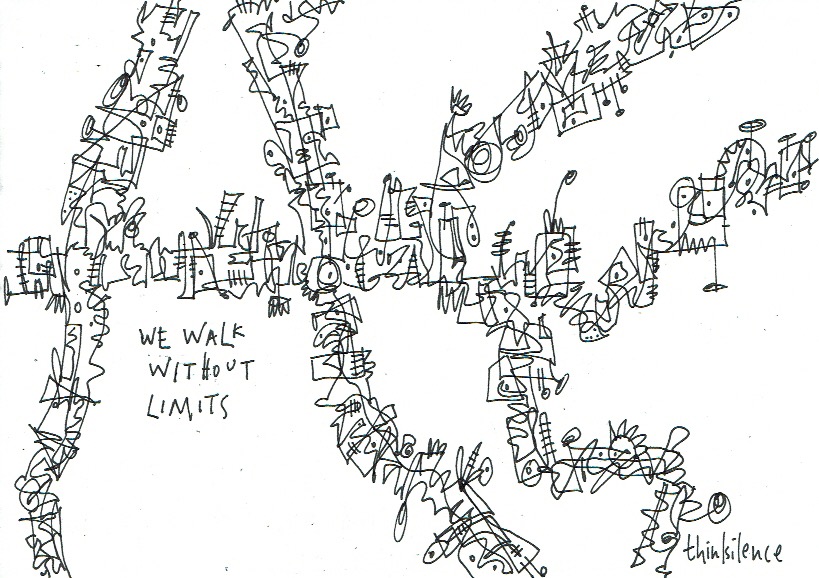


walk on

‘Under Niagara, the cataract falling like a veil over my countenance;
Upon a door-step … upon the horse-block of hard wood outside,
Upon the race-course, or enjoying picnics or a good game of
     base-ball,
At he-festivals with blackguard jibes and ironical license and bull-
     dances and drinking and laughter’.*

Walt Whitman was a walker, a wanderer.  There’s seems to be no limit or boundary to where he goes and what he sees during his lifetime.  In his poem Leaves of Grass, Whitman continues to show us what he is seeing:

‘At the cider-mill, tasting the sweet of the brown sqush … sucking the
     juice through a straw,
At apple-peelings, wanting kisses for all the red fruit I find,
At musters and beach-parties and friendly bees and hustings and
     house-raisings’.*

On and on Whitman walks, his short descriptions taking us into numerous new worlds:

‘By the cot in the hospital reaching lemonade to a feverish patient,
By the coffined corpse when all is still, examining with a candle;
Voyaging to every port to dicker and adventure’.*

He appears  not always to be in a place of wonder:

‘Hurrying with the modern crowd, as eager and fickle as any,
Hot toward one I hate, ready in my madness to knife him’.*

Whitman recovers, though, finding his way again:

‘Solitary at midnight in my back yard, my thoughts gone from me
     a long while,
Walking the old hills of Judea with the beautiful gentle god by my
     side;
Speeding through space … speeding through heaven and the stars,
Speeding amid the seven satellites and the broad ring and the diame-
     ter of eighty thousand miles,
Speeding with tailed meteors … throwing fire-balls like the rest,
Carrying the crescent child that carries its own full mother in its belly,
Storming enjoying planning loving cautioning,
Backing and filling, appearing and disappearing,
I tread day and night such roads.’*

This path before me seems to have no end.  I walk it and, like Whitman, I stumble, but the path is kind, giving me the time and grace I need to stand again and start to walk once more.  Andy Raine reflects how not everyone see the path this way:

“Too many people, guilt-stricken, wounded,
walk in regret,
feeling bad about failing,
apologise even for breathing.”**

Who told them that they couldn’t start over?

I reread these words from Daniel Kahneman on how we struggle to cross thresholds:

‘As in the case of lines, you are likely to stop where you are no longer sure you should go further – at the edge of the region of uncertainty.’^

But it is in these regions of uncertainty, where the continuing path takes, that the presently unimaginable can happen.  If we stop, building our cities, and naming them “Destination,” then we will never know what can be.  Kahneman’s words help me see this path is an expression of the infinite game: it is for as many as possible to travel for as long as possible, and when something threatens to stop people in their tracks we invent new ways of walking, of keeping going.  Seth Godin encourages:

‘Don’t be trapped into accepting shame from someone who is trying to keep you from doing something you have every right to do.’^^

The road or path or way we follow is full of questions and possibilities, and, somewhere between, a quest.

It’s everyone’s road.

‘I fly the flight of the fluid and swallowing soul,
My course runs below the soundings of plummets.

I help myself to material and immaterial,
No guard can shut me off, no law can prevent me.’*

(*From Walt Whitman’s Leaves of Grass.)
(**Andy Raine, quoted in the Northumbria Community‘s Morning Prayer.)
(^From Daniel Kahneman’s Thinking, Fast and Slow.)
(^^From Seth Godin’s blog: Common traps, worth avoiding.)


life by airbrush

“The least strained and most natural ways of the soul are the most beautiful, the best occupations are the least forced.”*

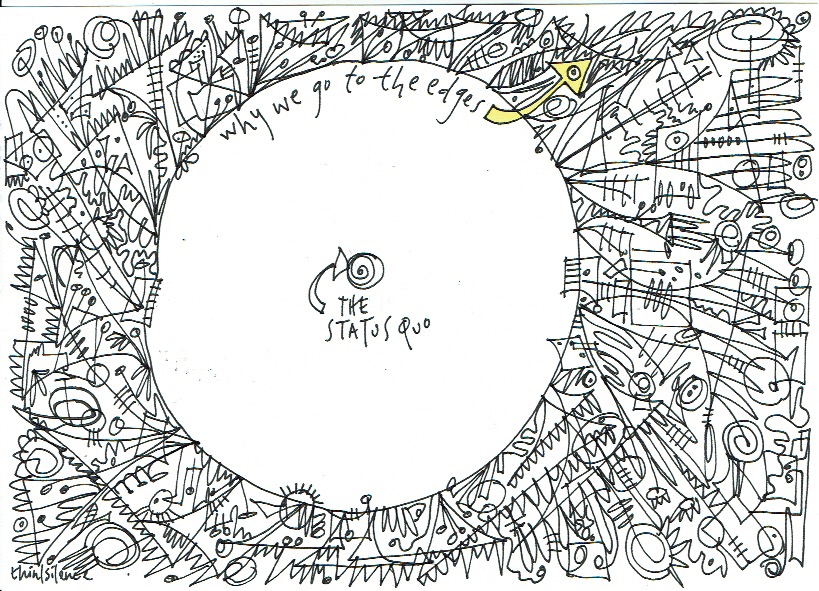
‘New social movements do not come from this in the centres of power. […] Look to the periphery, to people and places where commitment to the status quo is low, toward where hearts are most open to the new.’**

Seth Godin’s blog on airbrushing got me thinking about why we might “airbrush” our lives, presenting an images of ourselves, our lives, our families, our jobs, that feel to be more presentable to others, where we don not feel ourselves to be misfits, feeling embarrassment, or worse:

‘Spend enough time looking through the glass on your tablet and you’ll come to believe that you’re the only one with a less-than-perfect situation. With the right filter, the grass really is greener…”^

What we lose, according to Michel de Montaigne and Peter Senge, whose words lead us into today’s post, is the natural beauty and the beautiful-new which come from the uncontrived and less acceptable edges.

When our ways of speaking and acting change because we’re in the company of someone we’re playing up to or down to then we’re acting out of our ego – airbrushing has been around a long time, we just called it something else.

When we’re able to meet the world and those in it just as we are, with our unique perspectives we not only produce more but we change for the better the world that is increasingly in need of living without the airbrush.

(*Michel de Montaigne, quoted by Gretchen Rubin in The Happiness Project.)
(**From Peter Senge’s The Necessary Revolution.)
(^From Seth Godin’s blog Airbrushing.)

wisely does it

“The fool, with all his other faults, has this also, he is always getting ready to live.”*

Wisdom is more than knowing, it is about living.  Epicurus’ defining of a fool, above, allows us to see foolishness can mean many things but not acting upon them.  This kind of wisdom then becomes our capacity to deal with complexity.

After reading this, Philip Newell catches my attention when he writes:

‘One of the primary features of the rebirthing of God is reconnecting with wisdom, allowing the truth that has been etched into our being to come forth in new ways.  This reconnection will happen through a journey into the forgotten and unknown depths of our own soul and traditions.’**

Whilst Newell is a minister in the Church of Scotland and his focus and concern is for the maturing of the Christian faith, he gives expression to the possibility for those who are not religious continually develop and rebirth their worldview, whatever that be.

However, it’s the next part of his statement that is of particular interest.  When we go down into what George Appleton names “the deeps of my being,”^ we find we are less foolish than we think.  We know a lot of things, a lot of things we can act upon – which is what wisdom is about.

‘I just wanted to do it!  It was an internal drive that I couldn’t ignore.’^^

What Chris Guillebeau is describing here is what lies in the deeps of every person if they could find there way there.  The problem is in noticing.  Other voices, needs, demands distract us from travelling to this place in ourselves.

Frans Johansson would say we need a strategy:

‘The purpose of strategy […] is not to find the right answer, because you will be wrong anyway.  The purpose of the strategy its to move us to act.’*^

Maybe we don’t act because we want to get it right straightaway, or in the gaze of others.  Johansson is saying, though, that it’s far more important to be moving than getting it right the first (second, or third) time.  John Ortberg aligns with this when he remarks:

‘It’s better to go through the wrong door with your best self thank the best door with your wrong self.’^*

It’s about movement, and movement at our natural speed is the best way of thinking about this.  This can feel like a resurrection, a coming to life, and I offer this thought in an Epicurean way:

‘Peregrination was sometimes described as “seeking the place of one’s resurrection,” leaving the familiar in order to experience new birth, dying to boundaries and securities of home to be alive to what one had never imagined before.’**

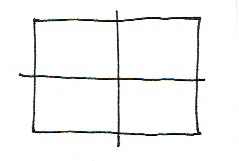
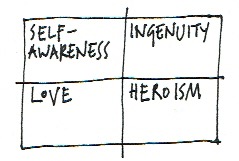
Peregrination or walking is a useful metaphor because it requires that we take only the necessary things from the journey.  Necessary then is interesting.  Beyond the essentials everyone might take for their walk, each will have different things they feel necessary for their walk.  I came across an exercise from Bernadette Jiwa that ties in helpfully here.  Jiwa is offering an empathy exercise in the form of “Notice what she carries” drawing four quadrants, filling each in as the things necessary to the journey are reflected upon:⁺

I suggest four labels four the quadrants which come from the Jesuits, as these suggest an inward and outward journey.

I offer this as a means of reflecting on what you find in the deeps or truth etched into your being:

What are you most aware about yourself: your talents, passions, learnings?
How have you been most imaginative and creative when it comes to doing something with these things – your experiments, even if these have failed?
Who have you shared these things with, as a means of love?
Where have you been most heroic (selfless), standing up for something that matters to you and changing something?

(*Epicurus, quoted in Maria Popova’s BrainPickings: A Stoic’s Key to Peace of Mind.)
(**From Philip Newell’s The Rebirthing of God.)
(^George Appleton, quoted in the Northumbria Community‘s Morning Prayer.)
(^^From Chris Guillebeau’s The Happiness of Pursuit.)
(*^From Frans Johansson’s The Click Moment.)
(^*From John Ortberg’s All the Places to Go.)
(⁺From Bernadette Jiwa’s Hunch.)

victory!

“When it’s over, I want to say: all my life
I was a bride married to amazement.
I was the bridegroom, taking the world into my arms.

I don’t want to end up simply having visited the world.”*

We compete in many arenas to win, but what is it we’re competing for?

These words from Mary Oliver suggest for me the kind of life many would hope to win.

I was born in 1959.  The world has changed in many ways since then.  I certainly know that I don’t want to live in a 1959 world today.

The world of humans has developed and improved in so many ways since then, thanks to the things many people have competed around and won in many areas of life; work: education, gender, sexuality, medicine, technology, politics.

The world has also become worse in many places, or at least remained the same: poverty, terrorism, conflict, global warming, personal anxiety.

There are certainly many places in which we need to keep pushing forward.

One way to win is to become people acting upon these things rather than being acted upon.  Echoing Erich Fromm’s belief** that no-one is absolutely free but more or less free, Alex McManus writes:

‘Freedom is the ability to choose within our bounds.’^

To know our bounds holds is also to know the possibility of expanding our bounds.  Maria Popova writes about a stoic’s key to peace of mind when she quotes Seneca:

“There are more things […] likely to frighten us than there are to crush us; we often suffer more often in imagination than in reality.”^^

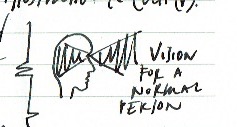
Popova includes an illustration from author Catherine Lepange showing how normal people and anxious people see.

It is indeed critical to be people who see beyond ourselves but I want to add to this illustration to look like this:

If we are to know how we are able to interact with what we see beyond ourselves, we also need to know ourselves – our bounds.

-I don’t want to be stuck in in 1959 and I don’t want to remain in 2017 either.  To understand that we are people capable of changing the world will require us to face failure – often the reason for much our fear and anxiety.  To know this comes with the territory and to better know ourselves is to give ourselves a better chance of winning:

‘where people do failure avoidance, they will never achieve the kind of courage and risk taking that lead to bold innovation’.*^

We hold on to victory.

(*Mary Oliver, quoted in Philip Newell’s The Rebirthing of God.)
(**See Erich Fromm’s The Art of Listening.)
(^From Alex McManus’s Makers of Fire: ebook version.)

(^^Seneca, quoted in Maria Popova’s BrainPickings: A Stoic’s Key to Peace of Mind.)
(*^From John Ortberg’s All the Places to Go.)

the speed of wonder: notice fast, look slow

‘Curious people do not simply tolerate ambiguity; they like it and are intrigued by it.  Curiosity can either be specific […] or global, a wide-eyed approach to everything.’*

‘Allowing your ignorance, or allowing curiosity to lead you, is often the best guide to what to ask about.’**

With the speed of light being more than 186,000 miles per hour, I wonder how fast the speed of curiosity is.

How quickly do I notice things this fast light makes visible to me?

What then I bring my slow attention to?

I want to hone both skills.

(*From Martin Seligman’s Flourish.)
(**From Edgar Schein’s Humble Inquiry.)

a change of plan

‘Daunted by the futility of keeping up with all the demand they cannot possibly meet, some will just surrender and retire gracefully into relative oblivion [but] each person must use whatever tools are available to carve out a meaningful, enjoyable life.’*

‘Stand at the crossroads, and look, and ask for the ancient paths, where the good way lies; and walk in it, and find rest for your souls.’**

Mihaly Csikszentmihalyi is writing about how people can get all the hope squeezed out of them,  He goes on to say some people turn to religion, the kind of ancient path Jeremiah refers to – but Csikszentmihalyi says they are only temporary solutions.

We need a way that allows for things to happen.  The best ways, ancient and modern, ought to bring us to spontaneity and surprise.  Erich Fromm captures something of this when he describes what freedom really is:

“Freedom is not the absence of structure […] but rather a clear structure that enables people to do work within established boundaries in an autonomous and creative way.”^

We need something that allows us to live now, rather than have to wait to something in there future, reversing the trend of our lives as Ralph Waldo Emerson saw it. how:

“We are always getting to live but never living.”^^

To listen to what our lives and make even the smallest of changes today is to begin.

(*From Mihaly Csikszentmihalyi’s Flow.)
(**Jeremiah 6:16)
(^Erich Fromm, quoted in Peter Senge’s The Necessary Revolution.)
(^^Ralph Waldo Emerson, quoted in Mihaly Csikszentmihalyi’s Flow.)