what is it about the meek and the future?

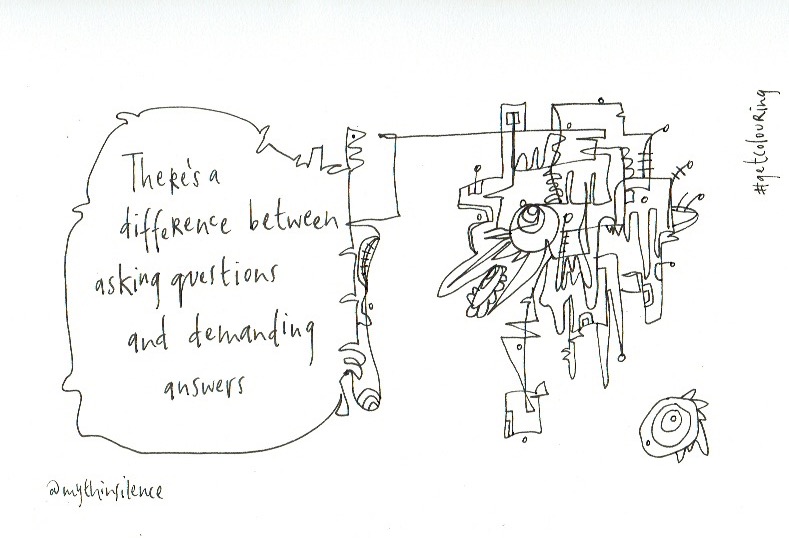
11-theres-a-difference

“And the point is to live everything.  Live the questions now.”*

‘In one study, dieters who kept a food diary lost twice as much weight as dieters who didn’t bother.’**

This isn’t about dieting but about the magic of journalling.

Journalling can take many different forms – online, notebook, image, word, public, private, long, short – but one of the brilliant things it allows us to do is fexplore a question, to reflect upon the journey.  It makes it possible to embrace incoming information and turn it into outbound action.

A friend told me yesterday about half a group of professionals being led through a journalling exercise rebelling, refusing to take part.  Of course, people are free to do this, but it’s an odd response.

Can there be a decent answer without fully exploring the rabbit-hole of questions – there’s never only one – or there be a destination without an engaging journey?

Although journalling doesn’t have to take up a lot of time, it allows us to slow down to notice, to be honest and face reality, and to understand there’s more about us than meets the eye, the fullness of meekness.  And meekness awakens the future.

‘Yes, we are broken, but at the same time we are awakening to our brokenness.’^

(*Rainer Maria Rilke, quoted in the Northumbria Community‘s Morning Prayer.)
(**From Gretchen Rubin’s The Happiness Project.)
(^From Alex McManus’s Makers of Fire.)

the speed of breathing

10-lifes-perfect-tense

‘If we set ut for the nearest star beyond our solar system at [the speed of a plane – five hundred miles per hour] it would take five million years to reach our destination.  If we travelled in the fastest rocket ship ever manufactured on Earth, the trip would take one hundred thousand years, or at least a thousand human life spans.’*

We can only see so far out into the universe.  The known universe is as far as our telescopes can reach out.  We do not know how much more universe lies beyond this.

Like the universe, our lives are expanding, and, we too can only see so far.  Unlike the universe, though, instead of peering into the past the further we look out into space, when we peer through the known universe of our lives, into the unknown, we are looking into our personal future.

With the physical universe, we will have to discover or invent ways of travelling faster.  In the personal universe the trick seems to be to travel more slowly.

‘Our breathing tells us how fast or slowly we are travelling.  If you haven’t taken the time to notice you’re breathing, you already known you are travelling too fast.  When you begin to notice your breathing, see how slow you can take it.  Notice the things that come into view as you reflect on your life within and engage without your life in purposeful conversations and explorations with others.

(*From Alan Lightman’s The Accidental Universe.)

the really important

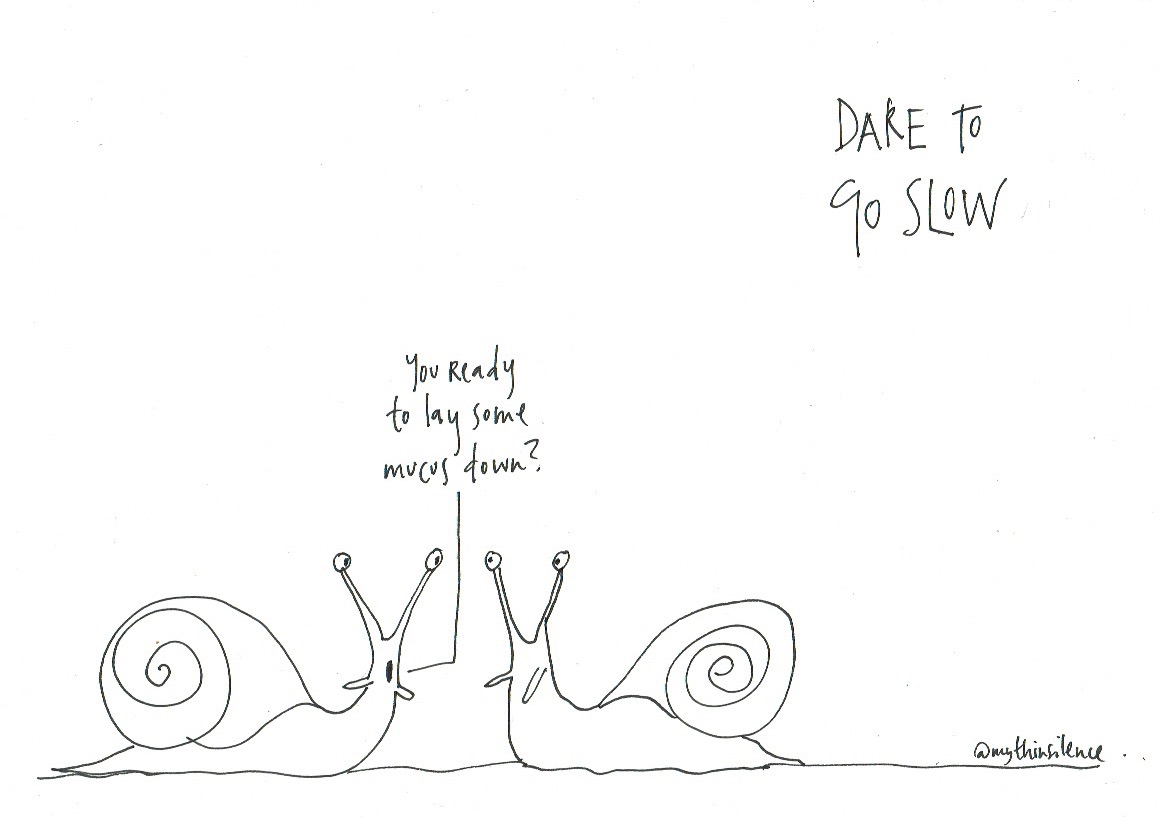
9-dare-to-go-slow

‘Life is ambiguous.  There are loose ends.  It takes maturity to live with the ambiguity and the chaos, the absurdity and untidiness.’*

“Moment by moment, when we’re rushed, we’re simply not the people we’re capable of being.”**

Rushing around and making ourselves constantly busy suggests importance and purpose which may or may not be real.

We think we’re way too busy to slow down, to reflect on our lives and get our bearings.  Even for that nagging thought which catches us off-guard, that suggests maybe there’s more than this.  So we avoid looking closely because we think it’ll be bad news, but maybe what we find will be kinder than we imagine, more than we think.

Maybe what we fill our days with will turn out to be less important or crucial than we make it out to be, but amongst all the experience and skill-building of our lives I believe we find far more than we lose.

And just maybe, the thing you notice you’re drawn to, or pulled back to, or you make all kind of tenuous links with no matter what the conversation, is the really important thing for you.

(*From Eugene Peterson’s Run with the Horses.)
(**From Maggie Berg and Barbara Seeber’s The Slow Professor.)


UDFj-39546284

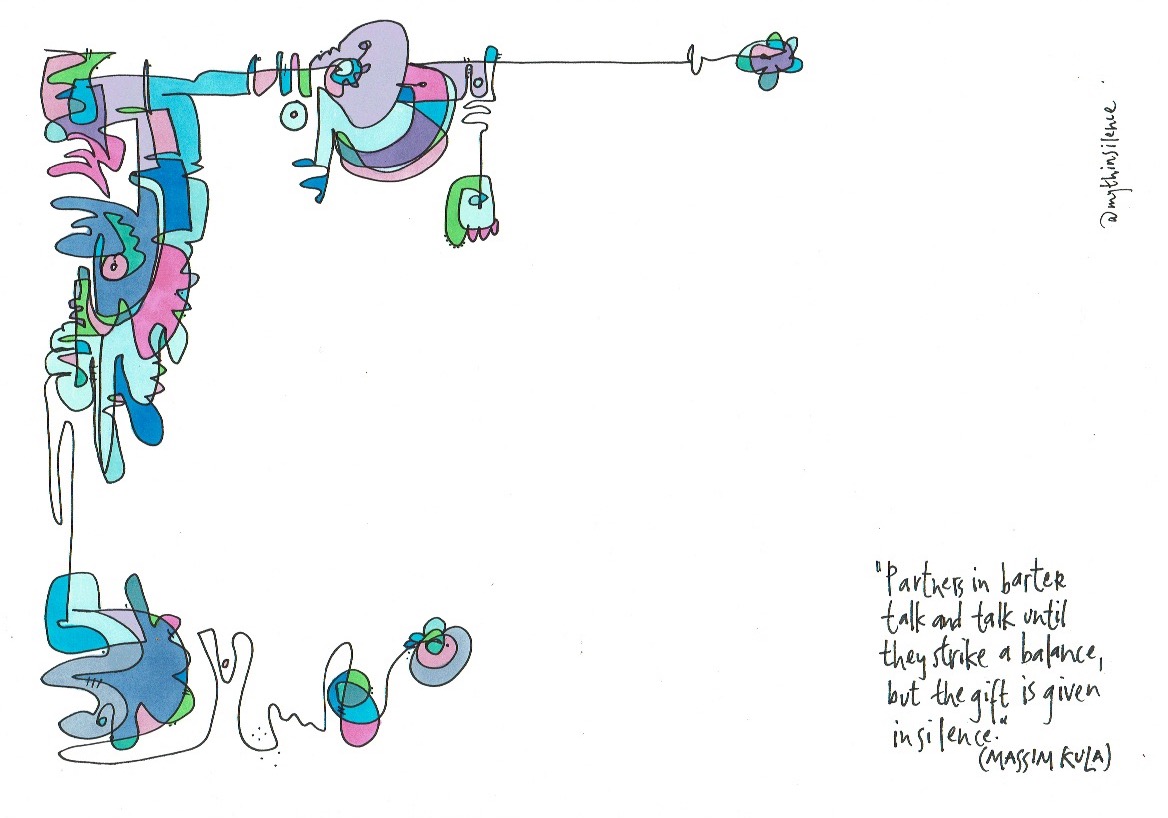
8-partners-in-barter-talk-and-talk

‘One measure of the progress of human civilisation is the increasing scale of our maps.’*

‘Here is summertime truth, abundance is a communal act, the joint creation of an incredibly complex ecology in which each part functions on behalf of the whole and, in return, is sustained by the whole community doesn’t just create abundance – community is abundance.’**

UDFj-39546284 is one of the farthest points in space we are able to see, a galaxy lying some 100,000,000,000,000,000,000,000 miles from Earth.

Another measure of our progress as human becomings is the decreasing scale of our maps, bringing places closer, like Aleppo and Haiti.

(*From Alan Lightman’s The Accidental Universe.)
(**From Parker Palmer’s Let Your Life Speak.)

being (……..)*

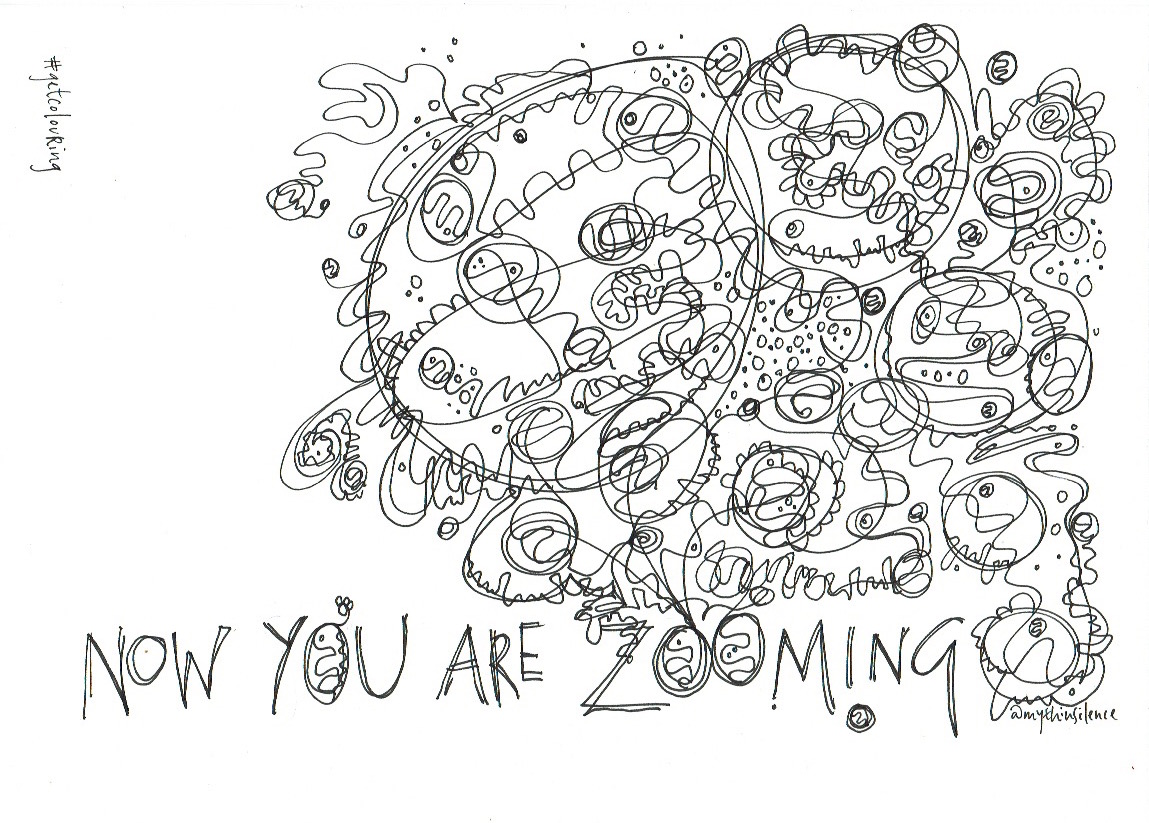
7-now-your-are-zooming

*Please insert your name within the brackets.

“Take me down to the spring of my life, and tell me my nature and my name.  Give me freedom to grow, so that I may become that self … .”**

Every person’s life is a garden of possibility.

I’m working on the garden around our house, and nature keeps teaching me that there’s always a possibility of newness just a season or two away.

“And for all this, nature is never spent;
There lives the dearest freshness deep down things …”^
‘You have connected to a deeper source – to the source of who you really are and to have a sense of why you are here – a connection that links you with a profound field of coming into being, with your emerging authentic Self.’^^

Yesterday I was imagining with a small group an entrepreneurial experience in its broadest sense, a space in which people can expand their understanding and experience in a co-creating way.  As I was thinking about this today, I was remembering a definition for being entrepreneurial: to take responsibility for.

It’s as if we look into the depths of our lives and notice more: “That gives me an idea.  I can do something with that!”  In this way we are all entrepreneurs.

In the 18th Century Denis Diderot led the collating of an Encyclopedia which alphabetically listed the work of different craftsmen and craftswomen, democratising the skills and talents of all those listed – whilst in Berlin salons of the bourgeois witnessed people dressing up and imitating some famous character from literature or history:

‘In Paris, the Encyclopaedia aimed socially lower and asked readers in salons not to imitate but to admire ordinary people bustling at work.’*^

Zooming is a word Seth Godin uses to describe how we take the things we can do even further.  Now we’re gardening.

It’s not about being someone else; it’s about being more who you are, who I am; we only need the right environments of learning, opportunity, and experience to expand this understanding and experiencing of who we are, to be able to zoom.

So I am being Geoffrey.

(**George Appleton, quoted in the Northumbria Community‘s Morning Prayer.)
(^From Gerard Manley Hopkins’s poem God’s Grandeur.)
(^^From Otto Scharmer’s Theory U.)
(*^From Richard Sennett’s The Craftsman.)

when symmetry is disagreeable?

6-asymmetrical-colour

‘In fact, in human-made art, especially in painting, its seems a light bit of asymmetry is desirable and found to achieve a higher aesthetic satisfaction.’*

‘Money comes to money.  Education to education, and ignorance to ignorance.  Those once victimised by history are likely to be victimised yet again.  And those whom history has privileged are more likely to be privileged again.’**

Can people change?

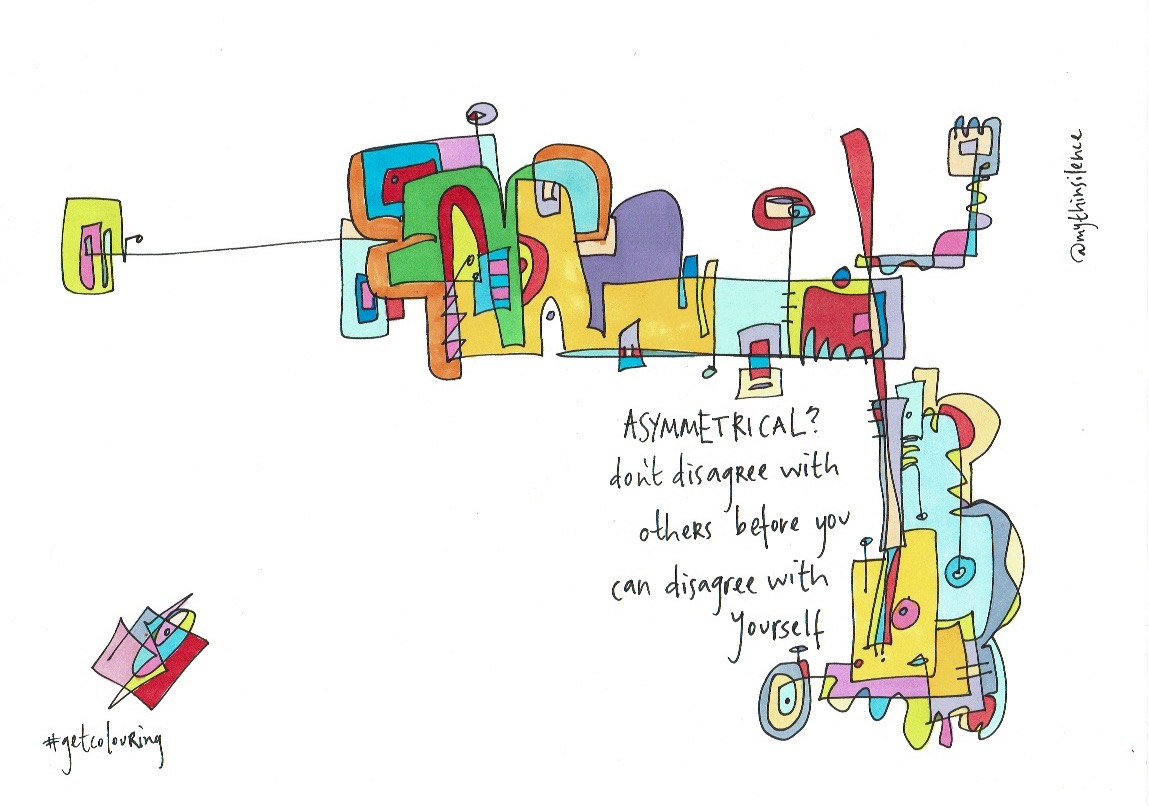
Symmetry and cycle is something life falls into, including human life.  For a few, this is good news.  For most people, it is bad news.

So we have to be thankful there’s also an asymmetry to life.  Some hope to change things by imposed order; others by an emerging order.

Asymmetry needs symmetry to be noticeable; indeed they need each other.  We appreciate both the roundness of the earth and also the irregularity of the mountains standing upon the irregular shapes of the continents.

When it comes to a human life, we all need something we’re not, something we don’t have, in order to be break out of recycling the same old same old, into a narrative, a journey, a drama.

(*From Alan Lightman’s The Accidental Universe.)
(**From Yuval Noah Harari’s Sapiens.)

the symmetry and asymmetry of life

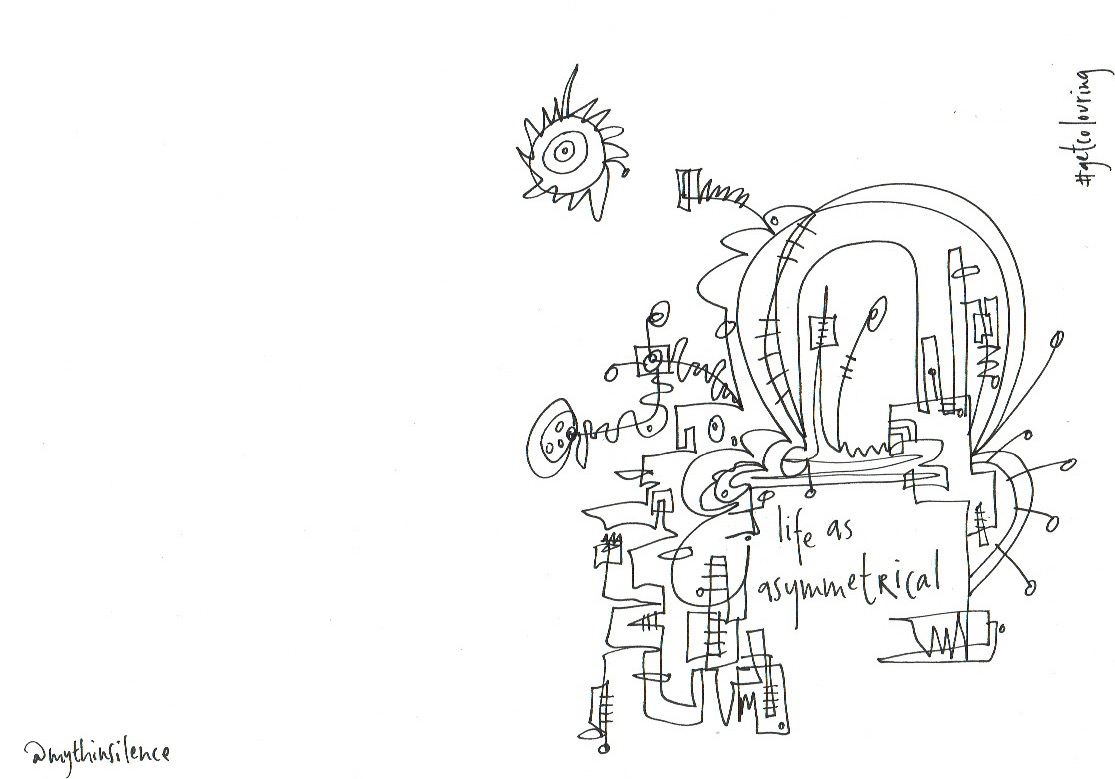
5-life-as-asymmetrical

‘Symmetry leads to economy, and nature, like human beings, seems to prefer economy.’*

‘The only essential is this: the gift must always move. … There are other forms of property that stand still, that mark the boundary or resist momentum, but the gift keeps going.”**

I found myself playing with ideas when I read these two things earlier.  Here’s what happened.

I am no mathematician, but neither do I need to be for the equation of a circle with radius R as R:x²+y²=R² to be true.  As I’m thinking about this, I’m interrupted and feel some mild irritation.  I notice this and tell myself its okay.  I return to the maths, but while I’ve been away in my thoughts, nothing has changed.  Even when the axes change to w and z, the maths stay the same: w²+z²=R2.

Then I notice my “to do” list is building up, and the symmetry of maths which would exist without any of us being here, does not help me with the asymmetry that consciousness, especially the human kind, introduces.

This symmetry we see in the natural order of things has evolved to minimise energy: bees form their hexagonal cells because it not only allows many bees to work simultaneously on their design with no wasted space, but it also reduces their energy output for wax to eight ounces of honey to one ounce of wax.*

Humans then come along with the ability to focus large amounts of energy on really difficult tasks, making it possible to overcome problems that should make us give up, if not wipe us out.

My natural tendency is to say “I can’t do this,” “I haven’t got enough resources,” “It’s too hard,” but I know I can put these thoughts aside, use up huge amounts of energy, and bring some asymmetry into existence.

Of course, it’s easier to do nothing, or as little as we can, but the human story suggests life is most meaningful when we get a little asymmetrical with it.

(*From Alan Lightman’s The Accidental Universe.)
(**From Lewis Hyde’s The Gift.)

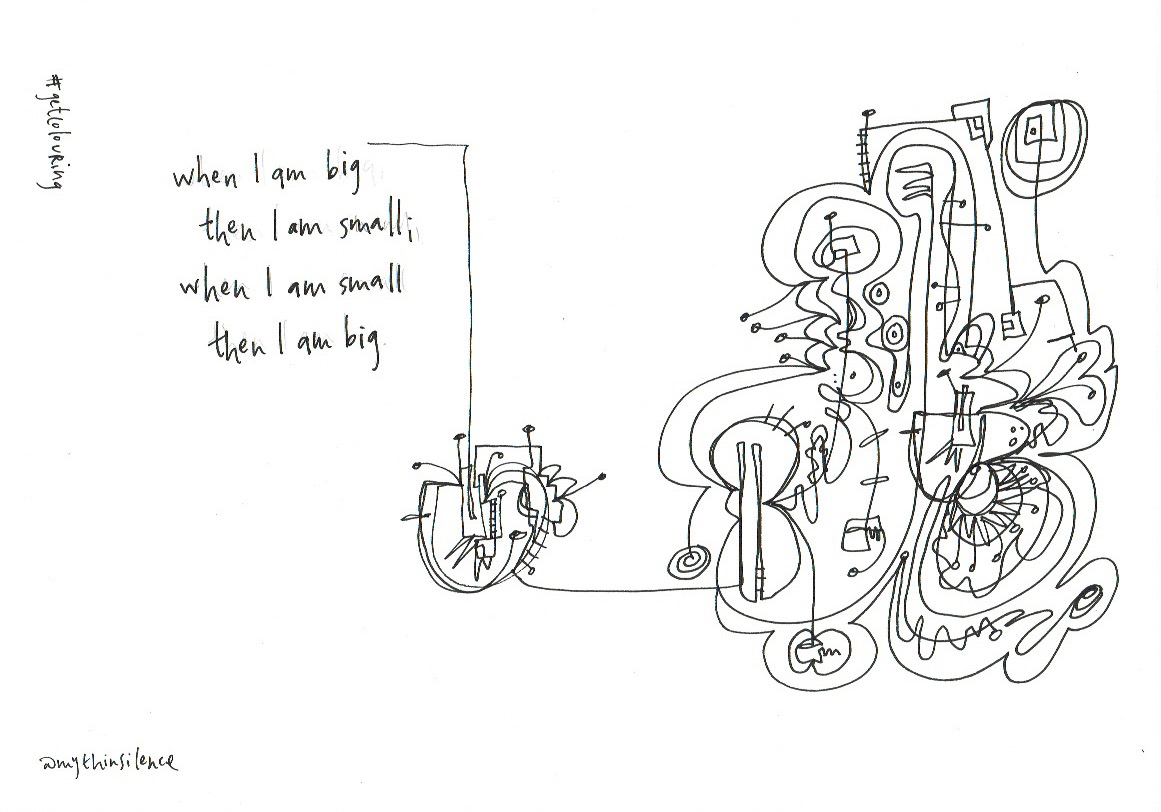
life is very small and very big at the same time

4-when-i-am-big

‘It takes roughly a trillion collisions between protons to coax on Higgs [particle] into existence, and,once created, the particle hangs around for less than a billionth of a trillionth of a second before changing into other subatomic particles.’*

‘The larger the world we live in, the larger our lives develop in response.’**

It seems to be that it is in the relationship between the small and the large that life exists most fully.

Everything that is exists in relationship to itself and to all things.

From our perspective, every relationship could be better too, but flawed can be more beautiful than perfection.  There’s hope for all of us:

‘All the hero has to do to make the story great is struggle with doubt, face their demons, and muster enough strength to destroy the Death Star.’*

It isn’t beautiful without effort.  The larger the life we live depends on the smaller the life we cultivate – the source of who we are, understanding why we’re here and what we must do, and, of course, in relationship to everyone and everything else.

And just this little thing may have changed you.

(*From Alan Lightman’s The Accidental Universe.)
(**From Eugene Peterson’s Run with the Horses.)
(^ From Donald Miller’s Scary Close.)

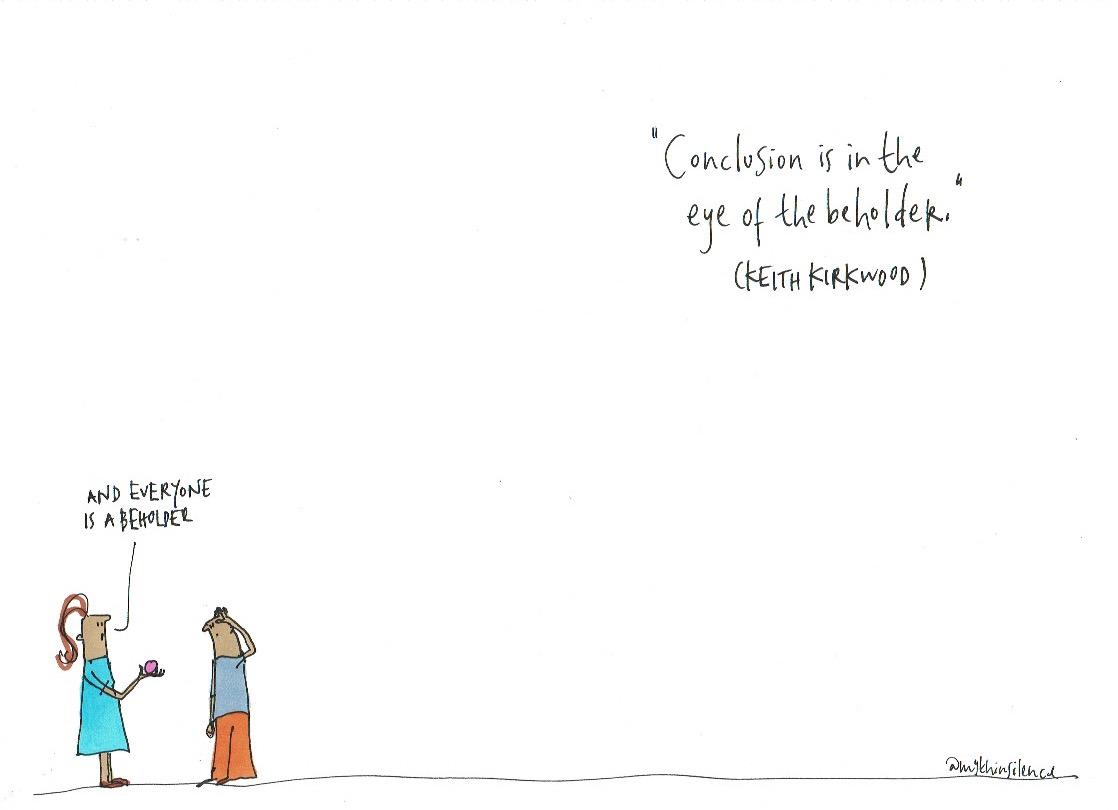
too many borders?

3-conclusion-is-in

“She always had the feeling that it was very, very dangerous to live even one day.”*

We are wanderers, never arriving, always between here and there.

It may not look like this on the surface.  We know exactly where we’ve arrived within certain borders – family, work, interests, nationality, friendships … .

These appear to be the critical borders, but they’re clumsy and clunky compared to the many others we cross or avoid every day: when we allow a relationship to deepen, or we spend time getting to know a stranger, when we encourage our children to pursue the things that interest them rather than look good on a report card, when we give time to explore a new idea, or stop to notice something we so often pass without paying attention.

Here we are prepared to accept that we are, in the truest sense, all ‘strange-appearing, strange-acting and strange-sounding people.’**

As Seth Godin suggests, we are all weird.^

Everyday we get to play in borderlands like these, the places that exist between people, ideas, and species and the natural world.  There is always more to life than we see.

We live physical and spiritual universes with their many borders, and we are ever explorers:

‘Each universe has its own power.  Each has its own beauty, and mystery’^^

(*Virginia Woolf, quoted in Gretchen Rubin’s The Happiness Project – one of Rubin’s personal koans.)
(**From Rohit Bhargava’s Non-Obvious.)
(^See Seth Godin’s We Are All Weird.)
(^^From Alan Lightman’s The Accidental Universe.)

where we belong?

2-and-there-is-more

“Seek solitude.  Listen to the silence.  It will teach you.”*

“Oh do not ask, “What is it?”
Let us go and make our visit.”**

Each of us has our personal koanswords and ideas and images we have collected through our lives which speak to us most loudly in the silent moments and places.

Making it possible to touch the wonder or promise of what is but cannot be seen, they remind us there is another world, more than this one.

Pulling us from the over-trodden path, away from the scant world that has become so many heuristics, they bring us to ‘the things others miss.’^

(*Frances Roberts, quoted in the Northumbria Community‘s Morning Prayer.)
(**T. S. Eliot, quote in Gretchen Rubin’s The Happiness Project.)
(^From Rohit Bhargava’s Non-Obvious.)