the future is a journey

11 the future is not

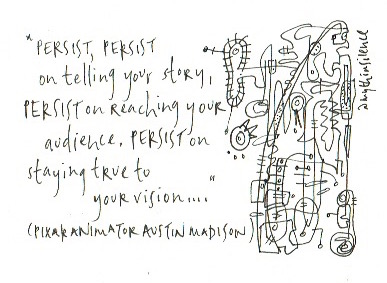
“PERSIST.  PERSIST in telling your story.  PERSIST in reaching your audience.  PERSIST in staying true to your vision … .”

‘There is only one way to assess a vision: what is attained relative to what might be attained without the vision.’**

“Have patience with everything§ unresolved in your heart … .”^

The future is a journey we make.

It is not something we imagine.

We each are made for something more: lives shaping the future for others through quests for honour, nobility, and enlightenment.

We can give up, though, because we never seem to arrive.  But our future is never the destination we think it is.  Just by moving, any possible future changes – and we have to move for it to be a journey.  Every step changes the whatever possibilities we think of as being the future.   What may surprise us, when we look back along the way we’ve been walking, is just how much stuff we’ve done.

(*Pixar animator Austin Madison, quoted in Ed Catmull’s Creativity, Inc..)
(**From Peter Senge’s The Necessary Revolution.)
(^Rainer Maria Rilke, quoted in the Northumbria Community‘s Morning Prayer.)
and now, back to the story

10 persist, persist

“If you want your dream to be
Take your time, go slowly”*

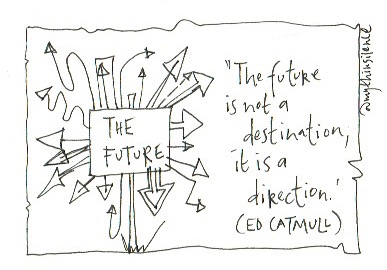
‘The future is not a destination – it is a direction.’**

Whatever the day ahead is known to contain for you, it’s crucial to return to your story: who you are becoming, what it is you must do, how these connect and stimulate one another in the energy of your life.

It’s a strange thing, but the more we connect to and develop our stories, the more we find ourselves in a larger story – making sense of why we’re here in the universe – including the larger stories of groups and organisations, and the best of these will always invite our unique contribution, as Michael Heppell encourages:.

‘The trick is to find people who complement each other rather than putting up with those who detract.’^

Thanks for reading; time to get back to your story.

(*Donovan Leitch, quoted in the Northumbria Community‘s Morning Prayer.)
(**From Ed Catmull’s Creativity, Inc..)
(^From Michael Heppell’s How to be Brilliant.)

within us, the future hidden

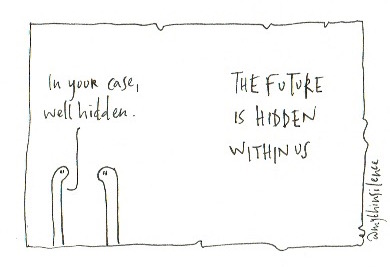
9 the future is hidden within us

Each of us was formed in a hidden, secret place.  Our parents had to be patient for around nine months to catch their first sight of us.  The mystery and wonder of this doesn’t escape us.

These words – hidden, secret, mystery, wonder – continue to be descriptors for our lives because the future is hidden within us.  Not what we have done or who we have been, but what we will do and our future Self.

Every day is an opportunity to bring to birth, your “deepest, as yet unborn, self.”*

(*An unnamed contributor to Gretchen Ruben’s blog, quoted in The Happiness Project.)

deeper and down

8 zing

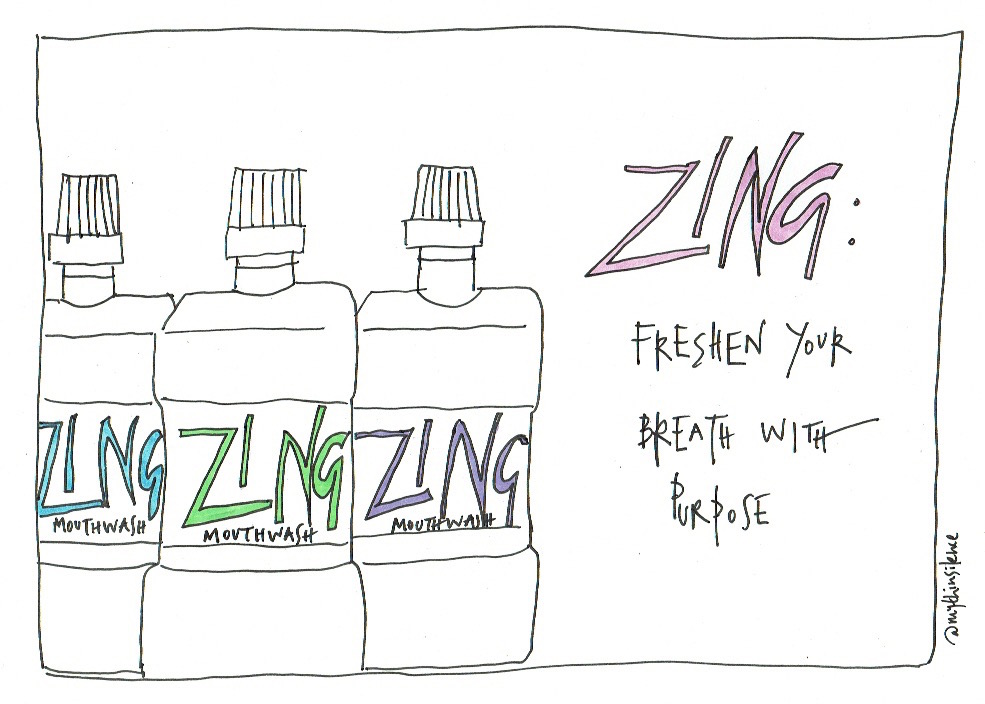
There is breath and there is zingy breath.

More than a Status Quo classic, deeper and down is about connecting our breath to our passion in a way that takes us on a journey.

Everyone has talents that can be deepened.  Pamela Slim caught my eye back in 2012 with a comment about only needing to identify something we can do that is an inch wide and a mile deep.*  This has stuck with me ever since.  Everyone has a passionate skill that is an inch (2.54 centimetres) wide.  The magic happens when it’s taken deeper. For me, my inch wide is simply about showing people something of how amazing they are – I then simply take this deeper.

What is your inch wide talent and passion?

(*See Pamela Slim’s Escape from Cubicle Nation.)


the passive stay at home

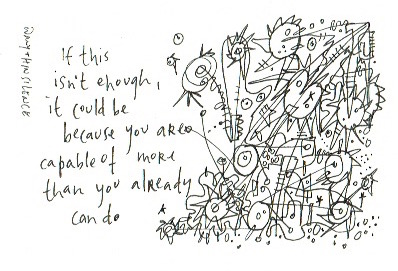
7 if this isn't enough

‘The sociologist Alejandro Portes observes about modern economic migrants that they tend to be entrepreneurial in spirit; the passive stay home.  This migratory dynamism was built into mediaeval goldsmithing.’*

“We didn’t just want to make lists of cool things we could do.   The goal was to identify passionate people who would take ideas forward.  We wanted to put people with clever insights in front of Pixar’s executive team.”**

It’s not about some people being passive and others being entrepreneurial.^   It’s about noticing where we’re passive and where we’re entrepreneurial.

A characteristic of being human is that we strive.  We have to overcome something, and we take risks in order to do this.^^

Striving and risks are the the means by which we create the best human stories when they recognise the spine or narrative arc of our personal story.

It doesn’t matter that I might stay at home when it comes to the thing you’re excited about; the important thing is that you don’t stay home, that you travel to the edges and bring your discoveries home for everyone.

(*From Richard Sennett’s The Craftsman.)
(**Tom Porter, quoted in Ed Catmull’s Creativity, Inc..)
(^Admittedly, some people do passively go through the entirety of their lives, whilst others go through their lives pushing, pushing, pushing.)
(^^Taking risks looks different on the inside for the person undertaking it, than for the person looking in from the outside.  In Entrepreneurial StrengthsFinder, Jim Clifton and Sangeeta Bharadwaj Badal 
list six things risk-takers do in order to mitigate risk: they know what they know and what they don’t know; take incremental risks; watch out for the “confirmation bias;” imagine various scenarios to see possible futures; do not gamble; and, ignore the unimportant projects.)

future-benders

6 we are learning

The Christian theologian Augustine came up with the doctrine of original sin, the idea that life begins corrupted and needs redeeming.

My preference is for the doctrine of original goodness: people are amazing, capable of astonishing feats of great beauty and kindness.

I admit, though, it doesn’t explain everything.  The kind of things resulting from our pride and greed and foolishness make for horrible messes.

We all need some way of explaining our goodness and our badness; it’s how we keep moving forward.

What’s most important is how we think about the future; not what we have been but what we can be.  We can relive the past, if we wish, but the future hasn’t happened.  We get to shape it.  It’s where we all get to change.   And how we imagine the future alters our behaviours in the present.

Future benders are those who manage to keep turning up in anticipation of something good happening.  When enough people turn up for this work, maybe then, we’ll see what we are made of.


why we need heretics

5 heretics are the new leaders

‘As the scholastics used to say: Homo non proprie humanus sed superhumanus est – which means that to be properly human, you must go beyond the merely human.’*

‘And while the poet must struggle to invent a new metaphor and the novelist a new story, the composer must discover the undiscovered pattern, for the originality is the source of the emotion.  if the art feels difficult, it is only because our neurons are stretching to understand it.  The pain flows from the growth.’**

We need the new, else we become complacent and narrow-minded.  It seems we must stay open-minded to have any mind at all: wisdom only grows in a life of doing things, and in this experience of knowing things, we come to know we can do more things in the future.

We find different metaphors and images for our lives that important for triggering our getting up, exploring, seeking, and questioning – ways for exploring our calling.

‘Old age offers the opportunities to integrate and bring together the multiplicity of directions that you have travelled.  It is a time when you can bring the circle of your life together to where your longing can be awakened and new possibilities come alive for you.’^

Old age just means you have more to invent new things from; defying definitions, you become more than you – more than the sum of your parts.  As such, you are a heretic, shaking up the order of things you know to be a threat to life in all its fullness.

(*From Eugene Peterson’s Run with the Horses.)
(**From Jonah Lehrer’s Proust was a Neuroscientist.)
(^From John O’Donohue’s Anam Cara.)

this whole day is mine

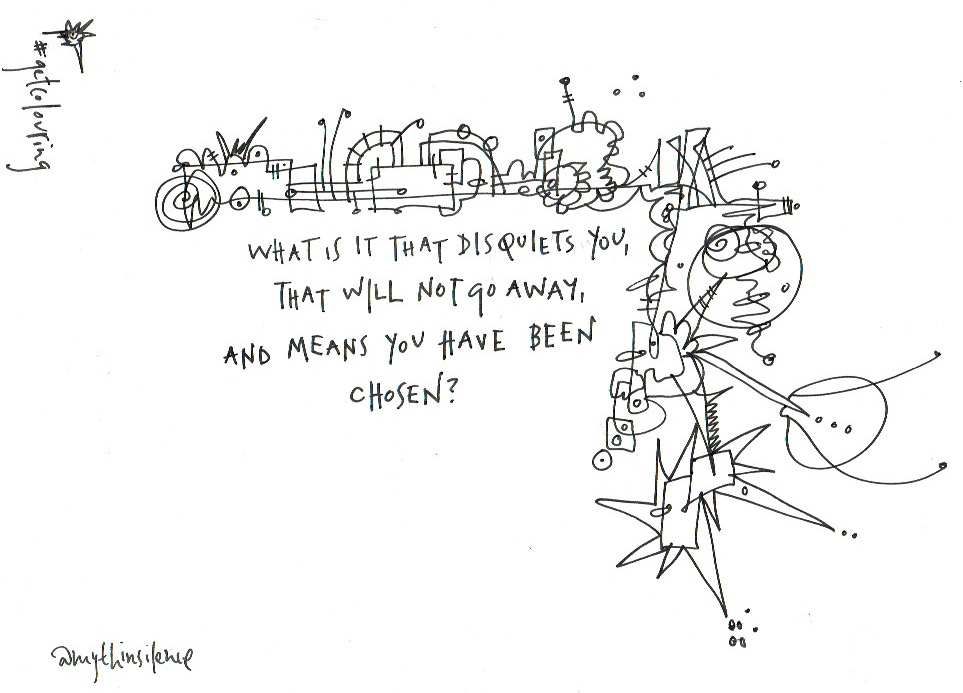
4 what is it that disquiets you

‘The days are long, but the years are short.’*

“You may be sure that it was not for any merit that others do not possess, nor for any power or wisdom, at any rate.  But you have been chosen and you must therefore use such strength and heart and wits as you have.”**

Is all of today enough for you?

You are already enough for today.

The future asks you to do something you cannot do.  This thought comes to you as thin silence, barely audible or visible yet returning to your consciousness like some determined flotsam remaining afloat on a restless ocean.

Sometimes irksomely, other times hopefully, always persistently, the future is calling you, not allowing you to deduce that life is only work, entertainment, and sleep, but is an adventure – whether one that is hidden or visible to others – that you are undeniably called.

(*From Gretchen Rubin’s The Happiness Project.)
(**Gandalf to a protesting Frodo in Lord of the Rings, quoted in Eugene Peterson’s Run with the Horses.)

givenness and liminality

3 we all require our wildernesses

‘[A]ll life is given and must continue to be given to be true to its nature.’*

‘[T]he vast changes required by a regenerative society will not be achieved just by reacting to crises after they arrive.  They will require inspiration, aspiration, imagination, patience, perseverance, and no small amount of humility.’**

Givenness is something we all can develop.

Some are more expressive in their givenness than others, but none of us know the limits of our capacity to give.  The question is more about how much more we can daily give in hundreds of ways, rather than some big once-in-a-lifetime way.

Our willingness to pursue givenness takes us into unknown, unfamiliar, and challenging places which lie between or uponon the far side of what we normally know and fill our days with.  These are preparing spaces, places of previously unknown knowledge and invisible energy becoming available  to us – like the wilderness for Jesus or Dagobah for Luke Skywalker.  They are places of challenge to be alive.

“He not busy being born is busy dying.”^

We accept our givenness by beginning, overcoming, giving it on, again and again.

(*From Eugene Peterson’s Run with the Horses.)
(**From Peter Senge’s The Necessary Revolution.)
(^Bob Dylan, quoted in Jonah Lehrer’s Proust was a Neuroscientist.)

we will always be explorers

2 we never know what note will come next

‘I never speak the first word.  I never make we first move.’*

“The years as they pass plunder us of one thing after another.”**

Each of us arrives in this life with a history, even if we’re unaware of it.

We sometimes speak of destiny, but where on earth does that come from?  And yet it can make so much sense when we fall upon what we feel we were born to do.  It’s as though we are coming back to some great knowing and cause, out of which we produce some gift or contribution for others.

These are the strange things we’re seeking to make sense of throughout our lives.

‘We shall not cease from exploration
And the end of all our exploring
Will be to arrive where we started
And know the place for the first time.’^

There is always something new for us to discover, though the best of the new comes with a struggle.

Jonah Lehrer suggests that, ‘Music only excites us when it makes the auditory cortex struggles to uncover its order.’^^  This provides us with a metaphor for lIfe.  We’re seekers of the patterns that make sense to us.  It’s all in the journey, though not any journey.  Again, using the metaphor of music:

‘Pretty noises are boring.  Music is only interesting when it confronts us with tension, and the source of tension is conflict.’^^

Try reading that again, inserting life for noises and music.  I’m not suggesting chaos.  We can’t survive chaos, but we can overcome more than we know, as we reach towards the note that will next come.

And finding ourselves back at the beginning, we start to explore once again.

(*From Eugene Peterson’s Run With the Horses.)
(**Horace, quoted in Gretchen Rubin’s The Happiness Project.)
(^From T. S. Elliot’s Little Gidding.)
(^^From Jonah Lehrer’s Proust Was a Neuroscientist.)