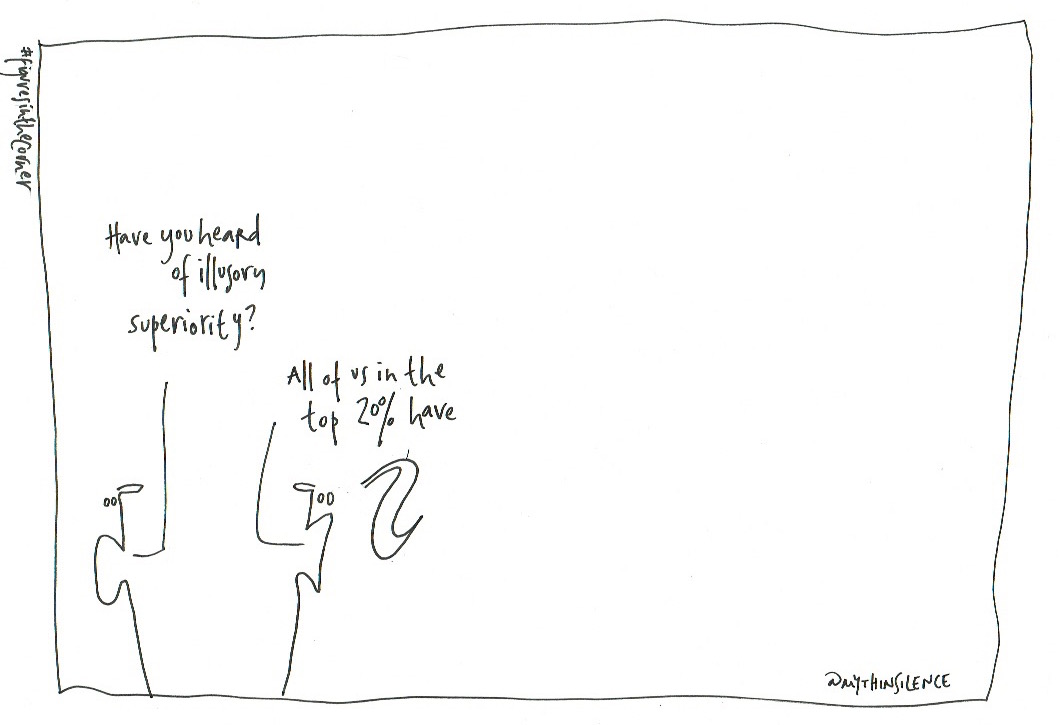
how we fool ourselves

11 have you heard of 1

‘You can’t achieve anything deeply satisfying without a drawn-out process leading up to it – and yet process demands a goal.’*

‘Impressions are always incomplete and require a dash of subjectivity to make them whole.’**

‘It’s difficult to tell the difference between what is impossible and what is possible (but requires a big reach).’^

I’m coming closer to the start point of a new future I’ve been moving towards for some time now – this story has been growing and developing for a while, though

From the perspective of the universe, my story is only me fooling myself.  It’s what consciousness requires, some creative subjectivity added to the numb objectivity we find ourselves wrapped up in.

Human consciousness is an interesting phenomenon, mind.  It makes for some amazing lives and some incredible stories.

And we all get an opportunity to join in.

(*From Chris Guillebeau’s The Happiness of Pursuit.)
(**From Jonah Lehrer’s Proust was a Neuroscientist.)
(^From Ed Catmull’s Creativity, Inc..)
asking questions forward

10 go slowly

‘The sun goes up; the sun goes down.  I can handle that.’*

Every day affords us an opportunity for remaining focused and staying open.

You may have noticed there’s more than a little tension in this, but this tension is how we make progress with the something significant our lives must be about.

Slowly is how we look within so we can move forward.  And what we find is freedom,

(*From Austin Kleon’s Show Your Work.)

if i ruled the world

9 natural born contributors

It would only end in tears. Better to work together to bring out everyone’s amazing contribution.

‘Being a valuable part of a scenius is not necessarily about how smart or talented you are, but what you have to contribute, the ideas you share, the quality of the connections you make, and the conversations you start.’*

Better to rule our own world – to know and love our art – in order to bring what it is we can bring into the world of others.

(*From Austin Kleon’s Show Your Work.)

this day has never happened before so how can we stay on track?

8 we are curious

‘You must remain attentive in order to be able to receive.’*

‘To the loving eye, everything is real.’

I might try and focus on what’s important to me at the beginning of the day, but I find myself wandering the further I get into the day.

Here are two things I’ve been trying to keep focused with:

A loving eye – which changes everything I may see in the day – including compassion, kindness, gentleness, and patience.

The second thing is curiosity, which keeps me open to the new and unfamiliar.

Then imagination and goodness get a chance.

(*John O’Donohue, quoted in the Northumbria Community’s Morning Prayer.)
(**From John O’Donohue’s Anam Cara.)

itchy, cranky people

7 scratch

‘Mortals must do what they are here to create or they will become cranky.’*

‘Every missed rite of passage led to a new rigidification of the personality, a lessening ability to see, to adjust, to understand, to let go, to be human.’**

We all get itches. Have you noticed, when you thoughtlessly scratch an itch it gets worse?

And when we go through life with an itch of something we could contribute, some art to bring, but thoughtlessly scratch it, the art doesn’t emerge and we just get crankier.

Here are three rites of passage we can use to do some thoughtful scratching and move from itch to art:

Notice your itch, what it is, why it’s there, who’s causing it, when is it’s most itchy.

Allow yourself to feel the itch, for it to guide you, even define you, transforming from an itch to an urge.

Do something about what you are seeing and feeling.  Try out the art that emerges from the itch. Offer it to others.

Now who’s cranky?

Not you.

‘When you make a dream come true for yourself, it’ll be a dream come true for someone else too.’^

(*From Seth Godin’s Tales of the Revolution.)
(**From Richard Rohr’s Adam’s Return.)
(^From Derek Siver’s All You Want.)

telling the story

6 telling the story

‘”What was most useful for you about this experience?”  Answering that question extracts what was useful, shares the wisdom and embeds the learning.’*

“All sorrows can be borne if you put them into a story or tell a story about them.”**

When we take time to reflect, we can pick out the things that we don’t want to pursue, but maybe valuable to others.

Other things intrigue us, but knowing so little about them, we set out to learn more.

Some things fall into our category of “not welcome here anymore,” and we take steps to rid our lives of them.

And then there are the things which we identify as being what our lives must be about – these are the things to pursue.

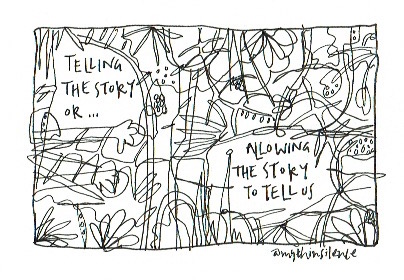
We’re learning how to tell the stories rather than allowing the stories to tell us.

(*From Michael Bungay Stanier’s The Coaching Habit.)
(**Karen Blixen, quoted in Stephen Grosz’s The Examined Life.)

did you see that?

5 reflecting

You did, but you’ve probably already forgotten.

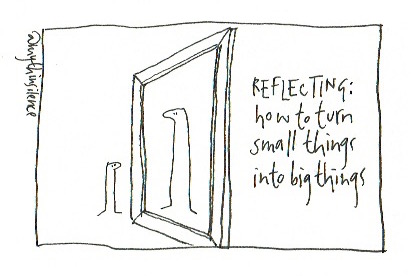
A key ability for doing astonishing work is interrupting our forgetting.

Others may have considerable skills and intelligence, but if they forget what they’ve come upon and you don’t, you provide yourself with an advantage for doing something valuable to bring to others. In fact, giving away what you’ve seen – in your own words – is a way of interrupting forgetting.  Reflecting is another way – reflecting being a way of practising remembering.

What did you learn?

What do you want to remember?

What was most useful to you?

‘The shortage is in people willing to do it.  To take a leap.  To walk onto the ledge and start.’*

Why not use what others forget?

(*From Seth Godin’s Poke the Box.)


yes, that’s good

4 how do you

‘People don’t really learn when you tell them something.  They don’t even really learn when they do something.  They start learning, start creating new neural pathways, only when they have a chance to recall and reflect on what just happened.’*

I often hear people sharing things they miss the “glory” of.

Robert McKee writes about how movies allow us to both experience something and to reflect upon it.  We don’t get the chance to reflect on life very often.**

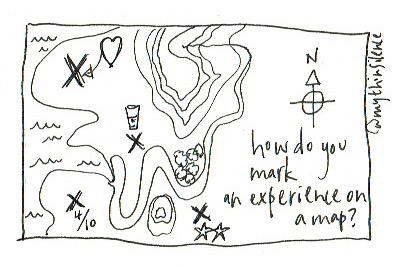
It doesn’t particularly matter what kind of reflection you make your own, but reflecting on life opens up possibilities of greater glory, like being able to mark an experience on a map so you can go there many times.

(*From Michael Bungay Stanier’s The Coaching Habit.)
(**See Robert McKee’s Story.)

personal myths and what comes from beyond

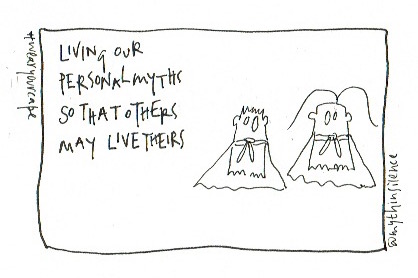
3 living our personal myths so others may live theirs

“It takes the ancient form of the quest: the hero journeys to a far-off place, gains something valuable and returns.”*

Many great stories begin because of an interruption.  The main character or protagonist is thrown off their expected path, tries frantically to get back, but realises the only way to go is forward, discovering things about themselves – good and bad – that they didn’t know, and, dealing with their demons and growing in their humanity, return to a new beginning.

There are everyday interruptions that can be used to live out our personal myth-quests in our day-to-day lives.  The interruption from beyond can take different forms – a person, an idea, a challenge, an invitation, a question … .

These are thin|silence moments, when we’re open to that which comes to us from beyond, altering the way we frame a day.  These myths are personal because we all discover and prepare for our own from the beginning of the day.

(*Philip Pullmann in the introduction to Lionel Davies’s Kolymsky Heights.)

the important no

2 heart and mind and will in flux

‘The leading edge thinkers in physics … suggest that nature is not a collection of objects in interaction but is a flux of processes. The whole notion of flux and process in fundamental to the indigenous sciences.’*

“To be on a quest is nothing more or less than to become an asker of questions.”**

There is the way of the mind, by which we progress through using all the information we can.

There is the way of the will, by which we move forward through trials, testing, and experimentation.

There is the way of the heart, by which we move forward according to what we must say yes to.

Many cannot wait to discern their heart and act on the information to hand, whilst others believe the best way to progress is to start moving, throwing themselves into activity.

Those who discern their heart, know the value of information and the importance to act, but also understand in order to say yes to the right things for themselves, they have to say no to the wrong things.

Of course, this is the way we have always progressed, through choice after choice, saying yes to this and no to that, yes to this and not to that – it’s almost binary.

“Thinking of the heart”^ is simply about doing this better, searching for more information and knowledge and moving faster into action (specifically, prototyping) from a deeper place of knowing and motivation, because this is the right path for us.

(*From Joseph Jaworski’s Source.)
(**Sam Keen, quoted in Michael Bungay Stanier’s The Coaching Habit.)
(^See Peter Senge’s The Necessary Revolution.)