living gracefully?

9 we are not perfect

Alan Lightman tells a beautiful little story about how people might live if they knew the world would come to an end in a month:

‘They do not seem to mind that the world will soon end, because everyone shares the same fate. A world with one month is a world of equality.’*

In this world, people drop their pretence, their seriousness, begin to notice the beauty all around them, forgiving each other, reconciling, living larger in a short time than they ever did in a large time.  With one minute to go, everyone holds hands in such silence they can hear the beating of their neighbour’s hearts.

If we found ourselves living in such a world but it didn’t come to an end, when realised this, would we go back to ways we used to live?  We know this new world is within our reach now, today.

‘Advice from every quarter, ancient and contemporary, backs up the observation that to change our feelings, we should change our actions.’**

No matter what I’m reflecting on in life, sooner or later I find myself pondering humility.  Previously, I’ve mentioned how humility is about not having too high or too low an opinion of ourselves.  Rather, it’s about having a true understanding of self – which means knowledge is involved.

There are negative uses to knowledge:

I’m not going to tell you so I’ll keep my job.
You know I know something about you; how does that make you feel?
You know I know something about you that you don’t want others to know, do you?

The Johari window offers four views of personal knowing: things we know about ourselves and hide from others, things we know about ourselves and share with others, things which others know about us which are hidden to us, and, things which neither we nor others know about us.

Perhaps, most hopefully, our journey is with one another towards what we do not know about each other, moving towards new knowledge we’ll share together, and holding more gracefully what we already know because it’s not the whole or finished picture.

The following words shared by Vincent Donovan from one of his students fits well here; they speak of a journey that understands there’s something more beautiful than we know now, a place discovered by both or all on a journey, not just one:

“In working with young people in America, do not try to call them back to where they were, and do not try to call them to where you are, as beautiful as that place may seem to you.  You must have the courage to go with them to a place that neither you nor they have ever been before.”^

This requires an open mind and heart, not working for this in order to get that:

‘Non-Dual people use knowledge for the transformation of persons and structures, but most especially to change themselves and to see reality with a new eye and heart.’**

What if those humbly imperfect and incomplete are discovering how to enter this new world, in acting and becoming, identifying their energy, being quietly persistent, iterating, with an eye for an opportunity?

(*From Alan Lightman’s Einstein’s Dreams.)
(**From Gretchen Ruben’s The Happiness Project.)
(^From Vincent Donovan’s Christianity Rediscovered.)

(^^From Richard Rohr’s The Naked Now.)
great moments

8 the path calling

“When a great moment knocks on the door of your life,
it is often no louder than the beating of your heart,
and it is very easy to miss it.”*

I wonder if you, like so many hearing the “great moment,” have the first thought: “This is for someone else, not me.”

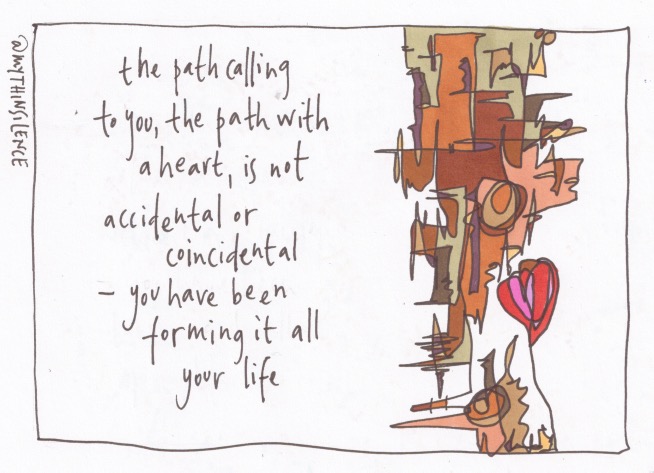
There’s a reason why this moment has come to you.  It’s not coming out of the blue; it comes because of your values, your talents, the experiences which fill your life and make you, you – including the good and bad, together with  the things you notice which no one else does.

To hear and respond, then, opens the possibility of something which will need to be described in new words and phrases – so different and new is it.

There’s even a game with minutes you can play.  The kind of ordinary minutes which each days brings, in which you can look for the opportunities of playing out what your life is asking of you, this into each moment: a note to self, or to someone else, an idea to jot down, someone to help, an innovation to bring, a plan to make, a journey to begin, a new word or phrase to devise, moment of reflection, a walk of noticing … .

All of this helping you to develop: to become more adaptable, learn faster, move quicker, home in on new ideas and absorb them rapidly, produce new possibilities faster.

None of this is requires you be complete or perfect but simply willing to respond when the knock comes.

(*Boris Pasternak, quoted in the Northumbria Community‘s Morning Prayer for the 8th February 2016.)

the beauty of meekness

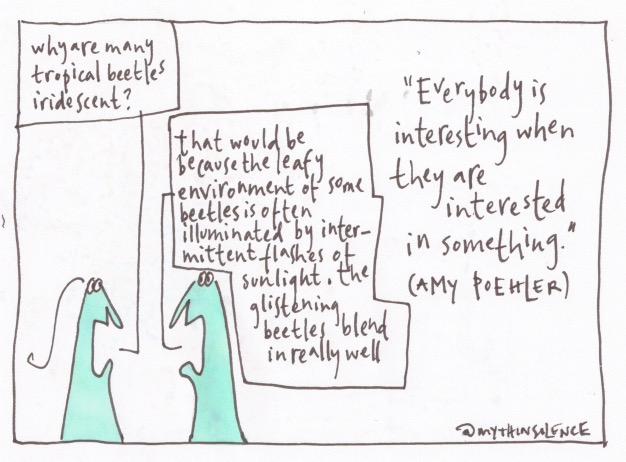
7 everybody is interesting

As I watched the dawn this morning, the darkness didn’t just disappear, it disappeared before beauty: scarlet, salmon, light orange.

I had found myself reading the words of a prophet about doing justice, loving kindness, and walking humbly.  To the original hearers, these words will have meant small everyday actions in the market place, in their work, and in their families and friendships.

I found myself needing to explore meekness again.

Meek people see a world beyond boundaries and ethnicities, marked by kindom and commonwealth, a movement from polarities to resonance:

‘You start knowing through, with, and in somebody else. … Your little I Am becomes We Are.’*

We each bring something different.  Each having our particular curiosities and needs, finding we’re drawn to this and not to that, and, digging deep enough, we’ll find this leads to someone or something we can make some difference for.

When forged in a place of stricture and confinement – in which we hone our skills, identify with our values, and iterate possibilities – meekness creatively brings simple beauty into the world.

(*From Richard Rohr’s The Naked Now.)
the ego fears change

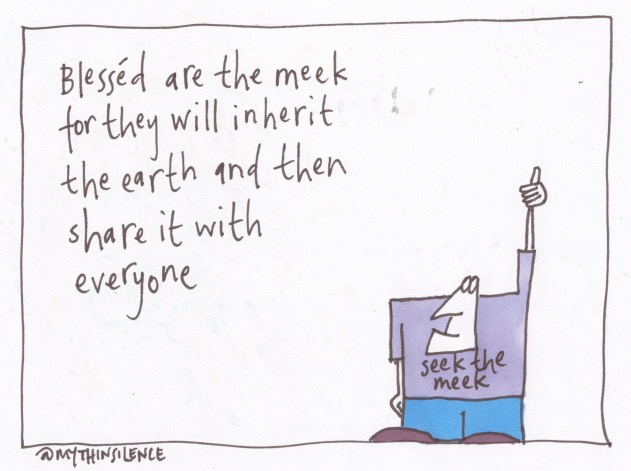
6 blessed are the meek

meek

adj.  meek·ermeek·est

1. Showing patience and humility; gentle.
2. Easily imposed on; submissive.

Check out the word meek and you come up with something akin to this from The Free Dictionary, with a heavy lean towards the weak; here’s another attempt:

1. humbly patient or docile, as under provocation from others.
2. overly submissive or compliant; spiritless; tame.
3. Obs. gentle; kind.

Maybe we need to redeem the word in this way.  Meekness is about knowing we must change.  Meekness doubts in a world that seeks and demands certainty.  Meek people question themselves, how they see things and what kind of difference they can make.  When this is directed towards openness, then, from this perspective, they make the very hopeful material.

‘The ego self is by definition  the unobserved self, because once you see it, the game is over.’*

Why bring ego into this?  As the undeveloped self, the ego doesn’t want to change; it’s most happy wanting others to change.  As long as the ego avoids change it remains hidden, and as long as it remains hidden nothing changes.

Perfect.

Ego doesn’t want to questions it’s beliefs, its relationships, or its actions.  One of its strongest tactics is to suggest there’s plenty of time to change, playing into our apprehension of time passes slowly when nothing much is happening.  Ego maintains inertia.

Obversely, we change by doing, by acting, by moving.  Meekness is not afraid to look on the present self and to advocate change, change allowing for growth, and growth enabling doing what each must do, which is about sacrifice and courage.

Meekness certainly does bring some surprises with it.

‘There is in the universe a higher kind of beauty.  It is the beauty of sacrifice, or giving up for others, or suffering for others.’**

(*From Richard Rohr’s The Naked Now.)
(**From Frank Laubach’s Letters By a Modern Mystic.)


path of fire

5 remember

One of the stories about time told by Alan Lightman in his excellent little novel Einstein’s Dreams is of a world in which effect precedes cause.

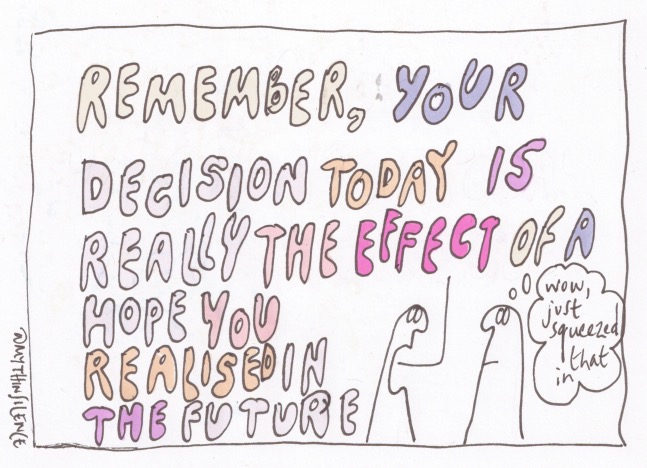
In such a world, people don’t act in order to make something else happen, but as a result of something we’ll hope for or decide upon in the future.*

Forty years ago today, I began a spiritual journey, and, turning Lightman’s story into a question, “Was the decision to begin the journey back in 1976 really  the effect of where I have now arrived?”

Or, “Is the place I have come to (I can’t say I’ve not arrived) more or greater than the reason I began?”

My answer has to be “yes,” and, it’s why I began.  Now I press on, and the question comes again, “Is this the effect from a choice I’ll make in the future because of the new, larger, more colourful place I find myself?

Only time will tell, this strange time.

I see how, looking back, I thought I’d begun this journey with a fully formed way of seeing, feeling, and behaving, and I see, as I’ve continued the journey, how so much of this was burned up along the way – a letting go in order to let come.

‘[E]very mass-produced product comprises a bundle of “take-it-or-leave-it” features or dimensions offered to all customers.”**  

Now I see this journey could only be understood as one of becoming, and as I continue to open my thinking, my feeling, and my behaving, this path of fire continues to burn up what is unnecessary to my becoming an authentic human being.

And it is the same for all of us.

“The new foundation consists not in objective statements but in subjective reality.”^

‘The sense of wonder can also help to recognise and appreciate the mystery of your own life.’^^

(*Alan Lightman’s Einstein’s Dreams.)
(**From Joseph Pyne and James Gilmore’s The Experience Economy.)
(^Jesuit Bernard Lonergan, quoted in Richard Rohr’s The Naked Now.)
(^^From John O’Donohue’s Eternal Echoes.)


always and everywhere

4 yesterday, i risked opening

What if our search is not for happiness but for wisdom?

What if happiness is something we experience along the way?

Wisdom as in being present in the moment, to others, to ourselves, to what we have, to the world in which we live and to its needs – not simply knowing but living out the intimacy of our knowing.   Moments of dignity, of nobility, of enlightenment – and the universe has just witnessed something very special.

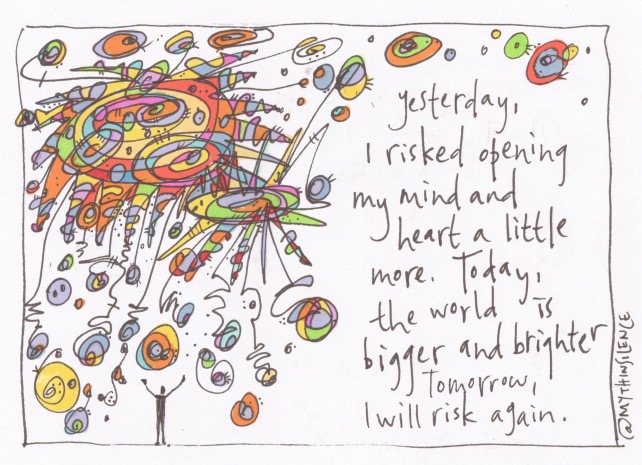
We may think these moments are here or there, now or then but what if they are always and everywhere, meaning that we won’t miss them, neither own them.  Wisdom and happiness must be available to everyone all the time, wherever they are,

We help one another to be open, here and now – openness is the most important thing.

‘We do not see things as they are; we see things as we are.’*

Welcome to the always and everywhere.

(*From Richard Rohr’s The Naked Now.)
there’s always time

3 running out of time

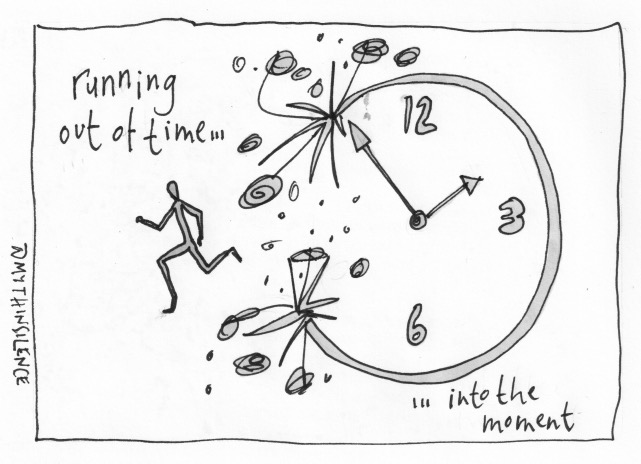
‘Time paces forward with exquisite regularity, at precisely the same velocity in every corner of space.  Time is an infinite ruler.  Time is absolute.’*

The business news for today included the story of SwiftKey joining Microsoft.  SwiftKey’s mission is to ‘enhance interaction between people and technology,’  and claims to have saved its users 10 trillion keystrokes, or 100,000 years of typing time.**

My question was: how were those 100,00 years of saved typing time used?

Have you ever been told: “You don’t know how to use your time well!”?

Time can come to us with a voice of judgement: “What do you think you’re doing?  You haven’t got time for this.”

Time can also come with a voice of openness: “This is your time to explore, to ask, to be.”

If I’m to move towards what Alex McManus calls the open possibilities of tomorrow’^ then I need to find some time now to begin.  Then we hear the voice of judgement: “You haven’t got time for this” – time to fail, learn, and try again. But finding the time now can be a better use of time than waiting for the right time and the right thing which we think will not fail.

‘You can avoid jeopardising your company’s future by slowing down and considering all the relevant factors before making a decision.’^^

This is also true for the company of one – my life or yours.

I guess I’m finding myself playing with time.  I make time for my journalling so that I can lose track of time in ideas, whilst also having a time-piece close by to make sure I “have the time” to do everything I need to.  It’s not perfect or complete, but I keep exploring.

One thing I know, now is the time.

“When the student is ready, the teacher appears.”*^

(*From Alan Lightman’s Einstein’s Dreams.)
(**From SwiftKey’s Blog.)
(^From Alex McManus’s Makers of Fire.)
(^^From Jim Clifton and Saengeeta Bharadwaj Badal’s Entrepreneurial StrengthsFinder.)
(*^A Buddhist saying, quoted in Gretchen Rubin’s The Happiness Project.)

time benders

3 doing what we love

‘At some time in the past, scientists discovered that time flows more slowly the further from the centre of the earth.’*

Time and presence are bound together.

If you happened to be around northern England or southern Scotland today, I hope you were able to spot the rare and amazing nacreous clouds, not just to know these were formed in the stratosphere at -85C, but to marvel at their gorgeous colours and gossamer-like appearance.

Alan Lightman tells one of his stories about time, imagining how some, in an attempt to add seconds to their lives, lives at the top of mountains in houses built on stilts.  Others, though, not caring if they age a few seconds faster, come down from their lofty dwellings:

These adventurous souls come down to the lower world for days at a time, lounge under the trees that grow in the valleys, swim leisurely in the lakes that lie at warmer altitudes, roll on level ground.  … When others rush by them and scoff, they just smile.’*

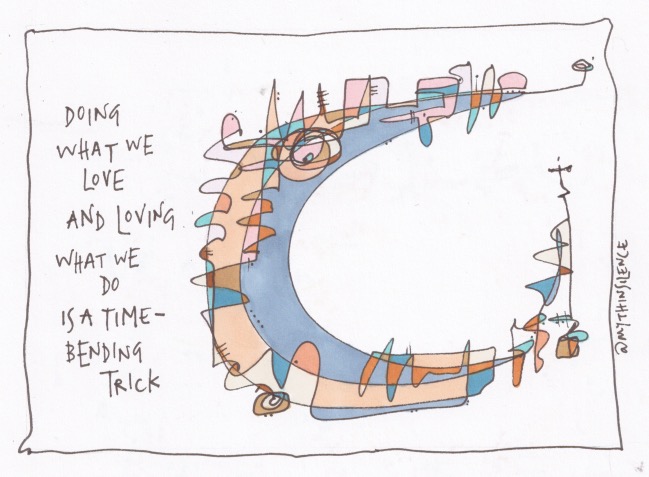
We know we each have the same amount of time as one another, and that or some time is plenty, whilst for others, it rushes by.  There are those who never have enough time to do what they really want.  For others, time melts into moments of being present.  I not only want to know about something, I want to taste it, be moved by the flow of it, to feel it.  Presence is wisdom, beyond knowledge: it’s ‘how we do the moment’**

Such experiences are all around us, in people, in ideas, as well as in nature.  We also get to make these moments of presence around what we love and value.

Enjoy.

(*From Alan Lightman’s Einstein’s Dreams.)
(From Richard Rohr’s The Naked Now.)
living in yes and the quest for happiness

1 when we say %22yes!%22

‘The great teachers are saying that you cannot start seeing or understanding anything if you start with “No.”*

There’s a link between “Yes” and happiness.

As we grow older, though, do we find ourselves increasingly on the slippery slope of saying no to what comes our way – new experiences in life, the experience of what is?

When we do experience something for what it really is – arguably rare, but a facet of happiness – then it simply is.  It’s not “this or it could be that:” in the experience, we’re not caught in “two minds” – we are simply present.

Wonderfully, there are many open windows in life – as Frank Laubach named them**.  Even a closed window can actually be an open window, as Marcus Aurelius pointed out:

“What stands in the way becomes the way.”^

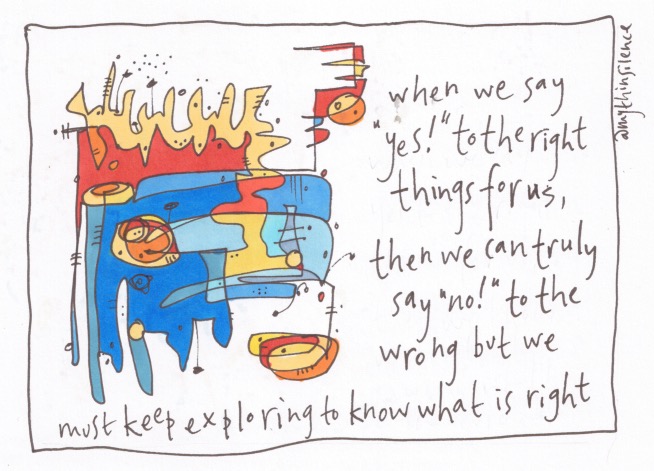
Saying yes opens up the quest for happiness, and there’s something more.  We can’t say yes to everything, we know, but the more we are open to all there is, the more we’ll come upon the things of our happiness and know what we must say no to – something we don’t want to get this the wrong way around.

Today will have many open windows – an idea to explore, a person to speak with, an action to execute.

A quest is always about questioning, and saying yes to take us deeper..

(*From Richard Rohr’s The Naked Now.)
(**Frank Laubach’s Letters By a Modern Mystic.)
(^From Ryan Holliday’s The Obstacle is the Way.)