openendedness

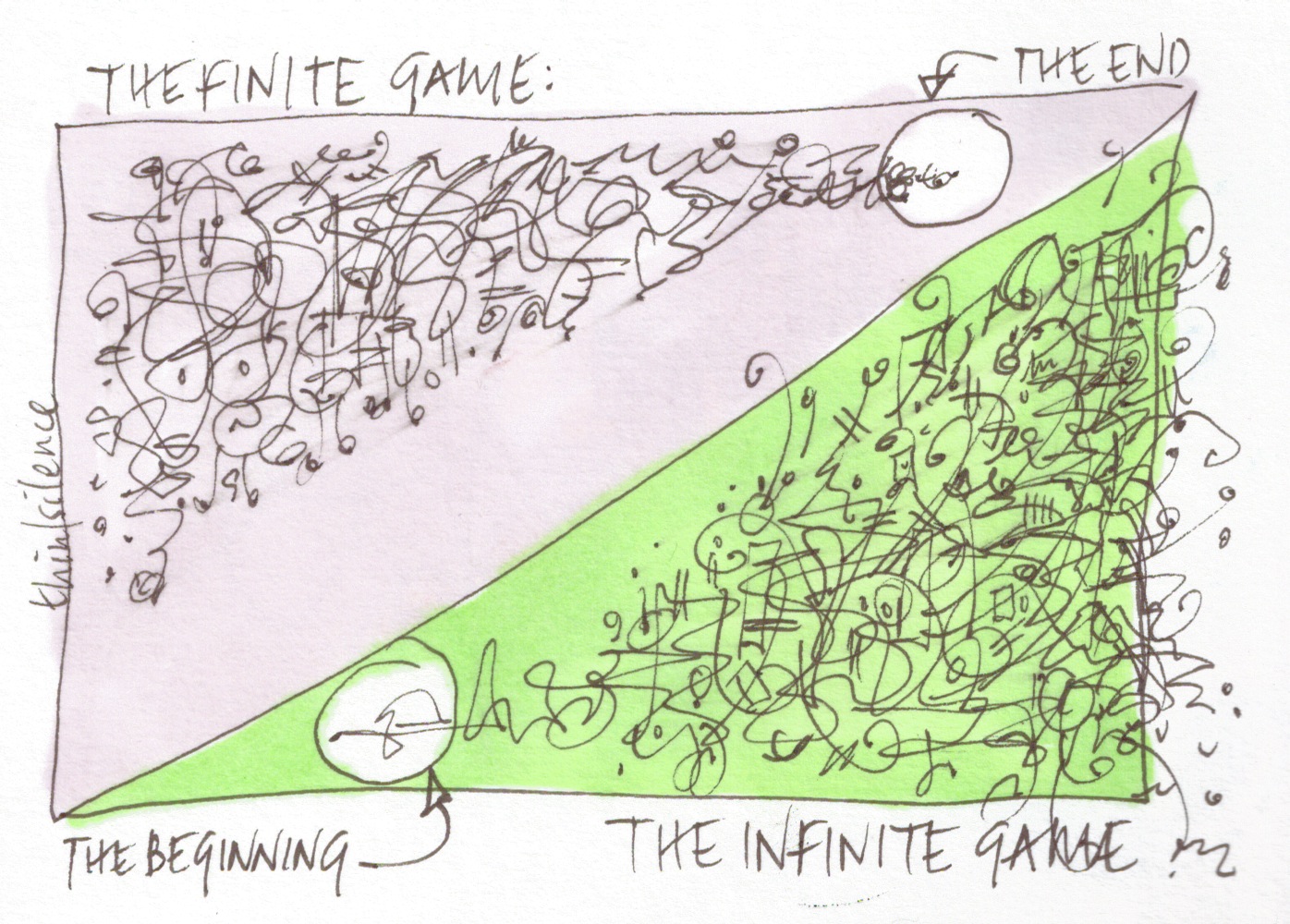
11 finite and infinite games

The result of producing and offering your art within an infinite game.

The finite game intends a predictable outcome;* the infinite game is full of inopportune surprises leading to we don’t know where and producing and crafting we don’t know what – not yet.

Openendedness not only produces more possibilities but transforms the player and the artist.

I am realising I’ve no idea where my conversations will go – they are infinite games.  There can be finite games within these – those I work with will know they’ll arrive at a better understanding of who they are and what they can do, and they’ll have many different ways and means to explore, but, really, I know our conversations could continue for the rest of our lives.

How are you developing openendedness in your art?

(*It is possible to play finite games within the infinite game, but the infinite artist knows they are not the bigger picture while the finite artist believes they are.)

remaining curious

10 elemental truth 3

Why is seeking, inquiring, and knocking on doors so crucial?

Why don’t possibilities appear more readily, answers offer themselves more speedily, and ways to move forward just neon-sign themselves for us?

Perhaps we’d be less than we really can be.

Perhaps there’s something in being curious which is about becoming Human.  It’s as though the journey is far more important for us than the destination.

We are born with the propensity for great curiosity.  Ken Robinson refers to this in his TED talk Changing Education Paradigms – viewed more than 1.3 million times.  Robinson refers to a longitudinal study on divergent thinking with a group of people.  They are almost all geniuses – 98% – and they are all kindergarten age.  Over the years of being retested, they lose their ability to think divergently.  (Robinson believes this to be result of our industrialised education.)

Curiosity leads us deeper, beyond knowing about something, to knowing something – and then to doing something about it.  It grows our thinking, our feeling, and our actions;  if everything came easier I’d wonder whether we could become deeper peoples: Human Becomings as my friend Alex McManus names our species.

Daniel Kahneman offers us something helpful to this when he refers to the illusion of familiarity: what we are first exposed to becomes most familiar and can lead to the shaping of our beliefs, impulses, choices, and actions.

Curiosity asks, What if there’s more?  What we think, what we feel, what we choose, and what we do could be wrong, or shallow?

The journey is everything, when we get to play real games which grow and develop our curiosity, making it possible for us to change, to become, even to become the difference we want to be for others.


the illusion of control and the importance of passion

9elemental rule 4

Control is an illusion because, mostly, we’re acted upon by life rather than the other way around.

This may sound somewhat at odds when it comes to what you’re exploring, including picking yourself to do the art you want to do.

Yet, the reality is we have little control – sometimes none at all – over so many things which surround us every day – the way others drive in our proximity, the way financiers and bankers will savings, how pilots felt today when they got up.  (You get the idea; the list goes on and on.)

It doesn’t matter who we are – even the dictator depends on the citizens of their country being willing to be dictated to.

Here  are five elemental truths identified in rites of passage from childhood to adulthood and which I bring to mind from time to time; they help me to see life in a much more real way:

Life is hard
You are not as important as you think
Life is not about you
You are not in control
You are going to die.

The idea behind these was for a child to be able die upfront and then live more fully, making their contribution to the community.

There are times when we don’t appear to have any control of all, and this is where the recognition of our passions is so critical.  It was in the most uncontrollable environment of the Nazi death camps that Viktor Frankl identified the one thing we can be sure of controlling; he wrote:

‘We who lived in concentration camps can remember
the men who walked through the huts comforting others,
giving away their last piece of bread.  They may have been
few in number, but they offer sufficient proof that everything
can be taken from a man but one thing: the last of the human
freedoms – to choose one’s attitude in any given set of
circumstances, to choose one’s own way.’

Passion is what we have when everything else is taken from us, the things we believe and feel and how we will act.  Perhaps you and I see who we are most essentially when all other illusions of control are taken from us.  If so, it makes sense to participate in infinite games because, it seems to me, we see how we need to connect with others.  We also begin to see how many of our finite games are illusions of control, games we play to make us feel better about our lives.

I dare to suggest that Nassim Taleb’s sceptical empiricist and flaneur would most likely value and enjoy infinite games, and offer us an insight into the usefulness of them.*

Beyond the illusion of control there is the importance of passion, which, when invested in the right ways and places and people, promises to produce a life of creativity, generosity, and enjoyment.

(*A sceptical empiricist is someone who values arriving at a judgement but does not rush to it, exploring and inquiring for as long as possible; it is a tiring occupation because it take so much energy.  A flaneur is strictly an idler, a loafer, but Taleb sees this character appreciating something about the randomness and unpredictability of life that many experts and forecasters do not.  I use flaneur to describe someone who journeys with purpose.)

the long trail*

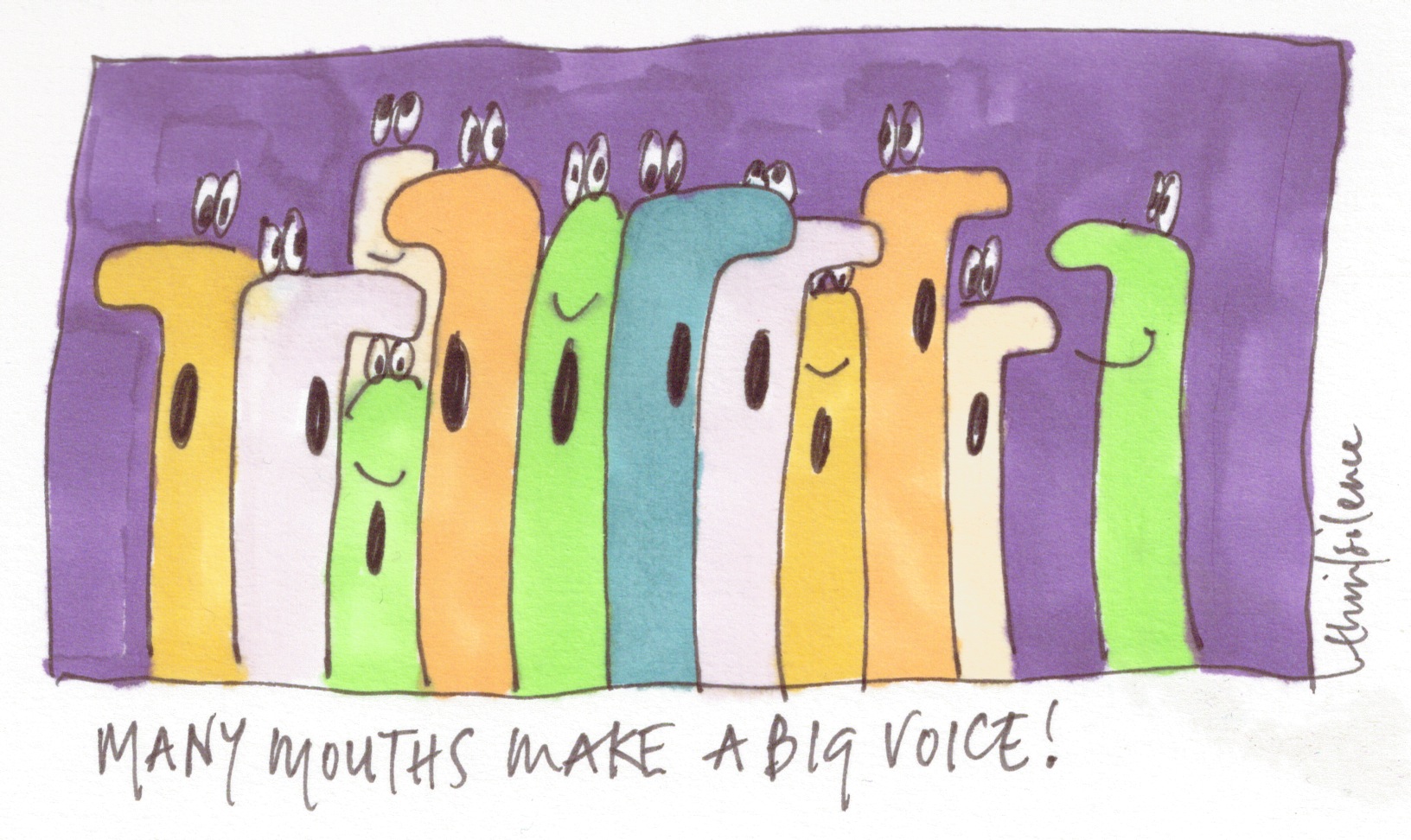
8many mouths make a big voice

It’s going to take some time.

Or, to put it another way …

You and your art are going to be around awhile.

We’re playing an infinite game, which is more concerned with how you’ll play the game than how you did before; rather than a finite game in which only some – those often perceived to be the best – get to play.  It strikes me that this is the genius of the infinite game.  You to bring everything you are, not just the best bits; you can bring the pain and the failures and figure out how to deal with them as the game plays out.  This means,of course, you pick yourself and you can begin now.

The rules of the infinite game, unlike those of the finite game, change in play, ensuring no one is rejected or ejected and the game doesn’t end.**

Who knows who you’ll become and what you’ll achieve if you just keep playing?

This game is real.  Daniel Kahneman tells me, ‘cognitive scientists have emphasised in recent years, cognition is embodied; you think with your body, not only with your brain.’  Kahneman also tells me an activated idea doesn’t evoke just one idea. but many – most of which will never rise into my consciousness, so masses of associative thinking happening in my unconsciousness.

All of this makes me wonder whether playing infinite games not only making it possible to evoke an idea, not only proffers ways for ideas to be embodied, but sets in motion loads of unconscious thinking which, if we  remain in the game, will burst out “from nowhere” further down the trail?

I’m just crashing together ideas from different places at the moment, but it seems to me, if we only allow ourselves to play finite games, little of this will have value.

Not only are you more ready than you know, not only does an infinite game provide the best place for dealing with your junk as well as with your art, but we’re also rooting for one another to keep playing the game.

(*The title of a Seth Godin blog playing on Chris Anderson’s term “the long tail” for how everything produced is accessible to purchase because of the internet.)
(**Think of the people, businesses, and parties which have self-destructed because they couldn’t change the rules of play.)

story business game

come and play

The story of your art

The business of your art.

The game of your art.

Three ways for being imaginative and craftful with your art: develop an open story, see your whole life as a business, or play an endless game.

I think they’ll all help us contribute more.

The last of these comes from James Carse’s (almost thirty year old) book Finite and Infinite Games, which has been on my wishlist for a while.

It’s not about playing any game, but participating in infinite games, which means it isn’t about winning the game, it’s about keeping everyone in the game and keeping the game going: ‘the purpose of continuing to play.’

It increasingly feels as though infinite games are the future – a future which invites everyone, is connected, and is graceful.

There are many who will struggle with this.  From whichever side of the finite game line, they believe only some get to play, and fewer still win – a world of scarcity.

An infinite game,an open story, and a sustainable business are about a world of abundance.

We begin with the value that everyone matters, not because of what they produce, but because of their intrinsic worth – when a person realises they matter, then they are moved to produce.  By playing this game, we get to involve as many as possible.*

A beautiful and genius element to infinite games is the inclusion of finite games.  The infinite-games player values and maximises the possibilities for bringing certain people together, for a particular amount of time, towards an agreed purpose – Chris Anderson identifies these as makerspaces.**

This new language is awakening me to the reality that I’m already playing infinite and finite games in a number of ways – I can think of at least five – and they are helping me and others to take our art further.

Time to play?

(*Intrinsicness is an important feature of the finite game, offering enjoyment and engagement throughout; the finite game makes little sense unless you win – something which only happens at the end.)
(**It is unlikely a finite games player will see the value in infinite games.)

bring it all

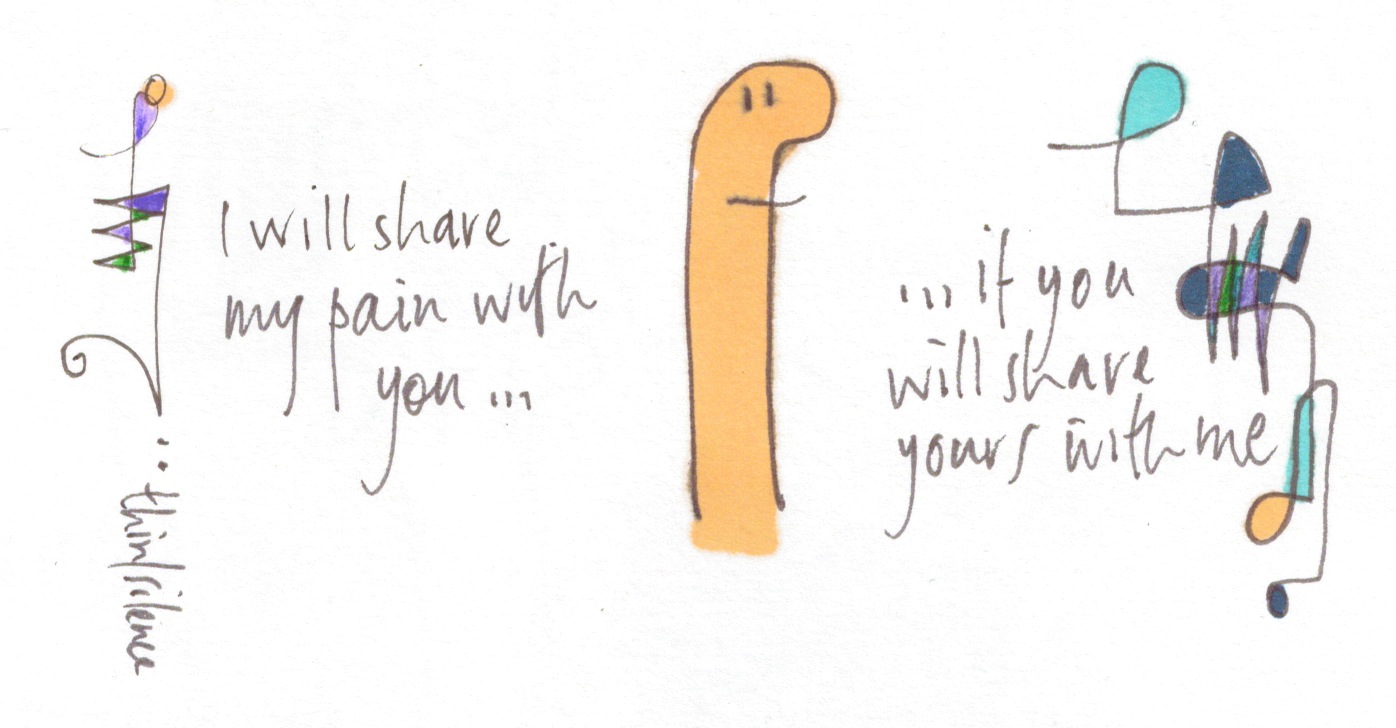
i will share my pain with you ...

This is about the stuff more difficult to bring to our art.

In the fifth Star trek movie The Final Frontier,* James T Kirk refuses the offer from the Vulcan Sybok to have his pain taken away, declaring how it to his pain which makes him Human.

Scott Doorley and Scott Witthoft offer an illuminating thought on this from an unusual source – that of shaping creative spaces – stating how we ought to:

‘Treat storage as a living entity that occupies at least
30 percent of your space.  You’ll need at least that much.’

Value the things you store from your past, is my gain from this.

Which bring up the question for each of us: how do we deal with the pain of memory and the memory of pain?  Either the prideful and greedy and foolish things we have been done, or, those done to us?

If we have a merciful and graceful place to store these, meaning we are prepared not to hide from, or bury the painful things, they become powerful resources for our art, which if lost leave us impoverished and inhibited.

What if they can help us to our key practices for art of humility, gratitude, and faithfulness, our ways for exploring a creative, generous, and enjoyable life.**

I’ve mentioned Daniel Kahneman‘s belief that we substitute an easy question for a difficult one whenever we can; he goes on to cite his law of least effort, which ‘asserts that if there are several ways of achieving the same goal, people will eventually gravitate to the least demanding course of action.’

Here is our enemy, though it promises to take away the pain of memory and the memory of pain, but better still to the use the pain redemptively to produce our art.  I stretch another thought I came upon which I see as covering the pain of our past and helps us to be young again:

‘YOUTH is not a number, it’s an attitude.  So many disruptive
artists have been youngsters, even the old ones.  Arts isn’t
genetic or chronological destiny, it’s a choice, open to anyone
willing to exchange pain for magic.’

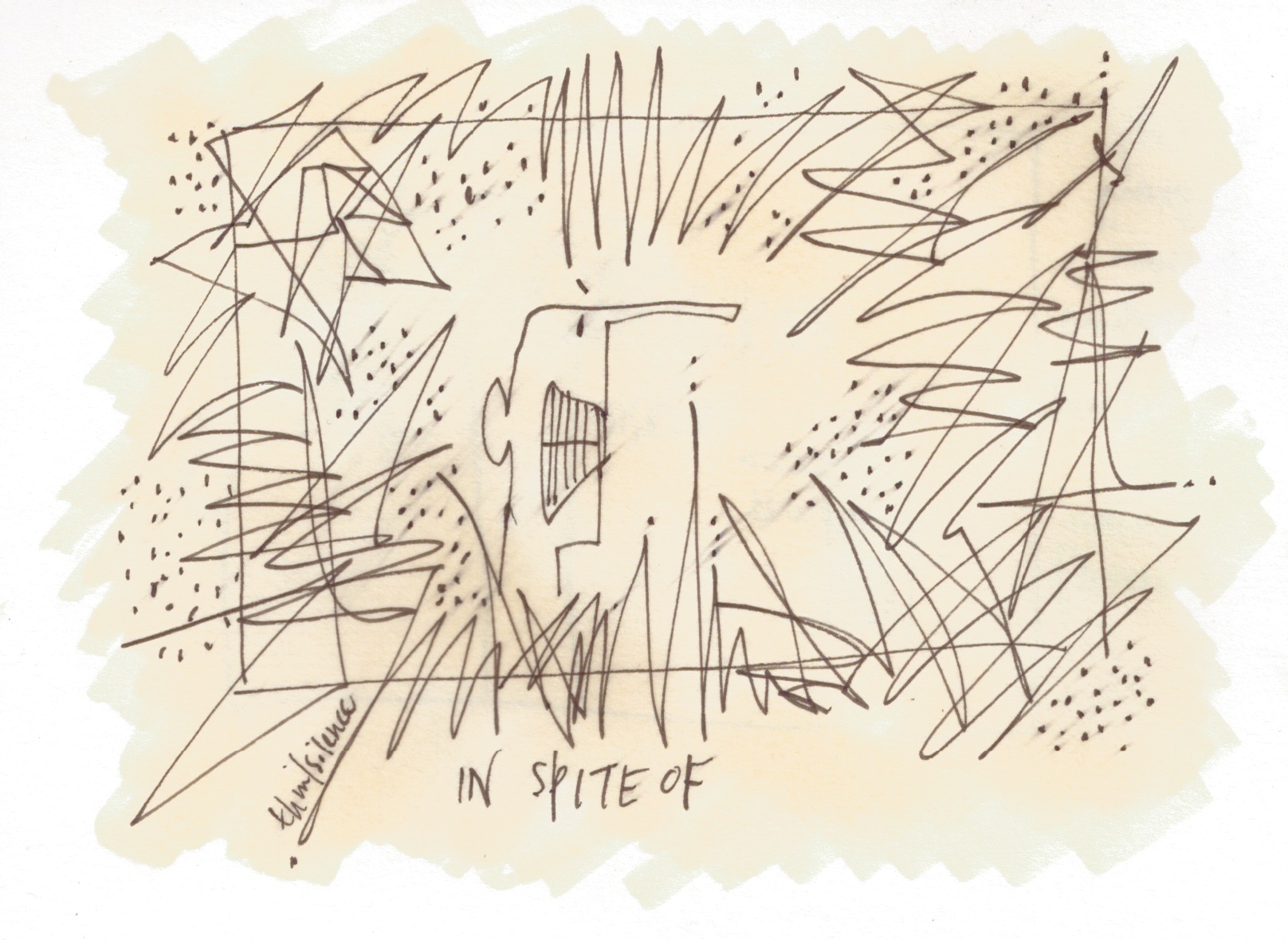
We can be courageous in spite of …; we can be generous in spite of …; and, we can live wisely in spite of … .

(*You’ve probably figured out my taste in movies by now.)
(**I share about this in more detail in other blogs – I’ll aim to find these and add a link.)


p is for participate

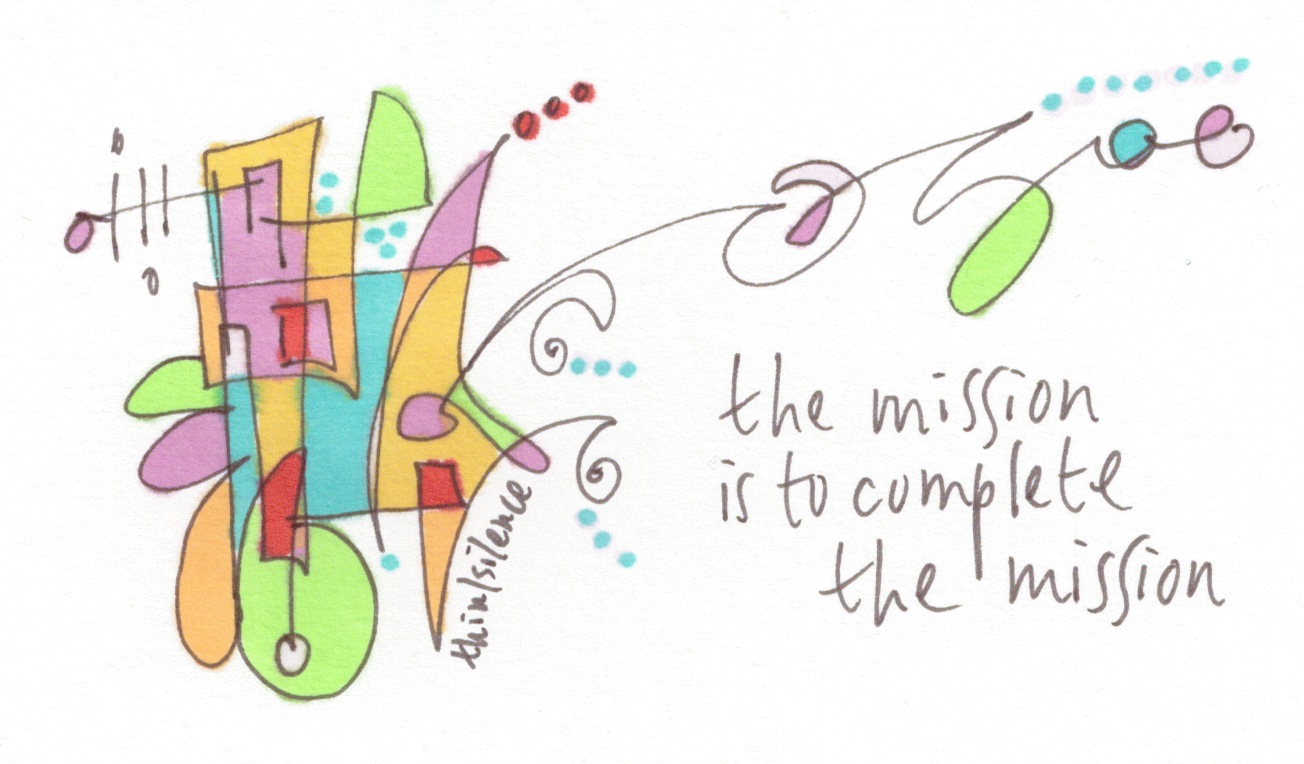
5the mission is to complete the mission

But it can also be for procrastination – the enemy of participation.

The world is changing,* and what we’re realising is, it’s a place of abundance rather than a place of scarcity.  We are invited to move from a world of observing to world of participating and contributing.

Yes, it will mean we’re vulnerable, but as Chris Anderson reminds us, we’re all born Makers – his word for artist and artisan.  As soon as we are able to imagine and play, we make things.  Somewhere between childhood and adulthood, we lose this, but we’re living in a time when imagining and making can be rediscovered.

I used to think you could get lost for days in Ikea, but sites like Pinterest are bigger still – pages and pages of online content displaying what people have made, often without big factories and workshops – evidence that many people are taking the opportunity to move from observing to contributing.

When you value the right things about yourself, and you understand that at your fingertips is everything you require to produce something right now, you have no idea of where it will go.

There is a growing realisation this is a world of abundance, beginning with the infinite resource of Human imagination, and they are beginning to play.  They are realising the truth, we are all born participants.

Time to join in.

(*We have been producing the ways and means for connecting more powerfully with Human creativity – says Chris Anderson: ‘Computers amplify human potential: they not only give people the power to create but can also spread their ideas quickly, creating communities, markets, even movements.’)


mind your language

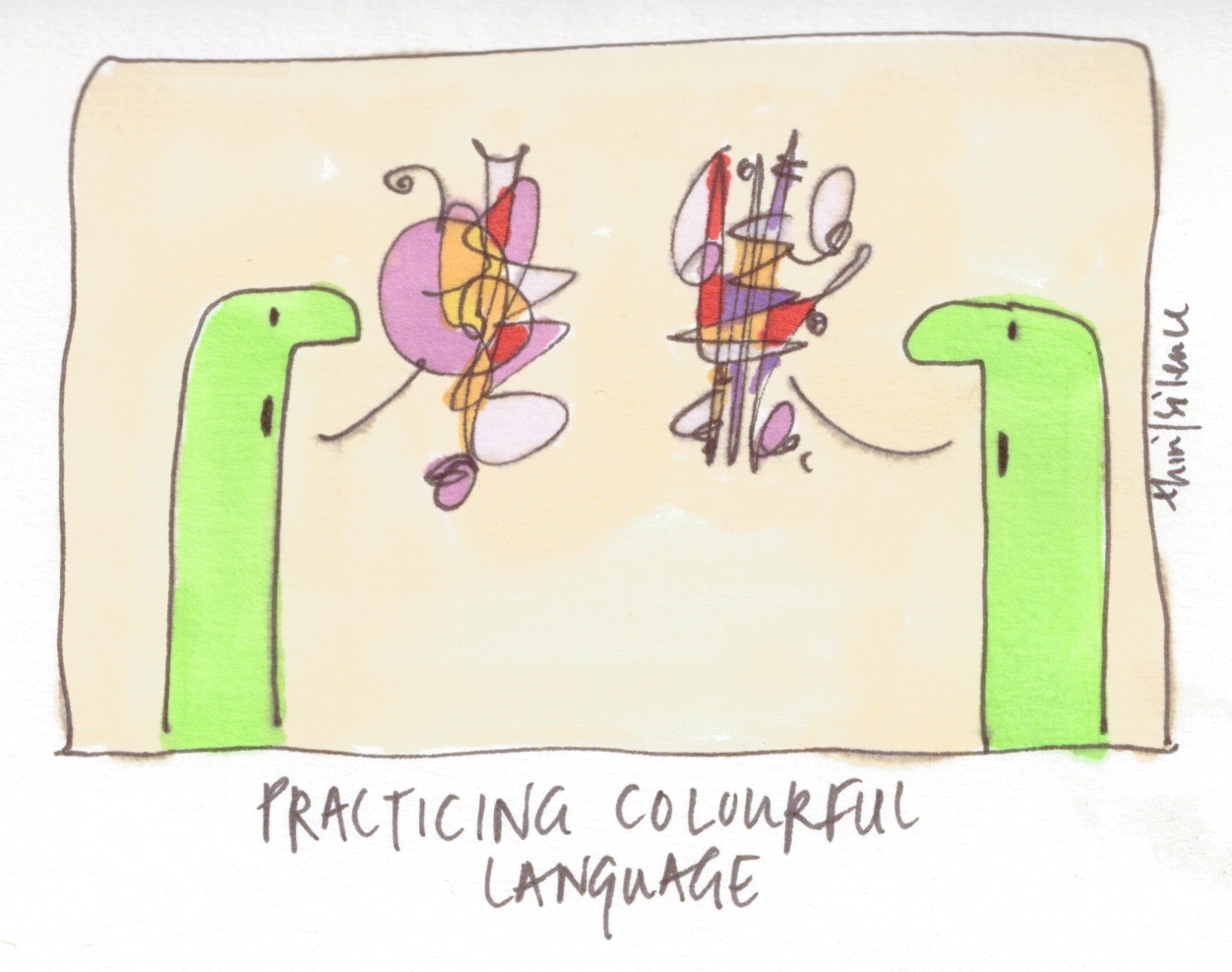
4practicing colourful language

It’s very important for what you do with your life.

When we use general words and terms, we ought not be surprised we struggle to move forward or action anything.  They might sound great but there’s little to get hold of or to push against.

If we speak in general ways, perhaps because of modesty or laziness or cluelessness or fear or a desire to impress the powers that be, I don’t think we help anyone, least of all ourselves.

Seth Godin offers the word plussing,* like his word zooming, it means taking your work farther:

Taking your work a little farther.  Going closer to an edge, whichever
edge.  Is there anything you can’t plus?  Anything you can’t make
simpler, more luxurious, cheaper, more extreme?  Anything you can’t
make more remarkable?

I love these words; they stop me and make me think.  The reason I mention them is because you can’t plus or zoom where there are no details to scale or grow – you just produce more general, and what good is that?

But you can plus specifically – that thing you’ve identified as your art with specific skills and actions and behaviours and practices – all of which can be developed into something more amazing.

(*A word used by Disney.)

repeat

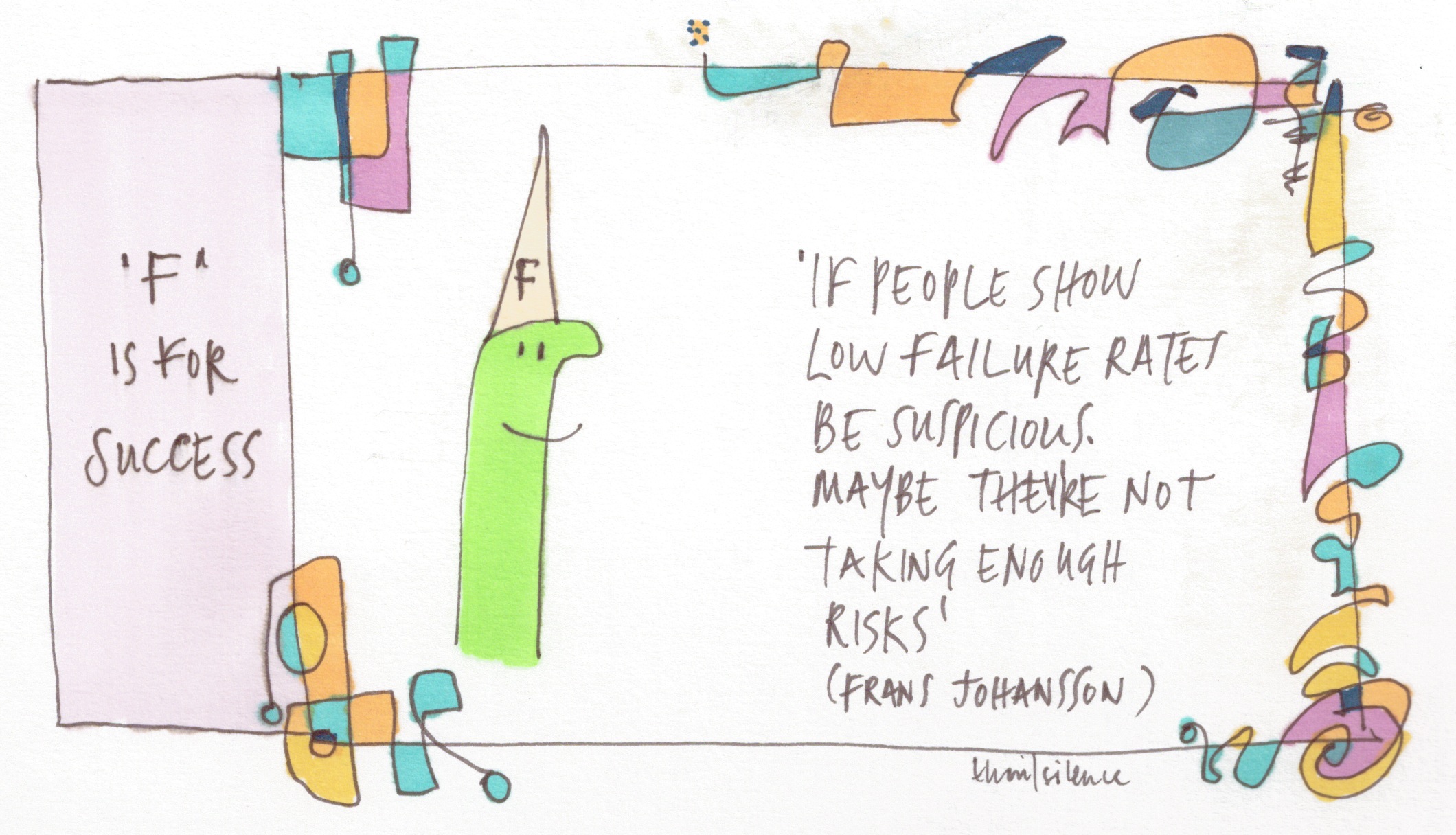
f is for success

Do people really want today to be a repeat of yesterday?

Do they get up saying “Same again, please”?

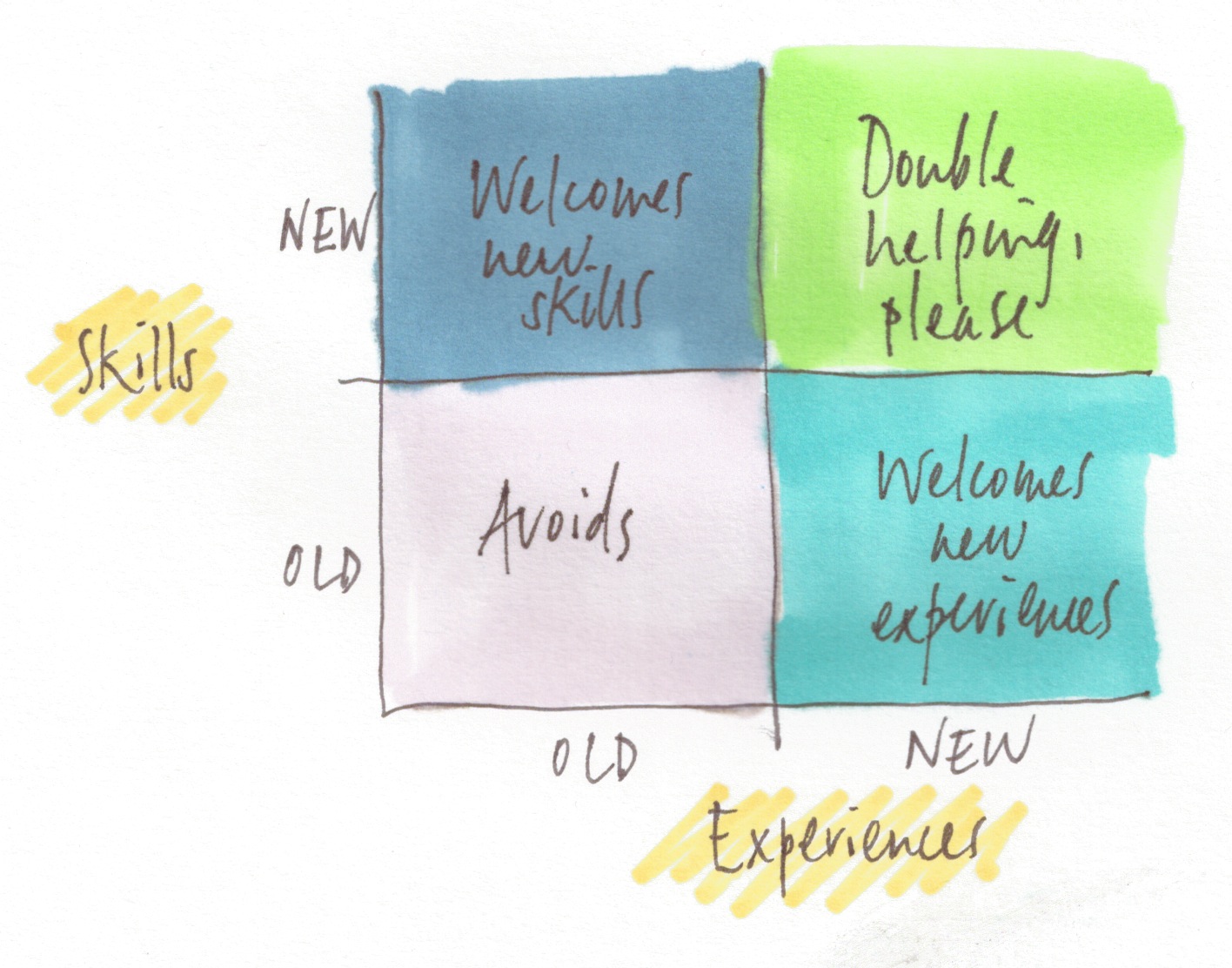
There are basically four kinds of repeat.

One repeat avoids anything different or new: skills or experiences.

The second repeat loves applying old skills to new experiences.

The third, loves developing new skills for existing experiences.

The fourth repeat wants to use every moment life gifts to explore new skills within new experiences.

4 repeats

I frame it in this simple way for now: what if the end of the day found us grateful for having met someone new, and/or encouraged someone, and/or served someone through our art.

They key lies in our art – that is, our story or purpose – and having to give expression to this every day which comes our way.

What kind of repeat will today be?

Three repeats are worthy, of which one is extremely so; one gives permission to entropy.

Your choice.  None are fixed or given.

You’ll fail often but that’s part of exploring the landscape of life.  As Frans Johansson says, ‘If people show low failure rates, be suspicious.  Maybe they’re not taking enough risks’.

(The cartoon quote is from Fran Johansson’s excellent The Medici Effect.)

in spite of

in spite of

An important footnote to the art you do.

Your art is the result of struggle, and you cannot do without the struggle.  It has brought you to an important place.  Pearls are produced from irritations which will not go away – and when they are taken away, that’s the end of the game..  Your art would not be so beautiful if it were not for the struggles.

It could well be, no-one seems to notice or be interested in what you do.  It is important to remember, you are not looking for the many, but for the focused few; your art being your ‘chance to convert the focused few,’ of which you are the most focused of all.

You need one person and you have begun – then there are two willing to do what others fear.

We follow a dream and work out our art in loneliness, seeking to connect in something which matters.

We must do all we can to connect.  We know the time is not tomorrow, the time is now.