free and freedom

free

Are two different things.

Businessman Mark Johnston is suing a Las Vegas casino after losing half a million dollars whilst drunk – the casino kept plying him with free drinks, allegedly.

An interesting news-story on the radio this morning, as I happened to be reading some Dan Ariely, who has studied the effects of something FREE! on people:

‘Zero is not just another discount.  Zero is a different place.
The difference between two cents and one cent is small.  But
the difference between one cent and zero is huge.’

If so, then then there’s both an upside and downside to FREE!  The upside is, offer something good for people free, like health screening, and people will be far more likely to accept, over against a reduced rate for this of, say, five pounds.

The downside is, people are blinded by FREE!, making decisions not in their best interest.

All of which made me wonder.  Maybe not everything that is easy in life is the bargain we think it is – effort-FREE! or pain-FREE! – and we need to stop and take a closer look.  It might well be the difficult and more costly choice offers the freedom we seek, the thing we really want.

That’s the downside, but the upside of easy may be how, when we’re living closely to our talents and passions, and an idea for what to do next comes to mind easily and effortlessly, then the next step might well be the one we must take.

It’s worth taking a closer look.

where’s risky now?

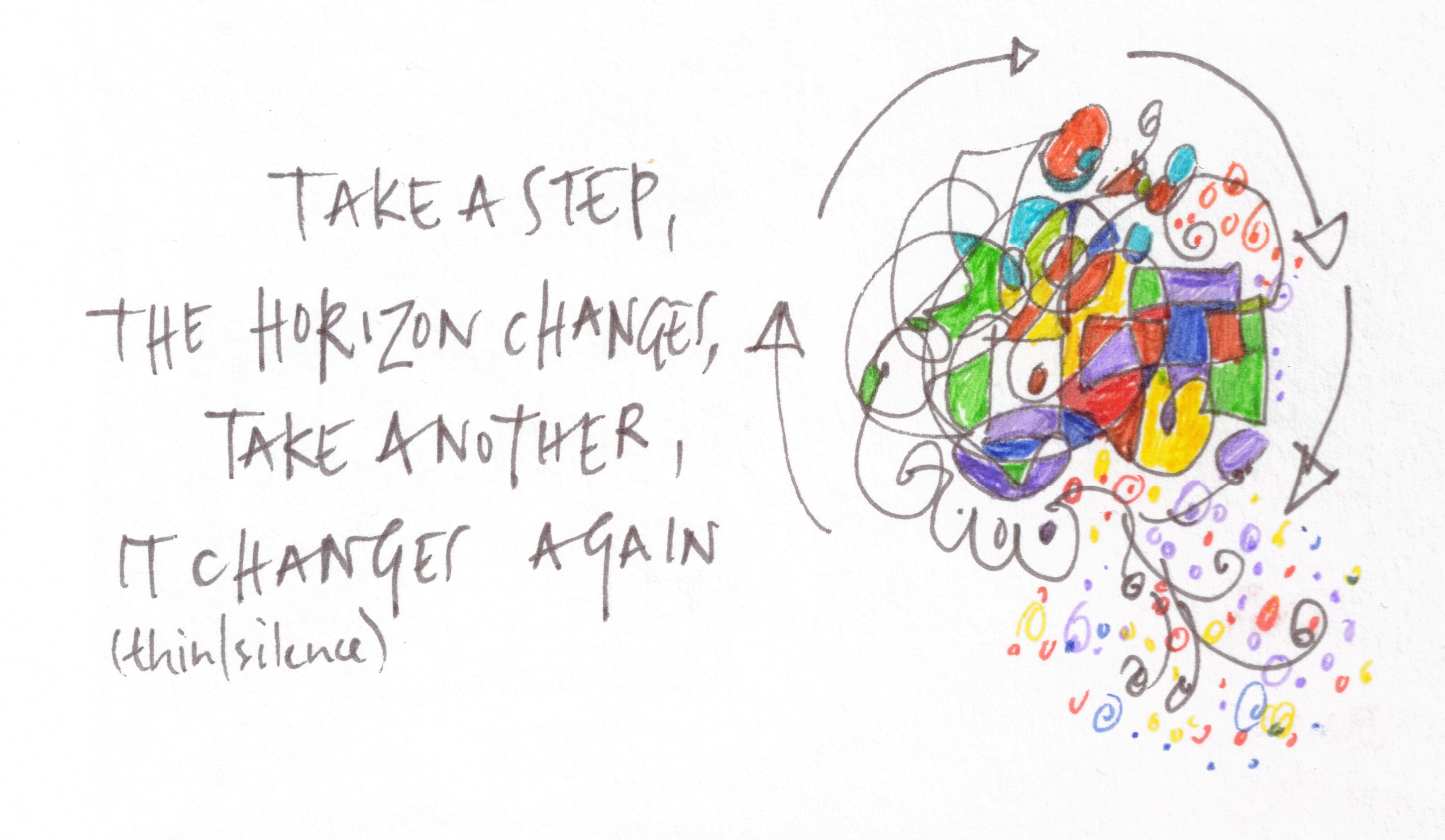
take a step, the horizon changes ...

To stay where you are.

We like the idea of doing something more with our lives.  We like the idea of somehow being creative.  We might identify what this might possibly be.

What will be your next step towards this?

And what will the thing be that you do tomorrow towards this?  (And if you read this early enough in the day: what will you do today to make this happen?)

Creativity has just become more difficult.

How come?

Too risky?
Maybe not sure where to begin?
Perhaps fear of the unknown?
Or maybe something will have to be given up?
Then, the cost may be too high?

Really, without taking a step, we don’t know if any of these things will prove to have any substance.  The thing you do know for certain is, if you stay where you are, doing the thins you do, nothing will change.  This may sound risk-free, but it’s the riskiest place to be:

“All around you, people will be tiptoeing through life,
just to arrive at death safely.  But dear children, do not
tiptoe.  Run, hop, skip, or dance, just don’t tiptoe.”
(College professor to his class)

Another reason it’s risky is because we’re living in a world of increasing possibilities, where our learning and experiences are changing in ways we couldn’t have imagined thirty years ago.  Who wouldn’t want to be part of this?

A few places to begin:

Order the book that’ll help you figure out what you must do: here’s one for starters

Join a local group who meet to enjoy together the thing you’re interested in.

If there isn’t one, start one: meetup.com is one, here’s another (all you need to begin is one other person).

Find or help build a new kind of library, one in which the librarian is “a data hound, a guide, a sherpa, and a teacher … the interface between reams of data and the untrained but motivated user.”*  (I’m part of a group wondering how we build such a library.)

Or something else which fills your imagination.

Dance, skip, run, or hop – up to you.

(*Seth Godin shares a wonderful picture of what the library of the future will look like: “The next library is a place, still. A place where people come together to do co-working and to coordinate and invent projects worth working on together. … The next library is a house for the librarian with the guts to invite kids in to teach them how to get better grades while doing less grunt work. And to teach them how to use a soldering iron or take apart something with no user-serviceable parts inside. And even to challenge them to teach classes on their passions, merely because it’s fun. … The next library is filled with so many Web terminals that there’s always at least one empty. And the people who run this library don’t view the combination of access to data and connections to peers as a sidelight—it’s the entire point.  Wouldn’t you want to live and work and pay taxes in a town that had a library like that?)

valued

an artist who is inspired ...

Yesterday was a day full of value.

In a meeting of Creative Edinburgh* in the morning, I had three conversations focusing on value one after the other.

A photographer found himself underpaid for one of his pictures which appeared on the front cover of one of yesterday’s national broadsheet.  It was a wonderful image which was worth far more than the price the paper paid.  Interesting: this picture was worth different amounts depending on where it appeared in a paper, its size, and whether it would be reproduced in colour or black and white.

Then another conversation with a designer of mats and cards and T-towels and more – I’ve just been on her website and it’s very attractive produce.  Our conversation focused on the question of how much do you charge for the things you design and make?

A thought was forming, which I’ll share in a moment.

I then had a third conversation with another photographer who was sharing how customers struggled to value his work, like not understanding how turning up for two hours at a wedding can cost as much as it does – the tip of the iceberg phenomenon.

Later in the day, I was meeting with someone describing his exploratory ways for lecturing in university, creating a learning environment for all, including himself.  An exciting conversation as we’re both passionate for producing creative people – he didn’t want to simply train students to pass an exam.  By this level of education this can be the driving factor, so were the students and university authorities valuing this new approach?

My thought formed some more.

Only you know the true value of what it is you do.

Whilst you need feedback, you cannot trust your “customer” to know what the value is or to set the “price”**  – you may produce the most amazing food but if someone is just looking to have a quick snack, they will not value your art, or pay you what it’s worth.

There’s another dynamic at work here: you must recognise as valuable the thing you do – which may be anything from a unique product you make to a wonderfully generous outlook on the world which you express in the ways you treat everyone you meet.

I can’t emphasise how important it is to know what your art is and to value it.  If you don’t, you may make a tradeoff which disadvantages you in life – trading the valuable thing you do at a low cost for something which is not valuable, but has a high cost.

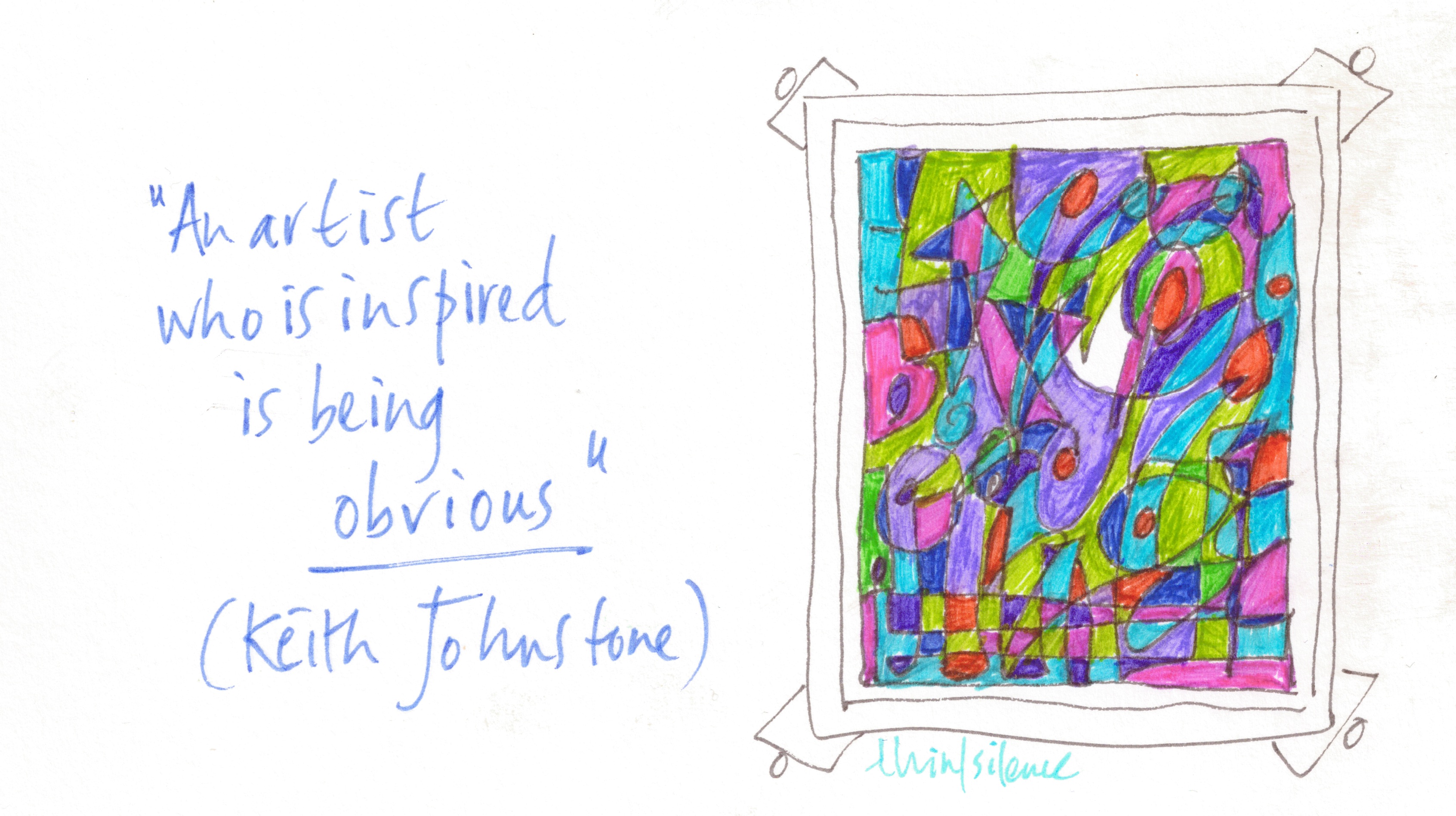
One last word: you don’t have to look for something crazily different to everything or everyone else.  When you know what your art is, and you value it, whatever comes to mind is an expression of your uniqueness: ‘An artist who is inspired is being obvious‘ (Keith Johnstone).

(* A not-for-profit supporting creative industry businesses and individuals in Edinburgh.)

(** I’m not talking about being extortionate.)

typeset?

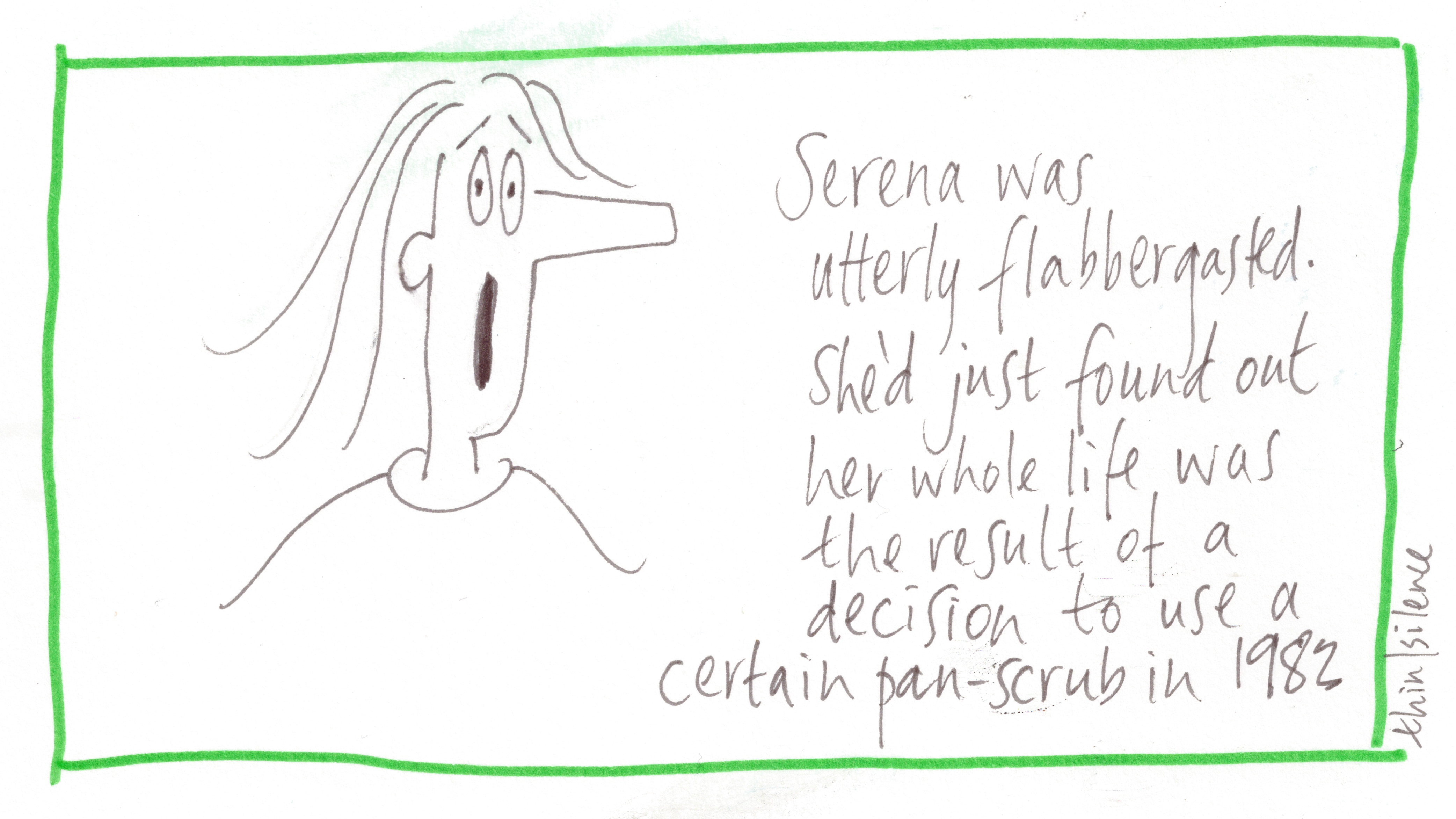
the reason we're here is serena was flabbergasted ...

Alfred Taberer was a printer of the old order: setting type by hand and working even in his 70s and beyond

On the front of the publication he produced for the organisation I was part of, it stated “Ten New Pence”.  It was 1983, decimalisation had been with us for twelve years – Decimal Day, 15th February. 1971.*

I had to smile.  I’m old enough to remember pounds, shillings, and pence.  That’s not ten new pence – it’s two shillings (2/-), and I would convert this new money backwards to find its true value!  (When you had to squeeze twelve pennies into five new pennies, and twenty shillings into a pound comprising 100 pennies rather than 240, many of us suspected someone was growing rich on the converting-up!)

I don’t do it very much now, but for many years, for smaller items, I’d do the backwards conversion.

It’s an example of an “anchor,” the result of arbitrary coherence, and these can have long-lasting effects.  (Perhaps it’s led to Frugal being my middle name!)

To know this is to have freedom.  To question why you do the things you do, why you buy this and not that, why you like this person but not that person, breaks the anchor chain, making it possible to meet new people, do new things, make choices which will transform your life.

And the most important word in all of this is the word question.

(Alfred never learnt to drive, but was transported by his sister in their Austin Metro.  In 1984 it became law to wear a seatbelt in the front of a car in the UK – Alfred refused and sat in the back.  In 1991 it became mandatory to wear seat belts in the rear – Alfred had been got.  My memories of Alfred and his sister Phyllis are fond ones.)

anchors and observations

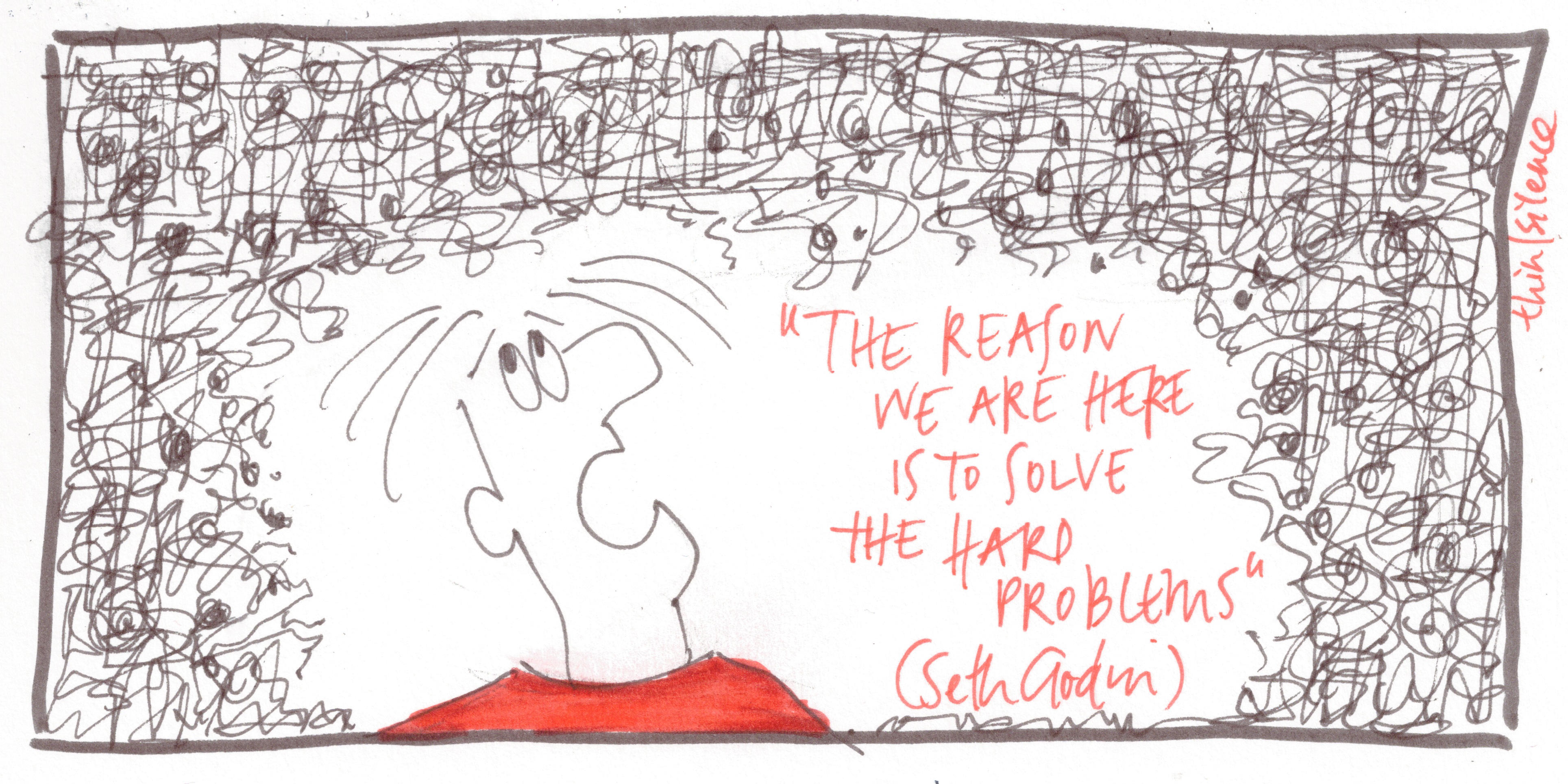
the reason we're here is to solve the hard problems

First of all, anchors.

I’ve found myself wondering about how much the first source I read or come across on a subject fixes my thinking on it – an anchor.  If I find I don’t really like what I’m reading or finding out about, then perhaps this isn’t my first exposure and I’m comparing to something else.  Who?  What?

Dan Ariely tells me this is “arbitrary coherence,” something Humans do as they seek to find lines of reference and patterns.  The arbitrary part might be an idea, a price, a starting point, which provides the anchor I need.  The coherence part is how I make sense of everything else in relation to this.

Of course, if the starting point isn’t a good or accurate one, I’ve got a problem.

Then, observations.

Perhaps an antidote to arbitrariness.  To really see things accurately is key to what I want to do with my life.  To notice the details, gain more information, and then to internalise them, mixing them with my skills and passions, will make it possible for me to express them through my art in a way that serves and contributes to another.

Of course, this is difficult.

To hold to the anchor makes life more straightforward and simpler; to let go is to be all at sea.  But “all at sea” is where the world is most of the time; your willingness to be anchor-free may be part of tackling the problems.  Which makes you something of a rarity in the world.  There are lots of anchor-people but not many let-go people.

no thanks, and yes please

we're just learning to dance in the garden of possibilities 1

No thanks to more.

James Hong, founder of hotornot.com sold his Porsche Boxster and bought a Toyota Prius.

His thinking?

“I don’t want to live the life of a Boxster,because when you get a Boxster you wish you had a 911, and you know what people who have 911s wish they had?  They wish they had a Ferrari.”

What Hong was doing was breaking the cycle of relativity, the thing which often lies behind us wanting more.

I don’t own a Boxster, and you may not have a car at all, but the thing about the cycle of relativity is it’s relative, so you and I will somehow experience it, unless we’ve broken the cycle.*

But I also want to say that it’s good to be hungry for more.**

Yes pleas, to more.

To have certain hungers or cravings is to be Human; it’s about recognising them for what they are, then we can meet them in a more fulfilling way.  The thing is, a 911 over a Boxster over a Ferrari won’t give the degree of pleasure we want – that’s why it keeps scaling up, whatever the starting point for us.

What Humans want is to be free to choose, to master something, and to live for a cause bigger than themselves.  When these things comes together in that thing you do, then something is going to happen.

The subtitle of the excellent Domino Project book End Malaria says it well: Bold Innovation, Limitless Generosity, and the Opportunity to Save a Life.

Be hungry.

(*I’m exploring how three words hold the key to freedom to choose and to do amazing things with our lives – humility, gratitude, and faithfulness.  When it comes to breaking the cycle of relativity, humility helps me focus more on who I am and how I can improve this (my future Self), rather than trying to appear more powerful, more knowledgable, or wealthier than others; gratitude helps me to really see just how much I have already and begin to figure out how to share it with others.)

(**One company of people had Magi!s (More) as a motto for their lives: to give everything they could and then to give more.)

potential and productivity

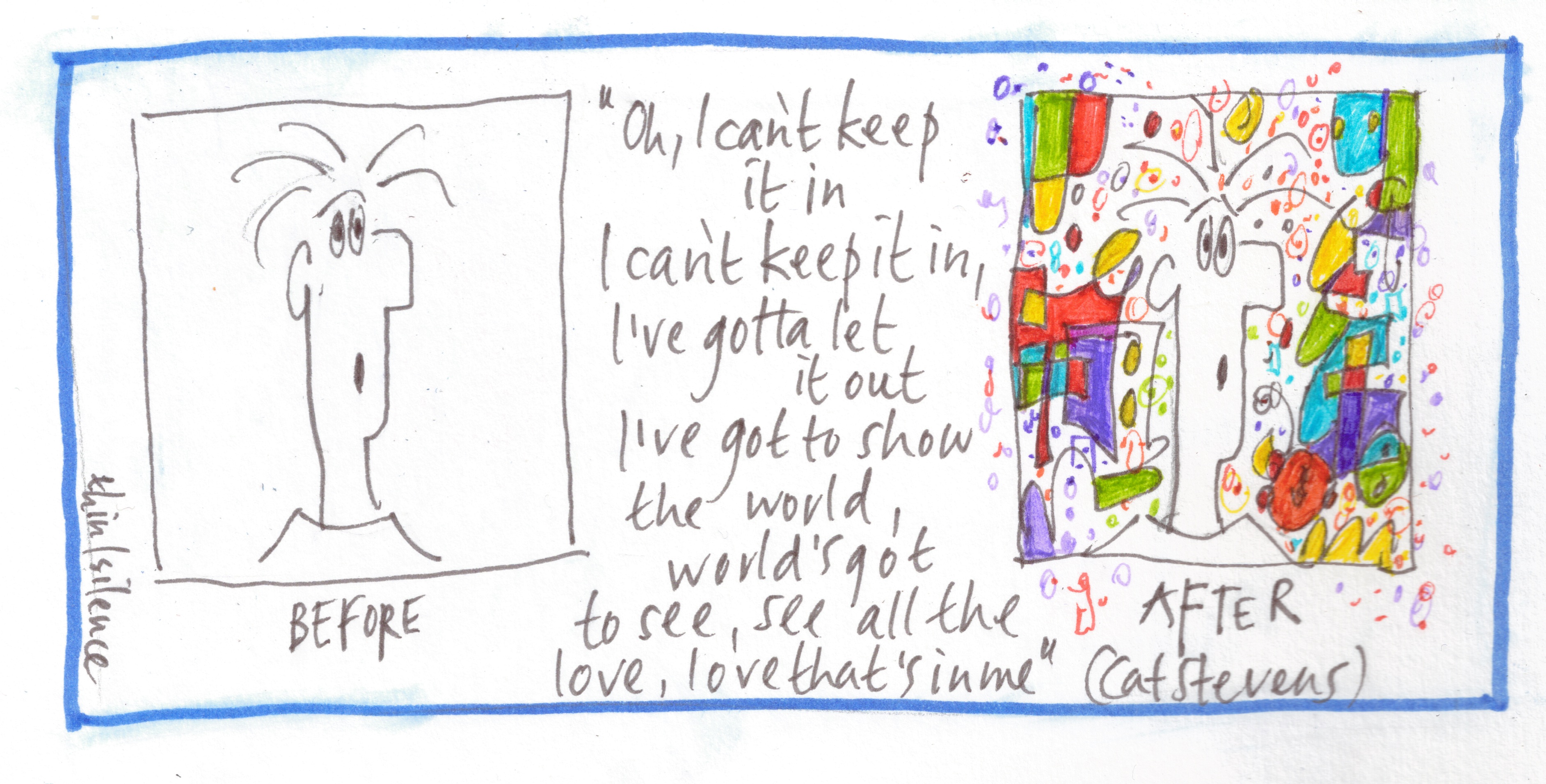
oh, i can't keep it in

Are two different things.

Potential is only valuable if we produce something.

Faithfulness may well be the best hope we have.  Faithfulness looks on our talents and abilities, our resources and our dreams, for ways of putting them to work.  At the same time faithfulness is aware of our relationship with others and with the world, noticing the needs around us.

It’s about being faithful to who we are, not who we are not.

When we are, our imaginations get to work, possibilities for creativeness come into play.  As we we’re faithful in these ways on a daily basis, we develop perseverance, the ability to keep going in the direction we know we must go, producing the things we know our lives can.

We need to stick to it because the first set of possibilities we produce are interesting but maybe not great, the next ones are better, but by the third set of possibilities we’re beginning to produce what world needs.

Perseverance takes faithfulness further, stretches language and use of metaphor and analogy – how Humans imagine more, new words or unusual ways of using words and images open doors to more possibilities.

The small steps of faithfulness adds up: keep going.

This morning I came upon the words which first identified my problem with potential and productivity.  I was forty five when I first read them: ‘If you’re forty-five and someone looks at you and says, “You have so much potential,” pause, excuse yourself, step into a closet, and have a good cry.’

In an earlier post, I shared how the person who wrote these words also opened up a way for me to start producing things – there’s always hope (I mean this).  I realised how I’d held back on what my life could be about, deferring to what others thought and wanted – akin to letting the clueless lead the clueless.

That was almost ten years and lots of small steps ago.  I’m keeping going.

faithfulness, doubt, and imagination

spot the differences

Faithfulness because it’s how we connect and share our art with each other.

And faithfulness because it’s how we need to connect with ourselves.

There’s general faithfulness, like turning up and being kind, and there is specific faithfulness.

Faithfulness is all the ways you express and deliver your talents and resources.

When I’m reading Bob Harris’s The International Bank of Bob and his desire to use his nest-egg of $20,000 to invest in people through Kiva, I’m reading about his faithfulness with his resources and his talents as a writer.  In the last few days, someone I know has been discovering he loves doing this too – different ways – but he wants to help people meet their needs; he, too, is being faithful with his resources and his abilities (I know his Strengths).

Then there’s doubt.

When we’re not faithful in these kinds of way, it’s probably not because we’re bad people, but because we doubt what we have and who we are.  Humans are comparison-creatures – we’re always comparing the things around us, usually things which are most easily comparable, so similar.  This creates a problem.  You can’t compare that thing you do (your art) with anyone else’s.  If you find yourself thinking, “I can’t do what that person is doing,” you’ve fallen into the comparison trap.  (Some teacher may have messed up your thinking by comparing your work with someone else’s – the teacher has fallen into the trap too – and who were they to compare you with someone else?)

The good news is Humans are capable of getting out of the trap.

We have imagination.

Our educations may have caused us to doubt and devalue imagination, but it is the means by which we overcome doubt and realise we don’t need to compare ourselves with anyone else.  With imagination we can break the bad habit of comparing like with like.  Why not have some fun –  what if that thing you do was a train, or a surgical instrument, or a sunset, what could you do?


The reason that thing you do can’t be be compared with something already existing is because it doesn’t exist.  It’s unique.

The world is waiting for you to produce your art, faithfully, day in, day out, with imagination, focus, and love.

gross national happiness

the journey to that thing you do

The Gross National Happiness Lab (GNH Lab) was birthed in Bhutan in January 2013, the result of this country’s decision not to measure its wealth only in terms of the Gross Domestic Product (GDP).

I like this a lot.  Maybe we can say, Humans are in the business of Gross interNational Happiness.  We’ve been exploring the same things as Bhutan these last couple of weeks.

What follows is some behind-the-post information; I appreciate keeping posts short only offers glimpses of the sources, ideas, and experiences which lie behind them.   (Apologies for it being a little longer than usual.)

Firstly, some words from the prime minister of Bhutan, Lyonchen Jigme Y. Thinley, an example of leading from the emerging future:

We know that true abiding happiness cannot exist
while others suffer, and comes only from serving
others, living in harmony with nature, and realising
our innate wisdom and the true and brilliant nature
of our own mind.

Here are some of the different themes, ideas, and experiences I’ve been overlaying:

Theory U (the “U” pictures a deepening and emerging experience), from Otto Scharmer, describes a journey from a WYSIATI (What You See Is All There Is) view of the world, people, and self, to which sees, understands, and experiences their interconnectedness.  Focusing on new kinds of health provision, business, finance, and farming, Scharmer explores the ways of change both individuals, societies, and organisations can experience.  The journey takes us across several borders, or thresholds: opening our minds, opening our hearts, and opening our wills.

The reason Theory U caught my attention is because of Erwin McManus‘s description of three Human quests, employing words we often use about Humans, but possibly don’t experience the power of.  The quest take us from pride to courage, from greed to generosity, and, from foolishness to wisdom.  There are again thresholds to cross.  The first can be seen as opening our minds (to use Scharmer’s phrase) via steps of humility, gratitude, and faithfulness (e.g., humility here is about accurately recognising our talents and abilities; gratitude about taking stock of all we have; faithfulness about creating daily habits of reflecting on and actioning these things).  The next threshold is about opening our hearts (e.g., we own the possibility of there being more to us than meets the eye – more than WYSIATI, we have more than we think in way of resources, and our habits are opening up possibilities we didn’t think possible), moving us to experience integrity, wholeness, and perseverance.  The final threshold is an opening of the will (e.g., we’re prepared to allow our dreams to grow larger and begin trying out the things we’ve been imagining), and we begin living with courage, generosity, and wisdom (wisdom being more about how we act than what we know).

Edward Deci‘s work on supported autonomy is hugely important when it comes to encouraging people in what they are discovering about themselves.  Deci discovered, when people sense others are trying to enforce beliefs and behaviours on them, they’ll conform (and imagination and creativity will seep from their lives), or they’ll resist and sabotage (resulting in destructive rather than constructive consequences).  Both McManus and Scharmer recognise a future/emerging Self (as a person who is both autonomous and connected) who needs to be encouraged and supported.  What others think and do can often drown out the whispers people need to hear from their own lives.

These kinds of experience for me include a small circle of people I’m a part of who are seeking to turn our dreams for a city that listens into some form of reality.  We’re increasingly realising our preparatory conversations are resonating with Theory U, and the process we are pursuing makes space and time for deeply listening to one another, recognising and appreciating what each brings, and seeking to bring all of this together in an interconnected way.

There’s also my own work of dreamwhispering (think coaching and mentoring and more), with people who’re identifying and developing their Strengths towards giving expression to their dreams.  I’m always trying out these thoughts and ideas and see the difference they make in real lives – beginning with my own.  In my thinking I carry my own description of being Human: to be Human is to live with creativity, enjoyment, and generosity.

Thanks for getting this far.

when lines are thresholds

you've gotta goout there

Lines are helpful because they help us begin that thing we do.

We don’t have to stay within the lines but, when we do that thing we do, we will arrive at lines we must cross, lines which are thresholds, portals into bigger worlds of creativity and contribution.

They will normally be met in this order:

The threshold of an opening mind – moving across this threshold will take you in greater seeing and understanding.  (Like when Malcolm Gladwell opened my mind to how a band like The Beatles and a genius like Mozart had already put in the equivalent of ten years or ten thousand hours of deep practice before they really burst onto their respective music scenes – exploding the natural talent myth.)

The threshold of an opening heart – moving across this threshold will take you deeper into the bigger world of what you see and understand by experiencing it through the lives of others.  (When I’m exploring with others the things which energise them, I get to see how they see and feel what they feel, and I also feel my own energy more acutely.)

The threshold of an opening will – moving across this threshold will take what you are seeing, understanding, and feeling, and do something with it.  (The more I accept I’m more ready than I realise to act, and am prepared to fail fast from trying out ideas, the more quickly I move from prototyping towards delivering.  This experience tells me there’s more to the world, more to people, and more to me than I thought, and I come to a new threshold of an opening mind and opening heart and … .)

And I didn’t say any of this is easy.  Thresholds are called that because they’re difficult to cross.

Hugh Macleod has posted this today – three thresholds.  I love it.

how to be successful