after you jump

15 what is your story

What were you thinking?

The excitement rush is over and the reality of what you’ve done is now settling in.

There’s only cold, hard reality, and, inside, a growing panic.

Time to refocus.  You have to trust all that brought you to the point of jumping: your story, filled with all that thinking and feeling and behaving.

There’re are certainly more words now in your lexicon for describing your skills and your dreams, and those of people around you.  You’ve even made up some new words and phrases up as so many of the inherited didn’t fit comfortably.

You know why you are who you are and why this has led you down different paths to others.

‘Leave it all, and let you send just slip back into the rhythms of your intimate wildness. You will be surprised at the lost terrains, wells and mountains that you will rediscover, territories which have been buried under well-meaning but dead names.  To go beyond beyond confinement is to rediscover yourself.*

If your mind isn’t on the fear right now, it’s because you’ve just reconnected to your story – the one which caused you to jump, the one that’ll not let you down now.

(*From John O’Donohue’s Eternal Echoes.)
be blessed

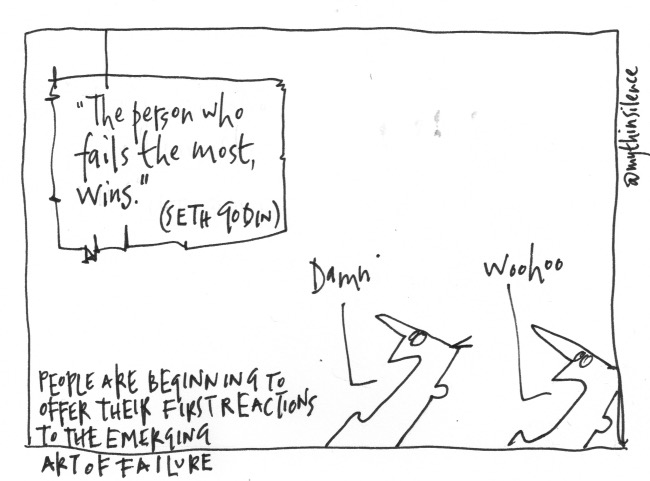
14 people are beginning to offer

“Be blessed.  And just as you are transforming your own life, may you transform the lives of those around you.  When they ask, do not forget to give.  When they knock at your door, be sure to open it.  When they lose something and come to you, do whatever you can to help them find what they have lost.  First, though, ask, knock at the door and find what is missing from your life.”*

Wisdom can be understood as what we know and who we are and the world in which we find ourselves, and our thoughts and our relationships and out behaviours all contribute to all things flourishing and thriving.

In the Genesis myth, Eve and Adam take the fruit from the tree of good and evil, or, wisdom – apparently, this was the one thing they were not supposed to do.

I find myself wondering whether this story is about how we are unable to pluck wisdom like a fruit, already formed; it has to be grown like a tree, through the kind of daily interactions described in the quote, above.

Wisdom-living is never ours in some hermetically sealed way.  Every thought, relationship, or behaviour reduces or increases the wisdom happening in our lives.

‘Whatever these forces are that make people do dumb things, they are powerful, they are often invisible, and they lurk even in the best of environments.’**

Even in the Paradise of the Genesis myth.

Wisdom – or thriving or life-in-all-its-fullness – emerges out of struggle.  It cannot be reduced to mundaneness or captured in habits and practices and self-help manuals – more attempts to pluck the fruit, more shortcuts.  By struggling to grow wisdom, we become receptive to what we do not know and cannot do, yet:

‘You were sent to the earth to become a receiver of the unknown.’^

‘The greatest quest is to make humanity human.  This will require more than knowledge, it will require wisdom.’^^

(*A Siberian shaman in Paulo Coelho’s Aleph.)
(**From Ed Catmull’s Creativity, Inc..)
(^From John O’Donohue’s Eternal Echoes.)
(^^From Alex McManus’s Makers of Fire.)

a hard rain’s a-gonna fall*

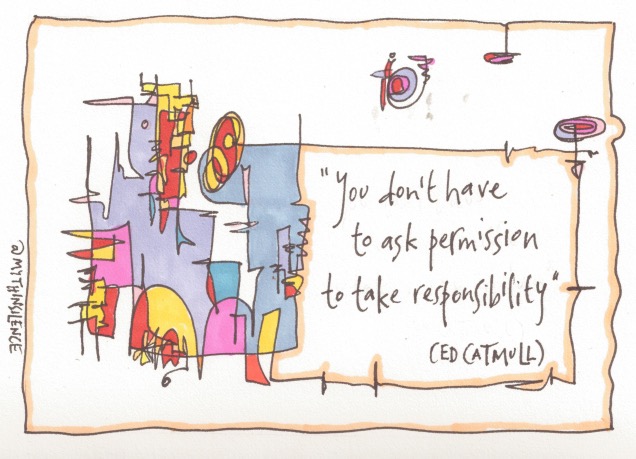
13 you don't have to

So what are we going to do?

We can moan about how hard things are – we all do it.

Or we can use these same things as means and opportunities for finding a better future – to be honed by the trial: who we are and what we do.

There are things that can destroy us – I don’t mean these things.  These are the abyss, chaos, but the edge of chaos is something else:

‘The edge of chaos is a condition, not a location.  It is a permeable, intermediate state through which order and disorder flow, not a finite line of demarcation.  Moving to the edge of chaos creates upheaval but not dissolution.  That’s why the edge of chaos is so important.  The edge is not the abyss  It’s the sweet spot for productive change.’**

Better rarely comes easily or via a shortcut.  Easy lulls us into asking the wrong questions.  Hard makes us ask deeper, better questions, and there’s always more than one to be asked.

(*Bob Dylan‘s song, which I first heard sung by Bryan Ferry.)
(**From Richard Pascale, Mark Millemann, and Londa Rioja’s Surfing the Edge of Chaos.)


alignment

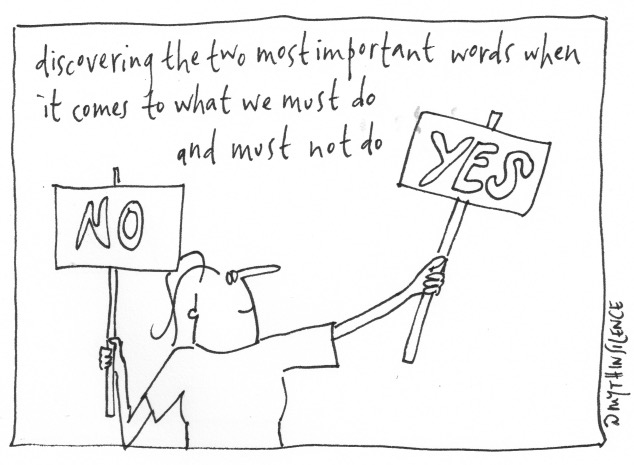
12 discovering the two most important words

‘Maybe it’s the afternoon, maybe it’s the light, but at that moment, the universe seems to be in perfect harmony.’*

There’s a moment when what are you doing, why are you doing it, who are you doing this for and with, and when you are doing it align.

Understanding what each of these elements comprises of will mean you’re better able to place yourself in a future moment of alignment, to do the thing only you can do, the reason you feel you are in the universe to contribute.

Be honest, in this moment, you’re not thinking about how much you earn or the size of the house you live in.  You know what has made this moment happen are values and hopes, some dreams, unique skills and talents, and a need beyond yourself.

What you’re realising is most the most important things of all are already within you, and, when you recognise and employ these you know a freedom of being and movement.

It’s worth taking a few moments to capture these things, to write or draw them to be able to reflect on them and imagine how to express them.  All of what you capture means you have enough to begin.

(*From Paulo Coelho’s Aleph.)

imitating the future

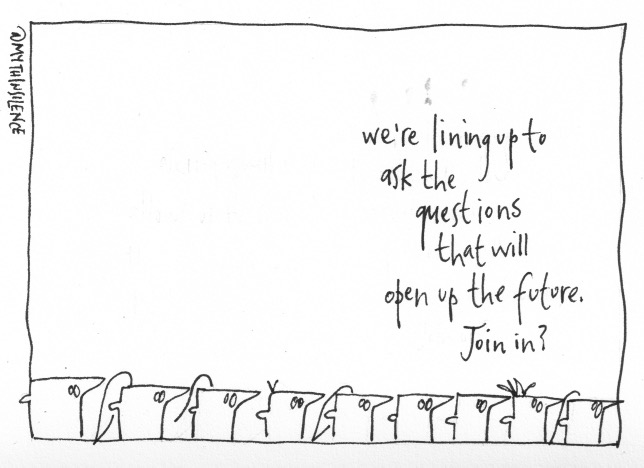
11 we're lining up

‘Live the question now.
Perhaps then, someday far in the future,
you will gradually,
without even noticing it, live your way into the answer.’*

Questions bring light.

We often speak about “shedding light” and “seeing the light,” and it sounds as though we’ve found the answers.

But more questions equals more light.

Asking if we’re going with the wrong answers, or whether we’re asking the wrong questions – the easier ones?

It’s best to see everything – nothing hidden.  The best questions open up more, allow us to imagine more, and imitate what we see.

‘Now, more than ever, more of us have the freedom to care, the freedom to connect, the freedom to choose, the freedom to initiate, the freedom to do what matters.  If we choose.**

(*Rainer Maria Rilke, from The Northumbria Community‘s Morning Prayer for 11 January 2016.)
(**From Seth Godin’s It’s Your Turn.)
(Here are ten questions proffered by Seth Godin in his blog today.)

the right story

10 find your story

“After all, a life without a cause is a life without effect.”*

‘For all you care about the artistry, visual polish frequently doesn’t matter if you are getting the story right.’**

You have to wait a long time for things to be perfect, to begin the thing you really want to do, but you can begin a story right now.

A life with cause each is meant to live.

We may try to escape or hide from this, but the future has a habit of visiting us with a path to follow, showing us something of what can be if we follow our curiosities and dreams, choose our niche explorations, and employ our talents.

Such a story is a place of must, where we’ll face our greatest challenges and opponents, yet feel fully alive, finding our greatest power and strength.

The right story defines us and and our contribution.  Yes, there are brighter, more attractive, or easier stories, but the power isn’t there.

‘There are no manuals for the construction of the individual you would like to become.  You are the only one who can decide this and take up the lifetime of work it demands.’^

This life is entered through humility, experienced through gratitude, and lived by faithfulness.

(*Paulo Coelho’s publisher, in Aleph.)
(**From Ed Catmull’s Creativity, Inc..)
(^From John O’Donohue’s Eternal Echoes.)
fallow

9 time to sow the future

fal¦low1
[ˈfaləʊ]

ADJECTIVE

  1. (of farmland) ploughed and harrowed but left for a period without being sown in order to restore its fertility or to avoid surplus production:

    synonyms: uncultivated · unploughed · untilled · unplanted ·

    [more]
  2. (of a person) not imagining the future.

Fallow was okay for a while, but not for the rest of her life.

Taking it easy, recuperating, had been important after what she’d been through.  But now, it was becoming a way of life, a life without any future all was same old same old.

A new year and an attempt to make and keep some resolutions wasn’t working.  Only Day 9 and they were proving unengaging.

Fallow had become resistant to the new and the different as time had gone on.  

None of this is helped when we recognise, as a species, we’re loss-averse, even when, by our own admission, what we have isn’t that great.

Breaking open the fallow ground, to “do something with our lives,” is difficult … but not impossible.

Beneath the surface of our lives, lying dormant, are memories of dreams and hopes and aspirations we once held.  Recovering and reimagining these is a dangerously disruptive thing – like ploughing, breaking things open.

Moving closer towards them – as in reading, TEdtalks and events (and suchlike), and talking with others who can help us is a harrowing experience – as in, breaking down the rough ploughing into something ready for planting.

Then, when we do something, playfully and experimentally, it’s like sowing the future – here’s something capable of growing into a crop and harvest.

She had come a long way with her company of knowingll that we learn through this, prepares us for the new season, and more.


who do you trust?

8 you have to trust yourself

‘The primary battle of this century is with ourselves.  It is the battle between the self and the Self – between our existing habituated self and our emerging future Self, both individuals and collectively.’*

“When a great moment knocks at the door of your life,
it is no often louder than the beating of your heart,
and it is very easy to miss it.”**

Do you trust your self?

In telling the story of Pixar, Ed Catmull shares how, when he set out in his work to marry the computer to movies, it just seemed right to him to hire people smarter than himself, and for his team to share their work with a larger community trying to overcome big problems.

You have to have confidence in who your are to be able to do this, even that you’ll be grow and developing for a long timeon the cutting edge of whatever fascinates you most: this is our emerging or future Self, the person we are growing every day.

The name I give to this confidence is humility.  To know who we are and the path we must take.

This kind of humility is about loving ourselves, and when we love ourselves, then we can hear and trust ourselves – including what catches our attention and how we move towards this.

We cannot learn these things unless we’re willing to step out and be vulnerable with our dreams and skills and futures: practices in trusting ourselves and others, and get a feel for issues and situations: which gives us information, which we gleam for knowledge, and live as wisdom.

(These days, we’re even learning to trust crowds of people we’ve never met to shape the path we walk to produce our art.)

Choreographer Twyla Tharp tells the story of one of her projects being heavily criticised by the press because of a failing first act, and how she had to trust herself to be the person she was learning through her life to become:

‘My support came from my routine, my sustenance from my rituals of self-reliance.’^

(*From Otto Scharmer’s Leading From the Emerging Future.)
(**Boris Pasternak, quoted in The Northumbria Community’s Morning Prayer for 8 January 2016)
(^From Twyla Tharp’s The Creative Habit.)


bold tribes

7 we don't want to

“Without us here to witness, the universe is just pointless physics unfolding.”*

“I think we need to be training people on how to change the world. … We need to have more ambitious goals.  The world has enough resources for a good quality of life for everyone.”**

‘To pull it off, we’d have to be creative not only technically but also in the ways that we worked together.’^

Here we are, making sense of the physics which begat chemistry which begat biology which begat consciousness which begat love and ideas and technology.

We have learnt that this happens best in supportive and challenging environments: bold tribes working towards *big hairy audacious goals” (bhags).^^

What is it that you see and nobody else wants to tackle?

It’s not important that you’re unable to do this alone, what matters is that you can do this with others.

I’m a member of a number of tribes in my city who are trying to change the world, in some way or other trying to enable people to be world-changers, taking small steps.  These people are being changed themselves, even as they each towards the future possibilities that have taken hold of them, and that, somehow, they must make happen – change which make me think, this works.

What is it that you see and nobody else wants to tackle?

Use the old and new technologies and you’ll find others to join with you.  If you’re struggling to get started, connect with us and we’ll support you in starting something.

‘Yes, the cards are unfairly stacked against too many people.  Yes, there are too many barriers and not enough support.  But no, your ability to create and contribute isn’t determined at birth.  It’s a choice.’*^

(*The character Cormac Wallace in Daniel Wilson’s Robogenesis.)
(**Larry Page, quote in Peter Diamonds and Steven Kotler’s Bold.)
(**From Ed Catmull’s Creativity, Inc..)
(^^A term coined by Jim Collins in Good to Great.  A University of Michigan summer school attended by Larry Page held, “Have a healthy disregard for the impossible.)
(*^From Seth Godin’s Whatcha Gonna Do With That Duck?)


excitement and trepidation – the perfect day

6 our choosings must

Every morning, I get to begin the day with excitement and trepidation.

Here again, is the possibility and responsibility of pursuing and developing my curiosities.  From ideas into happenings.

It is the same for you, though your curiosity is different to mine.

This has been honed in both of us over many years, through taking notice of many things, and homing in on some of these.  For some reason, these have called for your attention over everything else.

So, you move in closer and one thing leads to another.

One person leads to another person.

One experiment to another.

Before you know it, you’re waking with the excitement and fear of what following this trail will mean through another day.

It’s a big, wide, open perspective on life – because you’ve been discovering, there’s no end to your outer and inner worlds:

‘To follow your gift is a calling to a wonderful adventure of discovery.  Some of the deepest longings in you is the voice of your gift..  The gift calls you to embrace it, not to be afraid of it.’*

Peter Senge proffers that love is committing ‘to another’s completion, to another being all that she or he can and wants to be.’**

I need to ask, because of this connecting of lives and curiosities and possibilities, is this what it means to be Human?  An eco-adventure.^

We must trust the longing which calls to us from the deepest part of our being.  Far from being the least trustworthy voice in our lives, it may be the truest – coming from the most developed and connected part of us – where we’ve been connecting to others, our world, and our selves, knowing we have enough to begin.^^

How this is happening in every person is a beautiful thing.

(*From John O’Donohue’s Eternal Echoes.)
(**From Peter Senge’s The Necessary Revolution.)
(^From oikos, meaning, the whole house.)
(^^Here’s some astute insight from Seth Godin to go with this.)