what the world needs now …

14 calling all

What do you fear most of all?

Sometimes smaller fears get in the way of the things that are worth getting fearful over – like the fear of missing out on living the one life we have in a way that makes a difference, perhaps the greatest adventure of all: “bold innovation, limitless generosity, and the opportunity to save a life.”*

This journey witnesses us crossing the thresholds of judgement to openness, cynicism to compassion, and, fear to courage – into curiosity and inquiry, relationship, and action.

“Things change when you care enough to grab whatever you love, and give it everything.”*

What we think is the safest place to be can turn out to be the most dangerous.

Yesterday, I caught something of Jurgen Todenhofer’s story, how this writer and retired judge from Germany wanted to see the other side of the Islamic State story, successfully negotiating ten days within the caliphate.^

He brings his story back to all of us who want to understand more of what life within this region looks like, even as we try to imagine the future.  This journey wasn’t into Mediocristan, but into Extremistan, where, each night, he didn’t know what awaited him the following day.^^

As I listened to his extraordinary experience, I saw Todenhofer’s journey as one of servanthood for others, for the “powers that be” and for each of us.

Maybe we think we live in “Calmistan” – where everything is in its rightful place.  While Todenhofer’s story is extreme, reality is we all live in a world of randomness and chaos, every day wrestling it to some kind of order.  Calmistan does not exist – the ordering of chaos that has served is in the past will not serve us now.  We need imaginative, creative people, willing to overcome their lesser fears to face the greatest one of all.

[P]ersonally, I think the person who can’t change his or her mind is dangerous.’*^

(*The subtitle of End Malaria.)
(**Music student Amanda Burr to Ben Zander, quote in Rosamund and Benjamin Zander’s The Art of Possibility.)
(^See Jurgen Todenhofer’s My Journey Into the Heart of Terror.)
(^^Mediocristan and Extremistan are concepts of randomness and chaos identified by Nassim Taleb in The Black Swan.)
(^^From Ed Catmull’s Creativity, Inc.)
wisdom 4.0

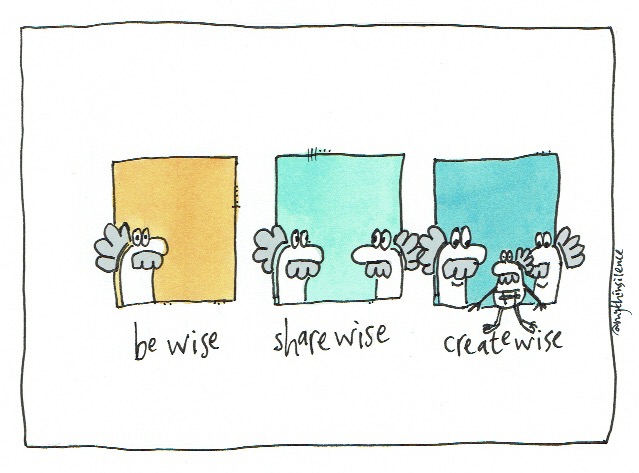
12 be wise

‘Wisdom is not a shift from me to you, but a shift from me to us.’*

What if wisdom exists in the following forms?

Wisdom 1.0: Often passed from others and seen as good enough for was we want to do in life, so lacks questioning; it’s expressed in heuristics and doesn’t worry too much about what others think.

Wisdom 2.0: There’s more wisdom than we first thought – it can be made to work for us and change our circumstances, and, to some extent, used for the good of others; wisdom is a valuable commodity and is scalable.

Wisdom 3.0: Wisdom exists in everyone, even in our planet and the universe, so we begin exploring what wisdom looks like from the perspective of others, stepping into their shoes; wisdom isn’t so scarce, and we have come a long way from the monochrome “wisdom according to me.”

Wisdom 4.0: Wisdom is far from fixed, it’s unfolding, and more, it’s something we discover and create and live within together; wisdom is abundant because there’s always more to come, it’s increasingly inclusive, abides in all relationships, and new relationships are constantly being formed within it.

What if Wisdom 4.0 is our future?  A future of endless, unfolding possibilities for making all things thrive?

(*From Erwin McManus’s Uprising. Erwin’s “me and you” and “me and us” echoes Otto Scharmer’s “I-in-me,” “I-in-you,” and “I-in-us”; Otto also has “I-in-it” between the first two: see his Theory U.)

simply elegant

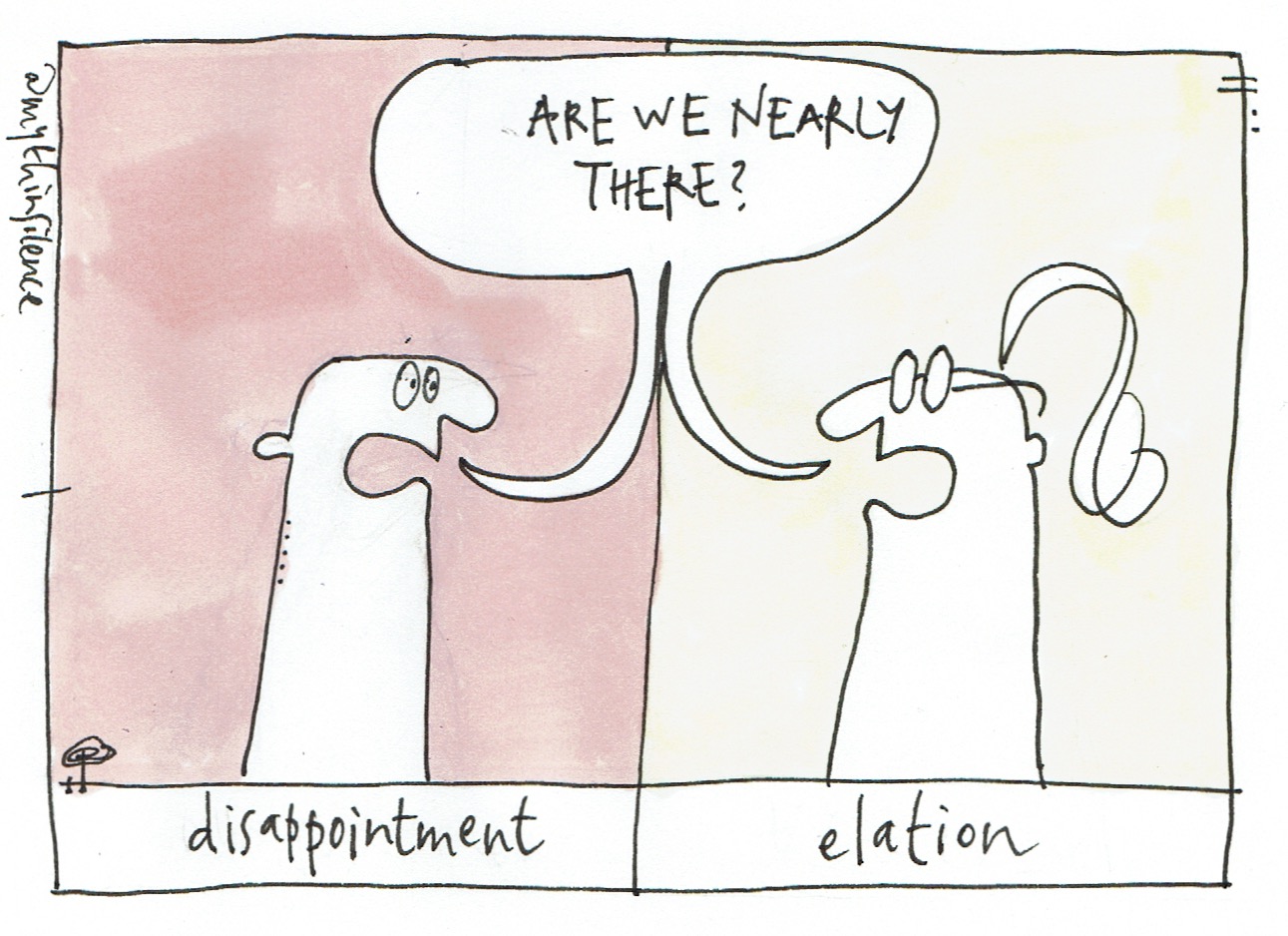
12 are we nearly there?

“If I start on a film and right away know the structure – where it’s going, the plot – I don’t trust it.  I feel like the only reason we’re able to find some of these unique ideas, characters, and story twists is through discovery.  And by definition ‘discovery’ means you don’t know the answer when you start.”*

How do we navigate the unknown?  Warren Berger ponders whether mission questions may be more helpful to us than mission statements.**

Wisdom is the elegant solution: a simplicity found on the far side of complexity.

It can all appear magical, but there’s no wizardry involved.  It’s wisdom’s ability to connect past and present and future that makes the difference.

‘To my mind, randomness is not just inevitable, it is part of the beauty of life.  Acknowledging it and appreciating it helps us respond constructively when we are surprised.’^

When we’re prepared to reflect on our past, even upon its ugliness, it becomes fuel for the fire we make for the future; when we’re unable to do this, what has happened is unavailable or of no use to us.

Our ability to learn from our mistakes leads to being grateful for their lessons, leading to new possibilities through experimenting and practise towards the unknown of the future – no longer a repeat of the past.

(*Up’s director Pete Docter, quoted in Ed Catmull’s Creativity, Inc.)
(**See Warren Berger’s A More Beautiful Question.)
(^From Ed Catmull’s Creativity, Inc.)

to live the question

11 true purpose

‘Live the questions now.’*

‘The heart of wisdom is motivated by the need of others.’**

We may think wisdom is found in answers, but it is more strongly encountered in questions.

When wisdom is not so much about what we know but how we live, then this may be one of the most powerful, catalytic question we can ask:

“What do you want/need?”

It holds the notion that somehow I can serve you – expressing the wisdom of humility.

It hopes that I have something to give to you – expressing the wisdom of awareness or gratitude for what I have.

It believes I will somehow find ways to deliver what I have – expressing the wisdom of faithfulness in discipline and creativity.

We can live for a lifetime in questions like this.

(*Rainer Maria Rilke, quoted in the Northumbria Community’s Morning Prayer, 11/4/16.)
(**From Erwin McManus’s Uprising.)

phenom

10 take your time

Take your time.  Go slowly.

Good advice or bad?

It looks like bad advice before the fact.

But when it’s how we make progress within an idea we’ve begun to pursue, or a journey we have intentionally set out on, then it potentially is dynamic advice – taking the long view, understanding there are many elements and stages and choices to be made.

To love everything is to love nothing, that is, to love it by knowing it deeply and fully.

As advice for the long haul, it believes that setting out a year for accomplishing something that hasn’t been engaged in before is more powerful than setting out aimlessly – like an expedition with out planning: it’s possible, but the odds are stacked against us.

It understands that reflection on progress is at least as important as the experiences, and that humility, gratitude and faithfulness provide powerful means to do this – that is, making deep reflection possible.

It has a feeling that at the end of the journey there’ll be the beginning of another – becoming part of something that is phenomenal.

Here’s one online dictionary’s attempt to describe a phenom:

To be “Phenomenal” at something, or to be a person of certain great qualities that just can’t be described. Not necessarily a prodigy, but certainly special. They posses a certain “it factor” about themselves, something that goes beyond the exterior but comes from their core and radiates out. 

True phenoms exude qualities such as ambition, caring, respect, honor, integrity, and all around character. They are the people you look at and although others may not see it, you know that they are going to be big one day. 

10 take your time 1


when we are rich in spirit

9 rich in talent

“Money must be funny in a rich man’s world,” sang Abba.

‘Money is … a universal medium of exchange that enables people to convert almost everything into almost anything else. … Money is accordingly a system of mutual trust, and not just any system of mutual trust: money is the most universal and most efficient system of mutual trust ever devised‘*

We all know how really useful money is.  Money makes it possible for us to exchange, store, and transport wealth easily, safely, and cheaply.  But this week money has been all about the Panama Papers, particularly how wealthy individuals hide their wealth from prying eyes.

Yuval Noah Harari estimates that there’s $60 trillion of money wealth in the world, but only about $6 trillion comprised banknotes and coins – the rest is electronic data.

I breathe in and breathe out.

Some believe money and/or wealth is everything – not so much in what they say, but in how they act.

I breathe in and breathe out.

Here are the basics for everything else: I get to breathe every day, and with breathing comes a plethora of possibilities.  But often I unaware of this gift which makes everything possible.  Hidden by our sophisticated complexity, your real wealth is stolen away.  I end up wrongly believing I need more before I can do what I want to do.

I breathe in and breathe out.

If I can begin something with what I have, with an abundance of spirit, then, if I receive some funding from somewhere, it simply means I may be able to do more.

Money can’t help here.  I can’t buy an abundance of spirit, so overcoming a poverty of spirit.

I breathe in and breathe out.

I recognise the skills and talents I have, the dreams, the friendships, the experiences in life.

I breathe in and breathe out.

I recognise the skills and talent, the dreams, the friendships, the experiences in life others have.

We breathe in and out.

We imagine and we try, and we see how much more there is.

(*From Yuval Noah Harari’s Sapiens.)

am i forgiven?

8 how forgiveness

In what can be an unforgiving universe, we’ve figured out ways of creating forgiveness.  We had to, we can’t exist without it.

‘You need to be generous with yourself in order to receive the love that surrounds you.’*

I found myself contemplating how forgiveness is just so crucial to human existence, including how it’s a really big deal in many of the world’s religions – humans needing to be forgiven by their gods, either conditionally or unconditionally, embodying this in all manner of rites and rituals.

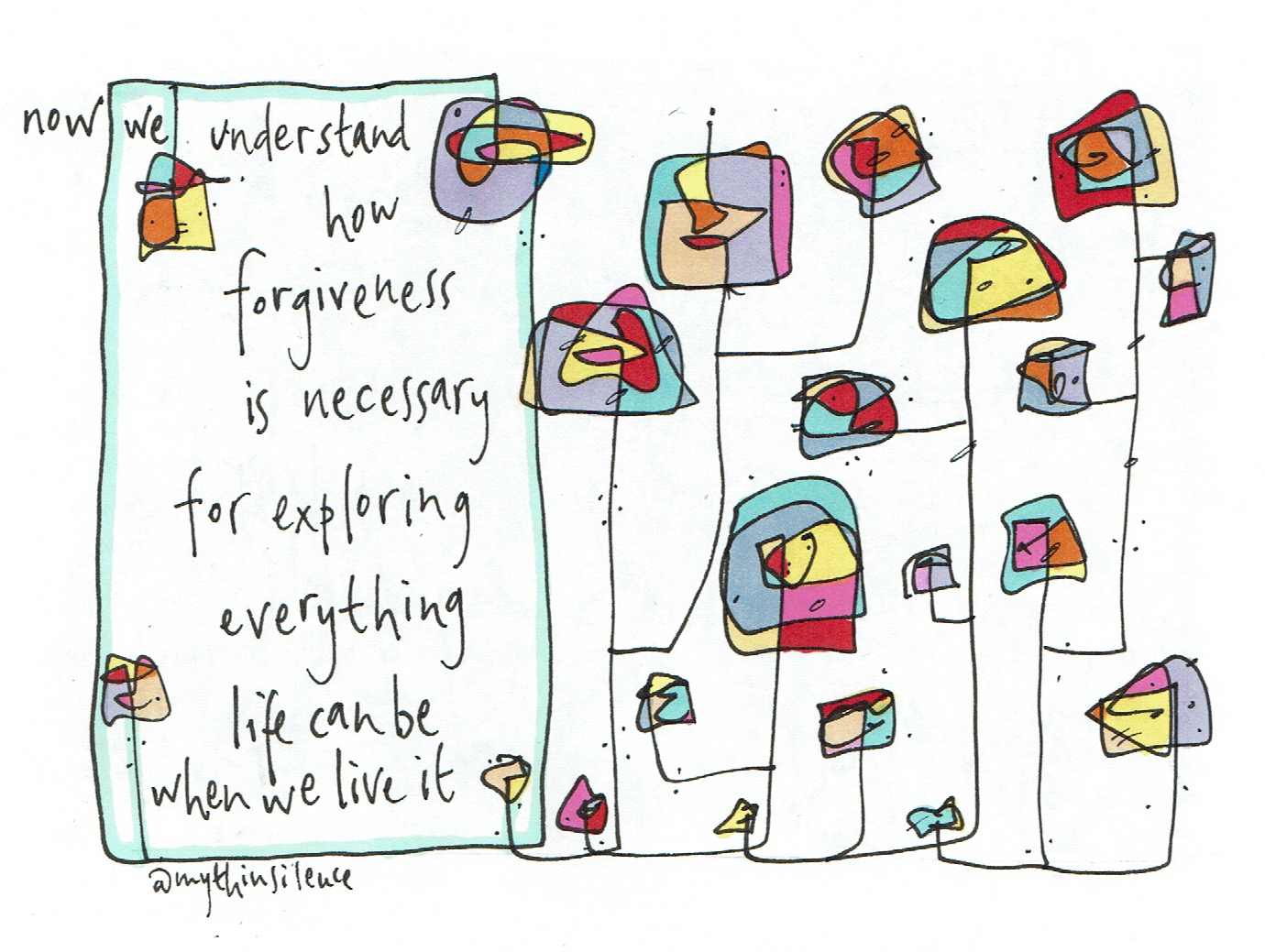
8 we understand

More than this, I found myself positing how these might be understand to be our explorations into forgiveness.  How humans, amongst all of the higher species, have developed concepts and expression of forgiveness most of all.  It appears to be a fundamental expression within the human ability to step outside of natural selection.

‘Be aware of your breathing.  Being aware of your breathing takes attention away from thinking and creates space.  It is a way of generating consciousness.’**

We can be restricted, or worse, paralysed, by a lack of forgiveness.  We still function.  We move, work, relate, holiday, shop, and play sports, but we don’t notice how some things have become closed to us, whilst others have become more of a rut.  Like breathing, we hardly notice the atmosphere in which we’re immersed – until we stop and allow awareness to form in us.

And in becoming aware, we open up new paths.

‘Failing gracefully is part of the deal.’^

We’re surrounded by unforgiving situations.  Ben Zander recounts how, in his world of music, so many conductors lead in an autocratic way, unwilling to admit their own mistakes, and how:

‘Many corporate heads and managers I have spoken to have since let me know that the orchestra is not the only hierarchical setting where this dynamic occurs.’^^

This is the atmosphere we’re all immersed in.  Those who are not prepared to admit they’re wrong, forgive themselves, and receive the forgiveness of others perpetuate unforgiveness out to others.

Forgiveness doesn’t overlook wrongs, but provides an environment in which people open their minds (to see what is what), and also their hearts and wills – meaning they change and behave differently.

Here’s a whole day in which to give it a test run.

8 now we understand

(*John O’Donohue, quoted in the Northumbria Community‘s Morning Prayer, 8/4/16)
(**From Eckhart Tolle’s A New Earth.)
(^From Seth Godin’s Graceful.)
(^^From Rosamund and Benjamin Zander’s The Art of Possibility.)

what i seek is what i need

7 just give me

I seek wisdom.  (The people who know me know how I need this.)

Wisdom meaning all I am and all I have being contributed in the right way at the right time for the right reason in the right spirit.

I make such slow progress towards becoming a wiser person.  But perhaps slow is okay.  Maybe I have the whole of life to work at it.

‘[Perseverance] is the ability to stand and thrive under pressure.’*

Perseverance expressed as active patience is the ability to open my mind, my heart, and my will, to be truly present.

‘We persevere in the confidence that we ourselves are being transformed.  Perseverance produces character, and character, hope.  And hope, we will discover, is the ultimate gift gained in wisdom.’*

I find I can keep moving towards the future, figuring out more ways to make my contribution, what it is I can do and you can’t, and what it is you can do and I cannot:

‘Naming oneself and others as a contribution produces a shift away from self concern and engages us in a relationship with others that is an arena for making a difference.’**

No matter what our age, we are all able to keep moving forward in our thinking, our relating, and our behaving.  And we watch our worldview altering from one of scarcity to one of abundance.

There’s always another chance, another opportunity, another possibility, and usually it will appear in the most unusual or difficult places or times – and there make our contribution.

(*From Erwin MacManus’s Uprising.)
(**From Rosamund and Benjamin Zander’s The Art of Possibility.)

the games people play

6 figure out

‘I settled on a game called I am a contribution.  Unlike success and failure, contribution has no other side.  It is not arrived at by comparison.’*

I know, whenever I compare myself with others, I lose.

I choose to be content.

One of the things I’ve discovered later in life is that I’m really satisfied with the “second seat.”**  I love the way it allows me to ask questions like, “What if?”  There’s a contentment in following where the questions lead.  It’s not the easy way; it places me on the path of perseverance, a path of faithfully carrying out the things I must do.

This is because I am discontented.

My discontent is what informs me about what it is I must do.  It’s brought me to the “second seat” so I can support others be who they must be.  When discontent is mixed with a dream it becomes a cause, it leads to a contribution.

Everyone has a different contribution.

Because this contribution game has no need of comparisons it’s an infinite game^ in which everyone’s life-contribution becomes a gift for everyone else.^^

We all have a contribution to make – becoming a generative being is something we learn.

Frank Laubach came up with a game with minutes, believing that we can invent some way of making a contribution to others in every minute.*^

To be inventive with every minute is daunting to say the least, but each day provides many moments in which we can make our contribution and be a gift.

“How will I be a contribution today?”*

(*Ben Zander in Rosamund and Benjamin Zander’s The Art of Possibility.)
(**The “second seat” doesn’t mean I want this place instead of the third or fifty third seat, but whether it be an individual or a group of people, I prefer the second place, allowing others the first.)
(^See James Carse’s Finite and Infinite Games.  An infinite game includes as many as possible for as long as possible, and if the rules threaten to exclude people or close the game down, they are changed.)

(^^Roz and Ben Zander suggest “finite” games offer us opportunities to hone our skills.  A finite game includes some and excludes many, it has a certain duration, and always plays by the rules.)
(*^Frank Laubach’s The Game With Minutes.)

the story we do not know

5 to be willing

‘A life story is a “personal myth” about who you are deep down – where we come from, how we got this way, and what it all means.  Our life stories are who we are.  They are our identity.  Life story is not, however, an objective account.  A life story is a carefully shaped narrative that is replete with strategic forgetting and skilfully spun meanings.’*

‘The dreamer is consciousness itself – who you are.  To awaken within the dream is our purpose now.  When we are awake within the dream, the ego-created earth drama comes to an end and a more benign and wondrous dream emerges.  This is the new earth.’**

Between these two conditions there spans a journey of great challenges, for we must face those details of our lives we’re prone to leave out, or may not even be aware of.  I don’t think we’ll ever fully know who we are – that would require us to be perfect and complete.  Things none of us will be.  But there is a greater integrity and wholeness to faithfully explore – every day bringing us to the possibility of learning, which is an attitude of openness, moving us beyond WYSIATI (“what you see is all there is”).

Most of all, it’s in our interactions with others that we learn most of all:

‘You may ask, “Who, actually, is doing the changing?  And the answer is the relationship.  Because in the arena of possibility, everything occurs in that context.’^

Imagine the kind of change that can take place in those who enter into a conversation of great openness, in which everyone learns about themselves and each other, as well as the subject in hand and the possibilities which lie before the newly formed “company.”

(*From Jonathan Gottschall’s The Storytelling Animal.)
(**From Eckhart Tolle’s A New Earth.)
(^From Rosamund and Benjamin Zander’s The Art of Possibility.)