the best years of our lives

16 hey listen to the

‘Why pursue a quest?  Because each of us in our lives writing our own story, and we only have one chance of getting it right.’

Chris Guillebeau reminds me why I’m making this move out of my work of 36 years and into dreamwhispering and doodling: we have one life to do the thing we must do.

I came upon these words this morning, following another anxious moment in the darkness of the night;  I’d woken up wondering what was going through my head to act on such an idea.

Guillebeau tells the story of Phoebe Snetsinger – birdwatcher extraordinaire – who died in an accident on one of her expeditions.  Phoebe had written of her twenty years birdwatching quest:

“It has become even more clear to me that if I had spent my life avoiding any and all potential risks, I would have missed doing most of the things that have comprised the best years of my life.”**

When I look back on the last ten years of experimenting and exploring that have led me to this moment, I realise, these have been the best years, and, because endings are only beginnings, the promise is that the best years of all are still to come, every day providing the possibility of becoming a better me and making a greater contribution.

Today’s has been a more personal post, but only because what has been true for Phoebe Snetsinger and for me is true for all of us, only your quest will be different.

(*From Chris Guillebeau’s The Happiness of Pursuit.)
(**Phoebe Snetsinger, quoted in Chris Guillebeau’s The Happiness of Pursuit.)


forget the former things, behold the new thing

15 i am not human, we

“It’s always important to know when something has reached its end.  Closing circles, shutting doors, finishing chapters, it doesn’t matter what we call it; what matters is to leave in the past those moments in life that are over.”*

[E]very time we remember anything, the neuronal structure of the memory is delicately transformed, a process called reconsolidating. … The memory is altered in the absence of the original stimulus, becoming less about what you remember and more about you.’**

I’ve recently been sharing how I’m moving into a new quest in life.^

It means moving into unfamiliar territory.  And reality is sharpening with only a couple of weeks to go – last evening my colleagues kindly hosted a meal for myself and another colleague who’s retiring, and there’s an unwritten rule that you don’t return within the first year of leaving.

The door on my past is closing.

There are loads of memories that force their way to the surface at such times, but Jonah Lehrer points out how inaccurate these memories are.  Every time I remember something I’m altering it, and it appears that this has to happen if I’m to remember something:

‘[T]he margins of those memories are being modified to fit what we know now.  Synapses are crossed out, dendrites are tweaked, and the memorised moment that feels so honest is thoroughly revised. … [E]very memory is inseparable from the moment of its recollection. … If your prevent the memory from changing, it ceases to exist. … we have to misremember something in order to remember it.’*

Such remembering is always, nostalgic, then.  No wonder I’m becoming more and more concerned and cautious over those who want us to regain the past, whether that be religious, political, nationalistic … or work, because it never existed as they remember it.

Does this mean nostalgia detracts from the present and the future?

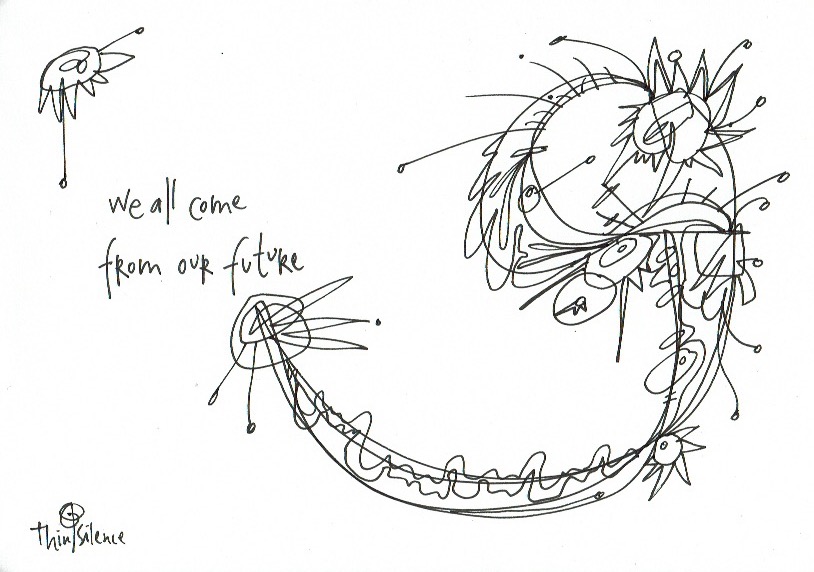
If we’re always trying to get back to something it must be hard to hear what the future is saying to us – about who we are, who we are together, and what it means to be connected to and part of the future of the whole earth.

Who, then, will behold the new thing?

(*Paulo Coelho, quoted in Chris Guillebeau’s The Happiness of Pursuit.)
(**From Jonah Lehrer’s Proust was a Neuroscientist.)
(^I am moving out of a role I’ve known for some thirty six years, into futuring, mentoring, blogging, and doodling.  Specifically, I want to contribute to those who feel their lives are unconsidered and overlooked, but who have amazing things to contribute.)

empty spaces

14 exploring empty spaces

“Suppose all your objects in life were realised, that all the changes in institutions and opinions which you are looking forward to could be completely effected at this very instant: would this be a great joy and happiness to you?”*

‘What Joseph Conrad said about maps is also true of the brain: the most interesting places are the empty spaces for they are what will change.’**

When we move into empty spaces on the various maps of life, things are happening in the empty spaces of our brains.  Our journeys alter us.

What is more, and as a result, a great quest is one that changes and grows – if we are alive to it.  We come to appreciate we can never realise our objectives, because more and more proffer themselves.  When one quest finishes, another may already have begun – another empty space on the maps we’re scrutinising.

I arrived in Edinburgh in 2006 with a quest, but I had no idea back then that I would find myself moving into what I’m about to do.  These ten years have changed me and I do not see fewer but more empty spaces.

I  don’t think there’s anything unusual about this; I think it is simply what we call life.

(*John Stuart Mill, quoted in Chris Guillebeau’s The Happiness of Pursuit.  Mill’s own answer to this was a gloomy “No”. – what else would there be to live for?)
(**From Jonah Lehrer’s Proust was a Neuroscientist.)

journey people

13 your choice

‘[T]he most important telltale factor is the development of a simple and elegant user interface – a gateway of effortless interaction.’*

Peter Diamandis and Steven Kotler are introducing the Gartner Hype Cycle, which is used to identify the delusion of hope surrounding a technology, followed by disillusionment, and finally the maturing of a technology towards its significant adoption.

13 gartner hype cycle

What they are offering here could well describe someone’s journey of development.

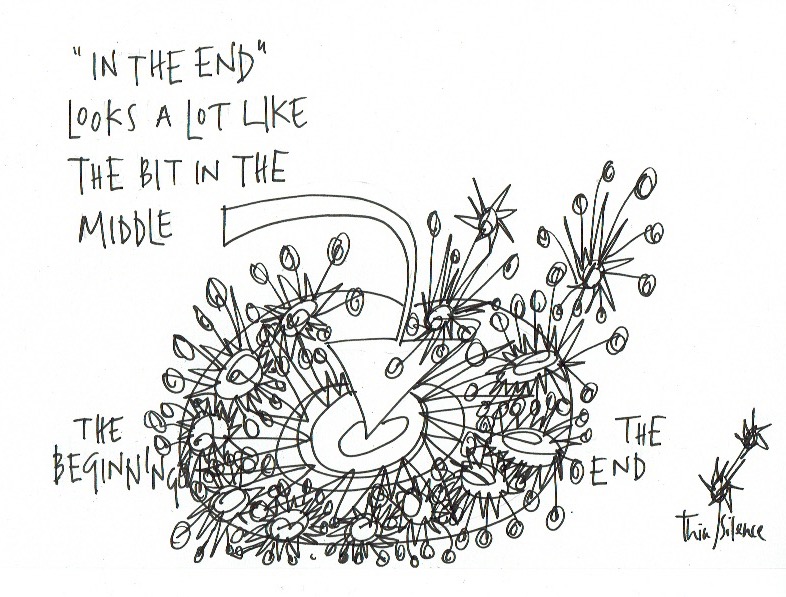
And, at the end of all our journeying, we return to the beginning and know that place for the first time – this is not the same as happy ever after … .  Have you noticed how difficult it is to finish a movie?  So many endings feel a let-down following the journey the movie has taken us on.

Is this all there is?
No, there is another beginning.

Perhaps we are hoping for happy endings when we need to be noticing the new beginnings?

“Many more adventures awaited Jason.  While some of those adventures were heroic, others were tragic.  But the future was the future.”**

An idea or desire is triggered within us and we set out on a journey with great expectations, but as reality sets in, and we realise it’s going to be harder than we thought, our memories begin to play tricks with us.  We forget the reason we set out on the journey was because we were discontented or were in an impossible place or were bored stiff – or something like that and we become disillusioned.   If we can overcome this and keep moving, then we’ll arrive at a place that provides a new beginning.

What we need to keep journeying every day is a simple and elegant user interface – a way of telling, reconnecting every day to our story, so that we keep moving.   After all is said and done, we are journey people.

‘[S]tories work because we’re not sure. We’re half there, half not.  This might work.  This might not work.  The tension of maybe.’^

(*From Peter Diamandis and Steven Kotler’s Bold.)
(**The tale of Jason and the Argonauts, told by Josepha Sherman, quoted in Chris Guillebeau’s The Happiness of Pursuit.)
(^From Seth Godin’s blog for today.)

i and thou

12 learning journeys

When we meet with another, we potentially come to a place in which together we can create something new.  It may be an idea, or a friendship or collaboration, or to begin something.

In their most vibrant form, these spaces are learning conversations in which each adds to the other; one is not seeking to bring the other to where they are, but together they are seeking to reach somewhere new.

We know we grow the most when we move from the familiar to the unfamiliar.

Sherry Turkle has reminded me of Martin Buber’s concept of “I and thou,” the ‘profound meeting of human minds and hearts.’*

First we learn to open our minds, then open our hearts and finally our wills, I and thou conversations make new realities possible.

(*From Sherry Turkle’s Alone Together.)


how we fool ourselves

11 have you heard of 1

‘You can’t achieve anything deeply satisfying without a drawn-out process leading up to it – and yet process demands a goal.’*

‘Impressions are always incomplete and require a dash of subjectivity to make them whole.’**

‘It’s difficult to tell the difference between what is impossible and what is possible (but requires a big reach).’^

I’m coming closer to the start point of a new future I’ve been moving towards for some time now – this story has been growing and developing for a while, though

From the perspective of the universe, my story is only me fooling myself.  It’s what consciousness requires, some creative subjectivity added to the numb objectivity we find ourselves wrapped up in.

Human consciousness is an interesting phenomenon, mind.  It makes for some amazing lives and some incredible stories.

And we all get an opportunity to join in.

(*From Chris Guillebeau’s The Happiness of Pursuit.)
(**From Jonah Lehrer’s Proust was a Neuroscientist.)
(^From Ed Catmull’s Creativity, Inc..)

asking questions forward

10 go slowly

‘The sun goes up; the sun goes down.  I can handle that.’*

Every day affords us an opportunity for remaining focused and staying open.

You may have noticed there’s more than a little tension in this, but this tension is how we make progress with the something significant our lives must be about.

Slowly is how we look within so we can move forward.  And what we find is freedom,

(*From Austin Kleon’s Show Your Work.)

if i ruled the world

9 natural born contributors

It would only end in tears. Better to work together to bring out everyone’s amazing contribution.

‘Being a valuable part of a scenius is not necessarily about how smart or talented you are, but what you have to contribute, the ideas you share, the quality of the connections you make, and the conversations you start.’*

Better to rule our own world – to know and love our art – in order to bring what it is we can bring into the world of others.

(*From Austin Kleon’s Show Your Work.)

this day has never happened before so how can we stay on track?

8 we are curious

‘You must remain attentive in order to be able to receive.’*

‘To the loving eye, everything is real.’

I might try and focus on what’s important to me at the beginning of the day, but I find myself wandering the further I get into the day.

Here are two things I’ve been trying to keep focused with:

A loving eye – which changes everything I may see in the day – including compassion, kindness, gentleness, and patience.

The second thing is curiosity, which keeps me open to the new and unfamiliar.

Then imagination and goodness get a chance.

(*John O’Donohue, quoted in the Northumbria Community’s Morning Prayer.)
(**From John O’Donohue’s Anam Cara.)

itchy, cranky people

7 scratch

‘Mortals must do what they are here to create or they will become cranky.’*

‘Every missed rite of passage led to a new rigidification of the personality, a lessening ability to see, to adjust, to understand, to let go, to be human.’**

We all get itches. Have you noticed, when you thoughtlessly scratch an itch it gets worse?

And when we go through life with an itch of something we could contribute, some art to bring, but thoughtlessly scratch it, the art doesn’t emerge and we just get crankier.

Here are three rites of passage we can use to do some thoughtful scratching and move from itch to art:

Notice your itch, what it is, why it’s there, who’s causing it, when is it’s most itchy.

Allow yourself to feel the itch, for it to guide you, even define you, transforming from an itch to an urge.

Do something about what you are seeing and feeling.  Try out the art that emerges from the itch. Offer it to others.

Now who’s cranky?

Not you.

‘When you make a dream come true for yourself, it’ll be a dream come true for someone else too.’^

(*From Seth Godin’s Tales of the Revolution.)
(**From Richard Rohr’s Adam’s Return.)
(^From Derek Siver’s All You Want.)