It’s a sign!

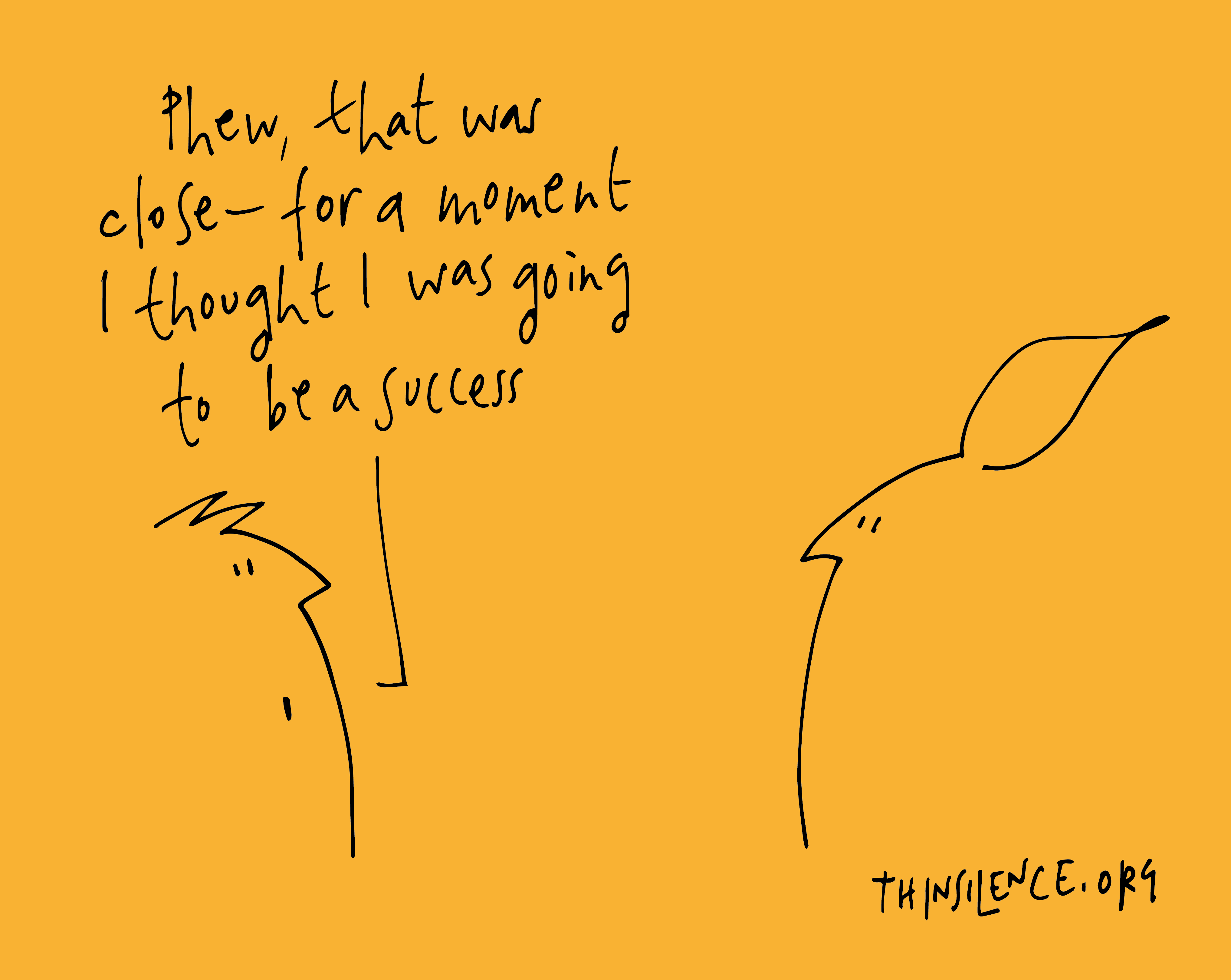
If I had a message for my contemporaries it is surely this: Be anything you like, be madmen, drunks, and bastards of every shape and form, but at all costs avoid one thing: Success … . If you are too obsessed with success, you will forget to live. If you have learned only how to be a success, your life has probably been wasted.*
(Thomas Merton)

True character can only be expressed through choice in dilemma. […] The choice between good and evil, or right and wrong, is no choice at all.  True choice is dilemma. It occurs in two situations. A choice between two irreconcilable goods, or between the lesser of two evils.**
(Robert McKee)

We all want to succeed at something, but this is different to being a success. The former is about doing certain things really well, the latter about how we are perceived by others. It could be argued that the first fosters a growth mindset whilst the latter is in danger of developing a fixed mindset, protective of the perceived success.

Robert McKee helps us to see that this isn’t simply a choice between what is good and bad, a good story needing to reflect the complexity of life. David Brooks would call this dilemma a vampire problem.

If you could take the bite and become immortal, super-powered, strong and more, but couldn’t go back, would you take the bite? He admits, life is full of vampire problems.

In another place McKee writes,

Thou shalt create complex characters rather than merely complicated story.^

What I take from this for our life-dilemmas is, we need to choose developing our character over telling a fantastical story.

One of the things I encourage the people I work with to do is identify the things that really energise them and the things that really de-energise them – forget the things in-between. This is about noticing what our bodies are noticing rather than what we are thinking about; we miss our energies at our peril:

The ancient myths were designed to harmonise the mind and the body, The mind can ramble off in strange ways and want things that the body does not want.^^

From the things captured on two lists, enriching and enervating environments can be identified allowing us to make more of the former happen and avoidance or management of the latter.

When these have been identified, we can use the acrostic SIGN to check whether we’re noticing the right things:

Successful: are you really good at doing this?
Intuitive: is it natural for you to do this, does it flow from you?
Growth: are you being developed in the process, both in character and personality?
Need: does this feed your hunger so you don’t binge on junk?
*^

When you provide many examples of your enriching environments then these are a SIGN you’re becoming a complex character.

(*Thomas Merton, quoted in Richard Rohr’s Immortal Diamond.)
(**From Robert McKee‘s newsletter: The Beauty of Character Dilemma.)
(^From Robert McKee‘s newsletter: Building a Character.)
(^^Joseph Campbell from Joseph Campbell and Bill Moyers’ The Power of Myth.)
(*^It’s the reverse for the things that de-energise you: you get by but you’re not successful, these things feel unnatural, you don’t grow as a result, and they don’t feed you.)
It isn’t logical*

Happiness is essentially a state of going somewhere, wholeheartedly, one-directionally, without reservation or regret.**
(William Sheldon)

Logic demands a direct connection between reason and action, but psycho-logic doesn’t.^
(Rory Sutherland)

William Sheldon is describing what I have come to understand as my slow journey in the same direction, it is living in the direction of my True Self.

I do not say as my True Self because I have much further to travel, each step intended to be with the grain of who I am, though, as Richard Rohr understands only too well, this is not easy:

Living in the True Self is simply a much happier existence, even though we never liver there a full twenty-four hours a day. But you henceforth have it as a place to always go back to.^^

Sheldon may call it happiness but it often feels like failure, disappointment, distraction or frustration and yet the path keeps calling. It is a deeper path, hence including Rory Sutherland’s remark which recognises that we are psycho-logic beings. Logic will struggle to make sense of following a path we cannot see; it helped us up the first mountain we climbed for ourselves but not with the commitment needed to climb the second mountain for others.

This is vocation, a second mountain experience; not what do I expect of life but what does life expect of me:

The sense of calling comes from the question, What is my responsibility here?*^

From this, I understand the path unfolds for me from the future rather than being determined from the past. I have no idea what will happen because I haven’t been there before, but I have faith to take me there. Faith is not a religious concept, it is a human ability:

The orientation of faith is such that it exists not in and of itself but as a quale-like response, to the Umwelt, the reality around us.^*

I’m glad we have faith because, as Brooks observes and I have experienced:

the messy way [vocation] happens in actual lives doesn’t feel holy at all; just confused and screwed up.

Have no doubt, you are being called and you are more than prepared for sensing the psycho-logical path

(*Why not listen to Supertramp’s Logical Song as you read?)
(**William Sheldon, quoted in David Brooks’ The Second Mountain.)
(^From Rory Sutherland’s Alchemy.)
(^^From Richard Rohr’s Immortal Diamond.)
(*^From David Brooks’ The Second Mountain.)
(^*From Alex McManus‘ Blue Moments – unpublished.)

Three words

Everyone should find the centre of his life in his work and be able to grow outward from this point as far as possible.*
(Rainer Maria Rilke)

It may make sense in our head but does it make sense in our heart? Commitment for a long haul comes from the heart, the willingness to connect at our deepest levels to what life is asking of us.

Seth Godin has just launched a new book. In his trailer for this he claims:

The path forward is about curiosity, generosity and connection. These are the three foundations of art. Art is a tool that gives us the ability to make things better and to create something new on behalf of those who will use it to create the next thing. Human connection is exponential; it scales as we create it, weaving together culture and possibility where none used to exist.**

I’ve just ordered the book, not because my head thought there’d be lots of good things in the book – although it did and there will be – but because I can feel what I call the zing in my chest as I listened to Godin speak and then wrote his words down for you to read.

Godin reminded me of my response to a question my friend Alex McManus asked a group I was a part of: What does it mean to you to be human?

I thought for a number of weeks before replying that for me it is to live with creativity, generosity and enjoyment – the latter only emerging when the first two are practised.

David Brooks writes about three themes found in the second mountain people he has met – the second mountain being the one we “climb” for others rather than for ourselves – and these themes are love, care and commitment.

Three sets of three words.

Perhaps there are three words that take what you must do from your head to your heart, words to play with each day.

(*From Rainer Maria Rilke’s Letters on Life.)
(**From Seth Godin’s trailer for The Practice.)

A daily wilderness

You are neither here nor there,
A hurry through which known and strange things pass.*

(Seamus Heaney)

This is a tale of two books. The first is Eugene Peterson’s Under the Unpredictable Path which pushed me out to explore a path – more a trail – some twenty two years ago, the second is David Brooks’ The Second Mountain which I have only begun to read, but know it will continue to challenge and encourage me in the same direction.

Brooks’ first mountain is climbed for ourselves and, while the climb shapes and feeds our ego, it can leave us hurting, bruised and dissatisfied when it dopes not provide us with the meaningful we fid ourselves seeking. So we descend into the valley where we face our dilemma and pain, and into the wilderness where we can begin to listen to our lives. Perhaps we see it as a gift providing us with the space and time we need:

There are no shortcuts. There’s just the same eternal three-step process that poets have described from time eternal: from suffering to wisdom to service. […] Listening to your life means having patience.**

From the wilderness, we will be able to begin to climb the second mountain, not for ourselves, but for others.

Twenty two years ago, as a minister in the Methodist Church, I found myself wiped out by all the different expectations placed on me, reading a book I’d been loaned in which a church pastor described a dilemma I knew only too well:

Every few days or so another pastor gets out of bed and says, “That’s it. I quit. I refuse to be a branch manager in a religious warehouse outlet. I will no longer spend my life marketing God to religious consumers. I have just read the job description the culture handed me and I am buying it no longer.^

Though it can sometimes be our utter curiosity and wide openness that takes us to the wilderness, more often it is pain and difficulty that takes us there. The author Eugene Peterson had found himself pulled in three directions: the expectations of denomination, local congregation and himself. He was about to quit. In describing where he found himself, Peterson introduced me to the term askesis, a place of confinement without which there is no purpose or energy.

Askesis is wilderness.

It is space in which we are able to listen to our life, a place the ego fears for being found out, but where our True Self can emerge. It is where, Brooks writes, we find our heart and soul:

We begin to realise that the reasoning brain is actually the third most important part of our consciousness.*

We are able to move beyond the shoulds others send our way: You should do this, you should do that; you do them so well. Though often well-meaning and even making sense in our heads, these shoulds make no sense to our hearts and souls. Brooks suggests that our hearts want to fuse with a person or cause while our souls want to fuse with goodness and meaning.

Looking back, I see the result of my own askesis was not to sort me out for another mountain, but began a daily practice of entering the wilderness, to listen to my life alongside being aware of the world around me. From this, in turn, has come my work with all kinds of people around their values, talents and energies. We slow things down in our conversations so we might look more closely at what their hearts resonate with – not a straight line to the future but a walk down the mountain and into the wilderness to find what Carlos Castenda refers to as[ a path with a heart:^^

Listen to your life. See it for the fathomless mystery that it is. In the boredom and pain of it no less than the excitement and gladness: touch, taste, smell your way to the holy and hidden heart of it because in the last analysis all moments are key moments and life itself is grace.*^

Where to begin? Why not find a daily quiet place where you may spend a few moments, gently and kindly holding your pain, and listening to what your life is saying to you about your values and talents and energies?

(*Seamus Heaney, quoted in David Brooks’ The Second Mountain.)
(**From David Brooks’ The Second Mountain.)
(^From Eugene Peterson’s Under the Unpredictable Plant.)
(^^”Before you embark on any path ask the question: Does this path have a heart? If the answer is no, you will know it, and then you must choose another path. The trouble is nobody asks the question; and when a man finally realises that he has taken a path without a heart, the path is ready to kill him. At that point very few men can stop to deliberate, and leave the path. A path without a heart is never enjoyable. You have to work hard even to take it. On the other hand, a path with heart is easy; it does not make you work at liking it.” – Carlos Castenada.)
(*^Frederick Buechner, quoted in the Northumbria Community‘s Morning Prayer.)

Welcome to Acedia

One of the reasons you are rushing about is because you are running away from yourself.*
(David Brooks)

in finding your True Self, you will have found an absolute reference point that is both utterly within you and utterly beyond you at the very same time**
(Richard Rohr)

Slowly the flame reduces, its wildness lost, heat dissipating, brightness diminishing and then it changes colour. Welcome to Acedia:

Acedia is the quieting of passion.*

David Brooks claims the state of acedia exists within the world of meritocracy, a place people are pulled into because they are given a load of freedom but nothing to help them figure out what they really want to do with it, their passion or desire:

Desire makes you adhesive. Desires pushes you to get close – to the person, the job, or town you love. But lack of desire leaves you detached, and distils in you over time an attitude of emotional avoidance, a phoney nonchalance. In short, the meritocracy encourages you to drift into a life that society loves but which you don’t. It’s impossible to feel wholehearted.*

I am playing with a few ideas to see how they overlap.

Remembering Ursula Franklin‘s proposal that all systems are technologies, I wonder whether prescriptive, production technologies are more likely to separate us from our True Self whilst holistic, growth technologies are more likely to join us.

I also wonder whether James Carse would equate the false self with a finite game (exclusive, goal-driven, rule-bound) and the True Self with the infinite (inclusive, game-driven, rule-changing).

Life is bigger than any of us know, but we are all invited to enter and explore. Rainer Maria Rilke writes about nature being greater than culture, and I borrow this sentiment for the larger life:

But, again and again throughout millennia, those forces shake off their names and rise like an oppressed class against their little masters, or not even against them – they simply rise and the various cultures slide off the shoulders of the earth, which is once again great and expansive and alone with its oceans, trees, and stars.^

We are cordially invited to leave Acedia for our great passion and True Self.

(*From David Brooks’ The Second Mountain.)
(**From Richard Rohr’s Immortal Diamond.)
(^From Rainer Maria Rilke’s Letters on Life.)

Better than a big box of nothing

Live from day to day, just from day to day. If you do so, you worry less and live more richly. If you let yourself be absorbed completely, if you surrender completely to the moments as they pass, you live more richly those moments.*
(Anne Morrow Lindbergh)

[Young people] are thrown into a world that is unstructured and uncertain with few authorities or guardrails except those they are expected the build on their own.**
(David Brooks)

As far as the universe is concerned, a day is given without meaning. We have to add meaning, but more than at any other time in human history, it is in short supply yet absolutely abundant.

Meaning may come from your deepest work or a philosophy, a worldview or faith, but each of these requires work on our part.

David Brooks’ argument is that in an age of individualism the generations have less and less to work with. After being given a load of freedom, they are handed ‘a big box of nothing.’**

It’s why finding the time to work on what Joseph Campbell identified as two critical myths is so important – the personal and the social, and why U.Lab‘s two questions are so helpful because they reinforce this: Who is my true Self? and What is my contribution?

Don’t be thrown off or distracted by tomorrow. Be present here, today, to know, to feel and to do.

(*Anne Morrow Lindbergh, quoted in the Northumbria Community‘s Morning Prayer.)
(**From David Brooks’ The Second Mountain.)

For everything that matters

The knowledge we get by tinkering, via trial and error, experience, and the working of time, in other words, contact with the earth, is vastly superior to that obtained through reasoning, something self-serving institutions have been very busy hiding from us.*
(Nassim Taleb)

Defining our freedom, articulating our mastery and connecting to a purpose that will likely outlive us that is more than a mental exercise will most likely involve more than a little risk.

And with risk comes the possibility of getting things wrong and messing up.

Better pack some forgiveness.

For others and for yourself.

(*From Nassim Taleb’s Skin in the Game.)

Daily joy

This is what it means to be young: this thorough faith in the most beautiful surprises, this joy in daily discovery.*
(Rainer Maria Rilke)

It’s never too late for us to rediscover the wonder of childhood.

(*From Rainer Maria Rilke’s Letters on Life.)

Where there’s a will there’s a way

The strong of sorrow may only be used extensively if one vows to play on them at some later point and in their particular key all of the joyousness that accumulates behind everything that is difficult, painful, and that we had to suffer, and without which the voices are not complete.*
(Rainer Maria Rilke)

My grandmother was fond of repeating the proverb: “Where there’s a will there’s a way.” She’d say it to encourage us to try.  I don’t think I’ve fully appreciated its power until now.**
(Bernadette Jiwa)

We’re on holiday, but some of the things we had hoped to do, we can’t because we’re not supposed to travel outside of our health board areas at the present moment. Of course, plenty of people will, which compounds our sorrows.

Rainer Maria Rilke reminds me, though, that if I want to play the sorrowful tune, I must also be prepared the joyful ones, too.

And even now, in the midst of this reality, there is imagination and the possibilities this will. Thank you to Wallace Stevens for reminding me of this, the way, if we have the will:

It is not only that the imagination adheres to reality, but also, tat reality adheres to imagination and that interdependence is essential.^

(*From Rainer Maria Rilke’s Letters on Life.)
(**From Bernadette aiwa’s The Story of Telling blog: The Will and the Way.)
(^From Wallace Stevens’ The Necessary Angel.)