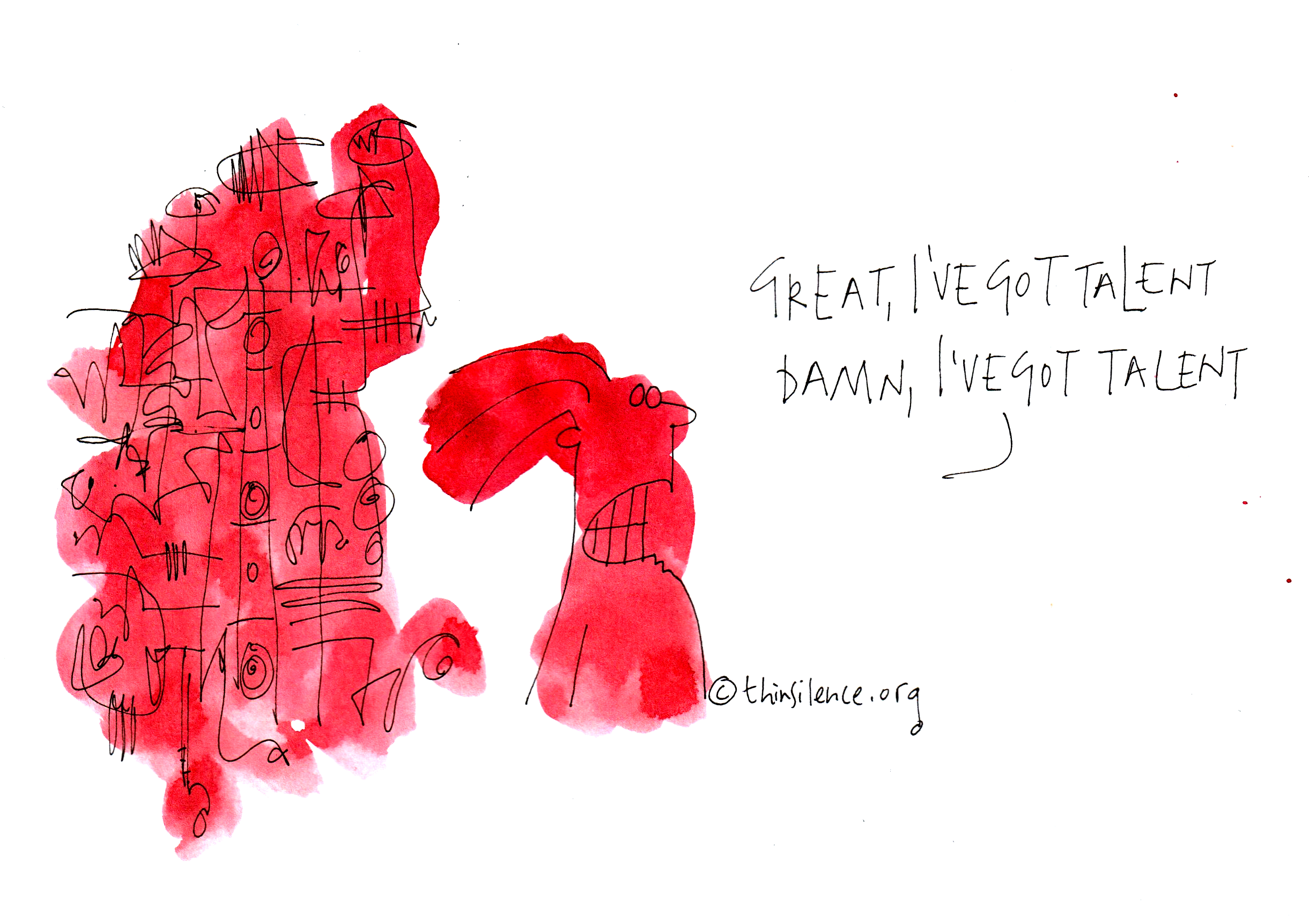
When a job’s worth doing

Work usually represents the area in which the individual’s uniqueness stands in relation to society and thus acquires meaning and value. This meaning and value, however, is attached to the person’s work as contribution to society, not to the actual occupation as such.*
Viktor Frankl

When we bring humanity to the work in a way that others demand, labour is honoured and valued.**
Seth Godin

I was listening to an outreach nurse on the radio earlier,
Telling of how she helped a housebound patient by unblocking
his kitchen sink; it led to him trusting her and allowing her to
help him with his health issues –
Perhaps meaningful and valuable rarely equates to
status and exposure.

Thank you to all those who bring their full
humanity to their work.

*Viktor Frankl’s The Doctor and the Soul;
**Seth Godin’s blog: Productivity, AI and pushback.

Still training after all these years

We don’t rise to the occasion, we fall to the level of our training.*
Ryan Holiday

Inspiration is for amateurs. The rest of us just show up and get to work.**
Chuck Close

I have noticed how work never becomes easier,
Something to do with how it keeps unfolding and
developing when I turn up and put in the effort, so,
Same place, same time tomorrow.

*Ryan Holiday’s Discipline is Destiny;
**Oliver Burkeman’s The Antidote.

Irreplaceable

What aspect of your work is hardest to copy? How can you amplify it?*
James Clear

The goodness inside you is like a small flame, and you are its keeper. It’s your job, today and every day, to make sure that it has enough fuel, that it doesn’t get obstructed or snuffed out.**
Ryan Holiday

It’s not just about talents and abilities,
Each person’s particular goodness amplifies their skills-set, making each
irreplaceable –
So we work on both.

*James Clear’s 3-2-1 newsletter: On becoming hard to copy, the power of fundamentals, and three qualities that matter;
**Ryan Holiday’s The Daily Stoic.

Discoveries ahead


Eudaemonia requires discovery: Of the things you care most deeply about and that transcend your immediate desires. Of the people you most want to emulate. Of the legacy you want to leave. Of your purpose in life. Of the habitual actions leading to the fulfilment of this purpose.*
Victor Strecher

If you’re caught in a norm that isn’t beneficial, it’s not helpful to think of it as a season or phase … there’s no pre-written ending coming to save you. It’s up to you.**
Gabe Anderson

A norm just is,
If you’re stuck in a norm – and sometimes it’s not easy to recognise,
(The fish wondering what water is and all of that),
This is the way things are going to be for quite a while;
Once recognised, though, there are some things we can do:^
Identify your talents, keep a couple of lists for what
you love and loathe, name your values –
Drop me a line about any of this,
I’m happy to help –
And you will find out whether the norm will transform or be
broken open for something else to take its place.

*Victor Strecher’s Life On Purpose;
**Gabe Anderson’s blog: Seasons. Phases. Norms;
^Doing the things can also tell you whether you’re stuck in a norm or not, if you’re not sure.

The call of duty

Never shirk the proper dispatch of your duty, no matter if you are freezing or hot, groggy or well-rested, vilified or praised, not even if dying or pressed by other demands.*
Marcus Aurelius

When we reject narratives that are counter to our story before we even bother to consider them, our story is getting in the way of our path to better.**
Seth Godin

Awake in the night,
I found myself wondering if I was fooling myself
with the story I am pursuing – I am grateful for
the doubting that brought me to reconsider what I see as
my calling and duty; my journaling shows me that
a year ago I had been pondering the small, bespoke, boutique
nature of my work, allowing me to revisit just why
it can be helpful.

It is possible that consider has a navigational origin:
Observe the stars – to examine and reflect on whether
we are continuing on the right course is critical, to
adjust as necessary, but then to do our duty.

How might you describe your duty?
When did you last reconsider it?

*Ryan Holiday’s The Daily Stoic;
**Seth Godin’s blog: Versions of reality.

Slow ideas

Each idea leads to another.*
Keith Haring

An inner alignment starts to develop that can release extraordinary energy and creativity, qualities previously dissipated by denial, inner contradictions, and unawareness of the situation and oneself.**
Peter Senge

Our ability to come up with ideas is astounding,
A single idea can set in motion a whole series of new thoughts;
It’s important for ideas to be made tangible or they’re not worth anything,
But before we rush forward into something we may regret, perhaps:
Nurture practices for becoming more self- and other-aware,
Seek the wisdom of others – past, present, and future,^
Begin small, experimentally – fail and learn, improve and
scale, or quit.

*Keith Haring’s Keith Haring Journals;
**Peter Senge’s The Necessary Revolution;
^I used to be secretive about my ideas, and, when I finally shared them, they were usually rubbish; the shared ideas were way better.

The best stories

The obstacle on the way becomes the way.*
Marcus Aurelius

God made man because he loves stories.**
Elie Weisel

We find ourselves in the best stories when we are
being present, adaptable, imaginative, playful, innovative with
what is happening around or to us;
If we think we’re going to get a story that’s exactly
what we want, we’re going to be
disappointed –
We know the skills to work on.

*Ryan Holiday’s The Daily Stoic;
**Dan McAdams’ The Stories We Live By.

Stories and stories

This is what fools people: a man is always a teller of tales, he lives surrounded by his stories and the stories of others, he sees everything that happens to him through them; and he tries to live his life as if he were telling a story.*
Jean-Paul Sartre

Marginalising the ego, abandoning it to the circumference, is a way of entering the soul. In fact it might be more accurate to say that marginalising the ego is precisely the work of the soul.**
James Carse

Back in 2011, I picked up a copy of
Joseph Campbell’s The Hero With a Thousand Faces, and at
fifty two years of age I was going to be helped to reframe and embrace
many of the stories of my life in a different way –
The myth leads us from our ordinary world into a
special world of challenges and threats, and death and life moments,
Forging who we can be and what we must do with our lives for the sake of others;
We bring these tropes back to our ordinary world towards living
selflessly, generously, and wisely.

Every life looks different from the perspective of a myth.

*Dan McAdams’ The Stories We Live By;
**James Carse’s Breakfast at the Victory.

Powerful

When you’re present, you don’t have control, and you don’t care. When you’re connected to your power, you don’t need to control … What matters is that you understand that being open is powerful.*
Katherine Morgan Schafler

I was thirty years old before I had an actual thought.**
Steven Pressfield

An infinite player seeks to touch and
not to move another,^
Such a person touches from
their true or super power;
The only power worth culturing is
that which recognises the true power of others,
Out of which a different
way of thinking begins to appear.

*Katherine Morgan Schafler’s The Perfectionist’s Guide to Losing Control;
**Steven Pressfield’s Do the Work – the other thinking is merely “monkey brain” or the regurgitated thoughts of others;
^James Carse’s Finite and Infinite Games.

Timefolders

I think songs have a way of talking into the future.*
Nick Cave

The future remembers you. Will you remember it back?**
AleXander McManus

Not all write songs but all
create stories, and through our imaginations
we are capable of folding time – so the future
shapes the present and makes it possible to
rework our past through
recognising our talents, energies, and values,^ and also through
foresight, intention, and love.^^

*Nick Cave and Seán O’Hagan’s Faith, Hope and Carnage;
**AleXander McManus’ Blue Moments;
^Our talents, energies, and values have been shaped through our years and experiences, whether good or bad, meaning that when we recognise these, we shape our stories with reality rather than fantasy;
^^I remember AleXander McManus speaking of shaping the future with foresight, intention, and love, though it strikes me that these qualities also work for the past.