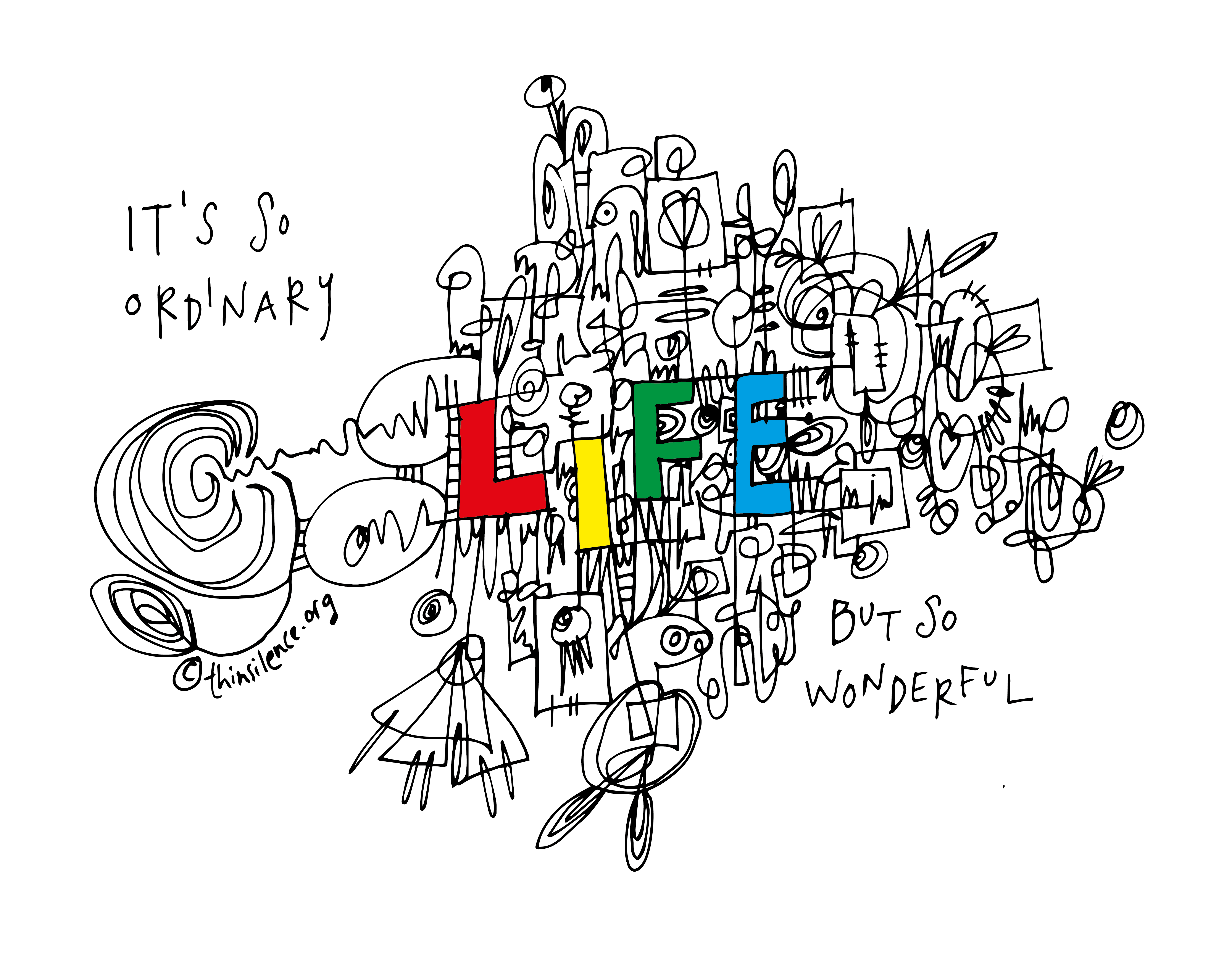
Everyday resurrection

It is a constant effort and hard work – an inexplicably life-affirming – to honour who you are what you believe, and why you are here.*
(Elle Luna)

Erich Fromm redefines resurrection so that we might also experience it in the everyday:

Man and society are resurrected every moment in the act of hope and of faith in the here and now; every act of love, of awareness, of compassion is resurrection; every act of sloth, of greed, of selfishness is death.^

I don’t know about you, but there are many things that don’t quite go as I imagined or planned, so the thought that today comes with the possibility of something being moved from death to resurrection is one that I want to grasp, understanding that it will also take effort and hard work.

There’s plenty to go around, too.

*From Elle Luna’s The Crossroads of Should and Must;
**From Erich Fromm’s The Revolution of Hope.

How do we become people who must?

Fun will require his to see the hidden potential in ordinary things so that we can put them to new uses. The defamiliarisation common to art offers another example of distinction between use and potential.*
(Ian Bogost)

The future is already here, just unevenly distributed.**
(Graham Leicester)

We hear a lot of about abundance from our schools and businesses, from our politicians, and yet the industrial system they maintain appears, on closer observation, looks to be more about scarcity.

All those children who struggle with the education system as it is, ending up in jobs that are more about turning up and functioning than celebrating and developing skills.

We all have more to be and give than we know.

I don’t bring anything revolutionary, only that we all have a must we can find, which we can live out in some way. Perhaps as an amateur or a side-job, if not a career or vocation. All I know is, if we find what it is, it will lead us to somewhere else and then to somewhere else again.

How do we become people who must? Keri Smith’s description of wanderers helps us to see how we can begin the journey to finding and developing our must:

Qualities of great wanderers: curious, inquisitive, nonconformist, rebellious, daring, revolutionary, inventive, visionary, self-sufficient.^

May we follow our curiosity, ask questions, be transformative, identify other paths, experiment, find a tribe, keep iterating, look ahead, and not wait to be called.

*From Ian Bogost’s Play Anything;
**From Graham Leicester’s Transformative Innovation;
^From Keri Smith’s The Wander Society.

Whatcha playing at!

Play is not an alternative to or a respite from work, but the process through which work is done – including the work of play in the sense of leisure and release. […] Thinking worldfully, it is better to think of play as a condition of the universe rather than a human activity – everything is “at play.”*
(Ian Bogost)

Those who experience do not participate in the world. For the experience is “in them” and not between then and the world.**
(Martin Buber)

If we’re charged with playing at something the insinuation is that we are not working, that we’re not committing.

Yet play is how we must describe what we enter into when we take our engagement with something or someone to a deeper, more invested place.

Play is how we must engage with the world if we are not to demean or disrespect it by attempting to take it into our knowing rather than allowing it to be what it is.

From I-in-me, I move to I-in-it, opening the possibility of I-in-us and even I-in-now when something new is generated:^

The revolutionary force in this century is the awakening of a deep generative human capacity – the I-in-now.^

*From Ian Bogost’s Play Anything;
**From Martin Buber’s I and Thou;
^From Otto Scharmer’s Theory U.

Well, we didn’t expect that

To be prepared against surprise is to be trained. To be prepared for surprise is to be educated.*
(James Carse)

And when playing a game, the question is not how to overcome that structure, but how to subject oneself to it […] the play is in the thing, not in us […].**
(Ian Bogost)

If play is a way of entering into the reality of things rather than avoiding them, perhaps we are most alive when we are surprised.

If we try to bring the game into ourselves, we are seeking to overpower the unknown with the known, we are mitigating surprise.

If Ian Bogost is correct in saying play is in the thing and not in us, we must step out of our familiar world into the unfamiliar and unknown.

One way we can approach this play is through reverence: to see something for what it is, someone for who they are, requiring us to step out of world and into theirs:

In order to become attentive to Beauty, we need to discover the art of reverence. […] Ultimately, reverence is respect before mystery. […] Playfulness, humoured even a sense of the anarchic are companions of reverence because they insist on the proper proportion of the human presence in the light of the eternal. Reverence is also the companion of humility. […] The earth is full of thresholds where beauty awaits the wonder of our gaze.^

*From James Carse’s Finite and Infinite Games;
**From Ian Bogost’s Play Anything;
^John O’Donohue’s Divine Beauty.

Conviction

The hunger will give you everything. And it will take from you everything. It will cost your life and there’s now a damn thing you can do about it. But knowing this, of course, is what set us free.*
(Hugh Macleod)

If you keep telling people who they are who their best selves are, if yo keep reminding them of their true identity, there’s a good chance they’ll figure out what to do.**
(Rob Bell)

The sun gives everything to be the sun, but to do its most amazing work, it needs a context. Earth.

A necessary reminder to us that while conviction is critical, context is essential:

Context is what gives meaning.  When you change the context, you change yourself.  This is where freedom lies.  You aren’t fixed, but incredibly fluid and flexible.  You can change and be transformed in incredible ways if you open yourself to new experiences, new situations, and new relationships.^

Such contexts of mutuality – in which both us and the context are developed – also make it possible for us to explore other contexts.

Seth Godin named this zooming, long before Zoom was a thing. You take a journey through continually growing or developing who you are and what you do. You may even frame these as what Joseph Campbell named mythological vision quests:

You leave the world that you’re in and go into a depth, or into a distance or up to a height. There you come to what is missing in your consciousness in the world you formerly inhabited.^^

Explore where your zooming takes you, whilst understanding it to be a story you are telling and growing:

Story is a powerful way of making wholes from disparate parts, weaving elements together to provide an instinctively satisfying sense of coherence.*^

*From Hugh Macleod’s Evil Plans;
**From Rob Bell’s What is the Bible?;
^From Ben Hardy’s These 20 Pictures Will Teach You More than Reading 100 Books;
^^From Joseph Campbell and Bill Moyers’ The Power of Myth;
*^From Graham Leicester’s Transformative Innovation.

Slowly but surely

The life-journey can be a journey of ascent to beauty. The longing at the heart of attraction is the union with the Beautiful. Not everything in us is beautiful. We need to undertake the meticulous work of clearance and clarification in order that our inner beauty may shine.*
(John O’Donohue)

Humans are slow animals […] and what we excel at is distances.  Sustaining a pace for hours our days. 
**
(Rebecca Solnit)

Japanese billionaire Yusaku Maezawa is in the news as he looks for eight people to join him in a trip to the Moon in 2023 without cost.

There are two qualifications. Potential crew members must advance whatever they do to help people and greater society in some way, and to support fellow crew-members with similar aspirations.

It is a good and beautiful sentiment, and whether we travel to the Moon or not, we all get to make a journey, often slowly, from ugliness to beauty, and that beauty becomes light to others:

Bring light to all that is overcast^.

A transformative journey comprises many things, perhaps three to explore and play with today being to see, appreciate and respect. To do so is to allow more light in as well as being able to shed more on others and other things.

Spring is a great time to engage in a simple exercise. Wander outside until you see something that is speaking to you of Spring’s approach. Spend some time simply paying attention to it and take a picture. Open the picture and do a little reflective journaling for about five minutes, describing what you have taken a picture of without using metaphors, so you can’t describe “leaves like blades” or similar. Simply describe what you see and perhaps add some simple illustrations. The aim is to see something for what it truly is without comparing it with something else, to be open to its real value and to respect it. Enjoy.

*From John O’Donohue’s Divine Beauty;
**From Rebecca Solnit’s Wanderlust;
^Plotinus, quoted in John O’Donohue’s Divine Beauty.

Playing with our words

All types of skill teach us the same deep truth: that the more we can immerse ourselves into the forces of play the more freedoms we have.*
(Bill Sharpe)

She had to increase her attention to detail in order to play, which runs counter to our ordinary conception of play as a release of attention and responsibility.**
(Ian Bogost)

I am making a list of my favourite words and some key texts containing them.

Life isn’t about knowing lots of impressive words, nor being called by them in the form of titles.

It isn’t about knowing them with our minds. Primarily, the richest life is experienced knowing and living our important words at a heart level.

A smaller vocabulary operating at a heart level can be more powerful than a larger list at a cerebral level. And such a person will be on the lookout for new words to add that will help them develop what fascinates them most and they long to develop.

Why not try it out for yourself?

Create a list of you favourite words and texts, and make time to reflect on what they are trying to tell you.

One or two a day will soon build up. Noticing how these words are important to you will heighten both your attention and imagination all the way through to doing something exceptional with them.

You may have guessed that Play(fulness) is on my list.

Pay attention.
Be astonished.
Tell about it.^

*From Bill Sharpe’s Three Horizons;
**From Ian Bogost’s Play Anything, referring to his young daughter making a game out of not stepping on the cracks between tiles when visiting a mall;
^Mary Oliver, quoted in Rob walker’s The Art of Noticing.

Playing with responsibility

Between stimulus and response there is a space. In that space is the power to choose our response.*
(Viktor Frankl)

When my dad taught at the University of Buffalo, the heart of his MBA classes was teaching about the ‘change agent’. This is the external force that puts change into motion. The change agent, once identified, gives us an understanding of our options and the need to respond, not to react.**
(Seth Godin)

To each stimulus there are three basic possibilities: we can react, respond or initiate. Fragility, resilience/robustness or antifragility^

To respond, or be response-able, is to be in a stronger place than reacting. To initiate, or choose none of the above, is to be in a stronger place still.

Though we cannot prepare for every thing that comes our way, it is worth going into training. Bob Stilger counsels,

When everything falls apart, we must invite our hands and our heart to come out to play, and ask our analytic mind to wait.^^

We’ll be able to do this if we take to heart Rob Walker’s advice to us, to make time for ourselves:

  • Scheduling creative play
  • Scheduling personal reflection
  • Scheduling specific passion-project focus*^.

We’re increasing the space in which we choose.

*Viktor Frankl, quoted in Rob Walker’s The Art of Noticing;
**From Seth Godin’s blog Tilting at Windmills;
^See Nassim Taleb’s Antifragile;
^^Bob Stilger, quoted in Peter Diamandis and Steven Kotler’s Bold;
*^From Rob Walker’s The Art of Noticing.
It’s just so ordinary

How should we take account of, question, describe what happens every day and recurs every day: the banal, the quotidian, the obvious, the common, the ordinary, the infra-ordinary, the background noise, the habitual?*
(Georges Perec)

Can life ever be ordinary?

Maybe we just treat it so:

To divert the beam of your attention to nature, to take in the staggering scale of spacetime under the starlit sky or the miniature cosmos of aliveness on the scale of moss or the blooming of a single potted flower, is to step beyond the smallness of your own experience, beyond its all-consuming sorrows and its all-important fixations, and into a calibrated perspective that arrives like a colossal exhale from the lung of life.**

Time and attention transports us into wonder, and, as we too are expressions of Nature, we’re able to uncover the extraordinary in what has become ordinary to us.

Ian Bogost encourages us to play anything and find that it can be or become something else:

Heroism permeates ordinary life, in repetitions far smaller and weirder than the flow of the seasons and the years.**

Boredom becomes both a sign that we are not paying enough attention and a portal through which we access a richer world:

Boredom is the secret to releasing pleasure. Once something becomes so tedious that its purpose becomes secondary to its nature, then the real work can start […] games aren’t the opposite of work, but experiences that set aside the ordinary purposes of things^.

Give yourself the gift of ten minutes to gaze at something in nature and then of human origin.

Perhaps a snow-drop. Leaving it’s name aside, consider its colours, form, the struggle it had to arrive, the amazing engine of growth that holds its potential for another season when nothing of it can be seen above the soil, but can take in all it needs from the same soil through its fine roots.

Take an object from around you and consider it in the same way, forgetting its name and considering where it came from, why it was thought to be a good idea, who may have made it, how it came into being, how old it is and how long it may last, the things you might be able to do with it.

Georges Perec coined the term infra-ordinary to describe the opposite to the extraordinary that tends to dominate our attention – there is wonder in the so-called ordinary:

Pay attention.
Be astonished.
Tell about it.^^

*George Perec, quoted in Rob Walker’s The Art of Noticing;
**From Maria Popova’s Brain Pickings: “I Go Down to the Shore”;
^From Ian Bogost’s Play Anything;
^^Mary Oliver, quoted in Rob Walker’s The Art of Noticing.