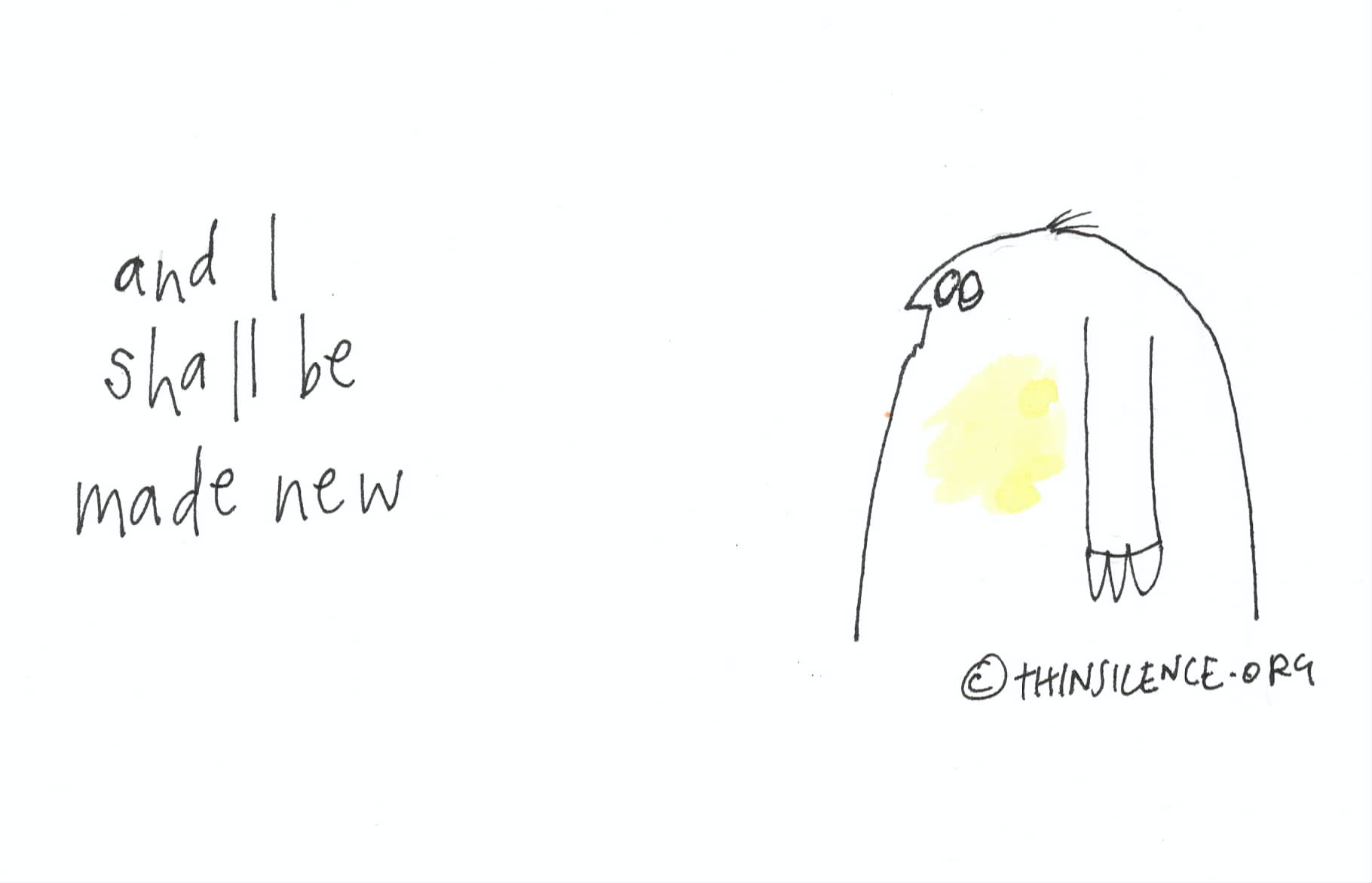
As good as new

it’s a book about making something new out of the old about using what’s in your life now to make up the next part of your life*
Jean Clough

I need this encouragement.

The old body is creaking: neck, fingers, back, feet, hearing.

If I were to focus on the state of the old body, I would think that life was reducing:

We have separated soul from experience, become totally taken up with the outside world and allow the interior life to shrink.**

There’s another part of us that is capable of ongoing renewal:

outwardly we are wasting away, yet inwardly we are being renewed day by day^.

Our lives are full of so many astonishing elements: bringing these out forms my work with all kinds of people towards being able to imagine more

Our inner lives have much to teach us, and:

There is no end to learning.^^

*Jean Clough, from Mary Ruth Broz and Barbara Flynn’s Midwives of an Unnamed Future;
**From John O’Donohue’s Divine Beauty:

^2 Corinthians 4:16;
^^Robert Schumann, from Steven Isserlis’ Robert Schumann’s Advice to Young Musicians.

Slow fashion

To be fully engaged, we must be physically energised, emotionally connected, mentally focused and spiritually aligned with a purpose beyond our immediate self-interest.*
Tony Schulz and Jim Loehr

 clothe yourselves with compassion, kindness, humility, meekness, and patience. Bear with one another and, if anyone has a complaint against another, forgive each other**
The Apostle Paul

Humans have an amazing wardrobe and get to try all kinds of clothes on every day.

*From Jim Loehr and Tony Schulz’s The Power of Full Engagement;
**Colossians 3:12-13.

I didn’t expect that

To follow your gift is a calling to a wonderful adventure of discovery. Some of the deepest longing in you is the voice of your gift. The gift calls you to embrace it, not to be afraid of it.*
John O’Donohue

Instead of asking yourself, “What can I know?” ask yourself, “What at this moment am I meant to know?”**
Austin Kleon quoting W.H. Auden

Don’t expect to remain found when you follow your gift.

It is more likely that you will become lost more often than not, coming upon things you didn’t know you would delight in if had you thought of the gift as supplying you with a road map.

If there is no lostness, no surprise, no incompetence, no morphing, it may be that you haven’t come upon our gift yet.

*From John O’Donohue’s Eternal Echoes;
**From Austin Kleon’s blog: Keep calm and make ugly art, quoting W. H. Auden.

Giving ourselves the chance to be encouraged

The challenge is to find a way of life that will be in harmony with your gifts and needs.*
John O’Donohue

This is the pleasure of limits, the fun of play. Not doing what we want, but doing what we can with what is given.**
Ian Bogost

I add milk, or some alternative, to my oats in the morning to make my porridge. A small amount of oats then becomes a hearty breakfast.

Reading the thoughts of others, being attentive on a walk to what is present all around, these are the liquids the contents of our lives require.

More input: we all need to give ourselves the chance to be encouraged every day.

*From John O’Donohue’s Benedictus;
**From Ian Bogost’s Play Anything.

Indeed

indeed (adv.)
c. 1600, a contraction into one word of the prepositional phrase in dede “in fact, in truth, in reality” (early 14c.), from Old English dæd “a doing, act, action, event” (see deed (n.)).

In-idea to in-deed: the all-important journey.

Fullness

Today the funeral of my father-in-law Derek takes place, and his family and friends will be gathering to remember and give thanks for a life that was quietly full of so many things, and most of all, his family.

Seeds of hope

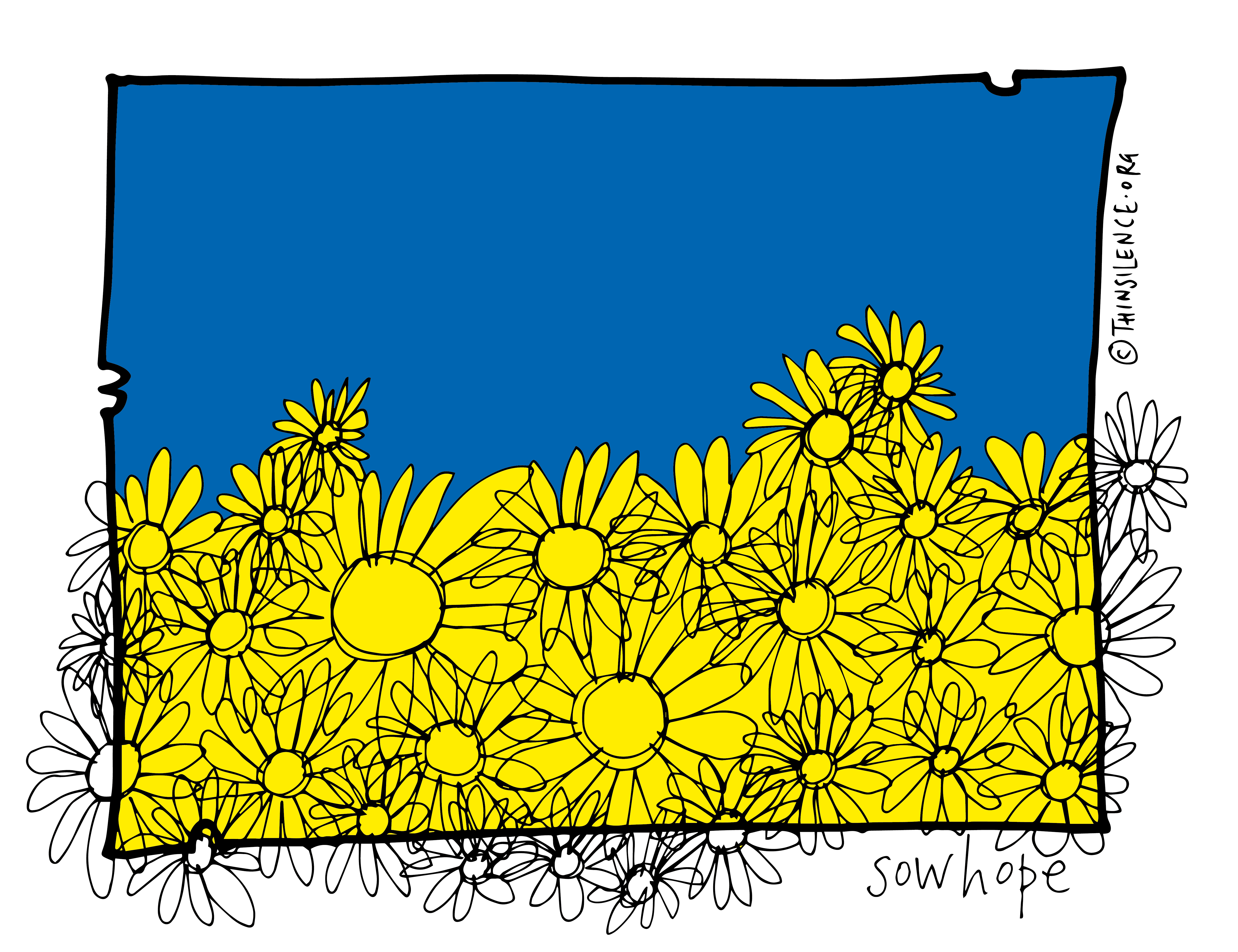
I’ve just discovered that the national flower of Ukraine is the sunflower.

We’re going to be connecting this to our 2022 sunflower festival for the housing estate we live on.

It will also link in to another initiative being planned that I’ll share with you as soon as I am able to.

The great thing about sunflowers is that they’ll grow virtually everywhere.

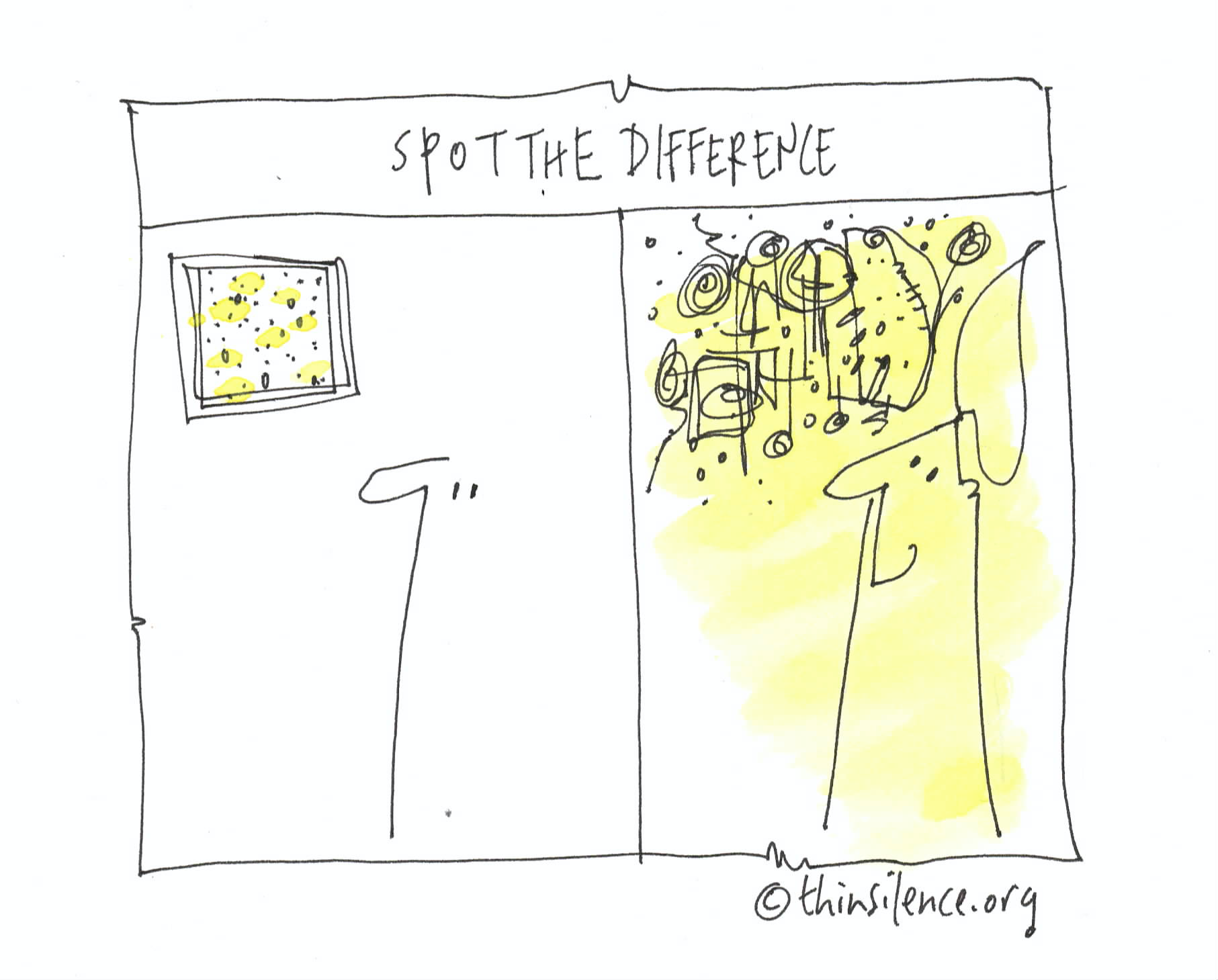
Something’s different

If today was a holiday in your honour, what would it be about?*
Seth Godin

Add to this Rob Walker’s idea** of pulling out a picture you’ve taken of a place and revisit to see how it’s changed.

Mix them up a little and now you have the idea of revisiting yourself, say, ten years ago, noticing what you’re doing now that you weren’t doing then that is important to you and is the things you’d be remembered for?

Of course, this isn’t about looking for a day to honour ourselves, it’s about doing more of what you’ve noticed in ever more imaginative ways for the sake of others.

*From Seth Godin’s blog: How would we celebrate your day?;
**From Rob Walker’s blog: Be a (Re)Visitor.

Playing patiently

In a world geared for hurry, the capacity to resist the urge to hurry – to allow things to take the time they take – is a way to gain purchase on the world, to do the work that counts, and to derive satisfaction from the doing itself, instead of deferring all your fulfilment to the future.*
Oliver Burkeman

Instead of calling everything a game, we should think of everything as playable: capable of being manipulated in an interesting and appealing way within the confines of its constraints.**
Ian Bogost

When we slow down, we are able to reconnect playfulness with seriousness.

Oliver Burkeman counsels how we must ‘slow down to the speed that art demands’.*

John O’Dohonue anticipates this when he writes,

This is what all art strives for: the creation of a living permanence.^

Whatever the most artful and lasting things are that we produce through our living, they are not going to happen in a hurry.

I’ll be taking to heart the three “rules of thumb” provided by Burkeman for exploring the power of patience:

The first is to develop a taste for having problems. … The second principle is to embrace radical incrementalism. … The final principle is that, more often than not, originality lies on the far side of unoriginality.*

I connect the first with the first elemental truth of “Life is hard,” that life is working on one problem after another, but a life without problems would be a boring life.

The second is about turning up, doing a little often. I connect this with the response of faithfulness: finding small ways to do what I value and what I do, every day.^^

The third encourages me to trust the path with a heart, that may not be original at the outset but will bear fruit as my slow journey in the same direction.

*From Oliver Burkeman’s Four Thousand Weeks;
**From Ian Bogost’s Play Anything;
^From John O’Donohue’s Benedictus:
^^Something I will take to heart for beginning that second book.