Noticing is about letting yourself out into the world, Rather than siphoning the world into you In order to transmute it into words. Verlyn Klinkenborg
Wonder and humility are wholesome emotions, and they do not exist side by side with a lust for destruction.** Rachel Carsons
Some want the world, Or some larger piece of it. Better for the world to have us entirely, That a larger world form inside us, A world we might share:
As Rilke says, ‘Hier su sein ist so viel – To be here is immense.’ Nowhere does the silence of the infinite lean so intensely as around the arm of a newly born infant. Once we arrive, we enter into the inheritance of everything that has preceded us; we become heirs to the world.^
Trauma is at the core of who are are as people. If we transform it, we can become unstoppable in what we’re trying to accomplish. If we don’t transform our trauma, then our lives become its by-produce.* Ben Hardy
Trauma is our common experience.
Turn towards it and there is the possibility of transformation, Turn away and it will likely ever haunt us.
Turn towards and we begin to free our imaginations:
We use imagination not to escape from reality but to join it, and this exhilarates us because of the distance between and an apprehension of the real.**
We collect our treasures held in common with others. Our commonplaces, though, promise uniqueness:
Each one is unique to its creator’s particular interest but they almost always include passages found in other texts, sometimes accompanied by their compiler’s responses.^
From such common things, placed together In new ways, emerges a uniqueness:
I don’t think of it as art – I just make things I like bigger, assuming that if I like them some other people might too. Some do, some don’t, and that’s alright too.^^
When we find each other, as I think we must, then we create a communitas of possibility for others. We all need help:
“Scenius”: a whole scene of people who are supporting each other, looking at each other’s work, copying from each other, speaking ideas, and contributing ideas.*^
We need what only you can bring. You are a once in a lifetime possibility:
There is a vitality, a life-force, an energy, a quickening that is translated through you into action and because there is only one of you in all of time, this expression is unique. And if you block it, it will never exist through any other medium and be lost.^*
BOKETTO n. Gazing vacantly into the distance without really thinking about anything specific. It’s nice that the Japanese think so highly of thinking about nothing much at all that they actually gave it a name. With the overcrowded and hurried lives we often lead, it can refresh the mind to go wander, with no destination in particular.* Ella Frances Sanders
That which we call imagination is from the first an attribute of the senses themselves; imagination is not a separate mental faculty (as we so often assume) but is rather the way the senses themselves have of throwing themselves beyond what is immediately given, in order to make tentative contact with the other sides of things that we do not sense directly, with the hidden or invisible aspects of the sensible.* David Abram
The imagination keeps the heart young. When the imagination is alive, the life remains youthful.** John O’Donohue
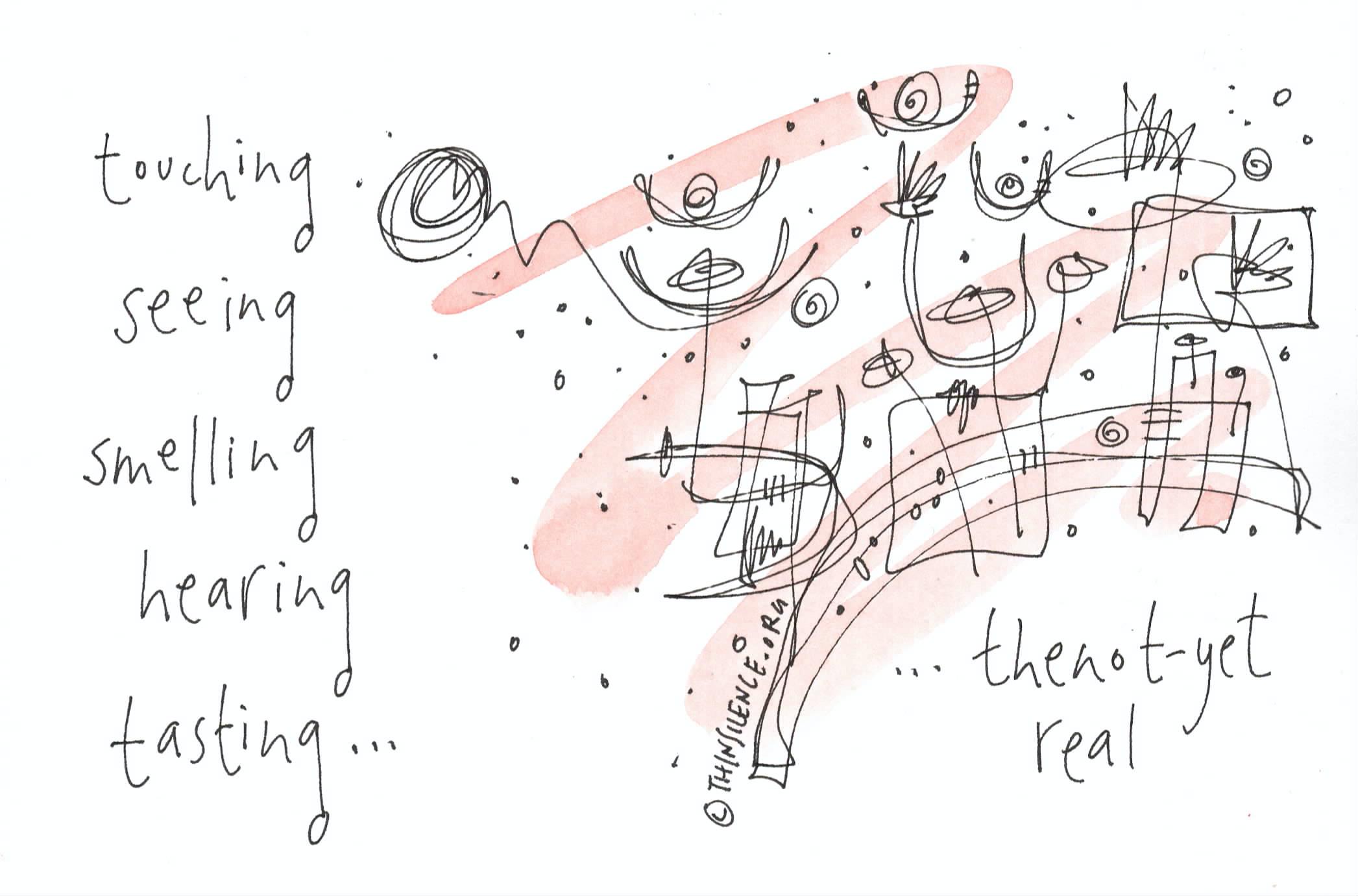
A sensual world invites us to smell, touch, hear, fast, see our imaginations into life-in-all-its-fullness.
To be open and not closed to the more that will surround us today, In the natural world – of which we are a part – And the worlds of our makings.
May we imagine more today than yesterday, And more tomorrow than today:
The first great wonder at the world is big in me.^
No one can make you feel inferior without your consent.* Eleanor Roosevelt
Start by learning to recognise what interests you. Most people have been taught that what they notice doesn’t matter, So they never learn how to notice, Not even what interests them.** Verlyn Klinkenborg
It often feels that I am only beginning to get the hang of living inside this life.
What if I could begin again? Knowing what I know now, What would I leave out and avoid? What would I leave in and why?
If it were somehow possible to make this wish, Would I take it from the genie?
Probably not.
Somehow this mix of good, bad and ugly has brought me here, And if I were to tinker with any of that, I suspect I may not be here today – Doing what I love to do – But somewhere else entirely.
Walking on earth is a miracle! We do not have to walk in space or on water to experience a miracle. The real miracle is to be awake in the present moment. Walking on the tree earth, we can realise the wonder of being alive.^
But if you want to go your individual way, it is the way you make for yourself, which is never prescribed, which you do not know in advance, and which simply comes into being of itself when you put one foot in front of the other … along the path prescribed by your unconscious … the next and most necessary thing.* Carl Jung
the essential thing “in heaven and earth” is … that there should be a long obedience in the same direction; there thereby results, and has always resulted in the long run, something which has made life worth living** Frederick Nietzche
Why do you think this is the end, That there is no new possibility?
Railing against the stories prescribed for us is, in the end, acquiescing.
“I am not this!” is a waste of energy when we could be exploring and being our truest self, doing the next thing whispered from within.
A changing of both the future and the past:
Although an initial reaction may be highly negative or debilitating, all painful experiences can be reframed, reinterpreted, and ultimately used as growing experiences.^
Then this is not the end, It is more likely a beginning, And you have grit as well as talent, Enlarged through small steps:
In the long run … grit may matter more than talent.^^
Apart from the stories others provide for us, When we faithfully do the things we must do – Including faithfulness to ourselves – We will find that we have travelled a great and meaningful distance:
And so the best we can do is walk step by next intuitively right step until one day, pausing to catch our breath, we turn around and gasp at a path. If we have been lucky enough, if we have been willing enough to face the uncertainty, it is our own singular path, unplotted by our anxious younger selves, untrodden by anyone else.*^
I went to the woods to live deliberately, to front only the essential facts of life … so that when it comes time to die, I will not discover I have not lived. Living is so dear.* Henry David Thoreau
The imagination is not what you play with, the imagination plays with you. It has the power both to create and destroy, in form and deform.** Mary Ruefle
If you have found your “woods,” And you dwell there more than not, You are blessed.
It is a demanding place, Where curiosity and imagination are honed, Activeness too, Forcing growth:
I profoundly believe that we don’t grow into creativity; we grow out of it.^
If there is no growth then we may still need to find our “woods.” Comfortable can become deleterious, Even toxic:
Where in your life or your work are you currently pursuing comfort, when what is called for is a little discomfort? … Choose uncomfortable enlargement over comfortable diminishment whenever you can.^^
Exploring the “woods” of others can be a place to begin, Or to begin again.
A child lives in a world of stories and metaphors long before he or she learns literality. So the language of our heart and the language of our soul is metaphorical not literal.* Robert Dilts
Rather than facing our fears, and rather than facing the truth, we avoid them. Rather than creating the life we want, we build the life that allows our problems to exist unresolved. Rather than becoming the person we want to become, we stay the person we are. Rather than adapting our personality to match our goals, we adapt our goals to match our current and limited personality.** Ben Hardy
We misunderstand imagination if we believe it helps us turn from reality. Reality is only waiting for imagination to come and play some new reality into being.
What we call the personality is often a jumble of genuine traits and adopted coping styles that do not reflect our true self at all but the loss of it.* Gabor Mati
In what condition is my relationship to the instinctual Self? When was the last time I ran free? How do I make life come alive again?** Clarissa Pinkola Estés
You and I are more than we appear to be.
You and I are covered over, Layers of rush and busy, Of outwith and objet.
You and I are being called to the wild places of solitude and curiosity, Of within and gift.





 THIN|SILENCE
You must be logged in to post a comment.