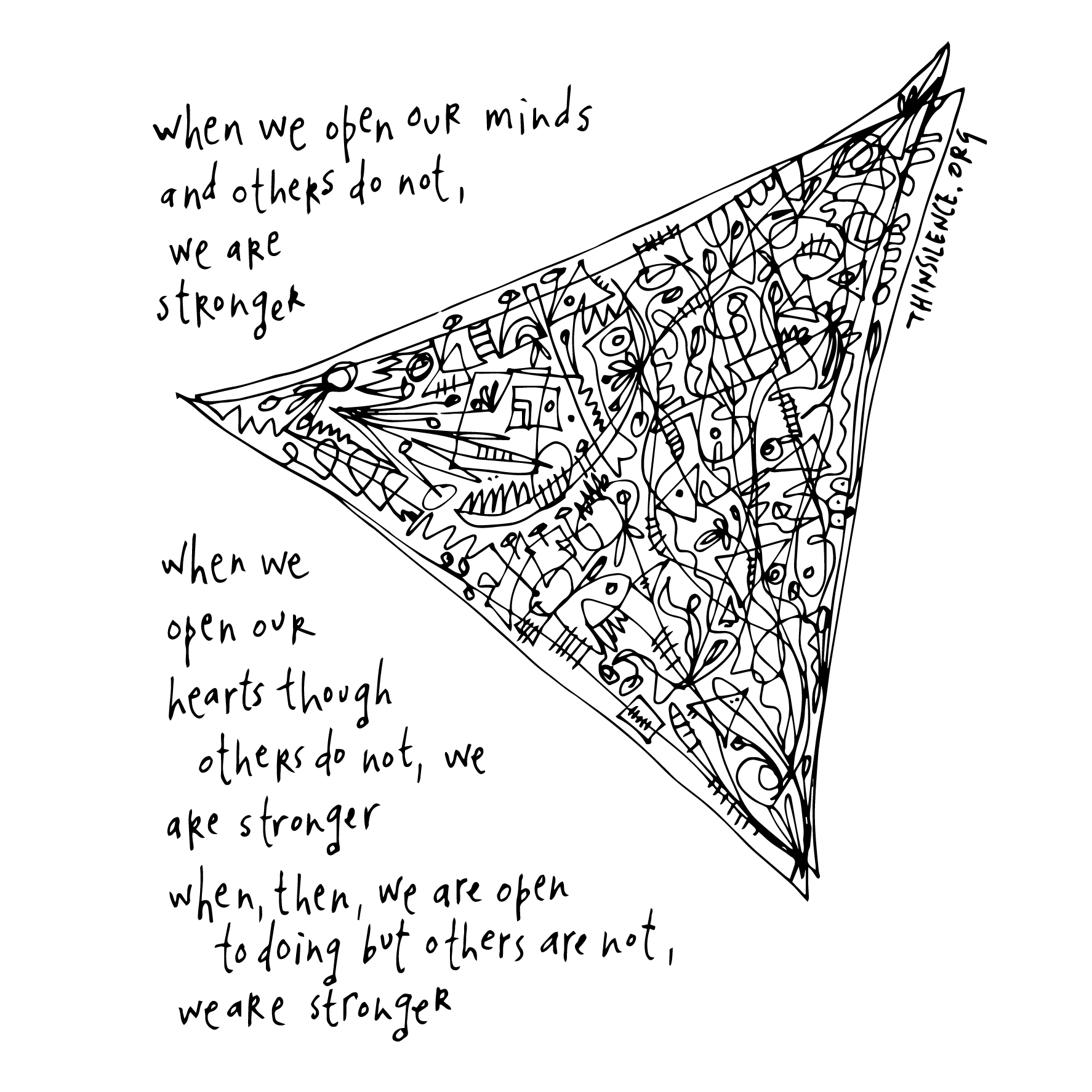
I am because we are

Life and Reality are not things you can have for yourself unless you accord them to all others.*
(Alan Watts)

Art calls us to recognise our pain and aspirations and open our minds to others.  Art helps us […] to realise that we are not alone.’**

It was an evening for supporting a charity involved in the education of young people in a country thousands of miles away.

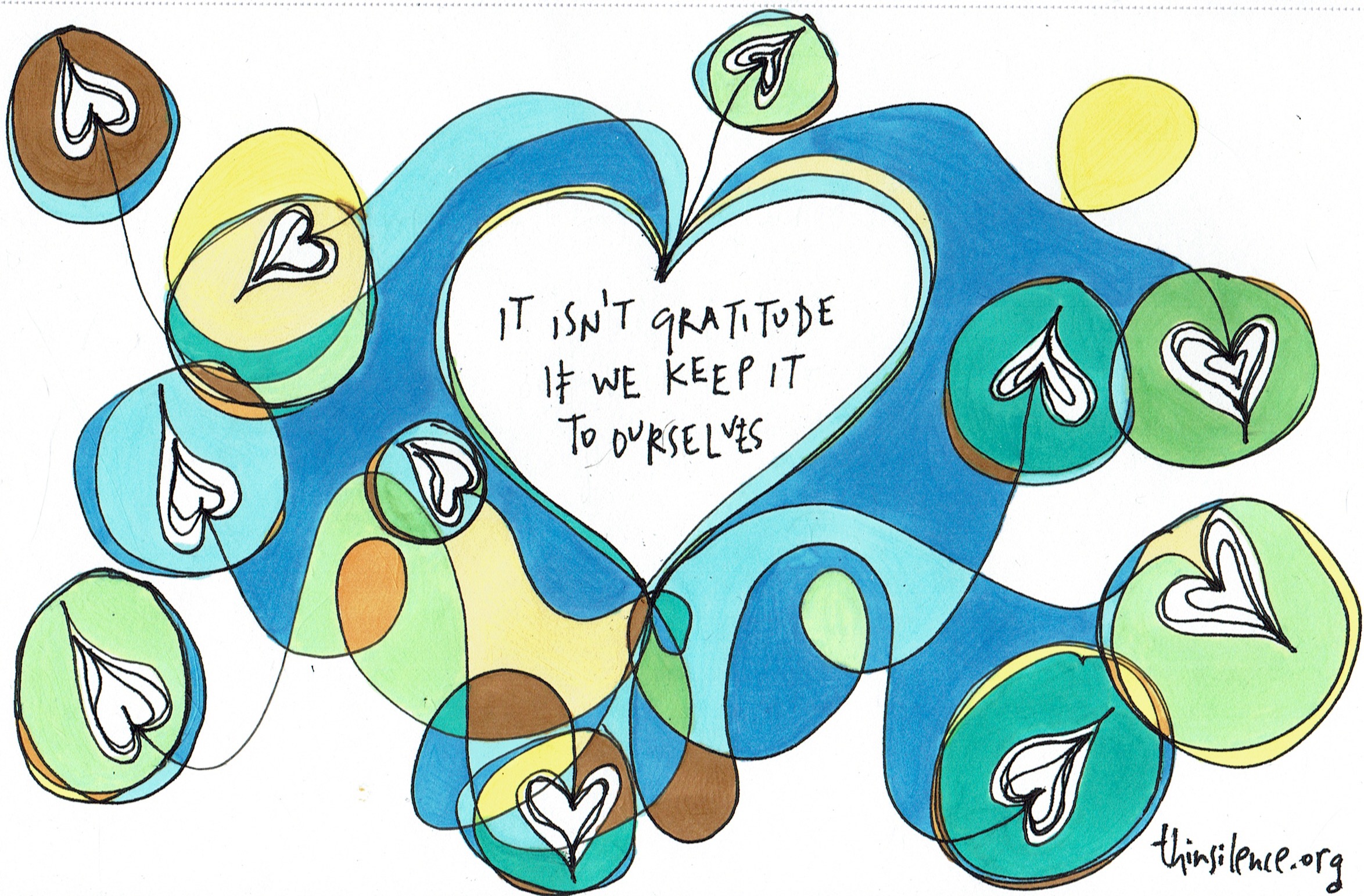
Stories of some of these young lives were shared in a variety of ways, set within an evening of simple art: poems, songs, photographs, storyboards, doodles and sketches.  Those who had gathered sometimes laughed and sometimes deeply sighed in connection at the sense of profound truth.  We were reminded of ubuntuI am because we are.

This is an experience we’re increasingly alienated from but trying to rediscover:

“We seek a private house, a private means of transportation, a private garden, a private laundry, self-service stores, and do-it-yourself skills of every kind.  An enormous technology seems to have set itself the task of making it unnecessary for one human being to ask another in the course of going about his daily business. […] We seek more and more privacy, and feel more and more alienated and lonely when we get it.”^

Sociologist Philip Slater was writing in 1970 about American society but could have been describing most Western societies.  Almost fifty years later, our worlds are even more separated – our poor rich world:

‘Every social association that is not face-to-face is injurious to your health.’^^

Some believe the next Human age will be one of ubuntu – finding one another.  It will not be easy.

We come across people who are so different to us that we feel we can never find anything in common.  Yet, when we transcend our differences, we find we have more in common than we know – everyone has a deep richness to bring:

‘Whoever is capable of giving of himself is rich.’*^

(*Alan Watts, quoted in Maria Popova’s Brain Pickings: I and Thou.)
(**From Karen Armstrong’s Twelve Steps to a Compassionate Life.)
(^Philip Slater, quoted in Kosuke Koyama’s Three Mile an Hour God.)
(^^From Nassim Taleb’s The Bed of Procrustes.)
(*^From Erich Fromm’s The Art of Loving.)

Wonder and dissent

When you wonder, you are drawn out of yourself.*
(John O’Donohue)

when the universe makes me wonder, all is at it should be**

Nothing is perfect.  We can always imagine something better.

The healthiest dissent comes from within and not without, from wonder and not from cynicism.

It all begins within ourselves.

(*From John O’Donohue’s Eternal Echoes.)
(*Cirque de Soleil’s Varekai, quoted in Alex McManus’ Makers of Fire.)

You know the way

To create today is to create dangerously.*
(Albert Camus)

You don’t have to strap yourself to a rocket to follow your dreams, unless you dream of heading for Mars.

It’s about identifying and developing the talent or genius that is yours and then holding it out there for others – the dangerous bit.

You know what it is.  Your heart will guide you.

(*From Albert Camus’ Create Dangerously.)

The art of lopsidedness (and finding each other)

This combination of collection and contemplation is central to effectively curate ideas and learn to predict the future.*
(Rohit Bhargava)

[The Miser] remains cold and indifferent to the joys and sorrows of others, even his own […] the memory of past feelings or experiences is the only form in which he is in touch with how own experiences.’**
(Erich Fromm)

For the whisky distiller, the “middle cut” is the flow of alcohol that is taken and casked after the volatile alcohol from the beginning of a distillation run and the bad tasting alcohol at the end of the run has been avoided.  Something really interesting then follows.  The alcohol can be casked in similar containers, stand side-by-side in the same environment, and yet turn out completely differently because of the smallest of influences in the casks.

There are a number of things I take from this as illustrating who we are and what we can be as humans.

We all have more volatile (unstable) and bad tasting characteristics but I believe there is a promising middle cut to all of us.  The way we each then collect from life and reflect upon these things produces very different people.

This is my hope: all of us can find our difference

Youngme Moon writes about how our determination to be like others or more well-rounded will not add but detract from our difference:

‘The truth of the matter is, true differentiation – sustainable differentiation – is rarely a function of well-roundedness; it is typically a function of lopsidedness.  The same can be said of excellence.’^

Instead of looking at others and wishing we were more like them – perhaps this is something Erich Fromm’s miser, we look at them and are glad that they are like them.

Walt Whitman captures something of this when he describes how his mother was captivated by a native American woman calling at their home asking if there is any work for her.  I include it at length simply because of how it illustrates how one person can be so open to another:

‘My mother looked in delight and amazement at the stranger,
She looked at the beauty of her tallborne face and full and pliant
     limbs,
The more she looked upon her she loved her,
Never before had she seen such wonderful beauty and purity:
She made her sit on a bench by the jamb of the fireplace … she
     cooked food for her,
She had no work to give her but she gave her remembrance and
     fondness.

The red squaw staid all the forenoon, and toward the middle of the
     afternoon she went away:
O my mother was loth to have her go away,
All the week she thought of her … she watched for her many
     a month,
She remembered her many a winter and many a summer,
But the red squaw never came more was heard of there again.’^^

The miser cannot see the middle of another nor themselves.  This inability reduces our capacity to imagine the future, which means, a better today.  I haven’t come up with a name of the person who is the opposite to the miser but they are marked by there ability to notice more – including how much they have, to reflect and imagine creatively as a result of what they have, and then the ability to act, to create, to explore as only they can.

Today is not only a sequel to the past but is also a prequel to the future.

(*From Rohit Bhargava’s Non Obvious – 2015 edition.)
(**From Erich Fromm’s The Art of Being.)
(^From Youngme Moon’s Different.)
(^^From Walt Whitman’s Leaves of Grass.)


ONE LINK TO MY BOOK AND CARDS AT METHODIST PUBLISHING

All at Methodist Publishing


Life: you’ve gotta squeeze it a little

I would love to live
Like a river flows,
Carried by the surprise
Of its own unfolding.*
(John O’Donohue)

[Keith] Jarrett didn’t produce a good concert in trying times.  He produced the performance of a lifetime, but the shortcomings of the piano actually helped him.**
(Tim Harford)

It’s 1975 in Cologne, Germany and Keith Jarrett is sat in a car in the rain having walked out from the venue that had supplied a sub-standard piano for what was to be a sell-out performance.  Jarrett had asked for a Bösendorfer but the instrument supplied was too small for the venue, out of tune, with the middle black notes not functioning.  A nineteen year old Vera Brandes had arranged this performance and she came out to the car and pleaded with Jarrett to go ahead.  He relented and what followed was a performance that produced an album that has outsold all other solo jazz albums and solo piano albums.

Tim Harford opens his book Messy with this story, warning against the “tidiness temptation.”  Life is messy and when we embrace this, we find some of the most beautiful things come into being.  Constraints and limitations aren’t the trouble we think they are:

‘In a world without constraints, most people take their time on projects and assume far fewer risks, while spending as much money as you’ll give them.’^

We each come with limitations and constraints built in.  When we reject rather than embrace these, we can end up looking around us for everything being absolutely right before we’ll try something different.

There’s a relationship between messiness and tidiness and when these get out of kilter then we begin to have problems.  Messiness can swing into chaos and tidiness can become regimentation, we end up bottling the past and calling it the future.  Nassim Taleb knows a lot about messiness – or randomness as he names it.  In his book about thriving in a random universe, he writes:

‘You cannot look at the future by naive projection of the past.’^^

Here we are with another day.  It doesn’t wish us any harm, it offers to all of us the basics of air to breathe, time to use and space to move in and through.  It just needs some squeezing: a different way of seeing, the finding of challenges, asking questions, seeking possibilities and knocking on the doors that won’t open easily.

‘Young writers often think – are taught to think – that a story starts with a message.  That is not my experience.  What’s important when you start is simply this: you have a story you want to tell.  A seedling that wants to grow.  Something in your inner experience is forcing itself up towards the light. […] As you write a story, if you can let it become itself, tell itself fully and truly you may discover what it’s really about, what it says, why you wanted to tell it.’*^

(*From John O’Donohue’s Echoes of Memory.)
(**From Tim Harford’s Messy.)
(^From Peter Diamandis and Steven Kotler’s Bold.)
(^^From Nassim Taleb’s Antifragile.)
(*^From Ursula Le Guin’s Words Are My Matter.)


STILL TIME TO GET YOUR EASTER CARDS

10 cards for £2.99 (plus postage)

The gamemakers

We all have our defaults.  Are yours helping you?*
(Seth Godin)

our instincts, our cravings, the things and places and ideas we burn for, the intuition that shells up from somewhere deep inside us**
(Elle Luna)

Knowing who we are and what can be our contribution provides us with the power to be playful – I am thinking about values, talents and passions which make it possible to be playful in the things we have to do, even in the things that are definitely not our first choices.  Of his book Flow, Mihaly Csikszentmihalyi writes:

‘In fact, one purpose of this book is to explore ways in which even routine details can be transformed into personally meaningful games that provide optimal experience.’^

Csikszentmihalyi names these “microflow” activities.  I am being reminded – and I need to be – how we can play our games within the activities of the day.  Johan Huizinga writes of playfulness as something we have known and lost and are able to regain, something always useful to the vibrancy of ancient societies (Huizinga was writing at the beginning of the twentieth century so his choice of words sounds strange to our ears):

‘This temporary abolition of the ordinary world is fully acknowledged in child-life but it is no less evident in the great ceremonial games of savage societies.’^^

There are times when we get to thoroughly play our games and other times we can be playful within the games of others: flow and microflow:

‘”The purpose of the flow is to keep on flowing, not looking for a peak or utopia but staying in the flow.” […] In normal life, we keep interrupting what we do with doubts and questions. […] But in the flow there is no need to reflect, because the action carries us forward as if by magic.’*^

The ultimate aim is to be so free and flowing in our playfulness and gamefulness that it becomes possible for us together to create new games that bring in a better future for the one or for the many.

(*From Seth Godin’s blog: Getting the default settings right.)
(**From Elle Luna’s The Crossroads of Should and Must.)
(^From Mihaly Csikszentmihalyi’s Flow.)
(^^From Johan Huizinga’s Homo Ludens.)
(*^From Mihaly Csikszentmihalyi’s Flow, including a quote from a rock climber.)

Two universes

It is like the anthropic argument: If I had designed [the universe] differently, it wouldn’t have produced me.  So that is a meaningless question.  I’m prepared to make do with the universe we have, and try to find out what it is like.*
(Stephen Hawking)

All of us are smarter than any of us, so the value to all goes up when you share.**
(Seth Godin)

Stephen Hawking is responding to the question of how we would have created the universe differently.

There’s something in his response that is about about living in the direction of life rather than against it.

Here we are with all of this consciousness and awareness and what will we do with it to see all things thrive?

Seth Godin writes in his delightful eBook Graceful:

‘No one is born graceful. It’s not a gift. It’s a choice.’^

Gracefulness is something we’ imagined and provided expression for because we’ve taken a look at the universe and decided it’s more about abundance than it is about scarcity.

The more we act out of ego – an untrue understanding of ourselves (perhaps too high or too low an opinion of ourself and others, or an opinion that the world is here for us to use and abuse), the more the universe appears to be a place of scarcity.

The more we act out of eco – connectedness to all things and all people – an astonishing transformation takes place, the universe becomes a place of abundance. It’s the closest thing to alchemy and quite astonishing.

I feel my daily quest increasingly to be the exploration of ego to eco.

Without this mystery I can only survive.

(*Stephen Hawking, quoted in Maria Popova’s Brain Pickings: Stephen Hawking on the Meaning of the Universe.)
(**From Seth Godin’s blog: Yes, there’s a free lunch.)
(^From Seth Godin’s Graceful.)

The alacrity factor

This, then, is the problem with uniform systems of measurement: The more entrenched a system of measurement, the more difficult is for a deviant, and outlier, or even an experimenter to emerge.*
(Youngme Moon)

Unless there’s an obvious reason to do otherwise, most of us passively accept decision problems as they are framed and therefore rarely have an opportunity to discover the extent to which our preferences are frame-bound rather than reality-bound.**
(Daniel Kahneman)

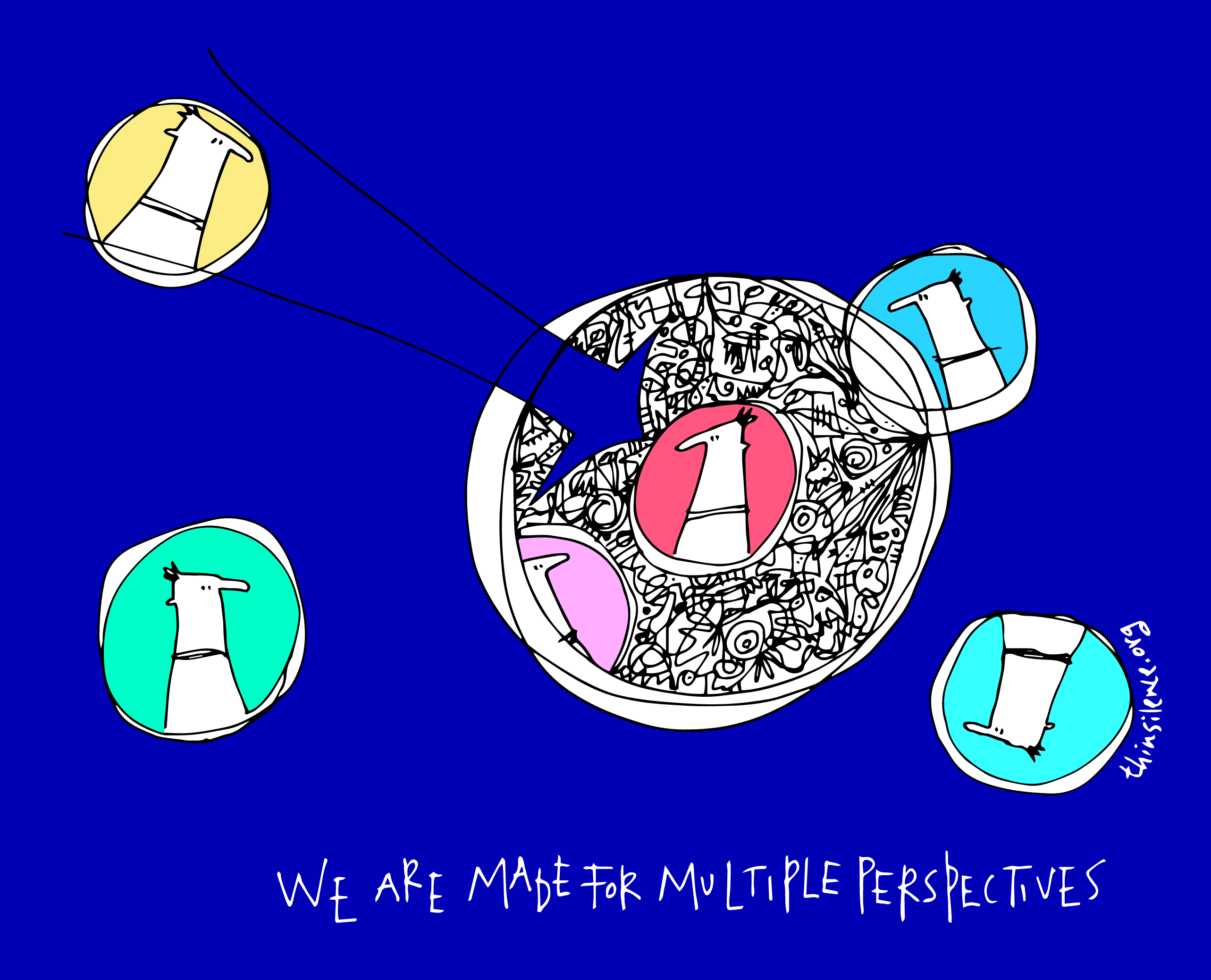
There may be another way of seeing things – everyone has a perspective.

Different perspectives bring conflict, however, and we don’t like conflict.  Yet conflict is a good thing more often than we realise.  The problem is how we work with it.  Visual artist Aftab Erfan takes the view that ‘conflict is unavoidable, that it is fundamentally a good thing,’ believing it to be ‘a doorway to wisdom and personal growth.^

Erfan reminds me of Scott Peck’s point in his book The Different Drum, how we have to move through chaos and emptiness towards community.  These three stages lie beyond pseudo-community – defined by everyone getting on with each other in a superficial way.  We may think that community is where we are trying to return to out of the chaos of disagreement and conflict but Peck’s point is that what we are seeking to return to is, in fact, pseudo-community.  Theory U echoes this in a number of ways.  Otto Scharmer writes about downloading, in which we don’t shake up our world or anybody else’s (pseudo-community).  This is followed by openness to another view, but which one will win (conflict, even chaos).  If we move forward, though, instead of returning to downloading, we will enter into dialogue (listening to the other, emptiness).  Beyond this, there is the possibility of new imaginings and possibilities that can only emerge from generative dialogue (community or “glory” as Peck described it).  –  believing generative dialogue lies beyond agreeing about everything for an easy life, or one argument winning over the other, to something new being imagined and created.

One of the important elements for the new-possible is to be different.

Youngme Moon writes about how providing feedback to her students in a particular way – naming five areas of performance – had an unforeseen outcome.  Her students now wanted to improve in their weaknesses.  This drive to improve weaknesses would only lead to everyone being the same.  She admits:

‘Just about everyone in my class was focused on improving their weaknesses. […] No one was playing to their strengths anymore  As a result, our class discussions had begun to lose their sparkle.’*

What Moon discovered in her classroom repeats in just about all areas where humans come together.  Friedensreich Hundertwasser named five skins we wear, and the fourth – social environment and identity – requires that we define ourselves if we are not to conform to others (the other skins are: epidermis, clothing, home and our planetary skin).

We need to know how we are different to contribute to bringing forth the new:

‘It is, however, through difficulty and opposition that we define ourselves.  The mind needs something against which it can profile and discover itself.’^^

Next time we’re in a room and ready to capitulate to the person who’s speaking most confidently and eloquently, let’s remember no one alone is wise to the point of all-knowing, rather, we are wise together.  Then let us share our thought, picture, feeling, song or difference.

Alacrity: brisk and cheerful readiness.

(*From Youngme Moon’s Different.)
(**From Daniel Kahneman’s Thinking, Fast and Slow.)
(^Aftab Erfan, from Drawn Together Through Visual Practice.)
(^^From John O’Donohue’s Eternal Echoes.)