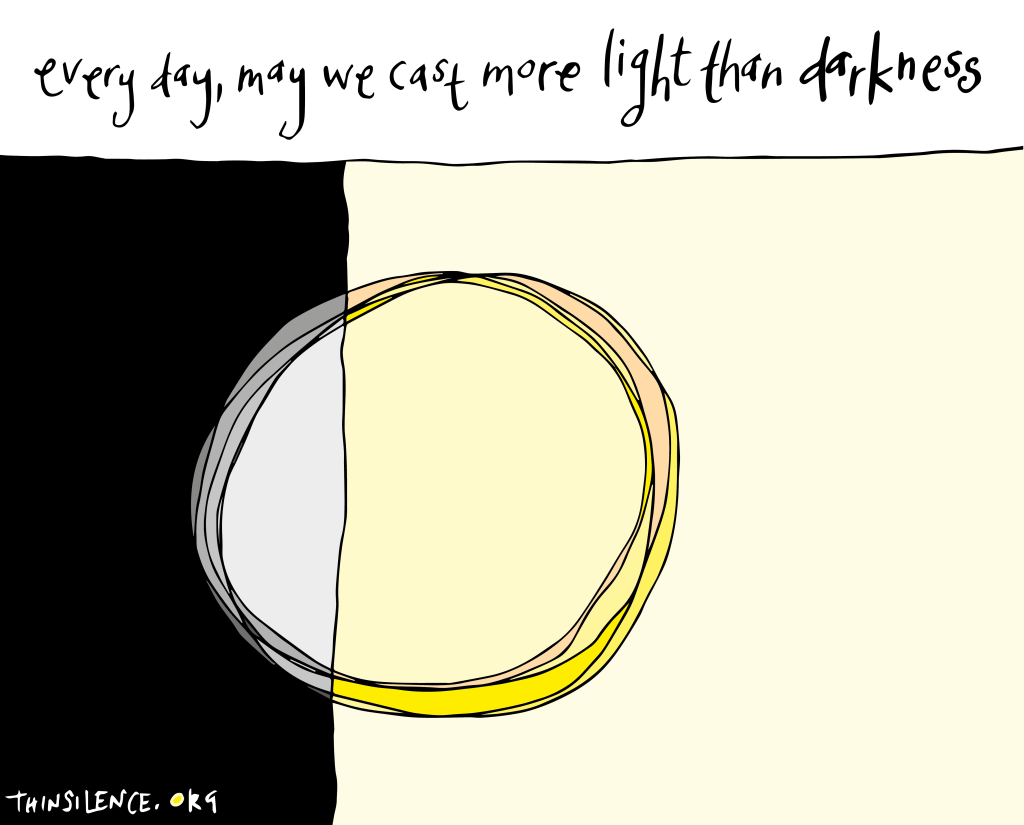
The humble perspective

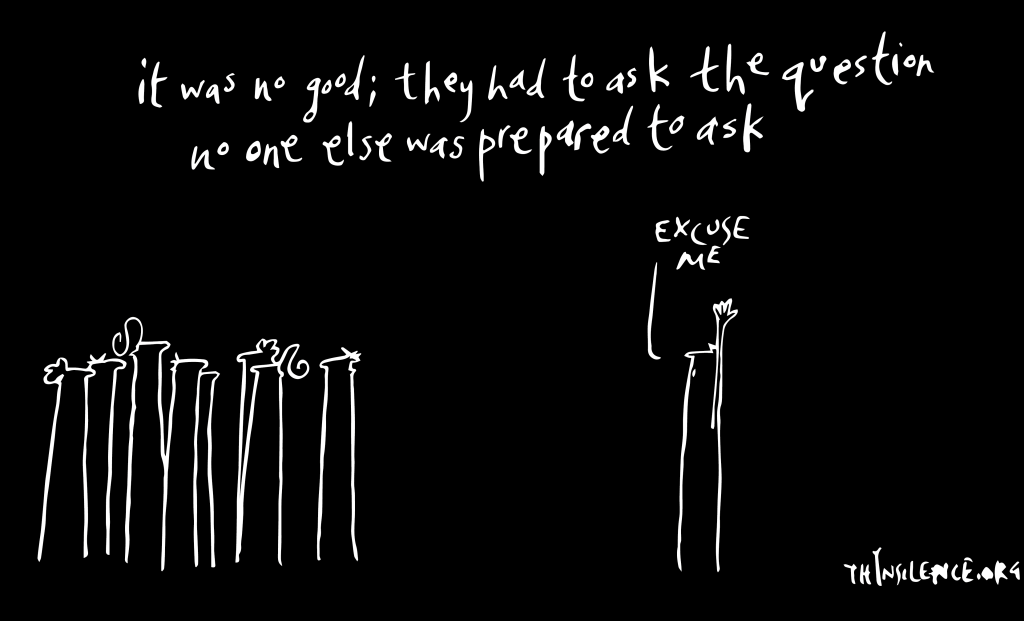
The purpose of life is to see.*
(Jack Turner)

It was less like seeing than like being for the first time.**
(Annie Dillard)

When Jesus of Nazareth said that the meek will inherit the earth there must have been those who thought this the most ridiculous thing they’d heard. I’m wondering, though, whether Jesus was encouraging us to embrace humility as a way of positioning ourselves better to all that is, being able to see more, feel more and, whenever and wherever possible, do more – as Seth Godin counsels:

We become original through practise.^

We’re not looking on the kind of humility that denies its own talents but knows its talents precisely and develops them, and, knowing others have talents, wants these to be known precisely and developed, too – even towards making it possible to collaborate.

It is this journey of seeing, feeling and doing more that brings us to ourselves and to others most fully: presence as Theory U has it, made possible by opening the mind, the heart and the will to the other:

I must know that I am, at least in part, the very thing I am seeking.^^

This works on a national scale, too, challenging so-called national pride to name precisely its talents and responsibilities, whilst also respecting and encouraging other nations to do the same, all towards a wonderful cornucopia of wonderfully original contributions.

This kind of humility is never a dead-end and always a portal of possibility for inheriting the earth.

(*Jack Turner, quoted in Terry Tempest Williams’ The Hour of Land.)
(**Annie, Dillard, quoted in Brian McLaren’s God Unbound.)
(^From Seth Godin’s blog: Two kinds of practice. I’ve altered the original “practice” to “practise.”)
(^^From Richard Rohr’s Eager to Love.)

Redefining abundance

An apt Wendell Berry quote comes to mind, about there being no such thing as sacred and secular places, but rather sacred and desecrated places.*
(Brian McLaren)

Those phenomena with which we have no affinity and which we are not in some sense ready to see are often not seen at all.**
(Thomas Kuhn)

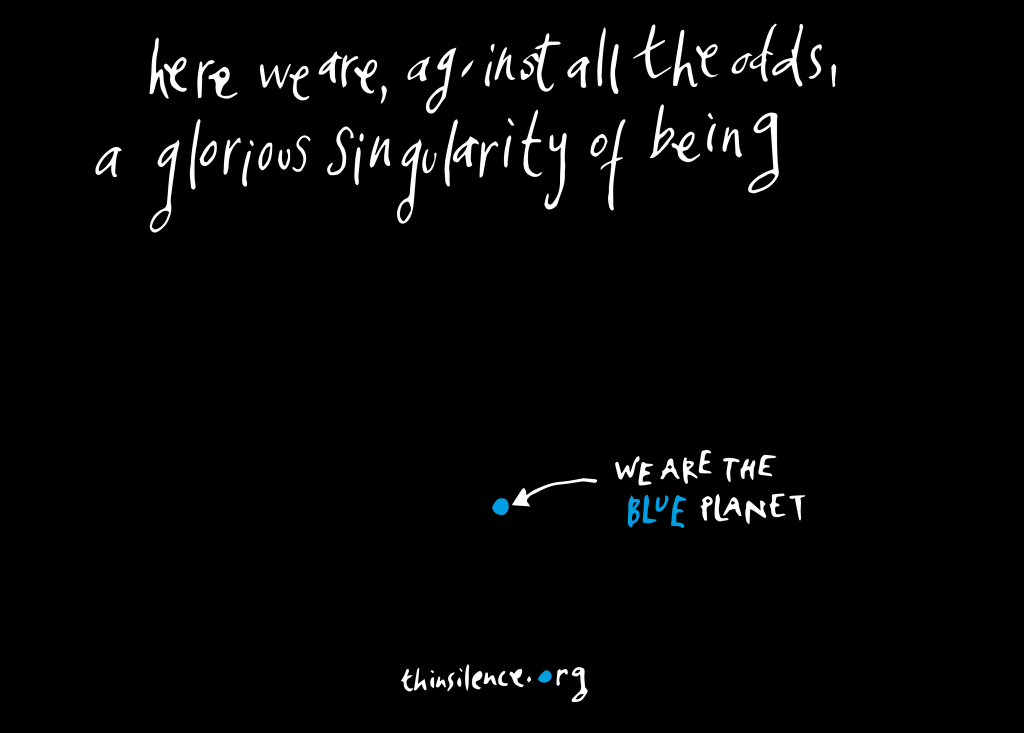
Brian McLaren points out that we live in a very narrow space, only a few miles deep, between the solidity that covers a core-heat similar to that of the sun’s surface and the deep cold of space. Yet everything we have need of is here – we have abundance, though it is not ours.

We share it with thousands upon thousands of other species, worlds upon worlds, worlds within worlds.

We so often define abundance as making more faster – not so much in our words but in our practices. McLaren has named this a suicidal system because we are using all of this earth’s resources and half of another world’s: 11:57 is his song about the system.

We must redefine abundance. Michael Bhaskar suggests that for our wellbeing what we want is to know we have choice:

Our wellbeing is dependent in the ability to exercise choice, but too much choice backfires. The feeling of choice, rather than its reality, is what we want.^

Just because we can choose, over and over again in a modern day, doesn’t mean we have to.

Exercising “because-we-can” choice desecrates and despoils the abundance we see and the abundance we do not see: the plethora of love available for everyone, the richness of comfort for those who mourn, the oceans of ideas for solving fauna and flora problems … .

In her wonderful poem for opening eyes Today, Another Universe, Jane Hirshfield begins with the diagnosis of the human on the condition of a tree:

The arborist has determined:
senescence      beetles      canker
quickened by drought
                           but in any case
not prunable   not treatable   not to be propped.

And so.

The branch from which the sharp-shinned hawks and their mate-cries. 

The trunk where the ant.

The red squirrels’ eighty-foot playground.

The bark   cambium   pine-sap   cluster of needles.

The Japanese patterns      the ink-net.

The dapple on certain fish.

Today, for some, a universe will vanish.
First noisily,
then just another silence.

The silence of after, once the theater has emptied. 

Of bewilderment after the glacier,
the species, the star.

Something else, in the scale of quickening things,
will replace it,

this hole of light in the light, the puzzled birds swerving around it.^^

(*From Brian McLaren’s God Unbound.)
(**Thomas Kuhn, quoted in Lynda Barry’s Making Comics.)
(^From Michael Bhaskar’s Curation.)
(^^From Maria Popova’s Brain Pickings: Today, Another Universe: Jane Hirshfield Reads Her Stunning Perspectival Poem of Consolation by Calibration.)

Wonderful

We are, in fact, worshippers on this boat. We worshiped the Mola mola this morning, and the black sea turtle, the sea lions, and birds, not to mention thirty or more different kinds of reef fish. We worshiped them be determining that they were worthy – worthy of our time, our attention, our pursuit, our availability. We worshiped them by forgetting ourselves in their presence, humbling ourselves to be benign elements of their environment.*
(Brian McLaren)

Freedom is presence, not absence.**
(M. C. Richards)

When we take ourselves away from centre-stage, wonder breaks in. We have all caught glimpses of wonder in our world, in the beautiful things we make and in each other, but when we get out of the way … oh my! Anything other than humility as a way into wonder proves to be a shortcut, and a dangerous one.

I have heard some heavy machinery nearby this morning. For more than two months this new housing site has been silent. I know there are plans to build on the field I posted a picture of on Monday and I am reminded of how easy we find it to destroy what has taken hundreds and sometimes thousands of years to create:

About the time we started to destroy the world, industriously shrinking it to the size of a theme park or a shopping mall, we started riding about worlds out in space and their alien beings and ways.^

More than a starship, Brian McLaren’s suggests we need worship – worth-ship – to help us into humility and into, connecting with some words I read this morning from M. C. Richards; she begins:

Man has many hungers. But they all seem to me to be versions of a twofold one: hunger for freedom, and hunger for union, a dance of each individuality with the world.**

These aspirations, Richards admits, are fallen or sick, producing ugliness, but, she says, we also aspire to wellness:

And we redeem them, not by wrestling with them and managing them, for we have not the wisdom nor the strength to do that, but by letting the light to shine upon them. And where does this light come from? It seems to shine in all created things, but in our sickness we are often opaque to it. It is our task to make ourselves permeable to light by yielding ourselves up to it.**

This is what McLaren is opening himself to as he explores the creatures of the Galapagos Islands. Our humility, taking the human from centre-stage, allows the light to make us well, for nature to heal us and centre us. It’s all around us: the sky, the birds, the trees, even the grass of a field:

Wonder.

Wonderful.

(*From Brian McLaren’s God Unbound.)
(**From M. C. Richards’ Centering.)
(^From Ursula Le Guin’s Words Are My Matter.)

The labyrinth of care

In a labyrinth one can be farthest from the destination when one is closest […].*
(Rebecca Solnit)

You will never regret offering dignity to others.**
(Seth Godin)

The greatest human achievement will be to live together with mutual dignity and respect – by respect I mean deeply seeing and valuing the other.

Albert Einstein widened this to all of nature, stating this to be the human task:

A human being is a part of the whole, called by us “Universe,” a part limited in time and space. Our task must be to free ourselves from this prison by widening our circle of compassion to embrace all living creatures and the whole of nature in its beauty.^

When we look back over history at our behaviour towards those who are different to us, we may feel we have made great progress, which we have, but the labyrinth-effect tells us that when we think we’re close to where we should be we’re probably not and must keep moving forward if we are to become fully human, something only possible together.

(*From Rebecca Solnit’s A Field Guide to Getting Lost.)
(**From Seth Godin’s blog: Justice and dignity, too often in short supply.)

(^Albert Einstein, from Brian McLaren’s God Unbound.)

When we are small in a big world

We imagine a wild theology that doesn’t limit itself to Plato and Aquinas but also consults the wisdom of rainbow trout and sea turtles, seasons and tides.*
(Brian McLaren)

Yesterday, in the early evening, my wife Christine and I took a walk around the field that lies on the other side of the small wood by our house. Since we had last walked the field – perhaps only a week earlier – grasses had surged upwards, hiding all of last year’s deadness and spectacularly bursting into flower.

I went out this morning to take a picture to share

The field had become a sea of greens swaying in the breeze, populated by the islands of majestic trees that shared this acreage, and we had to keep stopping just to take in the beauty.

We can be wowed by things we build: bridges and buildings, but this kind of wow is different. It’s the kind of perspective I need in life from something humans haven’t built – something I am a part of and have much to learn from.

(*From Brian McLaren’s God Unbound.)

Under authority

The demands of genre conventions and audience expectation should stir the imagination. They do not inhibit creativity, they inspire it. You must find a way to shape your story that both expresses your vision and satisfies the audience’s expectations.*
(Robert McKee)

The earliest artists worked within the outlines of their imaginations, the later reworked their imaginations.**
(James Carse)

It is likely that every person who has produced anything of significance for others will have placed themselves under the authority of something or someone.

There are all kinds of authority, from large to small, from people and roles to reading and crafts. What they all have in common at their best is that they enable others to flourish, to become more, to be inspired and make a difference in the world, helping each others towards finding our joy.

The alternative, the bad kind of authority, only hardens the path of same old same old (SOSO) and What You See Is All There Is (WYSIATI).

(*From Robert McKee‘s newsletter: Why All Writers are Genre Writers.)
(**From James Carse’s Finite and Infinite Games.)

The deepest joy

It’s true that how we spend our days is how we end up spending our lives. We can deliberately choose to spend them wisely.*
(Bernadette Jiwa)

A dream,” he said, “as it goes whiffling through the night is making a tiny little buzzing noise. But this little buzzy-hum is so silvery soft, it is impossible for human bean to be hearing it.”**
(The BFG)

To be filled with joy seems to be the richest place we shall ever find ourselves, so may there be many things that give you joy.

Above all, may there be that deepest of joys that gives you capacity to be who you are and bring what only you can bring for joy in others.

(*From Bernadette Jiwa’s The Story of Telling: Always, Sometimes, Never.)
(**From Roald Dahl’s The BFG.)

Go live your strengths: the dreamwhispering project

Technics and wisdom are not by any means opposed. On the contrary, the duty of our age … is to unite them in a supreme humility which will result in a totally self-forgetful creativity and service.*
(Thomas Merton)

I is a dream-blowing giant.**
(The BFG)

I want to share a little more about an idea mentioned earlier this month.

It has been reported that it is the young who are being most affected by unemployment as a result of the coronavirus pandemic, so I’m trying to figure out a way of making a form of my dreamwhispering work available to anyone who would like to explore the depths of their talents and skills towards being better prepared for work in the future.

It’s not HR and it’s not a careers service but it will make it possible to be more aware of what we have and what we can do.

The project will comprise of online sessions and offline reflection and exercises leading to participants noticing, reflecting upon and beginning to express nineteen significant truths about themselves. These include values, talents and the kind of environments we flourish in and perish in.

There’ll be no direct cost involved, but there will be an expectation for each person to be committed to the journey.

I’d really appreciate it if you would help me get the word out. Whilst the headline about young people being made unemployed caught my eye, the project is open to any who have been laid off because of Covid-19.

If you are interested then drop me a line at geoffrey@thinsilence.org.

It is also possible to support the project. If you are interested to find out what this means then please let me know.

(*Thomas Merton, quoted in Maria Popova’s Brain Pickings: Technology, Wisdom and the Difficult Art of Civilisational Self-Awareness.)
(**From Roald Dahl’s The BFG.)

A part of the bigger picture

you want to choose a niche an inch wide and a mile deep*
(Pamela Slim)

Somewhere along the way, you were given some terrible advice: you have to choose a niche.**
(Chris Guillebeau)

“Hitchedness” allows me to make sense of both these statements from two people whose insights I value when it comes to my love and work of helping people to explore their futures:

When we try to pick out anything by itself, we find it hitched to everything else in the universe.^

John Muir’s insight that everything in the universe is attached to everything else leads us into the richness of life that is abundant and beautiful and, if we conceive of peace as prosperity for the heart, soul, mind and body, peaceful too:

One is constantly reminded of the infinite lavishness and fertility of Nature – inexhaustible abundance amid what seems enormous waste. And yet when we look into any of her operations that lie within reach of our minds, we learn that no particle of her material is wasted or worn out. It is eternally flowing from use to use, beauty to yet higher beauty; and we soon cease to lament waste and death, and rather rejoice and exult in the imperishable, unspendable wealth of the universe, and faithfully watch and wait the reappearance of everything that melts and fades and dies about us, feeling sure that its next appearance will be better and more beautiful than the last.^

Life becomes a lesson – or experiment or adventure – in noticing. We cannot really notice in some hurried or forced way, and it is more than focusing hard. It is, as Nancy Kline allows, about paying attention with ease:

To be its best, Attention, from inside itself it seems, summons Ease. Ease emerges and sweeps and dips and saunters, draping itself around Attention’s focus allowing it dimension greater than focus alone can produce.^^

I can imagine Kline smiling with joy after forming these sentences because they have both truth and beauty.

It appears to be our bent to pay attention, to deeply notice what other species do not, though its ease, as with any art, will only appear though effort. Otherwise we can become distracted by lesser things that lead us into smaller lives, wasting our planet, hoarding, achievement, whilst all the time, waiting for us on the far side of this complexity, lies a wonder that will cause us to gasp and be silent and smile with joy. This joy becoming for us the most precious thing we shall ever possess.

On a personal note, I see how children and grandchild and wonderful ideas and amazing encounters with others and making beautiful things and the glory of the natural world and working with nibbed pens and reading books and playfulness and so, so many more things are all joined together and bring me joy, including these words from Erich Fromm which somehow are dearly comforting:

the highest step to which thought can lead us is to know that we do not know*^.

And all that I know and brings me joy is hitched to all you know and brings you joy, and all everyone has known and felt joy in and knows and feels joy in and will ever know and feel joy in is all tiny part of what Muir described when he saw:

the whole universe as an infinite storm of beauty.^

(*From Pamela Slim’s Escape from Cubicle Nation.)
(**From Chris Guillebeau’s Born For This.)
(^John Muir, quoted in Maria Popova’s Brain Pickings: The Universe as an Infinite Storm of Beauty.)
^^From Nancy Kline’s More Time to Think.)
(*^From Erich Fromm’s The Art of Loving.)

Facing monsters

After we grew up […] we found out how unreliable these stories had been. The simple, pleasant adult society they had prepared us for did not exist. As we suspected. the fairy tales has been right all along – the world was full of hostile, stupid giants and perilous castles and people who abandoned their children at the forest.*
(Alison Lurie)

From the beginning a curator was somewhere between a priest and bureaucrat, combining the practical with the otherworldly. Either way curators had access to and master over difficult, concealed knowledge.**
(Michael Bhaskar)

There may be more than one path leading out of the darkness.

This is what the best of our religions, myths and fairy stories tell us, often finding a new-norm seeded with meaning.^

Here we must note that it is hard for humans to let go of the past and to take hold of the future. As a result we can miss the nuance which, if we turn out attention to the difficult thing we face, becomes more apparent and with it, possibility – though the path of moving from victim to protagonist is a demanding one.

Like a curator bringing the practical and otherworldly together, we apply the lighter touch of imagination to the hardness of reality:

In fighting against resistance we will become more focused on getting rid of the problem than on understanding what it is; by contrast, when working with resistance we want to suspend frustration at being blocked, and instead engage with the problem in its own right. […] Apply minimum force is the most effective way to work with resistance.^^

It is as we work with the difficult things that different paths appear on the other side.

(*Alison Lurie, quoted in Bruce Handy’s Wild Things.)
(**From Michael Bhaskar’s Curation.)
(^At the moment I am reading J. K. Rowlings’ The Ickabog and Roald Dahl’s The Witches.)

(^^From Richard Sennett’s Together.)